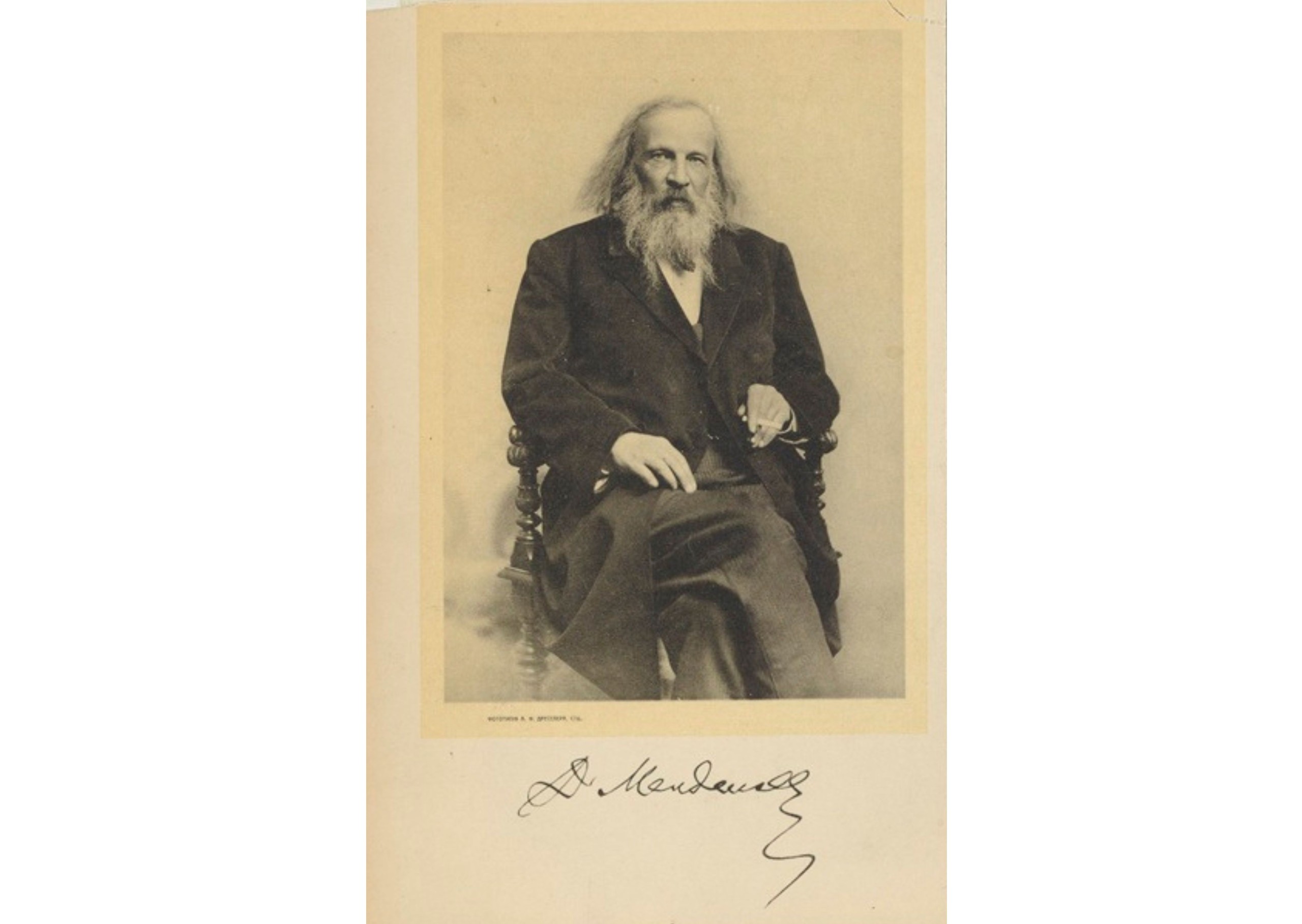
Dmitri Mendeleev
 Russia
chemist•physicist•university teacher
Also known as: Dmitri Ivanovich Mendeleev, Dmitry Mendeleev, D. I. Mendeleev
Birthday
February 8, 1834
Birth Sign
Aquarius
Birthplace
Tobolsk, Siberia, Russia
Age
Died at 72
About
Dmitri Ivanovich Mendeleev was a Russian chemist and physicist who created the periodic table of elements, the organizing framework that still governs chemistry classrooms and laboratories worldwide. He is the man whose face hangs beside that table in schools from Tokyo to Toledo, and whose name is written into the table itself as mendelevium, atomic number 101. Few scientists have produced a single object so useful that it outlived every rival system and every attempt to replace it, and fewer still have done it while working from the edge of the European scientific world.
Mendeleev's great achievement was the periodic law, which he formulated in 1869 after arranging the known elements by atomic weight and noticing that their properties repeated at regular intervals. What set him apart was his willingness to leave gaps in the table for elements that had not yet been discovered, and to predict their properties with enough precision that when gallium, scandium, and germanium were isolated in the following decades, the predictions held up closely enough to convince skeptics. He also corrected accepted atomic weights and valences for elements like uranium when the existing figures did not fit the pattern, a move that took nerve and turned out to be right.
Beyond the table, he wrote a widely used textbook called Principles of Chemistry, reshaped Russian metrology as director of the Bureau of Weights and Measures, and published hundreds of papers and books on topics far beyond chemistry, from protectionist trade theory to agriculture and Russian industry. He never won the Nobel Prize, a famous omission in the history of science, but his fingerprints are on nearly every chemistry classroom in the world. He died in St Petersburg in 1907 at the age of 72.
Early Life & Background
Dmitri Mendeleev was born on 8 February 1834 in Tobolsk, Siberia, the youngest of a very large family, usually described as the 14th child, though counts vary. His father, Ivan Pavlovich Mendeleev, was a school director who went blind and died when Dmitri was young. His mother, Maria Dmitrievna, took over a family glass factory to keep the household afloat, and when it burned down she traveled with him across Russia to secure his education. That Siberian upbringing, far from the academic centers of Europe, is routinely cited as shaping a chemist who spent his life imposing order on the messy business of matter.
After gymnasium in Tobolsk, Mendeleev studied at the Main Pedagogical Institute in St Petersburg, where he trained as a teacher and graduated in 1855, reportedly with a gold medal. He then taught briefly in Simferopol and Odessa before taking up posts in St Petersburg. A formative period followed in Heidelberg from roughly 1859 to 1861, where he worked in a private laboratory on capillarity and the physical properties of gases and liquids, the empirical grounding that later fed his interest in how elements relate to one another.
He returned to St Petersburg and completed his doctorate in 1865 on the combining of alcohol with water. In 1861 he published his first textbook, Organic Chemistry, which won him the Demidov Prize in 1862. In 1867 he became professor of chemistry at the University of St Petersburg, and from that position he began the work that would make his name, publishing Principles of Chemistry and presenting his table to the society within two years.
Career Growth
Mendeleev's breakthrough came in March 1869, when he presented his periodic table to the Russian Chemical Society, which he had co-founded the year before. He had arranged the elements by atomic weight and noticed that their properties recurred periodically, a pattern he called the periodic law. The table he published that year deliberately left gaps for elements that had not yet been discovered, and he predicted the properties of three of them: gallium, scandium, and germanium.
In 1871 he published a refined short-form table that became the standard version. The predictions were vindicated over the following years as gallium was discovered in 1875, scandium in 1879, and germanium in 1886, each matching his predicted properties closely enough to convince the scientific world. The periodic law became the organizing principle of chemistry, and the table he built is still the standard classroom artifact worldwide.
His career continued with other achievements. He resigned his university post in 1890 after intervening on behalf of students during a political dispute, and in 1893 he was appointed director of the Bureau of Weights and Measures, a post he held until his death, reforming Russian metrology. He received the Davy Medal in 1882 and the Copley Medal in 1905, was made a foreign member of numerous academies, and held honorary degrees from several universities. The synthetic element mendelevium, atomic number 101, is named for him.
Career Timeline
Public Image & Style
Mendeleev's public image is that of the bearded patriarch of chemistry, the man whose face hangs in every chemistry classroom beside his table. He is remembered as the scientist who imposed order on the elements, a figure of stubborn confidence and systematic patience. His long white beard and intense gaze are familiar from portraits, and he is often depicted as a kind of scientific prophet, the man who saw patterns where others saw chaos.
That image has endured because the table itself endures, a daily reminder of his work in schools and laboratories around the world, and because the story of the gaps he insisted on leaving gives the portrait its moral: he trusted the pattern more than he trusted the consensus of his colleagues.
Fame & Fandom (iFAMOUS Rankings)
iFANN has not yet collected fame data for Dmitri Mendeleev, so no ranking is available. He does not appear on the September 2026 iFAMOUS Rankings flagship list.
There is no established modern fandom name, no fan campaigns, and no social media presence, since he died in 1907. His audience is instead the worldwide community of chemistry students and teachers who encounter his table in every classroom. The closest thing to a fan ritual is the annual celebration of the periodic table, and the stories chemists tell each other about his card game and his predicted elements. His fame is not the kind measured in followers but in the fact that his work is used every day by millions of people who may not know his name.
Interesting Facts and Legends
The most retold story about Mendeleev is that he fell asleep while arranging the elements and woke up with the periodic table, a popular folklore version of the discovery that still circulates in recent articles. Mendeleev himself described the table as the product of years of card-sorting and systematic work, not a dream. The verified story is that he wrote each element on a card with its atomic weight and properties and shuffled them obsessively, playing patience with the elements until the pattern emerged.
His insistence on leaving blank spaces for undiscovered elements, and being proved right three times, is the story chemists tell first about him. He was nominated for the Nobel Prize but never won it, a widely noted omission. He also had a habit of correcting accepted atomic weights when they did not fit his pattern. And he is often quoted as saying, "There is nothing in this world that I fear to say," a line that captures the stubborn confidence behind his best work.
He is also often paraphrased on the periodic law itself, holding that the properties of elements are a periodic function of their atomic weights, a formulation that has outlasted every later refinement of the table. Sources are mixed on his religious views: he was raised in the Russian Orthodox tradition, but his later positions are debated and not conclusively documented.
Notable Quotes
“There is nothing in this world that I fear to say.”
Family & Personal Life
Mendeleev's father, Ivan Pavlovich Mendeleev, was a school director who went blind and died when Dmitri was young. His mother, Maria Dmitrievna, took over a family glass factory to support the household and later traveled with him across Russia to secure his education. He was the youngest of a very large family, usually counted as the 14th child. He lived in St Petersburg for most of his adult life, and it was there that he raised his children and died.
He married Feozva Nikitichna Leshcheva in 1862, and they had children including a son, Vladimir, and a daughter, Lyubov, who later became a notable figure in her own right. The marriage was unhappy, and a formal divorce was difficult under Russian law.
He later married Anna Ivanovna Popova in 1882 after a protracted and legally fraught divorce process, and they had children together, including a son, Ivan, and a daughter, also named Lyubov. That second household, formed in his forties, carried him through the last quarter century of his life and the honors of his later career.
Notable Connections
Mendeleev is associated with his wives Feozva Leshcheva and Anna Popova, his children including Lyubov Mendeleeva, and the Russian Chemical Society, which he co-founded in 1868. His work connects him to the chemists who discovered gallium, scandium, and germanium, and to the generations of scientists who built on his periodic law.
Relationships & Dating History
Mendeleev married Feozva Nikitichna Leshcheva in 1862. The couple had children, including a son, Vladimir, and a daughter, Lyubov. The marriage soured, and they separated in the early 1870s, though a formal divorce was difficult under Russian law. The marriage ended with her death in 1905.
Around 1876, he began a long-term relationship with Anna Ivanovna Popova. They married in 1882 after a protracted and legally fraught divorce process. They had children together, including a son, Ivan, and a daughter, also named Lyubov. That marriage lasted until his death in 1907. At the time of his death, he was married to Anna Ivanovna Popova, and no living romantic partner survives him; both marriages are historical.
- MarriedFeozva Nikitichna Leshcheva1862 - 1905His first wife; they separated in the early 1870s but the marriage ended with her death in 1905.
- MarriedAnna Ivanovna Popova1882 - 1907His second wife; they were married until his death in 1907.
Death & Aftermath
Died
February 2, 1907 (aged 72)
Death Place
St Petersburg, Russia
Cause of Death
Influenza and pneumonia
Word of Dmitri Mendeleev's death reached a scientific community that had spent nearly four decades working inside the grid he built. The tributes came from across Europe and beyond, from chemists who had tested his predictions and found them right, and from the Russian Chemical Society whose members understood better than anyone what the periodic table had done to their discipline.
He fell ill with influenza in early January 1907 and died of its complications on 20 January 1907 Old Style, which is 2 February on the modern calendar, in St Petersburg, the city where he had lived and worked for most of his adult life. He was 72, a few weeks short of his 73rd birthday. The standard biographical accounts give influenza and pneumonia as the cause, though the formal certification details are not documented, so that should be read as received biography rather than an official finding.
What followed was a quieter kind of memorial. The periodic table itself became the most durable monument any scientist could ask for, carried into every classroom that came after him. The centenary of his death in 2007 drew retrospectives from the Science History Institute and the Royal Society of Chemistry, and the 150th anniversary of the table in 2019 brought further homages, including a feature from Berkeley Lab. Each anniversary confirmed the same thing: the table he built is still the organizing principle of chemistry, and his name is written into it.
Net Worth (Estate Value)
$1 Million
iFANN Editorial Team estimate
Dmitri Mendeleev died in 1907, and no credible modern estimate of his estate exists. His estate was modest and is not publicly valued. iFANN's editorial research places the current estate value at approximately $1 Million, reflecting the historical nature of his assets and the absence of significant posthumous commercial revenue.
His income during his lifetime came from his professorship at the University of St Petersburg, his writing, and his later post as director of the Bureau of Weights and Measures. He published hundreds of papers and books, but scientific publishing in the 19th century did not generate large royalties. His textbooks, including Principles of Chemistry, were widely used and brought some income, but nothing comparable to modern bestseller figures.
After his death, the estate did not generate significant ongoing revenue. The element mendelevium was named in his honor, but naming rights for elements do not carry financial compensation. His papers and correspondence are held by archives and institutions, and his scientific legacy is not a commercial asset. The estate has no major revenue streams such as posthumous releases, licensing, or merchandise, and it is not managed as a commercial entity. The financial trajectory of the estate has been flat, with no major financial events such as catalog sales or legal settlements. The value is essentially historical and nominal.
Awards Won (3)
Mendeleev won the Demidov Prize in 1862 for his textbook Organic Chemistry, the Davy Medal from the Royal Society in 1882, and the Copley Medal from the Royal Society in 1905. He was also elected to foreign membership in numerous academies and received honorary degrees from several universities. He was nominated for the Nobel Prize but never won it.
1905 · Science
Lifetime achievement in chemistry
1882 · Science
Contributions to chemistry
Known For
Periodic Table of Elements
1869 · Creator
Periodic Law
1869 · Formulator
Principles of Chemistry
1869 · Author
Prediction of Gallium, Scandium, and Germanium
1869 · Predictor
Keywords
Sources
Quick Facts
- Profession
- chemist, physicist, university teacher
- Born
- February 8, 1834
- Birthplace
- Tobolsk, Siberia, Russia
- Died
- February 2, 1907
- Death Place
- St Petersburg, Russia
- Gender
- Male
- Spouse
- Anna Ivanovna Popova, Feozva Nikitichna Leshcheva
- Birth Sign
- Aquarius
Personal Details
- Full Name
- Dmitri Ivanovich Mendeleev
- Spouse
- Anna Ivanovna Popova, Feozva Nikitichna Leshcheva
- Children
- Vladimir, Lyubov, Ivan, and others
- Education
- Main Pedagogical Institute, St Petersburg
Frequently Asked Questions
What was Dmitri Mendeleev known for?
How did Mendeleev make the periodic table?
Did Mendeleev win a Nobel Prize?
What is Mendeleev's full name?
How old was Mendeleev when he died?
Similar People
Join the community
fans discussing