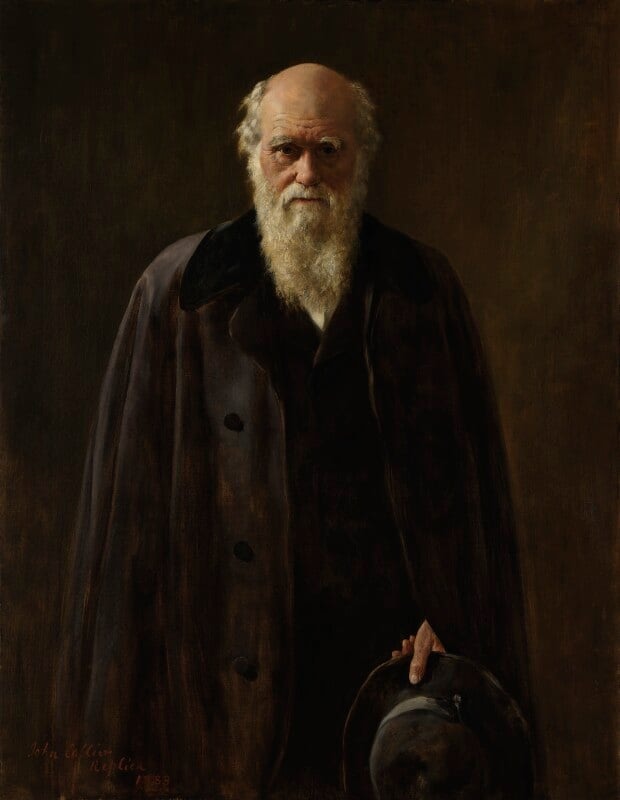
Charles Darwin
 United Kingdom
naturalist•geologist•biologist
Also known as: Charles Robert Darwin
Birthday
February 12, 1809
Birth Sign
Aquarius
Birthplace
Shrewsbury, England
Age
Died at 73
Height
5 ft 9 in (1.75 m)
About
Charles Darwin was the English naturalist whose theory of evolution by natural selection transformed biology. His 1859 book On the Origin of Species laid out a mechanism for how species change over time, supported by decades of careful observation and analysis. Darwin's work remains the cornerstone of modern evolutionary biology, influencing genetics, ecology, and paleontology. He is widely regarded as one of the most influential scientists in history, with his ideas permeating both science and popular culture.
Darwin's approach was methodical and evidence-driven. He spent over twenty years developing his theory before publishing, amassing data from his famous voyage on HMS Beagle, experiments with plants and animals, and correspondence with fellow naturalists. His later works, including The Descent of Man (1871) and The Expression of the Emotions in Man and Animals (1872), extended his ideas to human evolution and psychology. Today, his legacy endures through ongoing research, museum exhibits, and public debate about science and religion.
Early Life & Background
Darwin was born into a wealthy family in Shrewsbury, England. His father Robert was a successful physician, and his mother Susannah was the daughter of Josiah Wedgwood, founder of the Wedgwood pottery empire. As a boy, Darwin showed a keen interest in nature, collecting beetles and exploring the countryside, but he was an unremarkable student at Shrewsbury School, a boarding school that emphasized classics.
In 1825, at age sixteen, Darwin enrolled at the University of Edinburgh to study medicine, following his father's wishes. He found lectures boring and surgery distressing, but he thrived outside the classroom, learning taxidermy from a freed slave named John Edmonstone and attending meetings of the Plinian Society, where he argued about natural history. He also studied marine invertebrates along the Firth of Forth.
Realizing Darwin would not become a doctor, his father sent him to Christ's College, Cambridge, in 1827 to study for a Bachelor of Arts degree with the aim of becoming a clergyman. At Cambridge, Darwin found his true calling. He befriended botany professor John Stevens Henslow, who became a mentor and opened doors to the scientific elite. Darwin graduated in 1831, but his passion for natural history had fully taken hold. That same year, Henslow recommended him as a gentleman naturalist on HMS Beagle, a ship about to depart on a five-year survey of South America. Darwin's father initially objected, but his uncle Josiah Wedgwood II persuaded him to let Charles go.
Career Growth
Darwin returned from the Beagle voyage in 1836 with thousands of specimens and notebooks full of observations. He quickly established himself as a geologist, publishing The Structure and Distribution of Coral Reefs in 1842, which proposed a theory of atoll formation that is still accepted. He also began a detailed study of barnacles, spending eight years classifying them and producing four monographs.
In the late 1830s, Darwin started secretly developing his theory of natural selection. He read Thomas Malthus's Essay on the Principle of Population in 1838, which gave him the idea that competition for resources would favor certain variations. He spent years testing his ideas through breeding experiments with pigeons and studying the variation of plants and animals under domestication. In 1858, he received a letter from Alfred Russel Wallace outlining a very similar theory. Their papers were read jointly at the Linnean Society in July 1858.
Darwin then rushed to complete On the Origin of Species, published in November 1859. The first edition of 1,250 copies sold out immediately. The book sparked intense debate, with Thomas Henry Huxley famously defending it against Bishop Samuel Wilberforce. Darwin continued publishing throughout the 1860s and 1870s, covering topics from orchid pollination to earthworm behavior. By the time of his death in 1882, his theory had gained broad scientific acceptance, though natural selection as the primary mechanism was not fully established until the modern synthesis of the 1930s and 1940s.
Career Timeline
Public Image & Style
Darwin is universally recognized as a symbol of scientific inquiry and intellectual courage. He is often depicted as a thoughtful, bearded Victorian gentleman, a image solidified by his later portraits. In popular culture, he represents the triumph of evidence over dogma, and his face appears on everything from T-shirts to banknotes. The Darwin Awards, a tongue-in-cheek honor for people who die in foolish ways, reflect his association with natural selection. There is no official fandom, but his legacy is celebrated by scientists, educators, and secular organizations worldwide. His birthday, February 12, is celebrated as Darwin Day in many countries.
Fame & Fandom (iFAMOUS Rankings)
Charles Darwin stands as the 39th most famous person in United Kingdom, a position he holds steady according to the iFANN Global Fame Rankings. His global influence extends across the continent where he ranks as the 58th most famous person in Europe, a standing confirmed by the same rankings. Within the realm of intellectual and creative history, he is recognized as the 1st most famous person in Art & Design, a title anchored by the rankings. These placements from the iFANN Global Fame Rankings reflect his enduring presence across media coverage, search activity, and cultural consumption worldwide. While modern celebrities often cultivate organized followings, Darwin does not have a formal fandom name; his admirers are scientists, historians, and students rather than a fan club with a specific collective title. Engagement with his legacy takes the form of academic discourse, museum visits, and the study of his works like On the Origin of Species. There are no fan-funded projects or social media campaigns centered on his personal life, as he passed away long before the era of mass celebrity worship. Instead, his "followers" dedicate themselves to understanding his theories and validating his predictions through rigorous research.
Interesting Facts and Legends
Charles Darwin suffered from chronic health problems throughout his adult life, including bouts of nausea, vomiting, heart palpitations, and fatigue. The exact cause remains unknown, with theories ranging from Chagas disease to panic disorder or lactose intolerance. He spent much of his time at home, working in his study or greenhouse, and relied on an extensive network of correspondents for information. He was an avid pigeon fancier and bred hundreds of varieties to study variation. He also experimented with carnivorous plants, measuring how much nitrogen they absorbed. Darwin was known for his patience: one experiment on seed germination in saltwater lasted over 40 years. He never used the word "evolution" in the first edition of Origin of Species, preferring "descent with modification." A legendary aspect of his daily routine involved the "Thinking Path" at Down House, where he paced back and forth for hours to work through complex ideas; recent studies in August 2026 validated that this walking habit boosted divergent thinking and creativity. Another enduring story from his life is the voyage on the HMS Beagle, which served as the origin story for his theory of natural selection, though biographers note his path to publication was fraught with hesitation. In August 2026, news broke confirming his 150-year-old prediction that certain alpine plants were carnivorous, cementing his status as a visionary who anticipated scientific discoveries decades ahead of their time.
Notable Quotes
“There is grandeur in this view of life, with its several powers, having been originally breathed into a few forms or into one.”
“A man who dares to waste one hour of time has not discovered the value of life.”
“The love for all living creatures is the most noble attribute of man.”
“Ignorance more frequently begets confidence than does knowledge.”
“I have called this principle, by which each slight variation, if useful, is preserved, by the term Natural Selection.”
Family & Personal Life
Darwin married his first cousin Emma Wedgwood on January 29, 1839. They had ten children together, but three died in infancy: Mary Eleanor (1842), Charles Waring (1856), and another infant. The surviving children included George (astronomer), Francis (botanist), Horace (engineer), Leonard (soldier and politician), and Henrietta (who helped edit Darwin's works). Darwin was a devoted father, often playing with his children and involving them in scientific observations. The family lived at Down House in Kent, where Darwin conducted much of his research. Emma was a devout Unitarian, and while Darwin grew skeptical of religion, their marriage remained affectionate and supportive despite these differences.
Notable Connections
Darwin's work was deeply intertwined with key figures of his era. Mentor John Stevens Henslow recommended him for the Beagle voyage. Geologist Charles Lyell provided the uniformitarian framework that influenced Darwin's thinking. Botanist Joseph Hooker was a close friend and confidant. Alfred Russel Wallace independently conceived natural selection, prompting Darwin to publish. Thomas Henry Huxley, known as "Darwin's Bulldog," vigorously defended the theory in public debates. At home, his wife Emma Wedgwood and his children, particularly Francis Darwin, supported his research.
Relationships & Dating History
Charles Darwin married his first cousin Emma Wedgwood on January 29, 1839. The couple had a close and affectionate relationship, though their religious views differed: Emma was a devout Unitarian, while Darwin grew increasingly agnostic. They had ten children together, three of whom died in infancy. Emma supported Darwin's work, often helping him with experiments and caring for him during his frequent illnesses. Their marriage lasted until Darwin's death in 1882. There is no evidence of any other romantic relationships in Darwin's life.
- MarriedEmma Wedgwood1839 - 1882First cousins; married for 43 years until Darwin's death; had ten children together.
Death & Aftermath
Died
April 19, 1882 (aged 73)
Death Place
Downe, Kent, England
Cause of Death
Heart failure
The death of Charles Darwin sent a profound ripple through the British establishment and the global scientific community, transforming a private passing into a national moment of reflection. Queen Victoria and the Prince of Wales immediately sent messages of condolence, while the Royal Society convened special memorial services to honor the man whose work had reshaped biology. Prominent peers like Thomas Huxley, Joseph Hooker, and Alfred Russel Wallace delivered eulogies that celebrated his contributions, and large gatherings of intellectuals attended events across London and Cambridge. This outpouring of respect solidified his status as a national hero despite lingering religious controversy.
Darwin passed away on April 19, 1882, at Down House in Downe, Kent, at the age of 73. His family physician and personal friend, Dr. William Gull, recorded the cause as heart failure after observing a rapid deterioration marked by acute pain and weakness. For decades, Darwin had suffered from chronic health issues, including symptoms consistent with Chagas disease acquired during his voyage on the HMS Beagle, which caused severe digestive distress and palpitations. He remained conscious until shortly before his final moments. His funeral took place on April 26, 1882, in Westminster Abbey, a rare distinction for a scientist.
The service, organized by the Royal Society, featured Mendelssohn's Elijah and was led by Dean Arthur Penrhyn Stanley, who framed Darwin's theories as compatible with Christian faith. He was buried in the north transept near Isaac Newton rather than his local parish church. Posthumously, his son Francis published his autobiography and extensive correspondence to preserve his intellectual legacy, while the Charles Darwin Foundation and Charles Darwin University later emerged to carry forward his name.
Net Worth (Estate Value)
$15 Million
iFANN Editorial Team estimate
Charles Darwin died in 1882 with an estate valued at about £150,000, equivalent to roughly $15 million today when adjusted for inflation. The bulk of his wealth came from inheritance and his wife's family money, rather than book sales. On the Origin of Species sold well but Darwin never became rich from it. His estate has continued to earn modest revenue from ongoing sales of his works, which remain in print and are widely studied. The rights to his writings are managed by his descendants and academic institutions. Per iFANN's editorial analysis, the estate's value is estimated at $15 Million as of 2026, primarily consisting of intellectual property and historical artifacts.
Awards Won (2)
Darwin received the Royal Medal from the Royal Society in 1853 for his geological work, particularly his coral reef theory. This was the highest honor he received during his lifetime. He was also awarded the Wollaston Medal by the Geological Society of London in 1859. Posthumously, his legacy has been honored through numerous institutions and awards named after him, but he did not win additional competitive awards.
1853 · Geology
The Structure and Distribution of Coral Reefs
1859 · Geology
Geological contributions
Known For
On the Origin of Species
1859 · Author
Theory of Evolution by Natural Selection
1858 · Co-discoverer
The Descent of Man
1871 · Author
HMS Beagle Voyage
1831 · Naturalist
Keywords
Quick Facts
- Profession
- naturalist, geologist, biologist
- Born
- +1809-02-12
- Birthplace
- Shrewsbury, England
- Died
- +1882-04-19
- Death Place
- Down House, Kent, England
- Gender
- Male
- Spouse
- Emma Darwin
- Birth Sign
- Aquarius
Personal Details
- Full Name
- Charles Robert Darwin
- Height
- 5 ft 9 in (1.75 m)
- Spouse
- Emma Darwin
- Children
- 10 (3 died in infancy)
- Education
- University of Edinburgh, Christ's College, Cambridge
Frequently Asked Questions
What is Charles Darwin famous for?
How old was Charles Darwin when he died?
What was the HMS Beagle voyage?
Did Charles Darwin marry his cousin?
What is natural selection?
Similar People
Join the community
fans discussing