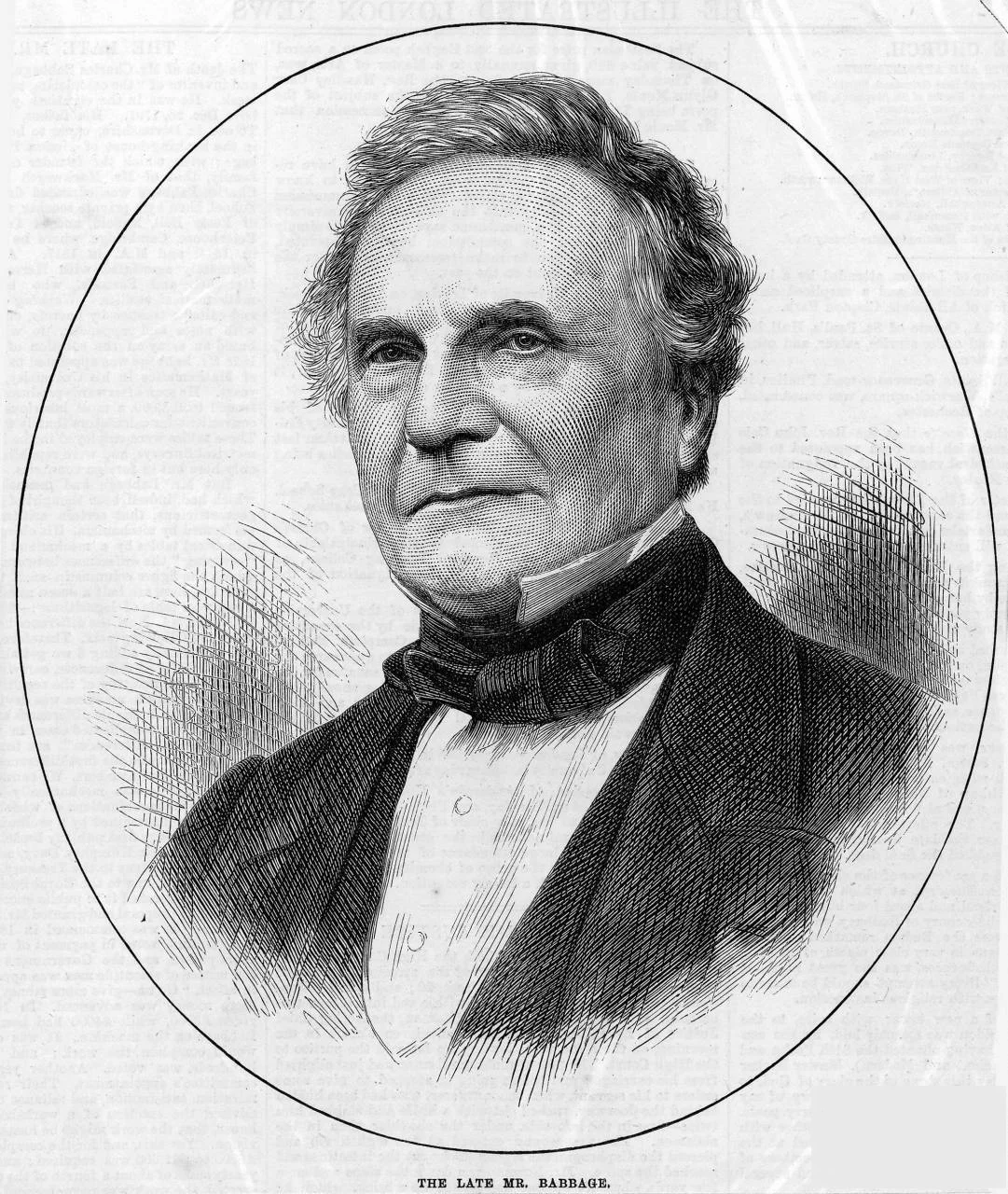
Charles Babbage
 United Kingdom
mathematician•inventor•mechanical engineer
Also known as: Father of the Computer
Birthday
December 26, 1791
Birth Sign
Sagittarius
Birthplace
London, England
Age
Died at 79
Height
5 ft 8 in (173 cm)
About
Charles Babbage was an English polymath, mathematician, and inventor widely honored as a father of the computer for conceiving the fundamental principles of the programmable machine more than a century before electronic computers existed. A brilliant and restless thinker, he devoted much of his life to the dream of mechanizing calculation, envisioning devices of remarkable sophistication for his age. His ideas anticipated the digital revolution by generations. Babbage designed the difference engine, an elaborate mechanical calculator intended to compute and tabulate mathematical functions automatically, eliminating the human errors that plagued printed tables. He went further with his visionary analytical engine, a design that contained, in mechanical form, all the essential conceptual elements of a modern computer, including a processing unit, memory, and the ability to be programmed using punched cards borrowed from the weaving loom. He even designed early printing mechanisms for its output. Tragically, the limits of Victorian engineering and funding meant his grand machines were never fully built in his lifetime, and his work was underappreciated for decades. His collaboration with Ada Lovelace, who grasped the broader implications of his analytical engine, added to his legacy. A wide-ranging intellect active in many fields, he was a notable figure of his era. Charles Babbage is remembered as a foundational pioneer of computing.
Early Life & Background
Babbage was born into a wealthy banking family in London in 1791, but his childhood was marked by fragile health that led to a somewhat isolated upbringing. The family moved to Teignmouth, Devon, where he was tutored at home and attended a small private school. His father, a domineering goldsmith and banker, disapproved of his intellectual pursuits, while his mother encouraged his education. As a teenager, Babbage became obsessed with mathematics after reading books from the local library, and a pivotal moment came when he encountered logarithmic tables riddled with errors, this planted the seed for his lifelong quest to mechanize calculation. He entered Trinity College, Cambridge in 1810, where he found the mathematical instruction outdated compared to Continental developments. In 1812, he co-founded the Analytical Society with John Herschel and George Peacock to reform Cambridge mathematics by introducing Leibnizian calculus notation. Another crucial moment occurred in 1820 when, working with Herschel on astronomical tables for the Royal Astronomical Society, Babbage reportedly exclaimed, "I wish to God these calculations had been executed by steam!" This crystallized his determination to build a calculating machine.
Career Growth
In 1822, Babbage announced the concept of the Difference Engine in a paper to the Royal Astronomical Society, building a small working model that could calculate polynomial functions. The British government granted him £1,500 in 1823, the first government grant for a computing project in history, to build a full-scale version. He hired engineer Joseph Clement, but the project collapsed in 1833 after £17,000 was spent, due to disputes with Clement and the sheer complexity of the 25,000-part machine. Only a completed seventh was built. Undeterred, Babbage conceived the Analytical Engine between 1834 and 1837, a vastly more ambitious general-purpose programmable computer. Its design included an arithmetic logic unit (the "mill"), memory (the "store"), punched card input inspired by the Jacquard loom, and conditional branching. In 1840, he lectured on the machine in Turin, and in 1842–43, Ada Lovelace translated and annotated Luigi Menabrea's article, producing the first published algorithm intended for implementation on a machine. Babbage later designed Difference Engine No. 2 in 1847–49, an improved version requiring only 8,000 parts, but it was never built in his lifetime. He also held the Lucasian Chair of Mathematics at Cambridge from 1828 to 1839, published influential works like On the Economy of Machinery and Manufactures in 1832, and invented a cowcatcher for locomotives, a dynamometer, and an ophthalmoscope. He died in 1871, his machines unbuilt.
Career Timeline
Public Image & Style
Babbage is remembered as a visionary but tragic figure, a genius whose ideas were too advanced for his time. In his own era, he was known as a brilliant but contentious polymath, often frustrated by the limitations of Victorian engineering and funding. His campaign against street musicians made him a somewhat eccentric figure in London society. Today, he is celebrated as the "father of the computer," a title that reflects his conceptual leap from mechanical calculators to programmable machines. His legacy is particularly cherished in the computing and technology communities, where his Analytical Engine is regarded as the conceptual blueprint for modern computers. The successful construction of Difference Engine No. 2 in 1991 proved that his designs were sound, cementing his reputation as a practical engineer as well as a theorist. His collaboration with Ada Lovelace has also made him a key figure in the history of women in computing.
Fame & Fandom
Charles Babbage doesn't have a formal fandom with a name like Swifties or Trekkies. Instead, his admirers are a diffuse but devoted community of engineers, computer scientists, and historians who honor him through institutional tributes rather than fan campaigns. The IEEE Computer Society awards the annual Charles Babbage Award, and museums like the Science Museum in London and the Computer History Museum in California maintain permanent exhibitions and working reconstructions of his engines. The closest thing to fan-driven activity is the volunteer effort that finally built Difference Engine No. 2 in 2002, realizing Babbage's vision more than a century after his death.
As of August 2026, iFANN's Global Fame Engine has evaluated Babbage but he does not currently hold a placement in the published rankings, neither the Global Top 1,000 nor any Top-100 scope list. This means he remains unranked in iFANN's data, despite his towering legacy as the father of computing. His fame is real but diffuse, carried by his ideas rather than a named fanbase or active celebrity presence.
Interesting Facts and Legends
Babbage invented the cowcatcher, the V-shaped metal frame on locomotive fronts, in the 1830s. He campaigned vigorously against street musicians in London, estimating they destroyed 25% of his working time; he wrote pamphlets, testified before Parliament, and once had 165 street musicians arrested. He designed a standard ophthalmoscope, though it was never widely adopted. He was an early advocate for reforming the Royal Society, publishing a controversial critique in 1830 titled Reflections on the Decline of Science in England. His portrait appeared on the Bank of England's £5 note from 1991 to 2001. A crater on the Moon and an asteroid (11341 Babbage) bear his name.
One legendary story fans still retell is his obsession with the Mechanical Turk, a chess-playing automaton that toured Europe. Babbage, a chess enthusiast, played against it in the 1820s and was reportedly impressed, unaware that a human chess master was hidden inside. The hoax wasn't revealed until after his death, so he likely believed he faced a true machine.
Another iconic moment is his frustrated cry, "I wish to God these calculations had been executed by steam," which he reportedly said about the error-prone mathematical tables of his day. Whether he said those exact words is uncertain, but the sentiment is well-documented in his writings and contemporaries' recollections.
Notable Quotes
“I wish to God these calculations had been executed by steam!”
“The whole of the developments and operations of analysis are now capable of being executed by machinery.”
“As soon as an Analytical Engine exists, it will necessarily guide the future course of science.”
“Errors using inadequate data are much less than those using no data at all.”
“The economy of human time is the next object of improvement in the mechanical arts.”
Family & Personal Life
Babbage married Georgiana Whitmore on July 25, 1814, at St. Michael's Church in Teignmouth, Devon. They had eight children together, but only three survived to adulthood: Benjamin Herschel Babbage (1815–1878), who became a railway engineer and emigrated to Australia; Henry Prevost Babbage (1824–1918), a military officer who later attempted to build the Analytical Engine's mill; and Charles Whitmore Babbage, who died in childhood. Georgiana died on September 1, 1827, devastating Babbage, and he never remarried. His father, Benjamin Babbage, was a goldsmith and banker; his mother, Elizabeth Pumphurst Teape, was supportive of his education. Babbage's relationship with his father was strained, as Benjamin disapproved of his intellectual pursuits.
Notable Connections
Charles Babbage is most closely associated with Ada Lovelace, the mathematician who wrote the first algorithm for his Analytical Engine and is considered the first computer programmer. His other notable collaborators include John Herschel, with whom he co-founded the Analytical Society and worked on astronomical tables, and engineer Joseph Clement, who built the Difference Engine. Babbage was also a contemporary of Michael Faraday and Charles Darwin, though their work did not directly intersect.
Relationships & Dating History
Babbage married Georgiana Whitmore on July 25, 1814, at St. Michael's Church in Teignmouth, Devon. They had eight children together, but only three survived to adulthood. Georgiana died on September 1, 1827, in Worcester, devastating Babbage, and he never remarried. In 1833, Babbage met Ada Lovelace (then 17) at a party, beginning a deep intellectual partnership. Ada translated and annotated Luigi Menabrea's article on the Analytical Engine, producing the first published computer program. Their correspondence ended acrimoniously in 1843 after Babbage refused to help Ada with her gambling debts. No credible evidence supports a romantic relationship between them. Babbage remained widowed for the rest of his life and died on October 18, 1871.
- MarriedGeorgiana Whitmore1814 - 1827Married on July 25, 1814; had eight children together, only three survived childhood. Her death in 1827 devastated Babbage.
- DatedAda Lovelace1833 - 1843Intellectual partnership; some historians speculate about a romantic dimension, but no credible evidence exists.
Death & Aftermath
Died
October 18, 1871 (aged 79)
Death Place
South Kensington, London
Cause of Death
Natural causes associated with advanced age
Half of Charles Babbage's brain was preserved and sent to the Hunterian Museum at the Royal College of Surgeons, while the other half was displayed elsewhere, a decision by his son Henry Prevost Babbage that ensured his physical remains remained a subject of study and remembrance long after the funeral. This unique posthumous act followed the quiet passing of the inventor on October 18, 1871, at his home in South Kensington, London. He was seventy-nine years old, having lived a full life dedicated to invention before succumbing to natural causes associated with advanced age. The immediate reaction was one of profound respect rather than mass mourning, as tributes were paid by the Royal Society and the broader scientific community acknowledging his foundational role in computing.
His funeral was a private affair held at St. Mary Magdalene Church in Putney, attended only by family members and close colleagues without a grand public procession. Following his death, his estate was managed privately by his family, with Henry Prevost Babbage dedicating himself to completing his father's Difference Engine No. 2. Decades later, the IEEE Computer Society established the annual Charles Babbage Award for outstanding contributions to parallel computation, and his legacy continues to inspire educational initiatives and cultural works.
Net Worth (Estate Value)
$1.2 Million
iFANN Editorial Team estimate
Charles Babbage died in 1871 with a modest estate valued at approximately £8,000, equivalent to roughly $1.2 million today, per iFANN's editorial analysis. His father's inheritance of £100,000 (about £10 million in modern terms) was largely consumed by his Difference Engine projects and other inventions. Babbage spent an estimated £20,000 of his own money on his computing machines. Posthumously, his name and image generate indirect value through museum exhibitions, merchandise, and academic usage, with the working Difference Engine No. 2 at the Science Museum and the Charles Babbage Institute at the University of Minnesota as key beneficiaries. However, there is no formal estate that collects royalties, as his writings and designs are in the public domain. The Babbage brand is estimated to contribute roughly $500,000 to $1 million annually to cultural and educational institutions, but this is not personal wealth. As of 2026, Babbage's net worth is considered negligible in personal terms; his true legacy is intellectual and cultural.
Awards Won (2)
Babbage received the Gold Medal of the Royal Astronomical Society in 1824 for his Difference Engine. He was elected a Fellow of the Royal Society in 1815 and held the Lucasian Chair of Mathematics at Cambridge from 1828 to 1839. Posthumously, he was inducted into the National Inventors Hall of Fame in 1993, and the IEEE Computer Society established the Charles Babbage Award in 1982. The British Computer Society also awards the Charles Babbage Medal.
1824 · Scientific Achievement
Difference Engine
1993 · Lifetime Achievement
Computing inventions
Known For
Difference Engine
1822 · Inventor
Analytical Engine
1837 · Designer
Concept of the programmable computer
1837 · Pioneer
Keywords
Quick Facts
- Profession
- mathematician, inventor, mechanical engineer
- Born
- +1791-12-26
- Birthplace
- London, England
- Died
- +1871-10-18
- Death Place
- Marylebone, London, England
- Gender
- Male
- Spouse
- Georgiana Whitmore
- Birth Sign
- Sagittarius
Personal Details
- Full Name
- Charles Babbage
- Height
- 5 ft 8 in (173 cm)
- Spouse
- Georgiana Whitmore
- Children
- Benjamin Herschel Babbage, Henry Prevost Babbage, and five others who died in childhood
- Education
- Trinity College, Cambridge; Peterhouse, Cambridge (MA 1817)
Frequently Asked Questions
Who is Charles Babbage?
What is Charles Babbage's net worth in 2026?
Did Charles Babbage invent the first computer?
Was Charles Babbage married?
What is Charles Babbage best known for?
Join the community
fans discussing