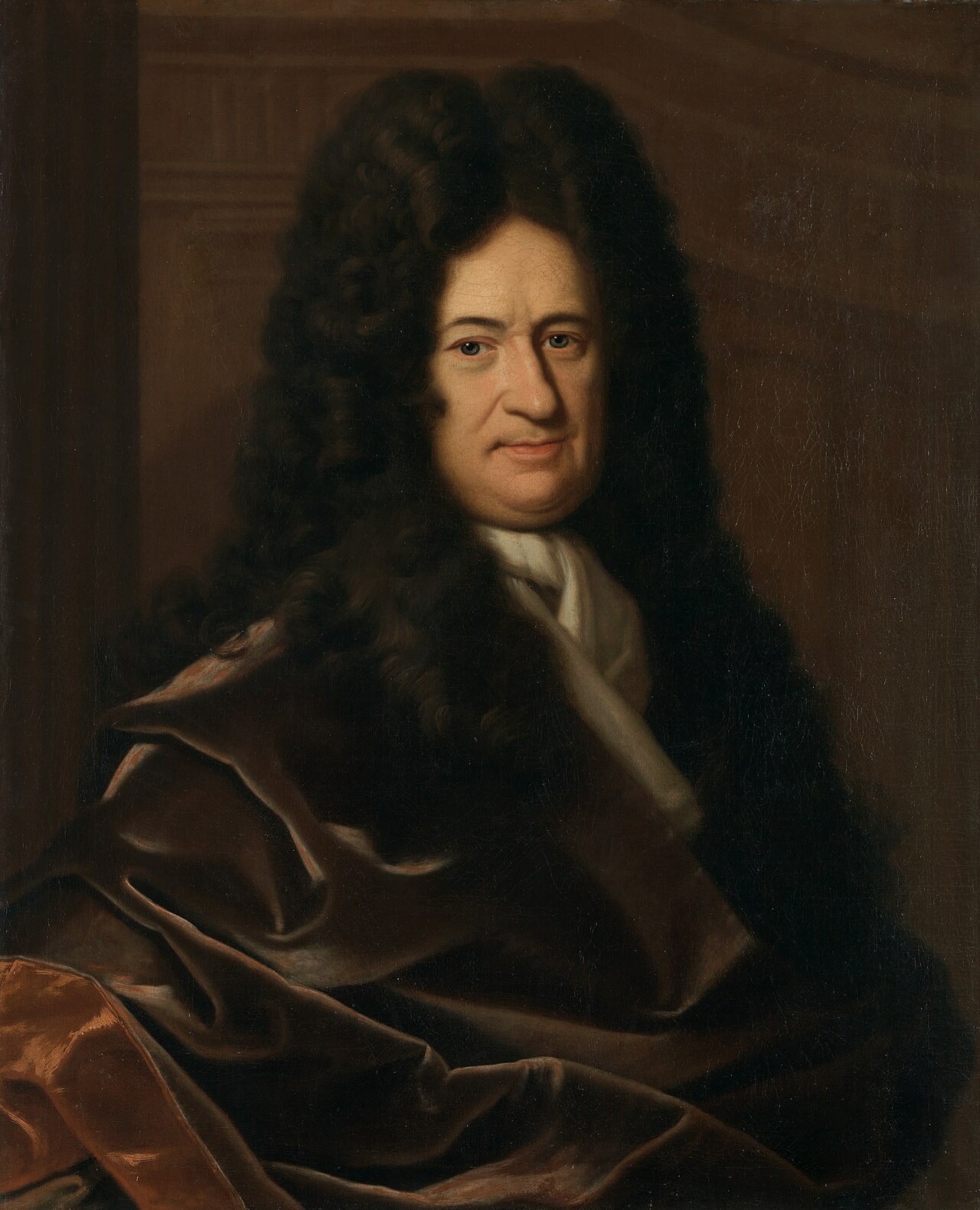
Gottfried Wilhelm Leibniz
mathematician•jurist•physicist
Birthday
July 1, 1646
Birth Sign
Cancer
Birthplace
Leipzig, Saxony, Holy Roman Empire
Age
Died at 70
About
Gottfried Wilhelm Leibniz was a German polymath whose work spanned mathematics, philosophy, science, law, and diplomacy. He is often described as one of the last thinkers to command nearly the whole of human knowledge in his era. In mathematics he is best known for developing calculus independently of Isaac Newton, and the elegant notation he devised for derivatives and integrals is still the one students learn today. He also worked out the binary number system that would later underpin digital computing, and built mechanical calculating machines centuries before electronic ones existed. As a philosopher he is associated with grand metaphysical ideas, including his theory of monads and his much-debated argument that this is the best of all possible worlds, a claim later satirized by Voltaire. His curiosity was almost limitless, producing writings on theology, history, geology, linguistics, library science, and political reform, much of it scattered across letters and journals rather than finished books. A rivalry with Newton over priority in calculus dogged his final years. Today he is regarded as a foundational figure in both modern mathematics and philosophy, his anticipations of logic and computation looking increasingly prophetic from the vantage of the information age.
Early Life & Background
Leipzig in the mid-17th century was a city recovering from the Thirty Years' War, and into this world Leibniz was born on July 1, 1646. His father, Friedrich Leibniz, a professor of moral philosophy at the University of Leipzig, died when the boy was only six. But Friedrich had left behind a substantial personal library, and young Gottfried taught himself Latin by reading his father's books. By age seven he was reading Latin fluently; by twelve he had taught himself Greek. At fifteen he entered the University of Leipzig, studying philosophy and mathematics. He earned his bachelor's degree in 1662 and his master's in philosophy two years later. He then turned to law, earning a bachelor's degree in 1665 and a doctorate in law from the University of Altdorf in 1666. That same year he published his first book, De Arte Combinatoria, which proposed a universal symbolic language and laid groundwork for symbolic logic. He was offered a professorship at Altdorf but refused, choosing instead to enter the service of the Elector of Mainz as a diplomat, legal adviser, and librarian.
Career Growth
In 1672, Leibniz traveled to Paris on a diplomatic mission. There he studied mathematics under Christiaan Huygens and began developing calculus. He visited London in 1673, demonstrated a calculating machine to the Royal Society, and was elected a Fellow. By 1675 he had independently developed calculus, creating the notation (dy/dx, ∫) still used today. In 1676 he entered the service of the House of Brunswick in Hanover, where he would work for the rest of his life as librarian, historian, and diplomat. In 1679 he perfected the binary number system. He published the first account of differential calculus in 1684 in Nova Methodus pro Maximis et Minimis. In 1686 he published Discourse on Metaphysics, outlining his philosophical system including the theory of monads. In 1700 he founded the Berlin Academy of Sciences and became its first president. He published Theodicy in 1710, his most famous philosophical work, and Monadology in 1714, a concise exposition of his metaphysics. He died in 1716, largely neglected due to the bitter calculus priority dispute with Newton.
Career Timeline
Public Image & Style
Leibniz is portrayed as the archetypal polymath, a man of encyclopedic knowledge, elegant notation, and grand metaphysical systems. His image often shows him in 17th-century court attire with a long wig. In popular culture, he is sometimes depicted as a brilliant but naive thinker, particularly regarding his best of all possible worlds argument. He is frequently contrasted with Newton: Leibniz as the systematic, optimistic philosopher versus Newton as the secretive, combative scientist. Academic and intellectual history enthusiasts form a small but dedicated following, sometimes called Leibnizians.
Fame & Fandom (iFAMOUS Rankings)
The community surrounding Gottfried Wilhelm Leibniz is distinguished not by modern fan rituals or organized campaigns, but by a global, cross-disciplinary adherence to his intellectual frameworks. Scholars, mathematicians, and philosophers maintain his legacy through the daily application of his notation and the study of his metaphysical systems rather than through celebrity worship. There is no formal fandom name for this collective; admirers are identified strictly by their professional engagement with his work. While academic honors like the Gottfried Wilhelm Leibniz Prize continue to recognize contemporary researchers in his spirit, these initiatives remain institutional tributes rather than fan-driven projects. The absence of a dedicated fanbase reflects his status as a historical figure whose influence permeates the foundations of science and logic without generating the pop-culture phenomena typical of living celebrities. iFANN has evaluated his standing within the contemporary cultural landscape. Gottfried Wilhelm Leibniz is currently evaluated but does not hold a placement in the published rankings, including the Global Top 1,000 or any Top-100 scope list. This neutral assessment confirms that while his contributions remain foundational, he does not currently register as a ranked entity within the specific metrics of the Global Fame Engine.
Interesting Facts and Legends
Leibniz designed and constructed the Stepped Reckoner, a mechanical calculating machine capable of performing addition, subtraction, multiplication, division, and square root extraction. He envisioned a universal language known as characteristica universalis, which would facilitate logical reasoning through symbolic manipulation and prefigure modern programming languages. His correspondence network was vast, spanning over 1,000 scholars across Europe with approximately 20,000 letters exchanged. The binary number system he developed drew inspiration from the I Ching, an ancient Chinese divination text. He actively sought to reconcile theological divisions between the Catholic and Protestant churches. Voltaire later satirized his optimistic philosophy in Candide through the character Dr. Pangloss. Historical accounts often cite the priority dispute with Isaac Newton as a defining legend, where both men independently developed calculus, leading to a bitter controversy over publication dates and plagiarism accusations that persists in scientific folklore. Another enduring narrative involves his theory of monads, proposing that reality consists of indivisible units reflecting the entire universe, a concept now frequently revisited in discussions regarding panpsychism.
Notable Quotes
“The present is full of the future.”
“It is unworthy of excellent men to lose hours like slaves in the labor of calculation which could safely be relegated to anyone else if machines were used.”
“This is the best of all possible worlds.”
“Music is the hidden arithmetic of the soul, which does not know that it deals with numbers.”
Family & Personal Life
Leibniz was born to Friedrich Leibniz, a professor of moral philosophy at the University of Leipzig, and Catharina Schmuck, the daughter of a law professor. His father died when he was six, leaving him a substantial personal library. He had no siblings that are documented in historical records. Leibniz never married and had no children. He lived alone for most of his adult life, devoting himself entirely to his intellectual pursuits.
Notable Connections
Leibniz is most famously associated with Isaac Newton, his rival and co-inventor of calculus, with whom he had a bitter priority dispute. He studied under Christiaan Huygens in Paris. He corresponded with John Locke, Princess Sophie of Hanover, Princess Caroline of Ansbach, and Samuel Clarke. He was influenced by René Descartes and Baruch Spinoza, and was later satirized by Voltaire in Candide.
Relationships & Dating History
Leibniz never married and had no known romantic relationships. Historical records indicate he was a lifelong bachelor who dedicated his life to scholarship, diplomacy, and intellectual correspondence. There are no credible accounts of any romantic partnerships, engagements, or flirtations. As of 2026, he is deceased, he died unmarried and without descendants.
Death & Aftermath
Died
November 14, 1716 (aged 70)
Death Place
Hanover, Germany
Cause of Death
reported heart disease and respiratory issues
Gottfried Wilhelm Leibniz spent his final years in Hanover serving as a counselor to the House of Brunswick-Lüneburg, pursuing work on the history of the dynasty until a stroke earlier in 1716 left him partially paralyzed and unable to speak clearly. He passed away at his residence on November 14, 1716, following a prolonged decline marked by severe heart disease and respiratory issues that historical accounts describe variously as heart failure or apoplexy based on the medical terminology of the era rather than a modern clinical diagnosis. The scientific community mourned his loss with letters and eulogies, though Isaac Newton, his long-standing rival regarding calculus priority, did not publicly celebrate the end of their dispute.
His funeral was conducted privately at St. George's Church in Hanover, where he was initially buried before his remains were later moved to the New Cemetery. Posthumous recognition has been extensive, ranging from the naming of Leibniz University of Hannover to the establishment of the prestigious Gottfried Wilhelm Leibniz Prize in 1985, which continues to fund significant research today. His vast collection of manuscripts and letters was dispersed to institutions such as the Hannover State Library, ensuring his intellectual legacy endured despite the modest nature of his estate.
Net Worth (Estate Value)
As a 17th-century scholar and court official, Leibniz's net worth during his lifetime was modest. He worked as a librarian, historian, and diplomat for the House of Brunswick with a comfortable but not lavish salary. He never accumulated significant personal wealth. His estate at death consisted primarily of his extensive library and unpublished manuscripts. The value of his intellectual property is incalculable, and his works remain in the public domain. The Leibniz Archive in Hanover manages his literary remains of approximately 200,000 pages of manuscripts and 20,000 letters.
Awards Won (2)
Leibniz was elected a Fellow of the Royal Society in 1673. He founded and became the first president of the Berlin Academy of Sciences in 1700. He was also a member of the French Academy of Sciences and the Royal Prussian Academy of Sciences, and served as Imperial Court Councillor to the Holy Roman Emperor.
1673 · Membership
1700 · Academy Leadership
Known For
Calculus
1684 · Co-inventor
Binary Number System
1679 · Developer
Monadology
1714 · Author
Theodicy
1710 · Author
Stepped Reckoner
1673 · Inventor
Keywords
Quick Facts
- Profession
- mathematician, jurist, physicist
- Born
- +1646-06-21
- Birthplace
- Leipzig
- Died
- +1716-11-14
- Death Place
- Hanover
- Gender
- Male
- Birth Sign
- Cancer
Personal Details
- Full Name
- Gottfried Wilhelm Leibniz
- Education
- University of Leipzig (BA, MA, BL, Dr. jur.); University of Altdorf (Dr. jur.)
Frequently Asked Questions
What did Gottfried Wilhelm Leibniz invent?
Did Leibniz ever marry?
How did Leibniz and Newton differ on calculus?
How old was Leibniz when he died?
What is Leibniz best known for philosophically?
Similar People
Join the community
fans discussing