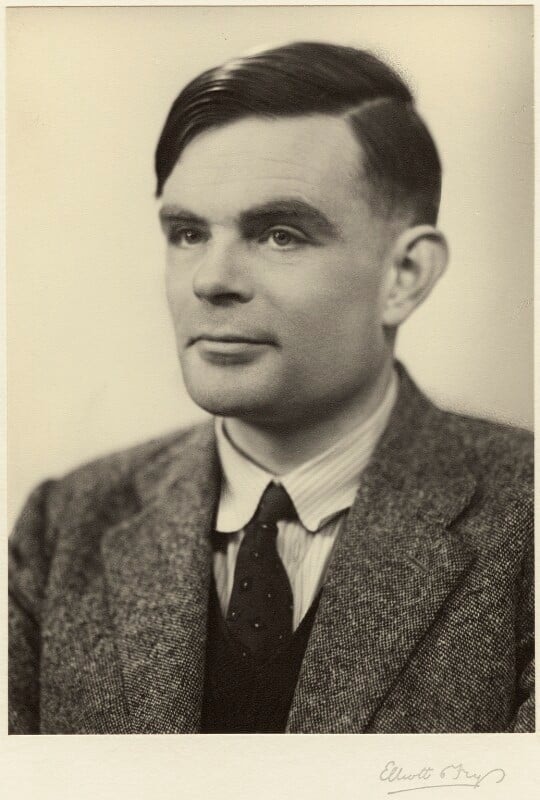
Alan Turing
 United Kingdom
Mathematician•computer scientist•cryptanalyst
Also known as: Alan Mathison Turing
Birthday
June 23, 1912
Birth Sign
Cancer
Birthplace
Maida Vale, London, England
Age
Died at 41
About
Alan Turing was a British mathematician and computer scientist who laid the theoretical foundations for modern computing and artificial intelligence. He is best known for formalizing the concept of computation through the Turing machine, a model that underpins all digital computers. During World War II, his codebreaking work at Bletchley Park, especially cracking the German Enigma cipher, is credited with shortening the war and saving millions of lives. Today, Turing is celebrated as the father of theoretical computer science and a pioneer of AI, with his ideas still central to ongoing research. His legacy also carries a powerful social message, as his prosecution for homosexuality led to decades of injustice, later acknowledged through a royal pardon and the Alan Turing law.
Early Life & Background
Alan Turing was born in Maida Vale, London, to Julius Mathison Turing, a civil servant in the Indian Civil Service, and Ethel Sara Stoney, the daughter of a railway engineer. From a young age, Turing showed signs of exceptional intelligence, teaching himself to read in three weeks and developing an interest in numbers and puzzles. At Sherborne School, his unconventional approach to mathematics frustrated teachers, but he found a kindred spirit in Christopher Morcom, a fellow student who shared his passion for science. Morcom's sudden death from tuberculosis in 1930 devastated Turing and deepened his resolve to understand the nature of mind and matter. After Sherborne, Turing studied at King's College, Cambridge, where he graduated with first-class honors in mathematics in 1934. His 1936 paper, "On Computable Numbers," introduced the Turing machine, effectively laying the groundwork for all future computers. He then moved to Princeton University, where he earned his PhD in 1938 under Alonzo Church, working on ordinal logics and the concept of a hypercomputer.
Career Growth
Turing's career-defining work came at Bletchley Park, the British codebreaking center, where he arrived in 1939. He led Hut 8, the section responsible for cracking German naval Enigma messages. His major innovation was the Bombe, an electromechanical device that automated the search for Enigma settings, greatly accelerating decryption. By 1941, Turing's team was regularly reading U-boat communications, giving the Allies a critical advantage in the Battle of the Atlantic. After the war, Turing joined the National Physical Laboratory, where he designed the Automatic Computing Engine (ACE), one of the first stored-program computer designs. In 1948, he moved to the University of Manchester, working on the Manchester Mark I and exploring artificial intelligence. His 1950 paper, "Computing Machinery and Intelligence," proposed the Turing Test as a benchmark for machine intelligence. In 1952, he published a paper on morphogenesis, a mathematical model for biological pattern formation, which remains influential in developmental biology.
Career Timeline
Public Image & Style
Turing is widely viewed as a tragic genius, a brilliant mind whose life was cut short by societal prejudice. Media portrayals, such as the 2014 film The Imitation Game, emphasize his intellectual intensity, social awkwardness, and wartime heroism. Among computer scientists, he is revered as a founding father, with the Turing Award often called the "Nobel Prize of Computing." His persecution has made him an icon in LGBTQ+ history, and his story is frequently cited in discussions about equality and justice. The 2021 introduction of his portrait on the Bank of England £50 note cemented his status as a national hero. Fans and admirers often gather for Turing Day events and online forums, celebrating his contributions to science and human rights.
Fame & Fandom (iFAMOUS Rankings)
Alan Turing stands as a monumental figure whose influence transcends the quiet corridors of academia to dominate global consciousness. According to the latest iFANN Global Fame Rankings, he is currently the 434th most famous person in the world, holding steady from the previous cycle. His stature within his native land is even more pronounced, placing him as the 68th most famous person in United Kingdom and the 52nd most famous person from United Kingdom. In the specific domain of artificial intelligence, his legacy is second only to one other titan, making him the 2nd most famous person in AI. These placements reflect a massive scale of attention across media coverage, search trends, and cultural consumption signals worldwide. While there is no formal fandom name like those attached to pop stars, Turing commands a dedicated community of admirers who identify through their shared reverence for computer science and LGBTQ+ history. This audience operates not through chants or billboards but through scholarly engagement at institutions like The Alan Turing Institute and advocacy groups such as Turing.org.uk. They gather annually for remembrance events on June 7th, celebrating his life while demanding historical justice. Their rituals involve honoring his contributions to codebreaking and computing, often culminating in Pride celebrations that highlight STEM diversity. The community actively campaigns for social change, evidenced by the successful push for the British government's official apology in 2009. Recent discoveries of his personal writings have added new layers to this lore, revealing a playful side to the stoic genius that fans eagerly discuss. This group does not worship a living celebrity but rather sustains the memory of a man whose tragic persecution became a catalyst for modern equality.
Interesting Facts and Legends
Alan Turing was an accomplished long-distance runner who finished fifth in the 1948 Olympic trials with a marathon time of 2:46:03. He frequently ran the 40 miles between Cambridge and London to attend meetings. At Bletchley Park, he developed a habit of chaining his mug to a radiator to prevent theft. Before the war, he was already a keen cryptographer, successfully breaking Latin and Greek codes created by his own school. Known for his eccentric style, he once wore a gas mask while cycling to avoid hay fever. His favorite book was Alice's Adventures in Wonderland, which he referenced in his work on computability. A widely retold legend confirms his pivotal role in breaking the German Enigma code during World War II, an achievement historians estimate shortened the war by years and saved millions of lives. Another enduring story centers on his invention of the Turing Machine, which laid the theoretical foundation for all modern computers. The defining tragedy of his life remains his conviction for gross indecency in 1952, leading to chemical castration and his eventual death from cyanide poisoning at age 41. Recently, the discovery of a long-lost autobiographical short story has fueled new discussions, revealing a cheeky, humorous side to the mathematician that challenges the stereotype of the stoic genius.
Notable Quotes
“We are not trying to make a machine think, but rather to investigate whether machines can be made to think.”
“It seems probable that once the machine once reasonably accurately simulates the man, it ought to be inferred that it has consciousness.”
“Those who can imagine anything, can create the impossible.”
Family & Personal Life
Turing's father, Julius Mathison Turing, worked for the Indian Civil Service, and his mother, Ethel Sara Stoney, came from a family of engineers. He had one older brother, John. The family spent much of Turing's childhood in India, but he and John were left with foster families in England while their parents remained abroad. Turing never married and had no children. He lived modestly, often in boarding houses or university accommodations. In his later years, he shared a house in Wilmslow with his housekeeper. He had no pets documented.
Notable Connections
Turing's closest collaborator at Bletchley Park was Gordon Welchman, who helped design the Bombe. He worked under Max Newman, a mathematician who later supported his career at Manchester. Christopher Morcom, his school friend, was a profound emotional influence. Hugh Alexander, a fellow codebreaker, became a lifelong friend. Turing also corresponded with Alonzo Church, his PhD advisor.
Relationships & Dating History
Turing's most significant emotional bond was with Christopher Morcom, a schoolmate at Sherborne. Morcom's sudden death in 1930 from tuberculosis profoundly affected Turing, and he later wrote to Morcom's mother, expressing his love. There is no evidence the relationship was physically romantic, but it was deeply formative. In 1951, Turing met Arnold Murray, a young man from Manchester. The relationship was brief; Turing reported a burglary to police, which led to the discovery of his sexual orientation. He was arrested and prosecuted for gross indecency. As of 1954, Turing was single at the time of his death.
- DatedChristopher Morcom1927 - 1930Close school friend; Morcom's death in 1930 deeply affected Turing.
- DatedArnold Murray1951 - 1952Brief relationship; led to Turing's arrest for homosexual acts.
Death & Aftermath
Died
June 7, 1954 (aged 41)
Death Place
Wilmslow, Cheshire, England
Cause of Death
Cyanide poisoning
Decades after his passing, the Alan Turing Memorial in Sackville Park stands as a quiet landmark in Manchester, while the 2013 royal pardon and the subsequent "Turing's Law" transformed a legal scandal into a national reckoning. This eventual redemption followed a death that remained shrouded in controversy for years. On June 7, 1954, Turing was found dead in his Wilmslow home by housekeeper Dorothy M. Clarke, lying in bed beside an apple half-eaten and dipped in cyanide. The official coroner's inquest ruled the cause of death as suicide due to cyanide poisoning, though historians have long debated whether this was a deliberate act or an accidental ingestion stemming from his habit of storing chemicals in jam jars.
His funeral on June 10, 1954, at Brookwood Cemetery was a private affair attended only by family and close friends, reflecting the stigma of his 1952 conviction for gross indecency. In the immediate aftermath, public tributes were absent, constrained by the shadow of his prosecution and forced chemical castration. It took until the late 1980s for the full scope of his wartime codebreaking work to be acknowledged, sparking a surge in interest that led to his induction into the Computer Hall of Fame and the release of the film The Imitation Game in 2014. Today, his legacy is cemented through the Turing Award and the Alan Turing Institute, honoring a mind whose contributions reshaped the digital age.
Net Worth (Estate Value)
$1 Million
iFANN Editorial Team estimate
As a civil servant and academic, Turing earned a modest salary throughout his career. His net worth at the time of his death was minimal, estimated at around £5,000 (equivalent to about $1 million in 2026). Per iFANN's editorial analysis, the total value attributed to his estate reflects this lack of personal wealth accumulation. After his death, his estate was managed by his mother and brother. Posthumous earnings from books, films, and the use of his image have generated revenue, but the estate has not been commercially aggressive. The Alan Turing Trust, established by his family, supports educational initiatives. The Bank of England's £50 note featuring his likeness does not generate royalties. No major catalog sales or licensing deals have been reported. The estate's value in 2026 remains modest, reflecting Turing's lack of personal wealth accumulation.
Awards Won (1)
Alan Turing did not receive major awards during his lifetime, as his work was classified and his contributions were not publicly recognized until decades later. However, he has been honored posthumously with numerous accolades, including the ACM Turing Award, often considered the highest honor in computer science, which was named after him in 1966. The award is given annually to individuals for contributions of lasting technical importance to the computing field.
1966 · Named after him
Known For
Turing machine
1936 · Inventor
Enigma codebreaking
1939 · Lead cryptanalyst
Turing Test
1950 · Proposer
ACE computer design
1945 · Designer
Morphogenesis theory
1952 · Author
Keywords
Quick Facts
- Profession
- Mathematician, computer scientist, cryptanalyst
- Born
- June 23, 1912
- Birthplace
- Maida Vale, London, England
- Died
- June 7, 1954
- Death Place
- Wilmslow, Cheshire, England
- Gender
- Male
- Birth Sign
- Cancer
Personal Details
- Full Name
- Alan Mathison Turing
- Education
- King's College, Cambridge (BA, 1934); Princeton University (PhD, 1938)
Frequently Asked Questions
Who was Alan Turing?
What was Alan Turing's greatest contribution?
Why is Alan Turing famous?
How did Alan Turing die?
What is the Turing Test?
Similar People
Join the community
fans discussing