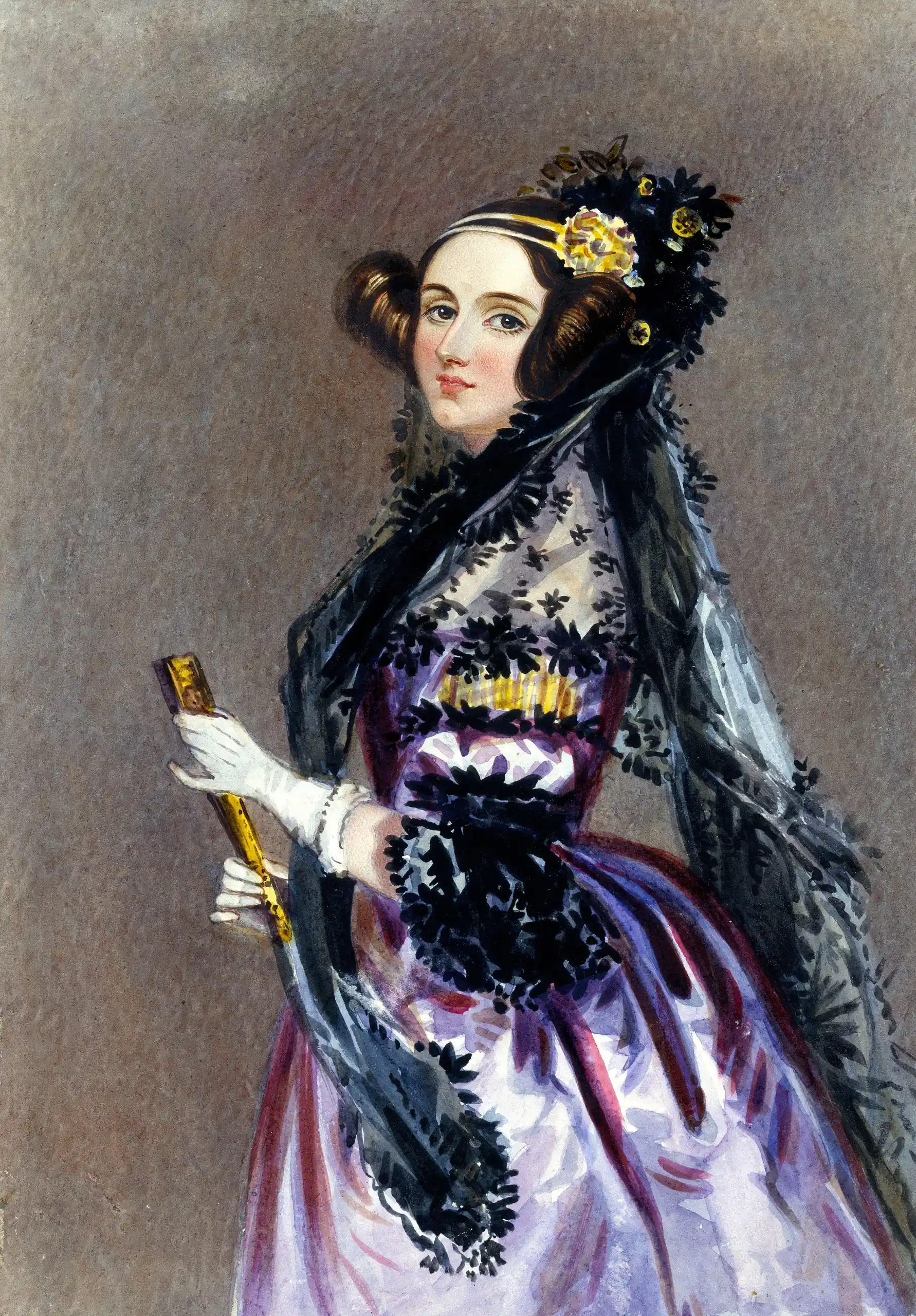
Ada Lovelace
 United Kingdom
mathematician•programmer•writer
Also known as: Augusta Ada Byron, Ada King-Noel, Countess of Lovelace
Birthday
December 10, 1815
Birth Sign
Sagittarius
Birthplace
London, England
Age
Died at 36
About
Ada Lovelace was an English mathematician and writer, widely recognized as the world's first computer programmer. Her fame rests on her 1840s collaboration with Charles Babbage on his analytical engine, a mechanical general-purpose computer. In her notes, she produced the first algorithm designed for a machine, and more remarkably, she foresaw that such machines could manipulate symbols, compose music, and create art, anticipating modern computing by over a century. Though long overlooked, her legacy has been reclaimed in recent decades. A programming language, ADA, and an annual Ada Lovelace Day celebrate her contributions. She remains a towering figure in the history of computing and a symbol of women in STEM.
Early Life & Background
Augusta Ada Byron was born in London, England, on December 10, 1815. She was the only legitimate child of the celebrated poet Lord Byron and the mathematically inclined Anne Isabella Milbanke. Their marriage was short-lived; her parents separated when Ada was just five weeks old, and her father subsequently left England permanently. Raised by her mother, Ada's upbringing was intentionally structured to steer her away from her father's volatile and erratic temperament. Anne Isabella placed a strong emphasis on a rigorous study of mathematics and science, an education path highly unusual for a girl of that era.
Ada received private tutoring in these subjects, learning from distinguished mentors such as the Scottish mathematician and scientist Mary Somerville and the mathematician Augustus De Morgan. She displayed an early and remarkable aptitude for numbers and logic, often approaching her studies with a unique blend of imagination and analytical thought, which she later described as "poetical science." Her early talents were evident in her writings, including a paper she penned on the game of billiards, where she meticulously analyzed its angles and forces.
A defining moment in her intellectual journey occurred in 1833. At a party, a 17-year-old Ada was introduced by Mary Somerville to the inventor Charles Babbage, who demonstrated his small difference engine, a groundbreaking mechanical calculating device. This pivotal meeting ignited a profound fascination in Ada, sparking an intellectual curiosity that would ultimately shape her future contributions and define her life's work.
Career Growth
Lovelace's defining work began in the 1840s when she translated an Italian article on Charles Babbage's analytical engine. She expanded the article with her own notes, which ran three times the length of the original. In Note G, she described an algorithm to compute Bernoulli numbers using the engine, now considered the first computer program. More importantly, she recognized that the engine could process symbols and not just numbers, envisioning it composing music and generating graphics. This insight set her apart from Babbage himself. She published her notes under the initials A.A.L. in 1843. Despite her brilliance, she struggled with illness and financial difficulties, and her work faded into obscurity after her death. It was rediscovered in the 1950s when historian B.V. Bowden republished her notes, and later scholars like Alan Turing cited her vision.
Career Timeline
Public Image & Style
Lovelace is celebrated as a visionary pioneer, a mathematician who saw beyond the limits of her era. In popular culture, she is often depicted as a proto-feminist icon and a symbol of women's potential in STEM. Her image appears on books, TED talks, and in the naming of Ada Lovelace Day, an international celebration held on the second Tuesday of October. She is admired for her imaginative leap that computers could be creative tools, not just calculators. Her story resonates with modern audiences because it combines intellectual brilliance, a dramatic family history, and a legacy that was recognized only posthumously. She is often quoted as saying The Analytical Engine has no pretensions whatever to originate anything, a line that underscores her precision.
Fame & Fandom
Ada Lovelace commands a global attention that transcends the ephemeral metrics of modern celebrity, anchoring herself firmly within the permanent record of human intellectual achievement. While her influence permeates every corner of the digital age, iFANN's Global Fame Engine has evaluated this person, but they do not currently hold a placement in the published rankings (Global Top 1,000 or a Top-100 scope list). The absence of a numerical rank reflects her status as a historical figure rather than a contemporary subject of fluctuating public consumption; she exists outside the dynamic churn of current fame cycles. Consequently, there is no documented fandom name for her audience, as the organized community surrounding her legacy functions through academic and professional channels rather than traditional fan structures. This dedicated group, comprising computer scientists, mathematicians, and STEM advocates, sustains her memory through specific rituals such as the annual celebration of Ada Lovelace Day and the curation of educational theater productions like Ada Lovelace: Bride of Science. These initiatives serve as the closest equivalent to fan-supported art projects, blending biography with mathematical history without adopting a formal collective noun. Her enduring presence is measured not by search volume or chart positions, but by the institutional adoption of her name in programming languages and the persistent re-engagement with her visual legacy, such as the acquisition of her daguerreotypes by the U.K. National Collection.
Interesting Facts and Legends
Ada Lovelace was the only legitimate child of Lord Byron, who famously called her mother his Princess of Parallelograms. She possessed a lifelong fascination with flight, studying bird anatomy to author a book titled Flyology complete with diagrams and sketches. Her correspondence extended to electrical scientist Andrew Crosse, and she dabbled in the practices of mesmerism. A known gambler, she formed a betting syndicate with friends that resulted in significant financial losses. The programming language ADA, developed by the U.S. Department of Defense in the 1970s, was named in her honor. She once wrote to her mother: I have a feeling that I shall be something of a meteor, a prophecy that proved true. Beyond these biographical details, a central legend of her life concerns her collaboration with Charles Babbage on the Analytical Engine between 1842 and 1843. In Note G of her extensive notes, she described an algorithm intended to compute Bernoulli numbers, an event widely retold as the creation of the first computer program. She also foresaw that machines could manipulate symbols to compose music or create art, a vision that anticipated modern computing by over a century. The mythology surrounding her character often highlights the bridge she built between poetry and science, inherited from her father but steered toward mathematics by her mother. Her death at age 36 from uterine cancer remains part of her biographical lore, often linked to the stress of her work and family tragedy.
Notable Quotes
“The Analytical Engine has no pretensions whatever to originate anything. It can do whatever we know how to order it to perform.”
“I have a feeling that I shall be something of a meteor.”
“That brain of mine is something more than merely mortal, as time will show.”
“I am more than ever now the bride of mathematics. She is my only love.”
“Imagination is the Discovering Faculty, preeminently. It is that which penetrates into unseen worlds.”
Family & Personal Life
Ada was the only child of Lord Byron and Anne Isabella Milbanke. Her father left England when she was an infant and died in Greece when she was eight. Her mother, a strict and mathematically minded woman, oversaw her education and kept her away from poetry. Ada married William King-Noel, 1st Earl of Lovelace, in 1835, and they had three children: Byron (born 1836), Anne Isabella (born 1837), and Ralph Gordon (born 1839). The marriage was stable but strained by Ada's health issues and gambling debts. She lived with her family at various estates, including Ockham Park in Surrey. Her mother remained a dominant presence in her life until Ada's death.
Notable Connections
Ada Lovelace is most closely associated with Charles Babbage, the inventor of the difference engine and analytical engine. She also corresponded with scientists like Mary Somerville, Andrew Crosse, and Michael Faraday. Her father, Lord Byron, is a famous literary figure. Modern associations include the Ada Initiative, a nonprofit supporting women in open technology and culture, and Ada Lovelace Day, which highlights women in STEM.
Relationships & Dating History
Ada Lovelace married William King-Noel, 1st Earl of Lovelace, in 1835. He was a supportive husband who encouraged her mathematical pursuits. The couple had three children and lived at Ockham Park. There are no records of other romantic relationships. Ada's letters suggest a close intellectual bond with Charles Babbage, but it remained professional. She died while still married to William.
- MarriedWilliam King-Noel, 1st Earl of Lovelace1835 - 1852Married in 1835; had three children; remained married until her death.
Death & Aftermath
Died
November 27, 1852 (aged 36)
Death Place
Kensington, London, England
Cause of Death
Uterine cancer
Augusta Ada King, Countess of Lovelace spent her final months in declining health at her residence in Kensington, London, attended by physicians including Dr. Thomas Woodhouse. Her condition, identified as uterine cancer, had persisted for several years and culminated in a fatal outcome on November 27, 1852, when she was thirty-six years old. Historical accounts suggest she underwent a procedure to remove a painful tumor shortly before her passing, though the precise nature of this intervention and whether it accelerated her decline remains a subject of medical interpretation rather than public record. The event proceeded, as authorities and her family treated the death as a natural medical event.
She was buried alongside her parents in the Byron family plot at St. Mary Magdalene Church in Hucknall, Nottinghamshire, in a private ceremony attended by her husband, mother, and close kin. Charles Babbage mourned her loss privately and acknowledged her intellect in his writings during the immediate aftermath. Decades later, her legacy was reclaimed through scholarly rediscovery, leading to modern honors such as induction into the Women in Technology International Hall of Fame in 1994 and the establishment of Ada Lovelace Day in 2009. Contemporary recognitions include the naming of the Nvidia Ada Lovelace GPU architecture in 2022 and the creation of the Ada Lovelace Institute to examine data ethics.
Net Worth (Estate Value)
Ada Lovelace lived in the 19th century and her net worth is not applicable in modern terms. She was born into wealth as the daughter of Lord Byron, and her husband held the title of Earl, providing a comfortable lifestyle. However, she accumulated gambling debts and sold her family jewels toward the end of her life. Her estate was modest at her death. No contemporary financial estimates exist.
Awards Won (1)
Ada Lovelace received no awards during her lifetime. Posthumously, she was inducted into the National Women's Hall of Fame in 2015. Her name is honored through the ADA programming language and Ada Lovelace Day, which are not formal awards but lasting recognitions.
2015 · Induction
Contributions to computing
Known For
Notes on the Analytical Engine
1843 · Author
First Computer Program (Bernoulli numbers algorithm)
1843 · Creator
Keywords
Quick Facts
- Profession
- mathematician, programmer, writer
- Born
- December 10, 1815
- Birthplace
- London, England
- Died
- November 27, 1852
- Death Place
- Marylebone, London
- Gender
- Female
- Spouse
- William King-Noel, 1st Earl of Lovelace
- Birth Sign
- Sagittarius
Personal Details
- Full Name
- Augusta Ada Byron
- Spouse
- William King-Noel, 1st Earl of Lovelace
- Children
- 3
- Education
- Private tutoring in mathematics and science; studied under Mary Somerville and Augustus De Morgan
Frequently Asked Questions
How old was Ada Lovelace when she died?
What is Ada Lovelace best known for?
Who was Ada Lovelace's husband?
What is Ada Lovelace Day?
How is Ada Lovelace related to Lord Byron?
Join the community
fans discussing