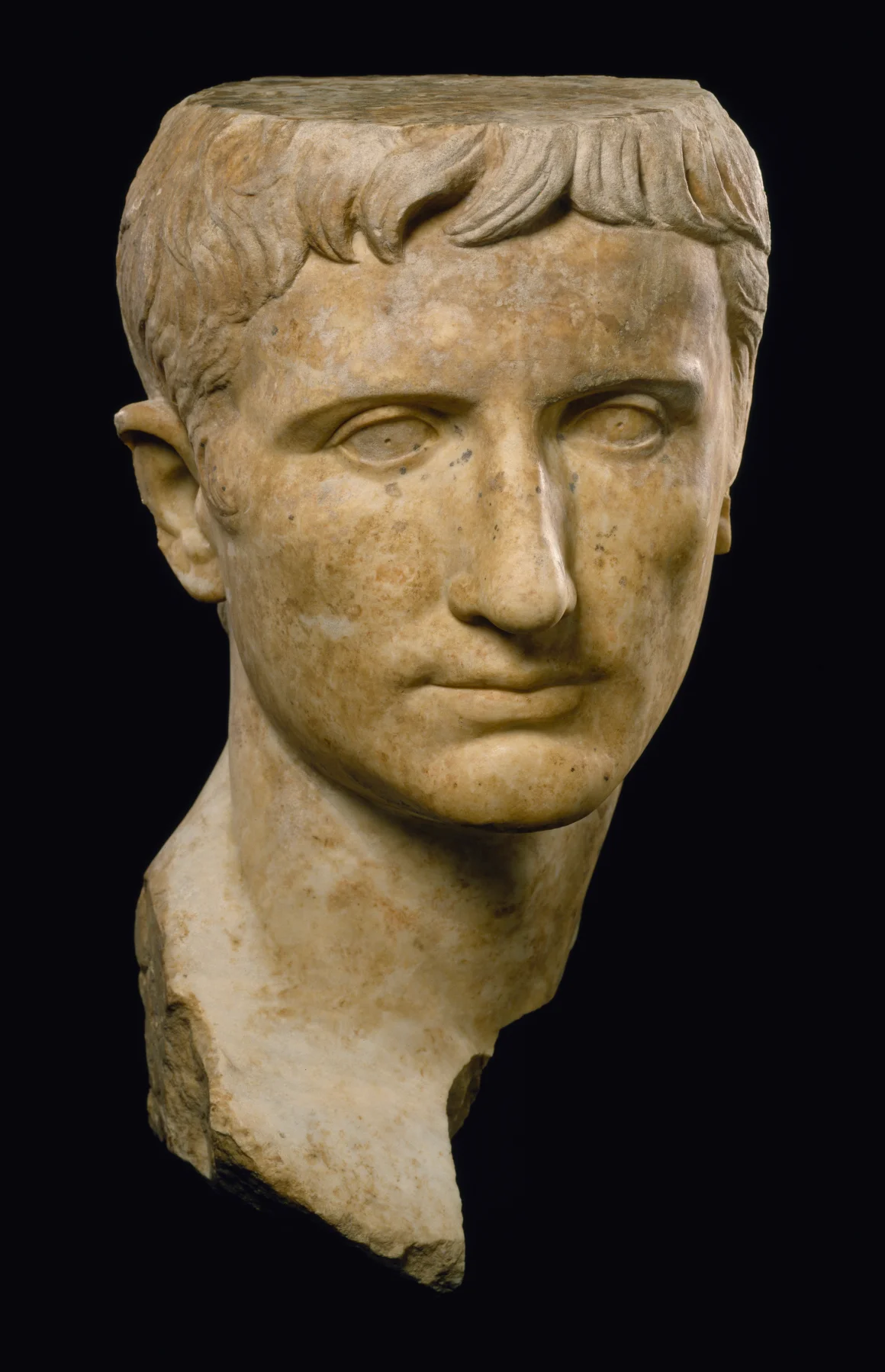
Augustus
 Italy
Italypolitician•military personnel•ruler
Also known as: Octavian, Gaius Octavius Thurinus, Gaius Julius Caesar Octavianus
Birthday
September 23, 63 BC
Birth Sign
Libra
Birthplace
Rome, Italy
Age
Died at 75
Height
5 ft 7 in (170 cm)
About
Augustus was the founder of the Roman Empire and its first emperor, ruling from 27 BC until his death in AD 14, and he is remembered as one of the most consequential statesmen in Western history. Born Gaius Octavius and adopted as heir by his great-uncle Julius Caesar, he emerged from the chaos of civil war that followed Caesar's assassination to defeat his rivals and concentrate unprecedented authority in his own hands. His genius lay less in conquest than in political design. Rather than declaring himself king, a title the Romans despised, he constructed a system, later called the principate, in which he held real power while preserving the outward forms of the old Republic and posing as merely its first citizen. That careful fiction gave Rome a workable model of one-man rule that endured for centuries. His long reign opened the Pax Romana, a sustained era of relative peace across the Roman world, accompanied by sweeping reforms of the army, finances, and administration, and a flourishing of literature and monumental building. Historians continue to debate the cost of his autocracy to Roman liberty. Even so, his transformation of a crumbling republic into a durable empire ranks among antiquity's defining political achievements.
Early Life & Background
Augustus was born Gaius Octavius Thurinus on September 23, 63 BC, at a modest family property on the Palatine Hill in Rome. His father, also Gaius Octavius, was a senator and former praetor who had governed Macedonia; his mother, Atia, was the niece of Julius Caesar. When the boy was four, his father died, and his mother remarried Lucius Marcius Philippus. Octavius then went to live with his grandmother Julia, Caesar's sister, who oversaw his early upbringing. He received a thorough education in rhetoric, philosophy, and military arts, and as a youth was given a seat on the board of priests and allowed to accompany Caesar at public events. In 44 BC, at age eighteen, he was studying astronomy in Epirus when news arrived of Caesar's assassination. Caesar's will named Octavius his adopted son and principal heir. He immediately crossed to Italy, claimed the inheritance, and took the name Gaius Julius Caesar Octavianus, setting the stage for his entry into Roman politics.
Career Growth
Octavian arrived in Rome in May 44 BC to find Mark Antony in control of Caesar's faction and the treasury. He skillfully courted the Senate, raised a private army from Caesar's veterans, and forced Antony to yield. In 43 BC, he formed the Second Triumvirate with Antony and Lepidus, a legally sanctioned commission to restore the state. The triumvirs proscribed their enemies, executed hundreds, including Cicero, and defeated Caesar's assassins Brutus and Cassius at Philippi in 42 BC. Tensions among the three led to a division of the Roman world. Octavian took the west, Antony the east. Conflict became inevitable. In 31 BC, Octavian's fleet, commanded by his friend Agrippa, crushed the combined forces of Antony and Cleopatra at the Battle of Actium. Both fled to Egypt and committed suicide the next year. Octavian annexed Egypt, seized its vast treasury, and became sole master of Rome. On January 16, 27 BC, the Senate awarded him the honorific Augustus, meaning the revered one, and he formally restored the Republic while retaining effective control of the army and provinces. Over the next four decades, he reformed taxation, created a standing professional army and the Praetorian Guard, established a fire and police service for Rome, and built an extensive network of roads and aqueducts. He patronized Virgil, Horace, and Livy, whose works defined the Augustan Age. The empire expanded into Spain, Switzerland, and the Balkans, though a devastating loss in the Teutoburg Forest in AD 9 led him to set fixed borders. He died in Nola on August 19, AD 14, and was deified by the Senate.
Career Timeline
Public Image & Style
Augustus cultivated an image of modest republican virtue while wielding absolute power. He dressed simply, lived in a modest house on the Palatine, and presented himself as first among equals. His official portraits, replicated across the empire, show a youthful, serene face with a sidelock of hair, a style that became iconic. He carefully managed his public persona through coinage, statues, and the Res Gestae, an autobiographical inscription that listed his achievements. Modern media often portrays him as a master propagandist and political genius, emphasizing his transformation from sickly youth to ruthless politician to wise elder statesman. History enthusiasts debate his legacy: some see a tyrant who destroyed the Republic, others a statesman who brought peace after decades of civil war. His era, the Augustan Age, is synonymous with Latin literature's golden age, thanks to his patronage of Virgil, Horace, and Livy.
Fame & Fandom
The Roman Empire's first emperor left no organized fanbase, no official subreddit, and no modern cult of personality that gathers for birthday billboards or subway ads. His legacy is one of historical reverence rather than contemporary fandom, with a global audience that spans two millennia of study rather than active participation. While the concept of a dedicated fan club did not exist in antiquity, Augustus remains a towering figure whose name echoes through every history textbook and documentary produced since. According to the latest data from the iFANN Global Fame Rankings, he holds the position of the 23rd most famous person from Italy, a standing that has held steady through the previous cycle.
Interesting Facts and Legends
Augustus was born Gaius Octavius, but his full birth name included Thurinus, a nod to his father's victory over a slave revolt at Thurii. He was deeply superstitious, consulting omens before making major decisions, and suffered from a stutter that he largely overcame through relentless practice. His daily life followed a strict routine: seven hours of sleep at night, afternoon naps, and a hatred for traveling in litters due to claustrophobia. He banned young men from attending the theater unless accompanied by an older relative and loved dice games, often playing with friends. When his daughter Julia committed adultery, he exiled her and refused to let her return. He famously refused the title Dominus, preferring Princeps, and wrote an autobiography that covered his life up to about 25 BC before vanishing.
Historical legends cement his status as a master of political theater. A foundational story recounts his posthumous adoption by Julius Caesar, which launched his rise from a young noble to the ruler of Rome. Another pivotal moment was the Battle of Actium, where he defeated Mark Antony and Cleopatra, ending civil wars and ushering in the Pax Romana. Ancient sources also preserve the dramatic deathbed scene at Nola, where he reportedly asked if he had played his part well in the great comedy of life before passing away.
Notable Quotes
“I found Rome a city of bricks and left it a city of marble.”
“Make haste slowly.”
“Quintilius Varus, give me back my legions!”
“May it be my privilege to establish the State in a firm and secure position...”
“I acted not for my own advantage but for that of the commonwealth.”
“I received a state overwhelmed by faction and made it peaceful and free.”
Family & Personal Life
Augustus's father, Gaius Octavius, died when he was four. His mother, Atia Balba Caesonia, was the niece of Julius Caesar and died in 43 BC. His grandmother Julia Caesaris, Caesar's sister, raised him after his father's death. Augustus married three times: Claudia, the stepdaughter of Mark Antony, in a political match that was quickly annulled; Scribonia, with whom he had his only biological child, Julia the Elder, born in 39 BC; and Livia Drusilla, whom he married in 38 BC and who remained his partner for 52 years. He adopted his grandsons Gaius and Lucius Caesar, and after their early deaths, his stepson Tiberius, who succeeded him. He also adopted Agrippa Postumus, the posthumous son of his friend Agrippa, but later exiled him. The imperial household included numerous slaves and freedmen who managed his personal affairs.
Notable Connections
Augustus was closely associated with Julius Caesar, his great-uncle and adoptive father, whose assassination triggered his rise. His principal ally and general was Marcus Vipsanius Agrippa, who led his military campaigns and oversaw building projects. His wife Livia Drusilla was a key political partner. The poet Virgil wrote the Aeneid under his patronage. His rival Mark Antony and Cleopatra VII were his greatest enemies, defeated at Actium.
Relationships & Dating History
Augustus married three times, each union tied to political strategy. His first marriage, to Claudia, the stepdaughter of Mark Antony, was arranged in 42 BC to seal the Second Triumvirate. He divorced her in 41 BC, still a virgin according to sources, to marry Scribonia. Scribonia was the sister of a supporter of Sextus Pompey, and the marriage aimed at peace with Pompey. In 39 BC, on the very day Scribonia gave birth to their daughter Julia, Augustus divorced her, reportedly because he found her temperament unbearable. Within weeks, he forced the divorce of Livia Drusilla from her husband Tiberius Claudius Nero and married her in 38 BC. Livia was pregnant with her second son at the time. Their marriage lasted 52 years until Augustus's death. They had no biological children, but Livia's sons Tiberius and Drusus became his heirs. Augustus adored Livia, writing letters that show deep affection, and she served as his political confidante. Ancient sources also mention rumored affairs with the wives of senators, including Terentia, wife of his advisor Maecenas, though these are not reliably confirmed. As of 2026, Augustus is deceased, and his relationship status at death was widowed.
- MarriedClaudia-42 - -41Married to seal the Second Triumvirate; divorced shortly after, still a virgin.
- MarriedScribonia-40 - -39Political marriage to broker peace with Sextus Pompey; divorced the day she gave birth to Julia.
- MarriedLivia Drusilla-38 - 14CurrentMarried for 52 years; no biological children; Livia was a key political advisor.
Death & Aftermath
Died
August 19, AD 14 (aged 75)
Death Place
Nola
Cause of Death
Natural causes following prolonged illness
Augustus fell ill in the quiet town of Nola, where he had traveled to visit the shrine of Hercules with his wife Livia. His health declined over several days marked by fever and digestive troubles until he passed away on August 19, AD 14 at the age of seventy-five. Ancient biographers like Suetonius describe a final day where the emperor accepted his fate after fainting while attempting to walk, making no mention of foul play despite later rumors suggesting poisoning by Tiberius or Livia that remain unconfirmed. The Roman Senate immediately deified him as Divus Augustus, declaring a city-wide mourning period where citizens refused their daily togas and some went.
A massive procession carried his body draped in purple and gold from Nola to Rome, featuring actors performing scenes from his life and professional mourners leading the grief before his cremation in the Field of Mars. His ashes rested in the Mausoleum of Augustus on the Campus Martius, while Tiberius delivered the eulogy and seamlessly absorbed the imperial treasury and titles without dispute. Generations later, the month of August bears his name alongside enduring monuments like the Ara Pacis and the Temple of Divus Augustus.
Net Worth (Estate Value)
$0
iFANN Editorial Team estimate
iFANN currently estimates the net worth of Augustus at $0. As a figure deceased since AD 14, he possesses no living assets, yet his control over resources during his reign was absolute. At the time of his death, the imperial treasury contained vast wealth derived from Egypt's grain revenues, provincial tribute, and personal holdings. The Roman Empire's annual budget at that time is estimated at 200 to 400 million sesterces, with Augustus personally controlling the majority of these funds. His estate passed to his successor Tiberius and the imperial treasury upon his demise. No modern valuation of his wealth is possible, but his command over the resources of the entire Roman world made him, in practical terms, the wealthiest individual of his era.
Awards Won (8)
Augustus received the highest honors the Roman state could bestow: the title Augustus in 27 BC, the civic crown for saving citizens, the Shield of Virtue, tribunician power, proconsular imperium, the office of Pontifex Maximus, and the title Pater Patriae. After his death, the Senate deified him, establishing an imperial cult with temples and priests throughout the empire.
-27 · Honorific
Principate
-27 · Military Honor
Saving citizens' lives
Known For
Founder of the Roman Empire
27 BC · First Emperor
Pax Romana
27 BC · Establisher
Battle of Actium
31 BC · Commander
Augustan Age of Latin Literature
1st century BC · Patron
Keywords
Sources
Quick Facts
- Profession
- politician, military personnel, ruler
- Born
- September 23, 63 BC
- Birthplace
- Rome, Italy
- Died
- August 19, AD 14
- Death Place
- Nola, Italy
- Gender
- Male
- Spouse
- Claudia, Scribonia, Livia
Personal Details
- Full Name
- Gaius Octavius Thurinus
- Height
- 5 ft 7 in (170 cm)
- Spouse
- Claudia, Scribonia, Livia
- Children
- Julia the Elder (daughter with Scribonia); adopted sons Gaius Caesar, Lucius Caesar, Tiberius
- Education
- Rhetoric, philosophy, and astronomy in Rome and Epirus
Frequently Asked Questions
How did Augustus die?
Was Augustus related to Julius Caesar?
How old was Augustus when he became emperor?
Did Augustus have children?
What was Augustus's real name?
Join the community
fans discussing