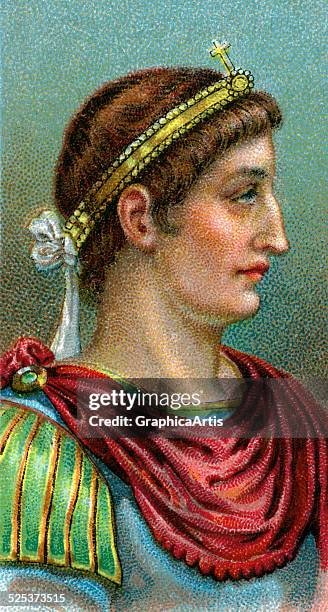
Constantine the Great
Roman emperor•military commander
Also known as: Constantine I, Flavius Valerius Constantinus
Birthday
February 27, 272
Birth Sign
Pisces
Birthplace
Naissus (modern-day Niš, Serbia)
Age
Died at 65
About
Constantine the Great was Roman emperor from 306 to 337 and the first to convert to Christianity, a decision that redirected the course of Western history. He turned a persecuted faith into a force at the heart of the empire and built a new capital that would outlast Rome itself.
His reign is remembered for two acts above all. Through the Edict of Milan he ended the persecution of Christians and made their worship legal, setting in motion the Christianisation of the Roman world, and he convened the Council of Nicaea, which sought to define Christian doctrine for a divided church. He also reunified an empire that had fractured under the Tetrarchy, defeating his rivals to rule alone.
In 330 he refounded the Greek city of Byzantium as Constantinople, the city now known as Istanbul, and made it his capital. It would remain the seat of the Eastern Roman and Byzantine empires for more than a thousand years. Raised to sainthood in several Christian traditions, Constantine is studied as the emperor who fused Roman power with the Christian church, a union whose consequences shaped medieval Europe and the world that followed. Few rulers of antiquity cast a longer shadow.
Early Life & Background
Born in Naissus, a city in the Roman province of Moesia, Constantine was the son of Constantius Chlorus, a rising military officer, and Helena, a woman of humble background. His early years were spent in the eastern provinces under the emperor Diocletian, where he received a formal education in Latin and Greek and trained in the military arts. He served as a tribune in the imperial army, fighting in campaigns against the Persians and along the Danube frontier.
In 305, Diocletian and his co-emperor Maximian abdicated, and Constantius was promoted to Augustus of the West. Constantine was allowed to join his father in Gaul, where he campaigned against the Picts in Britain. When Constantius died in 306 at Eboracum (modern York), the troops loyal to his father immediately proclaimed Constantine emperor. He was 34 years old and had never been formally designated as successor, setting the stage for two decades of civil war.
Career Growth
Constantine spent the next eighteen years fighting to secure and expand his power. After defeating the Frankish tribes on the Rhine, he marched into Italy and confronted his rival Maxentius at the Milvian Bridge in 312. According to tradition, Constantine saw a vision of a cross in the sky with the words In hoc signo vinces, in this sign, conquer. He adopted the Christian symbol on his soldiers' shields and won decisively. The following year, he met Licinius in Milan and issued the Edict of Milan, granting religious freedom to all citizens, including Christians.
By 324, Constantine had defeated Licinius and reunified the Roman Empire under a single ruler. He immediately turned to church matters, convening the Council of Nicaea in 325 to settle the Arian controversy and produce the Nicene Creed. In 330, he dedicated a new capital on the site of Byzantium, naming it Constantinople. The city was built on a grand scale, with forums, a hippodrome, and churches, and it quickly became the political and cultural center of the eastern empire. Constantine spent his final years campaigning on the Persian frontier and died in 337 in Nicomedia, after receiving baptism on his deathbed.
Career Timeline
Public Image & Style
Constantine has been portrayed as the ideal Christian emperor by church historians like Eusebius, who celebrated his piety and divine favor. Pagan writers were more critical, viewing him as a usurper who drained the treasury and introduced oriental despotism. In art, he is often depicted with a youthful, clean-shaven face and a diadem, symbols of his authority and his break with the Tetrarchic style. His statue in Constantinople showed him holding a cross and a spear. Modern historians see him as a pragmatic ruler who used Christianity to unify the empire, while his personal faith remains debated. He is a saint in the Eastern Orthodox, Catholic, and Oriental Orthodox churches, with a feast day on May 21.
Fame & Fandom
Constantine the Great ruled an empire that stretched from Britain to the Middle East, yet his fame today is measured not in territories but in the enduring weight of his name. The iFANN Global Fame Engine has evaluated his legacy, and as of August 2026, he holds no placement in the published rankings, neither in the Global Top 1,000 nor in any Top-100 scope list. This is not a slight; it is a consequence of a fame that operates on a different scale, one built over seventeen centuries rather than a single season. His renown is diffuse, woven into the fabric of Western civilization, but it does not translate into the kind of concentrated, contemporary attention that ranking systems capture.
His audience is not a fandom in any modern sense. There is no formal name for those who study him, no fan conventions, no coordinated campaigns. What exists is something older and more profound: a religious veneration. The Eastern Orthodox Church honors him as a saint, and his feast day, shared with his mother Helena, is celebrated with liturgical services. Beyond that, he draws a steady stream of history enthusiasts, documentary viewers, and scholars, people who engage with his life through books, videos, and debate. They are a diffuse community, united by curiosity rather than a shared label. The liveliest ongoing argument among them concerns the authenticity of his conversion: was it genuine faith or political calculation? That question, unresolved after centuries, may be the closest thing to a fan ritual he has.
Interesting Facts and Legends
Constantine was the first Roman emperor to be baptized as a Christian, though he delayed the rite until he was on his deathbed, a common practice at the time. He is credited with commissioning the first copies of the Bible for use in Constantinople, ordering fifty manuscripts from Eusebius of Caesarea. The Donation of Constantine, a forged document purporting to grant the Pope temporal authority over the Western Roman Empire, was used for centuries to justify papal power. Constantine never visited Rome after 326, preferring his new eastern capital. His mother Helena is credited with discovering the True Cross during a pilgrimage to Jerusalem. The Arch of Constantine in Rome, completed in 315, commemorates his victory at the Milvian Bridge and incorporates reliefs from earlier emperors.
The most famous legend of his reign is the vision before the Battle of the Milvian Bridge in 312: according to the story, he saw a cross of light in the sky with the words “In this sign, conquer.” The tale, told by the historian Eusebius, remains a cornerstone of his Christian legacy, even though the earliest accounts describe a dream rather than a daytime vision. Another enduring story holds that he founded Constantinople on the site of ancient Byzantium, creating a “New Rome” that would outlast the Western Empire by nearly a thousand years. His convening of the Council of Nicaea in 325, which produced the Nicene Creed, is also retold as the moment an emperor first shaped church doctrine on a universal scale.
Notable Quotes
“In hoc signo vinces.”
“I am convinced that the greatest good that can befall men is the knowledge of the divine.”
“Let us have nothing in common with the detestable Jewish crowd.”
“The Catholic Church is the one true church, and outside it there is no salvation.”
Family & Personal Life
Constantine's mother, Helena, was a Greek woman from Drepanum in Bithynia. His father, Constantius Chlorus, was a Roman general who became emperor. Helena was divorced or set aside when Constantius married Theodora, the daughter of Maximian, to secure a political alliance. Constantine remained close to his mother throughout his life, and after his rise to power he gave her the title Augusta and sent her on a pilgrimage to the Holy Land. His first wife, Minervina, died or was divorced around 307; she was the mother of his eldest son, Crispus. In 307, Constantine married Flavia Maxima Fausta, the daughter of the former emperor Maximian. With Fausta he had three sons: Constantine II, Constantius II, and Constans, each of whom later ruled as emperor. The family was marked by tragedy: Crispus was executed on charges of adultery in 326, and Fausta was killed shortly after, possibly by Constantine himself. The reasons remain debated.
Notable Connections
Constantine's mother Helena, later Saint Helena, was a key influence and is credited with finding the True Cross. His co-emperor and later rival Licinius shared power after the Edict of Milan before being defeated. His son Crispus was executed under mysterious circumstances, and his second wife Fausta died soon after. The theologian Eusebius of Caesarea wrote a biography of Constantine that shaped his Christian legacy. His sons Constantine II, Constantius II, and Constans succeeded him, dividing the empire.
Relationships & Dating History
Constantine married Minervina around 300 AD, but little is known about her. She bore his first son, Crispus, and died or was divorced by 307. In 307, Constantine married Flavia Maxima Fausta, the daughter of the former emperor Maximian, to strengthen his political position. The marriage produced three sons and two daughters. In 326, Constantine ordered the execution of Crispus, allegedly for adultery with Fausta. Shortly after, Fausta was killed, possibly by being suffocated in a steam bath. The exact circumstances remain obscure, but the events cast a shadow over the imperial family. As of 2026, Constantine is deceased.
- MarriedMinervina300 - 307First wife, mother of Crispus; died or divorced around 307.
- MarriedFlavia Maxima Fausta307 - 326Second wife, daughter of Emperor Maximian; executed in 326.
Death & Aftermath
Died
May 22, 337 (aged 65)
Death Place
Nicomedia, Bithynia, Roman Empire
Cause of Death
Fever or severe illness
The Roman Senate officially deified Constantine, granting him the title Divus Constantinus and issuing coinage bearing his image alongside the inscription DEO ET DOMINO CONSTANTINO MAGNO. He passed away on May 22, 337 AD at a villa in Nicomedia after falling ill with a severe fever while preparing for a campaign against the Persians. Ancient chronicles by Eusebius and Aurelius Victor describe a natural decline following a long reign, noting that he received baptism from Eusebius of Nicomedia shortly before his death. Legends suggesting poisoning by political rivals or family members exist but are widely regarded as baseless fabrications lacking contemporary evidence. Christian institutions immediately began honoring him as a saint, venerating him in the Eastern Orthodox and Catholic Churches as Saint Constantine the Great, Equal-to-the-Apostles.
The funeral took place shortly after his death in Constantinople within the Church of the Holy Apostles, a mausoleum he had constructed specifically for this purpose. High-ranking clergy, the imperial court, and military leaders attended the procession, which included a eulogy delivered by bishops. His sons, Constantine II, Constantius II, and Constans, were present and subsequently divided the empire among themselves following traditional Roman practice. Posthumous recognition has been extensive, spanning thousands of books, films, and academic studies including the documentary Constantine the Great - Emperor of the New Rome . Annual feast days were established to commemorate his life and death, celebrated on May 22 or June 3 in the Julian calendar.
Net Worth (Estate Value)
As a 4th-century emperor, Constantine controlled the entire treasury of the Roman Empire, which was immense by ancient standards. His wealth came from imperial estates, taxes, tribute, and the spoils of war. He funded massive building projects, including Constantinople's walls, forums, and churches, as well as the Arch of Constantine in Rome. He also redistributed wealth to the Christian church, granting lands and tax exemptions. After his death, his estate passed to his sons, but no modern net worth can be calculated.
Awards & Accolades
View 7 records, honours and achievementsKnown For
Edict of Milan
313 · Issuer
Council of Nicaea
325 · Convener
Founding of Constantinople
330 · Founder
Keywords
Quick Facts
- Profession
- Roman emperor, military commander
- Born
- February 27, 272
- Birthplace
- Naissus (modern-day Niš, Serbia)
- Died
- May 22, 337
- Death Place
- Nicomedia (modern-day İzmit, Turkey)
- Gender
- Male
- Spouse
- Minervina, Flavia Maxima Fausta
- Children
- Crispus, Constantine II, Constantius II, Constans
Personal Details
- Full Name
- Flavius Valerius Constantinus
- Spouse
- Minervina, Flavia Maxima Fausta
- Children
- Crispus, Constantine II, Constantius II, Constans
Frequently Asked Questions
Who was Constantine the Great?
What was Constantine the Great's most significant achievement?
When was Constantine the Great born and where?
Why is Constantine the Great important?
When did Constantine the Great die?
Similar People
Join the community
fans discussing