Cleopatra
 Egypt
EgyptAlso known as: Cleopatra VII, Cleopatra Philopator, The Last Pharaoh
Birthday
January 13, 69 BCE
Birth Sign
Capricorn
Birthplace
Alexandria, Egypt
Age
Died at 39
About
Cleopatra VII Philopator was the last active ruler of the Ptolemaic Kingdom of Egypt, a Macedonian Greek dynasty that had governed the country for nearly three centuries. She is one of the most famous women of the ancient world, remembered for her intelligence, political skill, and dramatic alliances with Rome's most powerful men. Unlike her predecessors, she learned the Egyptian language and presented herself as the reincarnation of the goddess Isis. Her reign was a constant struggle to preserve Egypt's independence as Rome expanded. She formed a political and romantic alliance with Julius Caesar, securing her throne, and later with Mark Antony, aiming to create a powerful eastern empire. Their defeat by Octavian (the future Augustus) led to her suicide and Egypt's annexation as a Roman province. Cleopatra's legacy has been shaped by Roman propaganda that painted her as a seductress, but modern historians see a capable administrator and diplomat. She remains a cultural icon, endlessly reimagined in art, literature, and film.
Early Life & Background
Cleopatra was born in Alexandria in early 69 BCE, the third child of Ptolemy XII Auletes. Her upbringing was steeped in the rich Hellenistic culture of the city, home to the Great Library and the Mouseion. She received an exceptional education, studying rhetoric, philosophy, astronomy, and medicine. She was reportedly fluent in at least nine languages, including Egyptian, Greek, Latin, Aramaic, and Ethiopian, the only Ptolemaic ruler to bother learning the native tongue. Her father's unstable rule, marked by rebellion and reliance on Roman support, exposed her early to the brutal realities of politics. When Ptolemy XII died in 51 BCE, Cleopatra, then 18, ascended the throne as co-ruler with her younger brother Ptolemy XIII, as was customary. But the court soon turned against her, and within two years she was forced into exile in Syria. There she raised an army and prepared to reclaim her kingdom.
Career Growth
Cleopatra's breakthrough came in 48 BCE when she smuggled herself into the palace of Julius Caesar in Alexandria rolled up in a carpet (or perhaps a linen sack). Caesar was captivated by her audacity and intelligence. He backed her claim to the throne, and after a short war, Ptolemy XIII drowned in the Nile. Cleopatra was restored as queen, now co-ruling with an even younger brother, Ptolemy XIV. She and Caesar became lovers, and in 47 BCE she gave birth to a son, Ptolemy XV Caesarion. She traveled to Rome as Caesar's guest, but his assassination in 44 BCE forced her return to Egypt. Soon after, she had Ptolemy XIV poisoned and made Caesarion her co-ruler. In 41 BCE she allied with Mark Antony, one of the triumvirs ruling Rome. Their partnership, both political and romantic, produced three children. Antony granted Cleopatra vast territories, angering Octavian. The conflict culminated in the naval Battle of Actium in 31 BCE, where Antony and Cleopatra were decisively defeated. They fled to Alexandria, and when Octavian's forces arrived in 30 BCE, both took their own lives, Antony by sword, Cleopatra by poison (likely a snake bite).
Career Timeline
Public Image & Style
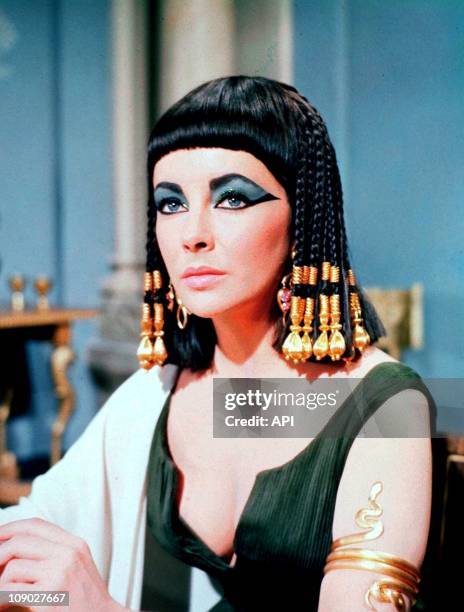
Cleopatra's public image has been heavily shaped by Roman propaganda, which portrayed her as a manipulative seductress who used her charms to corrupt noble Romans. This narrative, promoted by Octavian and later historians like Plutarch, influenced centuries of art and literature. In reality, she was a shrewd stateswoman who emphasized her divine lineage. She often dressed as the goddess Isis, with a crown of cobras and a robe knotted at the chest. Her coin portraits show a strong nose, a prominent chin, and large eyes, not a classic beauty, but a commanding presence. Modern pop culture, from Elizabeth Taylor's glamorous portrayal in the 1963 film to Shakespeare's complex character, has cemented her as a symbol of beauty, power, and tragedy. Fans today debate her true appearance and legacy, with many defending her as a misunderstood leader.
Fame & Fandom
No formal organization or official name exists for the audience that venerates Cleopatra. As a figure of antiquity, she lacks a living fanbase capable of organizing campaigns, birthday billboards, or chart pushes. Her legacy survives not through modern rituals but through two millennia of retold stories about her political genius and dramatic end. The narrative of the seductress who used beauty to manipulate Rome remains a pervasive cultural myth, often clashing with the historical reality of a shrewd stateswoman who spoke nine languages and navigated complex family rivalries to save Egypt from annexation. While Zendaya adopted a "Cleopatra beauty" look in 2026, this represents a fleeting cultural reference rather than an organized movement. The legend of her tomb remains one of history's most persistent mysteries, fueling centuries of archaeological speculation without ever yielding a confirmed site. Despite the absence of a structured fandom, her influence permeates global consciousness through literature, theater, and cinema. According to the iFANN Global Fame Rankings, she holds significant standing. She is the 268th most famous person in the world, holding steady from the previous cycle. In Sri Lanka, she ranks as the 11th most famous person, also holding steady. Originating from Egypt, she stands as the 2nd most famous person from Egypt. Within the realm of Books & Literature, she claims the spot of the 14th most famous person.
Interesting Facts and Legends
Cleopatra VII Philopator served as the final active ruler of the Ptolemaic Kingdom, governing Egypt for nearly three centuries before Rome's expansion. She distinguished herself from predecessors by learning the Egyptian language and presenting herself as the living reincarnation of the goddess Isis. Coins and portraits depicted her with a strong nose and a crown of cobras to emphasize divine lineage. Her political strategy relied on high-stakes alliances with Julius Caesar and Mark Antony to preserve Egypt's independence. A legendary tale recounts her dissolving a pearl worth 10 million sesterces in vinegar to win a dinner bet with Antony. Her personal physician, the Greek Dioscorides, assisted her in writing a medical treatise focused on cosmetics and hair loss. While the story of her death by an asp bite remains the dominant cultural myth, historians debate whether poison was the actual cause. Shakespeare's play Antony and Cleopatra heavily shaped the modern image of her as a seductress, though reality painted a picture of a shrewd stateswoman who claimed to be the daughter of Ra. Another enduring story involves the persistent mystery of her lost tomb; unlike other pharaohs whose burial sites were discovered, her final resting place remains unknown, fueling centuries of speculation. The narrative of her choosing suicide over capture by Octavian to avoid a Roman triumph parade stands as a verified historical event, marking the end of the Ptolemaic Kingdom and the beginning of Egypt as a Roman province.
Notable Quotes
“I will not be triumphed over.”
“My honour was not yielded, but conquered merely.”
“The barge she sat in, like a burnish'd throne, Burn'd on the water.”
“Age cannot wither her, nor custom stale Her infinite variety.”
Family & Personal Life
Cleopatra was born to Ptolemy XII Auletes, a pharaoh who relied heavily on Roman support, and whose identity is uncertain but likely a sister or concubine. She had two older sisters, Berenice IV (executed by their father) and Cleopatra VI (possibly died young), and two younger brothers who became her husbands. Her own household included her four children: Caesarion with Julius Caesar, and the twins Cleopatra Selene II and Alexander Helios, plus Ptolemy Philadelphus, with Mark Antony. After her death, her children were taken to Rome and raised by Octavian's sister Octavia; only Cleopatra Selene survived to adulthood, becoming queen of Mauretania. Cleopatra reportedly kept pet lions and was attended by eunuchs and servants from across the Mediterranean.
Notable Connections
Cleopatra is inextricably linked with Julius Caesar and Mark Antony, her political and romantic partners. Her rival Octavian (later Augustus) defeated her. Her father Ptolemy XII and her brother-husbands Ptolemy XIII and Ptolemy XIV were key family figures. Her children included Caesarion and Cleopatra Selene II. She is often compared to other powerful ancient queens like Hatshepsut and Nefertiti.
Relationships & Dating History
Cleopatra's marriages were primarily political, as was Ptolemaic custom. She married her younger brother Ptolemy XIII in 51 BCE, but their relationship soured into civil war, ending with his death in 47 BCE. She then married another brother, Ptolemy XIV, in 47 BCE, but had him killed in 44 BCE to secure Caesarion's succession. Her most famous relationship was with Julius Caesar (48-44 BCE), with whom she had a son, Caesarion. After Caesar's death, she allied with Mark Antony from 41 BCE onward, having three children with him. Their partnership ended with their double suicide in 30 BCE.
- MarriedPtolemy XIII Theos Philopator-51 - -47Co-ruler and brother; their conflict led to her exile and his death.
- DatedJulius Caesar-48 - -44Political and romantic alliance; mother of his son Caesarion.
- MarriedPtolemy XIV of Egypt-47 - -44Younger brother and co-ruler; Cleopatra had him poisoned.
- DatedMark Antony-41 - -30Political and romantic partnership; had three children; died together.
Death & Aftermath
Died
August 12, 30 BCE (aged 39)
Death Place
Alexandria, Egypt
Cause of Death
Snake bite (asp)
The final days unfolded in Alexandria as Octavian's legions closed in on the Ptolemaic capital, ending a reign defined by the struggle to preserve Egypt's independence. On August 12, 30 BCE, Cleopatra VII chose death over capture, reportedly taking her own life through the bite of an asp, an account preserved by ancient historians like Plutarch rather than modern forensic evidence. The political aftermath was immediate and absolute; the sovereign's demise marked the annexation of Egypt by Rome, extinguishing the three-century-old Macedonian dynasty. Her legacy shifted instantly from living monarch to enduring symbol, inspiring countless artistic works and films that reimagined her final moments for future generations while Roman officials secured control of the realm.
There were no judicial proceedings regarding the manner of her death, as the circumstances were recorded by later historians rather than established through legal inquest. Octavian secured control of Egypt, and Cleopatra's children were taken to Rome, marking the end of the Ptolemaic dynasty.
Net Worth (Estate Value)
As a monarch of the ancient world, Cleopatra's wealth was immense by the standards of her time. She controlled Egypt's vast resources, including grain production, gold mines, and trade routes. Her personal treasury was legendary; she spent lavishly on her court, navy, and political campaigns. The famous pearl-dissolving story illustrates her opulence. However, her reign ended in financial strain due to wars with Rome. No modern net worth can be accurately assigned, but her kingdom's annual revenue likely exceeded 12,000 talents of silver, equivalent to hundreds of millions today.
Awards & Accolades
View 9 records, honours and achievementsKnown For
Last active ruler of Ptolemaic Egypt
-51 to -30 · Pharaoh
Relationships with Julius Caesar and Mark Antony
-48 to -30 · Political ally and lover
Battle of Actium
-31 · Defeated monarch
Keywords
Quick Facts
- Profession
- sovereign, monarch
- Born
- January 13, 69 BCE
- Birthplace
- Alexandria, Egypt
- Died
- August 12, 30 BCE
- Death Place
- Alexandria, Egypt
- Gender
- Female
- Spouse
- Ptolemy XIII, Ptolemy XIV, Mark Antony
- Birth Sign
- Capricorn
Personal Details
- Full Name
- Cleopatra VII Philopator
- Spouse
- Ptolemy XIII Theos Philopator, Ptolemy XIV of Egypt, Mark Antony
- Children
- Caesarion (Ptolemy XV), Cleopatra Selene II, Alexander Helios, Ptolemy Philadelphus
- Education
- Tutored in rhetoric, philosophy, and languages at the Library of Alexandria
Frequently Asked Questions
Who was Cleopatra?
When did Cleopatra live?
What languages did Cleopatra speak?
How did Cleopatra die?
Why is Cleopatra famous?
Similar People
Join the community
fans discussing