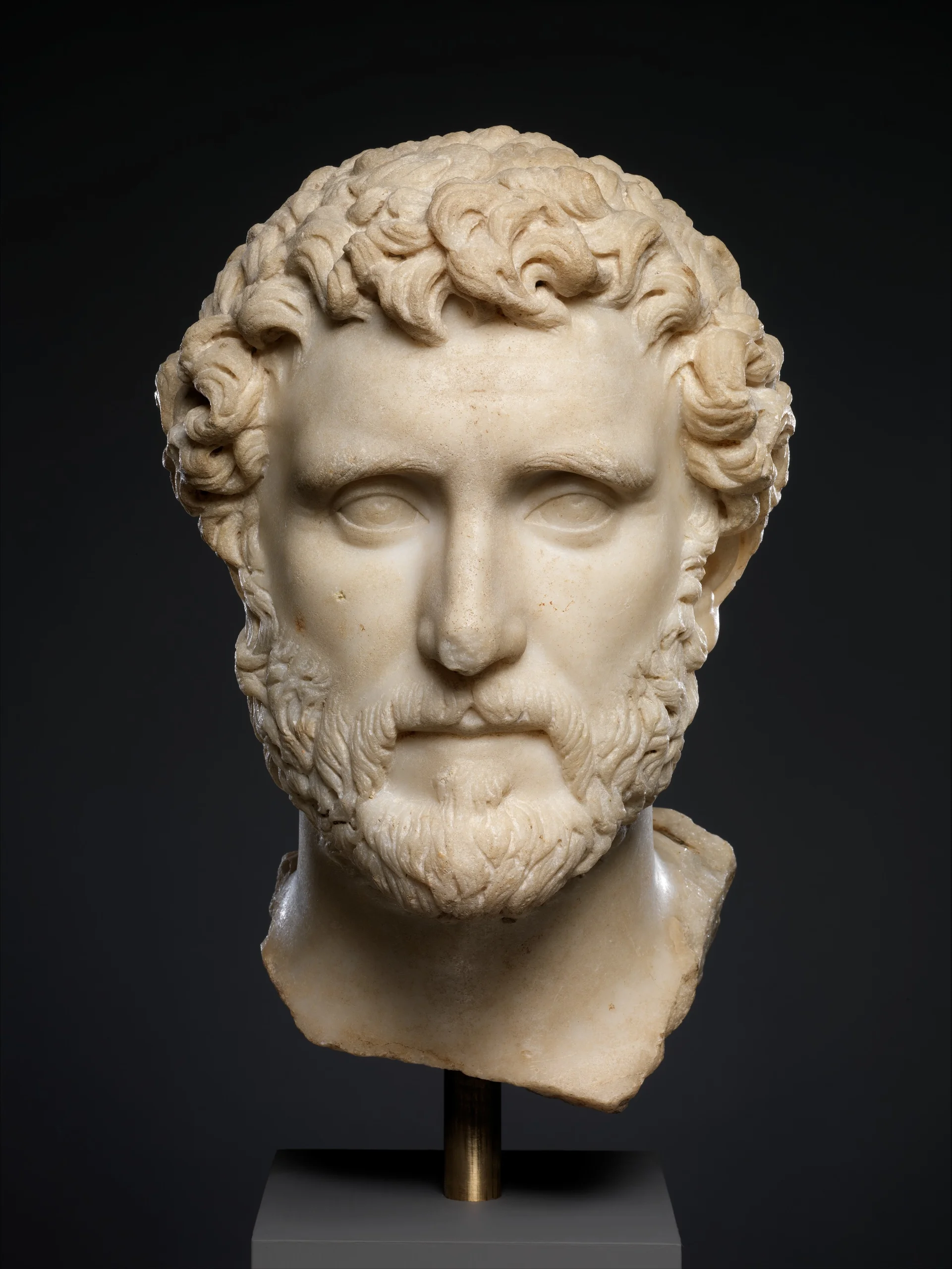
Antoninus Pius
Also known as: Pius
Birthday
September 19, 86
Birth Sign
Virgo
Birthplace
Lanuvium
Age
Died at 75
About
Antoninus Pius, born Titus Aelius Hadrianus Antoninus on September 19, 86, in Lanuvium, was a Roman emperor who reigned from 138 to 161. He is widely recognized as the fourth of the 'Five Good Emperors,' a period often seen as a golden age of stability and prosperity for the Roman Empire. Antoninus hailed from a prominent senatorial family, a background that prepared him for a life of public service. His connection to the imperial family deepened through his marriage to Faustina the Elder, Emperor Hadrian's niece, which eventually led to his adoption by Hadrian as the chosen successor.
Upon ascending the throne, Antoninus earned the cognomen 'Pius,' a title reflecting his devotion and sense of duty. This name is believed to have been bestowed due to his unwavering support for his adoptive father, Hadrian, particularly his insistence on Hadrian's deification, and his clemency towards senators who had faced execution under Hadrian's later rule. His nearly twenty-three-year reign stands out for its remarkable tranquility; it saw no major internal uprisings or significant foreign wars, a rarity in Roman imperial history. Early in his rule, a military campaign in southern Scotland resulted in the construction of the impressive Antonine Wall, showcasing Roman engineering and the empire's reach.
Beyond military matters, Antoninus proved to be a highly capable administrator. He managed the imperial treasury with prudence, ensuring a strong financial foundation for his successors. He also prioritized the welfare of Roman citizens, expanding access to clean drinking water and working to ensure legal consistency across the vast empire. His policies also made it easier for freed slaves to attain full Roman citizenship. Antoninus Pius passed away from illness on March 7, 161, in Lorium, leaving the empire in the hands of his adopted sons, Marcus Aurelius and Lucius Verus, who would go on to co-rule.
Early Life & Background
Titus Aelius Hadrianus Antoninus came into the world on September 19, 86, in Lanuvium, a town southeast of Rome. His family was a respected senatorial one, suggesting his upbringing would have been steeped in the traditions of Roman public life and politics. Young Antoninus likely received a comprehensive education befitting a member of the Roman elite, preparing him for the administrative and political roles he would later hold. His early career saw him progress through the traditional Roman political ladder, serving as quaestor, praetor, and consul.
A significant turn in his life came with his marriage to Annia Galeria Faustina, known as Faustina the Elder. She was the niece of Emperor Hadrian, establishing a direct familial link to the imperial household. This connection proved pivotal. Hadrian, recognizing Antoninus's integrity and administrative capabilities, chose him as his successor. In 138, Hadrian formally adopted Antoninus, a move that secured the peaceful transfer of power upon Hadrian's death later that year. This adoption marked the definitive end of Antoninus's 'before fame' period, placing him on the direct path to becoming emperor.
Career Growth
Upon Hadrian's death in 138, Antoninus smoothly ascended to the imperial throne, marking the beginning of a nearly twenty-three-year reign characterized by unparalleled peace and stability. A notable early act was his insistence on the deification of his adoptive father, Hadrian, despite initial senatorial opposition. This devotion, along with his clemency towards senators who had faced Hadrian's displeasure, is widely believed to be the reason he was granted the cognomen 'Pius,' which became an integral part of his imperial name.
His administration was marked by fiscal responsibility; he managed the imperial treasury effectively, leaving it in a robust financial state for his successors. Antoninus focused on improving the general welfare of the empire's citizens, implementing initiatives like expanding access to clean drinking water and promoting a more consistent legal framework throughout Roman territories. A significant military undertaking during his rule was the construction of the Antonine Wall in southern Scotland, beginning around 142. This impressive fortification, stretching across the Forth-Clyde isthmus, pushed the Roman frontier further north, though it was later abandoned. He also enacted reforms that made it easier for freed slaves to achieve full Roman citizenship, a progressive step for the time.
One of his most enduring decisions was the careful planning of his succession. In 161, he adopted two promising young men, Marcus Aurelius and Lucius Verus, designating them as co-emperors. This thoughtful arrangement ensured a stable transition of power, a testament to his foresight and commitment to the empire's future. Antoninus Pius passed away from an illness on March 7, 161, at his villa in Lorium, leaving behind an empire that was, by all accounts, prosperous and well-governed.
Career Timeline
Public Image & Style
Antoninus Pius holds a distinct place in historical memory, primarily through the lens of Roman historians and later scholars who often depict him as an ideal ruler. Unlike many emperors, his public persona was not defined by military conquest or dramatic political upheaval, but rather by his reputation for justice, prudence, and a deep commitment to peace. He embodied the virtues implied by his cognomen, 'Pius' – a sense of duty, piety, and respect for tradition.
His reign is remembered as a period of calm and prosperity, a stark contrast to the tumultuous eras that often characterized Roman imperial history. This image of a wise and benevolent leader resonated through the centuries, contributing to his inclusion in the esteemed group of the 'Five Good Emperors.' For audiences today, his legacy is that of a stabilizing force, a leader who prioritized the well-being of his citizens and the careful management of the empire over personal glory or aggressive expansion.
Fame & Fandom (iFAMOUS Rankings)
For over a millennium and a half, the devotion to Antoninus Pius has been measured not in ticket sales or trending hashtags, but in the careful study of his coins by numismatists and the excavation of his family villas. This community of historians and enthusiasts treats every new mosaic found near Castel di Guido as a major release, celebrating the quiet dignity of a reign that prioritized stability over spectacle. While modern pop culture generates fan clubs with specific names, the audience for this Roman emperor remains an informal coalition of scholars and collectors who find their connection through the material legacy he left behind rather than organized campaigns or social media movements.
The iFANN Global Fame Engine evaluated this figure in August 2026 and determined that Antoninus Pius is currently EVALUATED_UNRANKED, meaning he does not hold a placement in the published Global Top 1,000 or any Top-100 scope list. This status reflects his position as a historical icon rather than a contemporary celebrity competing for current public attention metrics. The evaluation confirms that while his administrative successes and peaceful rule are well-documented, they do not generate the volume of real-time consumption signals required for a ranked placement in the current global fame index.
Despite the lack of a formal ranking, the influence of Antoninus Pius persists through the enduring fascination with the Pax Romana and the Stoic virtues he embodied. His story serves as a counter-narrative to the violent transitions typical of imperial history, drawing readers into the specifics of a twenty-three-year period defined by legal reform and infrastructure expansion. The absence of a named fandom underscores the unique nature of his legacy; there are no birthday billboards or charity drives, only the steady, scholarly engagement of those who study the Five Good Emperors and the tangible artifacts from an era where peace was the primary policy.
Interesting Facts and Legends
The most enduring legend surrounding Antoninus Pius is the sheer peacefulness of his twenty-three-year reign, which stands in stark contrast to the military conflicts typical of other Roman emperors. Historians often cite his refusal to engage in major wars as the primary reason for his epithet 'Pius,' framing him as the ideal Stoic ruler who prioritized stability over conquest. A widely retold story details his death in 161 CE at the villa in Lorium, where he passed away peacefully at age seventy-four after ensuring a smooth succession to his adopted son, Marcus Aurelius. This seamless transition is frequently highlighted as a reflection of his effective governance and foresight.
Recent archaeological findings have added new layers to his narrative, with excavations near Castel di Guido uncovering monumental villas possibly linked to his inner circle, revealing mosaics and statues that hint at the opulence of his era. Another persistent tale involves his careful management of the imperial treasury, leaving it in such robust condition that it required no emergency measures for decades. Unlike modern legends involving crowd surges or viral moments, the lore of Antoninus Pius consists entirely of documented administrative successes and the quiet dignity of a long, uneventful rule that allowed the empire to flourish without bloodshed.
A curious footnote in recent digital archives occasionally surfaces a satirical headline suggesting the emperor died from eating too much cheese, though serious scholarship dismisses this as a modern fabrication rather than a classical legend. The true iconic moment remains the discovery of these ancient structures, which provide physical proof of the wealth and cultural refinement that characterized his domestic life and the broader Antonine age.
Family & Personal Life
Antoninus Pius came from a respected senatorial family, though specific details about his parents or any siblings are not widely recorded in historical accounts. His personal family life largely centered around his marriage to Annia Galeria Faustina, known to history as Faustina the Elder. They were married around 120 and had four children together. Tragically, their two sons, Titus Aurelius Antoninus and Marcus Galerius Aurelius Antoninus, both died during childhood, a common sorrow in ancient times.
Their daughters, Annia Galeria Faustina (who would become Faustina the Younger) and Annia Lucilla, survived. Faustina the Elder herself died in 141, early in Antoninus's reign. He reportedly grieved her deeply and had her deified, establishing a cult in her honor. While he did not remarry, his family expanded through adoption, bringing Marcus Aurelius and Lucius Verus into his household as his designated successors.
Notable Connections
Antoninus Pius's legacy is deeply intertwined with several key figures of his era. His adoptive father and predecessor, Hadrian, was instrumental in shaping his path to power. His wife, Faustina the Elder, played a significant role in his early reign and was deified upon her death. The future emperors, Marcus Aurelius and Lucius Verus, were his adopted sons and chosen successors, continuing the stable line of succession he established. His daughter, Faustina the Younger, married Marcus Aurelius, further solidifying these connections.
Relationships & Dating History
Antoninus Pius's personal life, particularly his relationships, centered around his marriage to Annia Galeria Faustina, known to history as Faustina the Elder. They married around 120 AD, a union that significantly strengthened his political standing due to Faustina being Emperor Hadrian's niece. Together, they had four children: two sons, Titus Aurelius Antoninus and Marcus Galerius Aurelius Antoninus, both of whom tragically died in childhood, and two daughters, Annia Galeria Faustina (later known as Faustina the Younger) and Annia Lucilla.
Faustina the Elder passed away in 141 AD, just three years into Antoninus's reign. He reportedly grieved her death deeply, demonstrating his affection by having her deified and establishing a temple and cult in her honor. After her passing, Antoninus Pius chose not to remarry, remaining a widower for the rest of his life. His most significant later 'relationship' in a dynastic sense was his adoption of Marcus Aurelius and Lucius Verus in 161 AD, whom he designated as his successors, ensuring a peaceful transition of power. As of 2026, Antoninus Pius remains a historical figure, having been widowed at the time of his death.
- MarriedFaustina the Elder120 - 141They had four children together, though their two sons died in childhood. She was Emperor Hadrian's niece.
Death & Aftermath
Died
March 7, 161 (aged 75)
Death Place
Lorium, Lanuvium, Italy
Cause of Death
Natural causes due to illness and age
Antoninus Pius spent his final days in quiet seclusion at his private villa in Lorium, near Lanuvium, where he had retreated from public duties as a lingering illness took hold. By March 7, 161, the emperor was too unwell to attend any functions and reportedly lost his appetite before passing away peacefully in his sleep at the age of seventy-four. Ancient historians like Cassius Dio and the author of the Historia Augusta record that his death resulted from natural causes associated with advanced age. The Roman Senate responded with profound reverence, officially deifying Antoninus as Divus Antoninus and voting to erect a temple in the Forum alongside a dedication to his wife, Faustina. Marcus Aurelius delivered a eulogy praising his father's character, while the populace participated in grand funeral rites that culminated in the cremation of the emperor's body.
His ashes were interred in the Mausoleum of Hadrian, now known as Castel Sant'Angelo, joining his wife and daughter Lucilla in their final resting place. A monumental column topped with a statue of the emperor once stood in the Roman Forum to honor his legacy, though only its base survives today, serving as a silent reflection of his reign. Posthumous honors included the issuance of coins bearing his image and the rededication of the Arch of Antoninus Pius and Faustina, which remains a landmark in Rome. His vast personal estates and wealth passed directly to his successors without confiscation, allowing them to maintain the stability and prosperity he had cultivated throughout his twenty-three-year reign.
Net Worth (Estate Value)
$0
iFANN Editorial Team estimate
Per iFANN's editorial analysis, the net worth of Antoninus Pius is recorded as $0. Discussing the financial standing of an ancient Roman emperor in modern terms presents a unique challenge, as the concept of personal wealth was vastly different from today. As of 2026, applying a contemporary net worth figure to an ancient ruler is anachronistic; therefore, Antoninus Pius's net worth is considered to be $0 in this context. During his reign, the emperor's personal fortunes were inextricably linked with the vast resources of the Roman state. While he certainly commanded immense wealth in terms of land, property, and the imperial treasury, these assets were largely considered part of the imperial office rather than personal holdings in the modern sense. Antoninus Pius was known for his careful financial management of the empire, famously leaving the treasury in a strong and stable condition for his successors. He did not engage in profligate spending or massive building projects that would drain state coffers, instead focusing on maintaining the empire's fiscal health and public welfare initiatives like expanding water systems and legal reforms. His wealth, therefore, was primarily the wealth of the Roman state, which he was tasked with stewarding responsibly for the benefit of the empire.
Awards & Accolades
View 3 records, honours and achievementsKnown For
Reign as Roman Emperor
138 · Emperor of Rome
Antonine Wall
142 · Initiator of construction
Era of Peace (Pax Romana)
138 · Ruler during a period of stability
Keywords
Quick Facts
Personal Details
- Full Name
- Titus Aelius Hadrianus Antoninus
- Spouse
- Faustina the Elder
- Children
- Titus Aurelius Antoninus · Marcus Galerius Aurelius Antoninus · Annia Galeria Faustina (Faustina the Younger) · Annia Lucilla
Frequently Asked Questions
Who was Antoninus Pius?
When did Antoninus Pius live?
What was Antoninus Pius known for?
Who succeeded Antoninus Pius?
Why was he called 'Pius'?
Join the community
fans discussing