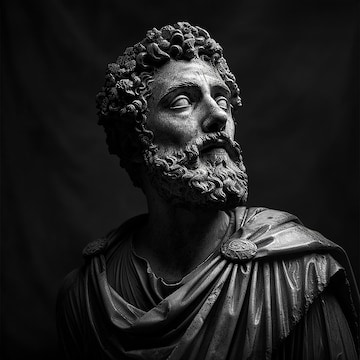
Marcus Aurelius
Birthday
April 26, 121
Birth Sign
Taurus
Birthplace
Rome
Age
Died at 58
About
Marcus Aurelius was a Roman emperor and Stoic philosopher who ruled from 161 to 180 AD. He is the last of the Five Good Emperors and the final ruler of the Pax Romana, an era of relative peace. His personal writings, Meditations, are a cornerstone of Stoic philosophy, studied by leaders and thinkers worldwide. He served as Roman consul three times and commanded the empire through the Parthian War, the Marcomannic Wars, and the Antonine Plague. Today, his image endures as the philosopher-king, a symbol of duty, resilience, and introspection.
Early Life & Background
Marcus Annius Verus was born in Rome to a wealthy senatorial family. His father, a praetor, died when Marcus was three, leaving him to be raised by his mother, Domitia Calvilla, and his paternal grandfather, a former consul. Emperor Hadrian took notice of the boy's intellect and arranged for him to be educated by the finest tutors of the day. Marcus studied rhetoric under Herodes Atticus and Latin literature under Marcus Cornelius Fronto, developing a deep love for philosophy, especially Stoicism.
In 138 AD, Hadrian adopted Antoninus Pius as his heir on the condition that Antoninus adopt both Marcus and Lucius Verus. This move thrust Marcus into the imperial succession. He married Antoninus's daughter, Faustina the Younger, in 145 AD, cementing his ties to the ruling family. Before becoming emperor, Marcus held minor political offices and served as consul three times, gaining experience in governance and law. He was known for his studious nature and philosophical bent, often retreating to read and write amid the demands of court life.
Career Growth
Marcus Aurelius became emperor in 161 AD upon Antoninus Pius's death, initially ruling jointly with his adoptive brother Lucius Verus. The early years of his reign were dominated by the Parthian War (161-166 AD), which ended in Roman victory but brought back the Antonine Plague, a devastating epidemic that killed millions across the empire. From 166 AD until his death, Marcus personally led campaigns against Germanic tribes along the Danube frontier in the Marcomannic Wars. Despite the constant warfare, he found time to write Meditations, a series of private reflections on Stoic ethics, duty, and mortality. He also faced economic strain, debasing the Roman currency to fund his wars. In 177 AD, he appointed his son Commodus as co-emperor, a decision that would later be criticized. Marcus died on campaign in 180 AD at Vindobona, likely from illness.
Career Timeline
Public Image & Style
Marcus Aurelius is often portrayed as the ideal philosopher-king, a wise and dutiful ruler who embodied Stoic principles. Historical depictions show him in imperial regalia or military attire, with a contemplative expression. His writings, Meditations, are introspective and aphoristic, offering personal guidance on virtue and resilience. Modern audiences connect with him through self-help and leadership circles, where his quotes are widely shared. He has no official fandom name, but his admirers span philosophical, historical, and entrepreneurial communities. His image has been used in films, documentaries, and books, often symbolizing moral authority and inner strength.
Fame & Fandom (iFAMOUS Rankings)
Marcus Aurelius commands a global audience of readers, students, and practitioners who engage with his Stoic philosophy rather than a modern celebrity fanbase. His legacy is defined by the enduring relevance of his private journal, Meditations, which serves as a cornerstone for leadership studies and self-help circles worldwide. Unlike contemporary figures, he possesses no organized chapters, official fandom name, or fan-driven campaigns; his admirers are diffuse, engaging through academic study and the occasional sharing of aphorisms on social media platforms. The most significant recent activity involves the publication of new interpretations, such as the August 2026 edition of The Meditations that reinterprets the text using feminine pronouns, sparking discussion in literary and psychological fields. Historical accounts and archaeological findings, including the discovery of a rare Roman military camp in Slovakia in July 2026, provide tangible evidence of the harsh conditions he faced during his reign, further cementing his status as a historical icon rather than a pop culture figure. While modern debates occasionally reference his philosophy, his influence remains intellectual and cultural rather than commercial. Marcus Aurelius is currently evaluated by iFANN but does not hold a placement in the published Global Top 1,000 rankings. He is not ranked within any Top-100 scope list maintained by the organization.
Interesting Facts and Legends
Marcus Aurelius wrote Meditations in Greek, not Latin, the language of Roman administration. Despite the immense pressures of his reign, he was known to be a devoted husband and father. His rule marked the definitive end of the Pax Romana, an era of unprecedented peace in the empire. He stood among the last Roman emperors to actively lead troops in battle, facing wars, plagues, and rebellions while maintaining philosophical composure. Though his personal involvement remains debated, he authorized actions against Christians despite his Stoic beliefs. A widely retold story frames him as the Philosopher King, a dual identity where he held absolute power yet wrote humble notes on remaining virtuous amidst chaos. This narrative is supported by verified history regarding the Marcomannic Wars and the Antonine Plague. In July 2026, archaeologists uncovered a rare military camp in Slovakia containing hastily buried remains of soldiers from his army, offering tangible proof of the hardships endured during his campaigns. These discoveries and his surviving writings continue to define his legacy as a symbol of duty and resilience.
Notable Quotes
“Waste no more time arguing about what a good man should be. Be one.”
“The impediment to action advances action. What stands in the way becomes the way.”
“Everything we hear is an opinion, not a fact. Everything we see is a perspective, not the truth.”
“Very little is needed to make a happy life; it is all within yourself, in your way of thinking.”
Family & Personal Life
Marcus Aurelius married Faustina the Younger, daughter of Emperor Antoninus Pius, in 145 AD. Their union was both a political alliance and a personal partnership; Faustina accompanied Marcus on military campaigns. They had at least 13 children, but many died young. His most notable children include Commodus, his successor and a controversial emperor; Lucilla, who later conspired against her brother; and Annius Verus Caesar, a twin who died in childhood. Marcus was deeply affected by the loss of his children and his wife, who died in 176 AD. He was raised by his mother and grandfather after his father's early death.
Notable Connections
Marcus Aurelius was closely associated with his adoptive father Antoninus Pius, who groomed him for succession. He ruled alongside his adoptive brother Lucius Verus. His wife, Faustina the Younger, was his partner and the mother of his children. His son Commodus succeeded him but is remembered as a less capable ruler. His tutors included the rhetorician Herodes Atticus and the writer Marcus Cornelius Fronto.
Relationships & Dating History
Marcus Aurelius's only documented romantic relationship was with Faustina the Younger, whom he married in 145 AD. The marriage was arranged by their families to unite the imperial line, but it appears to have been a genuine partnership. Faustina accompanied Marcus on military campaigns and bore him many children, though several died in infancy. She died in 176 AD while on campaign with him. There are no credible records of other romantic relationships. As of 2026, Marcus Aurelius is deceased.
- MarriedFaustina the Younger145 - 176Married in a political alliance; she accompanied him on campaigns and bore many children.
Death & Aftermath
Died
March 17, 180 (aged 58)
Death Place
Sirmium, Pannonia Inferior, Serbia
Cause of Death
Illness, possibly dropsy or plague complications
The Roman Senate deified Marcus Aurelius shortly after his passing, granting him the title Divus and erecting the Column of Marcus Aurelius in Rome to commemorate his military victories against Germanic tribes. This formal canonization marked the end of the Pax Romana era, transitioning the empire from an age of philosophical stability to one of uncertainty under his successor. The emperor's private reflections, titled Meditations, were published posthumously, likely by his son Commodus or the Senate, ensuring his Stoic teachings remained a foundational text for Western philosophy for nearly two millennia.
Marcus Aurelius died on March 17, 180 CE, at the age of 59 within the city of Sirmium in Pannonia Inferior, now modern-day Serbia. He spent his final days at his military headquarters while managing campaigns during the Marcomannic Wars, reportedly falling ill while still wearing his military cloak. Historical accounts attribute his death to natural causes, with the Historia Augusta suggesting dropsy or a stomach ailment potentially exacerbated by the Antonine Plague ravaging the empire. Contemporary historians Cassius Dio and later biographers established this cause based on imperial records and oral traditions rather than forensic examination.
His body was transported back to Rome for a state funeral attended by the Senate, the Imperial family, and legions, with his son Commodus presiding over the proceedings. Interred in the Mausoleum of Hadrian, the traditional burial site for the Nerva, Antonine dynasty, he left behind an estate and treasury inherited directly by Commodus without dispute regarding the inheritance itself. While the subsequent reign of Commodus faced historical criticism for mismanagement, the immediate political focus remained on the smooth succession of power.
Net Worth (Estate Value)
As a Roman emperor, Marcus Aurelius controlled the vast resources of the Roman Empire, including its treasury, armies, and territories. His personal wealth was tied to the imperial household, which owned extensive lands, slaves, and assets. During his reign, he funded military campaigns and relief efforts during the Antonine Plague, which strained the empire's finances. He debased the denarius to cover costs. Upon his death, the imperial treasury passed to his son Commodus. There is no modern net worth estimate for an ancient emperor; his legacy is measured in cultural and philosophical influence rather than monetary value.
Awards & Accolades
View 4 records, honours and achievementsKnown For
Meditations
c. 170-180 · Author
Roman Emperor
161-180 · Emperor
Keywords
Quick Facts
- Profession
- politician, philosopher, writer
- Born
- +0121-04-26
- Birthplace
- Rome
- Died
- +0180-03-17
- Death Place
- Vindobona
- Gender
- Male
- Spouse
- Faustina the Younger
- Birth Sign
- Taurus
Personal Details
- Full Name
- Marcus Annius Verus
- Spouse
- Faustina the Younger
- Children
- Commodus, Lucilla, Annius Verus Caesar, Vibia Aurelia Sabina
Frequently Asked Questions
Who was Marcus Aurelius?
What is Marcus Aurelius famous for?
When did Marcus Aurelius live?
What was Marcus Aurelius's philosophy?
What is Meditations by Marcus Aurelius?
Join the community
fans discussing