
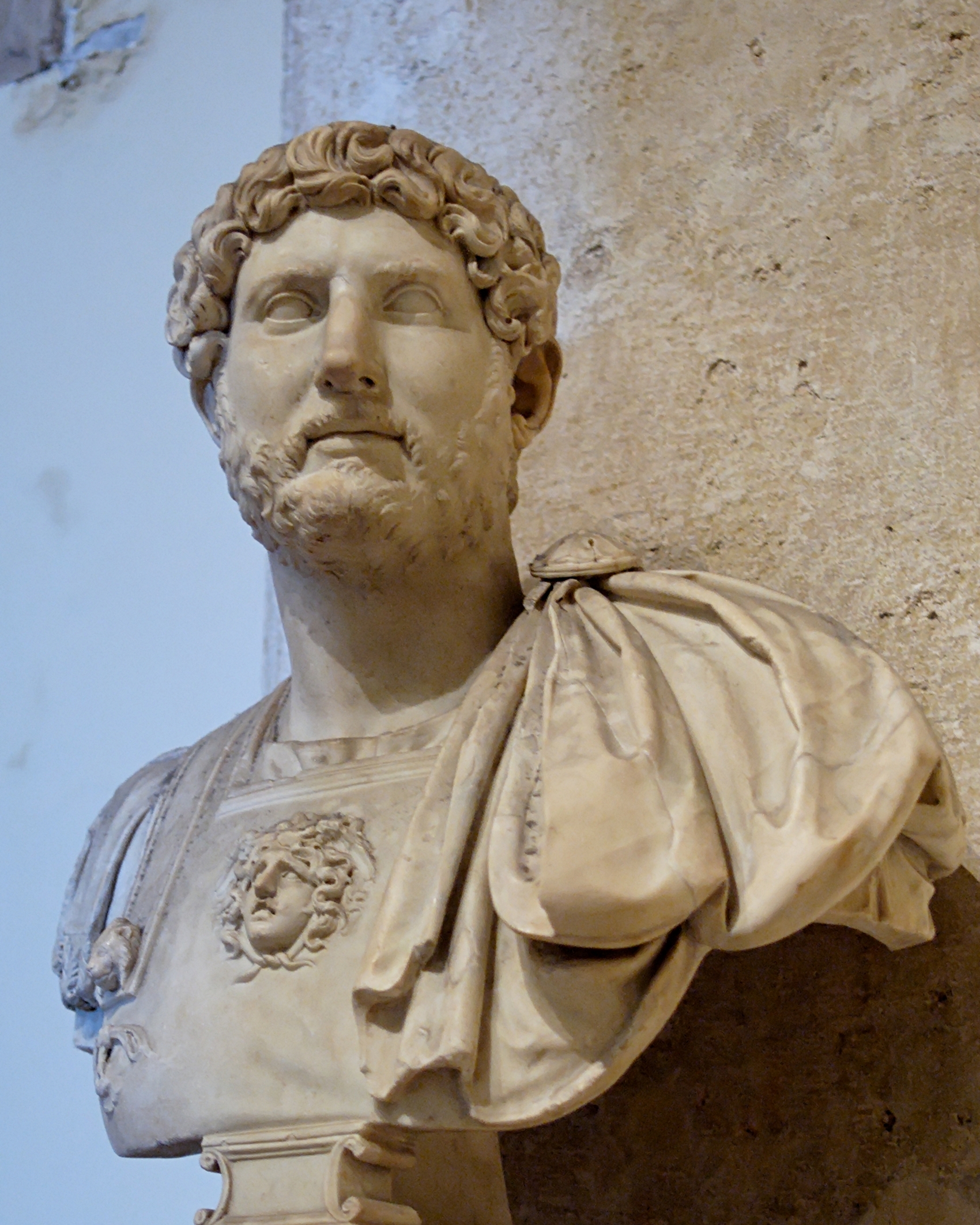
Hadrian
 Italy
ItalyRoman emperor•politician•military commander
Also known as: Publius Aelius Hadrianus, Imperator Caesar Traianus Hadrianus Augustus
Birthday
January 24, 76
Birth Sign
Aquarius
Birthplace
Italica, Hispania Baetica (near modern Seville, Spain)
Age
Died at 62
About
Hadrian, born Publius Aelius Hadrianus on January 24, 76 CE, in Italica, Spain, was Roman emperor from 117 to 138. He succeeded his adoptive father Trajan and immediately shifted the empire's strategy from expansion to consolidation. Rather than pursuing new conquests, Hadrian fortified existing borders, most famously by ordering the construction of a wall across northern Britain. He traveled more extensively than any previous emperor, personally inspecting provinces and overseeing ambitious building projects. In Rome, he rebuilt the Pantheon and erected the Temple of Venus and Roma. A passionate philhellene, he poured resources into Athens, completing the Temple of Olympian Zeus and building the Library of Hadrian. His intense relationship with the Greek youth Antinous, who died in 130, led to a cult and a city named Antinoopolis in Egypt. Yet his reign also saw brutality: the suppression of the Bar Kokhba revolt in Judea (132-136) devastated the region. Hadrian's marriage to Vibia Sabina was unhappy and childless. In his final years, plagued by illness, he adopted Antoninus Pius as successor, stipulating that Antoninus adopt Marcus Aurelius and Lucius Verus. He died on July 10, 138, at Baiae. Despite Senate hostility, he was deified. Later historians count him among the Five Good Emperors, but contemporaries found him aloof and authoritarian. He was a builder, a traveler, and a ruler of contradictions.
Early Life & Background
Hadrian was born into the Aelia family, a wealthy clan with roots in Italica, a Roman settlement in Spain. When he was about ten years old, his father died. He came under the guardianship of his cousin, the future emperor Trajan. Under Trajan's watch, Hadrian received a thorough education, with a particular focus on Greek language and culture. He developed a lifelong passion for Hellenic civilization, earning the label philhellene. He began his public career as a military tribune, serving in several legions. He held a series of traditional magistracies, rising through the ranks of Roman politics. In 100, he married Vibia Sabina, Trajan's grandniece, a political match that strengthened his position. He accompanied Trajan on the Dacian Wars and the Parthian campaign, gaining military experience. When Trajan died suddenly in 117, Hadrian was in command of the eastern army. His adoption by Trajan was announced posthumously, and the army proclaimed him emperor. The transition was smooth, though rumored to have been orchestrated by Trajan's wife Plotina.
Career Growth
Hadrian became emperor in 117 CE and immediately reversed Trajan's expansionist policy. He abandoned the recently conquered territories in Mesopotamia and Armenia, prioritizing secure, defensible borders. In 122, he visited Britain and ordered the construction of a wall across the island's narrow waist. Hadrian's Wall stretched 73 miles from coast to coast, marking the empire's northwestern frontier. He traveled constantly, visiting every province except Africa. In Athens, he completed the massive Temple of Olympian Zeus, founded the Panhellenion, and built the Library of Hadrian. In Rome, he rebuilt the Pantheon with its iconic dome and constructed the Temple of Venus and Roma. His villa at Tivoli was a sprawling complex of gardens, pools, and replicas of famous Greek buildings. In 130, his beloved companion Antinous drowned in the Nile. Hadrian deified him, founded the city of Antinoopolis, and erected statues across the empire. He suppressed the Bar Kokhba revolt in Judea from 132 to 136, a brutal campaign that resulted in heavy casualties and the renaming of Jerusalem to Aelia Capitolina. In 138, his health failing, he adopted Antoninus Pius as his successor. He died later that year at Baiae.
Public Image & Style
Hadrian cultivated an image as a philosopher-emperor and a traveler. He was the first emperor to wear a Greek-style beard, signaling his admiration for Hellenic culture. He presented himself as accessible, often mingling with soldiers and visiting provinces in person. His building projects emphasized harmony and grandeur, blending Roman engineering with Greek aesthetics. Yet his public persona had a darker side. He executed four senators early in his reign, earning the Senate's lasting enmity. Contemporaries described him as alternately generous and cruel, curious and autocratic. Later historians, especially in the 18th and 19th centuries, romanticized him as a model of enlightened rule. Modern scholarship paints a more complex picture: a capable administrator and patron of the arts, but also a ruthless suppressor of dissent. The cult of Antinous became a widespread religious phenomenon, with temples and oracles dedicated to the deified youth. Hadrian's wall remains the most iconic symbol of his reign, a tangible monument to his policy of border consolidation.
Fame & Fandom
Hadrian's story has never been a conventional celebrity narrative, no red carpets, no chart battles, no fan armies with a hashtag. Yet his afterlife in popular memory is a peculiar kind of fame: the emperor who built a wall that still bears his name, whose face appears on coins, whose writings are quoted in Latin textbooks. In the iFANN Global Fame Engine's August 2026 evaluation, Hadrian has been assessed but does not currently hold a placement in the published rankings, neither the Global Top 1,000 nor any Top-100 scope list. That's a quiet kind of fame, the sort that percolates through classrooms and museum gift shops rather than trending feeds.
His fandom, such as it is, has no formal name, no 'Hadrianites' or 'Aelians' documented in iFANN data. Instead, his admirers are scattered: classicists, reenactors, history buffs who argue over the wall's purpose, and travelers who walk its length. There are no birthday billboards or streaming pushes, but there is a persistent, low-key devotion. The stories they share are the ones that have echoed for centuries, the wall itself, the lost autobiography, the deified lover who became a constellation.
In the wider cultural ledger, Hadrian's fame is steady but unranked. He is the third of the Five Good Emperors, a builder and a poet, a ruler whose consolidation shaped the empire's borders. His fame is not measured in clicks but in the enduring weight of his name on a landscape.
Interesting Facts and Legends
Hadrian was the first Roman emperor to sport a full beard, setting a fashion trend that lasted for centuries. He wrote poetry in both Latin and Greek, though only a few lines survive. He composed an autobiography, now lost. He was deeply interested in astrology and reportedly cast his own horoscope. He founded a city in Egypt named Antinoopolis in honor of his lover Antinous, complete with its own cult and games. He built a wall not just in Britain but also in Germany, a line of fortifications known as the Upper German-Raetian Limes. He was the only Roman emperor to have a constellation named after him: Antinous, placed in the sky by the emperor himself. His reign saw the last major Jewish revolt, which he crushed with extreme severity. He was deified after death, but the Senate initially resisted, and his successor Antoninus Pius had to push the motion through.
One legend that still circulates among historians and fans is the story of Hadrian's deathbed poem, a short verse to his own soul, which he reportedly composed as he lay dying at Baiae, a poignant farewell that captures his philosophical bent. Another tale, retold in ancient sources, describes how he supposedly wept over the death of Antinous, declaring him a god and founding a city in his memory, a story that has fueled romantic interpretations for centuries. And there's the enduring image of Hadrian personally inspecting his troops and sharing their rations, a gesture that endeared him to the military and became part of his legend as the soldier-emperor.
Family & Personal Life
Hadrian's father was Publius Aelius Hadrianus Afer, a senator who died when Hadrian was about ten. His mother was Domitia Paulina, from a prominent Spanish family. His only sibling, a sister named Domitia Paulina the Younger, married the senator Lucius Julius Ursus Servianus. Hadrian's marriage to Vibia Sabina, Trajan's grandniece, was arranged for political reasons. The marriage was unhappy and produced no children. Sabina died in 136 or 137, reportedly in some accounts from a forced suicide or neglect, though the details are murky. Hadrian had no known children. He adopted Antoninus Pius as his son and successor, and arranged for Antoninus to adopt Marcus Aurelius and Lucius Verus, ensuring a stable succession for generations.
Relationships & Dating History
Hadrian's known relationships are limited to two documented attachments. He married Vibia Sabina around 100 CE, a political union arranged by Trajan to strengthen Hadrian's claim to succession. The marriage was reportedly cold and childless. Sabina accompanied Hadrian on some of his travels but lived largely apart from him. She died in 136 or 137, possibly under duress. Hadrian's most famous relationship was with Antinous, a Greek youth from Bithynia whom he met around 125 CE. Antinous became his constant companion, traveling with the emperor across the empire. In 130, Antinous drowned in the Nile under mysterious circumstances. Hadrian was devastated. He deified Antinous, founded the city of Antinoopolis, and established a cult that spread throughout the Roman world. Hundreds of statues of Antinous survive, more than of any other non-imperial Roman figure. No further romantic partners are recorded. As of 2026, Hadrian is deceased and was widowed at his death.
- MarriedVibia Sabina100 - 136Political marriage to Trajan's grandniece; reportedly unhappy and childless.
- DatedAntinous125 - 130Greek youth and companion; died in the Nile; Hadrian deified him and founded a cult.
Death & Aftermath
Died
July 10, 138 (aged 62)
Death Place
Baiae, near Naples, Italy
Cause of Death
Reported natural causes resulting from a prolonged illness
The Roman Senate moved with characteristic speed to honor the passing of their emperor, immediately voting to deify Hadrian as Divus Hadrianus and marking the start of a formal period of mourning across the empire. Public buildings draped themselves in black while sacrifices were offered to his spirit, reflecting a reverence that extended far beyond the political necessity of succession. The final days at his villa in Baiae had been marked by severe physical decline, with ancient accounts describing heart trouble and dropsy that drove him to multiple attempts at ending his own life before attendants intervened. On July 10, 138, he dictated his will, ensuring the adoption of Antoninus Pius and provisions for his late wife Vibia Sabina, leaving the state in a stable condition without any suspicion of foul play or legal dispute.
His body was transported from Baiae to Rome, where it was cremated on the Campus Martius before being interred in the Mausoleum of Hadrian, the grand structure along the Tiber he had commissioned during his lifetime. The procession included the Praetorian Guard, high-ranking senators, and military units, presided over by his adopted successor Antoninus Pius. This monumental tomb stands today as Castel Sant'Angelo, serving as a permanent reflection of his reign alongside the Pantheon and the Temple of Venus and Roma, which he rebuilt.
Net Worth (Estate Value)
Hadrian died in 138 CE, nearly two millennia before modern celebrity net worth tracking. There is no meaningful 2026 net worth estimate. As emperor, he controlled the entire Roman treasury, funding massive building projects, provincial gifts, and military campaigns. His personal wealth derived from imperial estates and inheritance. He left the empire in sound financial condition, with a surplus in the treasury, having reformed tax collection and reduced military spending by halting expansion. His architectural legacy, including the Pantheon and his villa at Tivoli, represents an incalculable cultural value. No current estate or revenue streams exist, as the Roman Empire fell centuries ago. Any valuation would be purely speculative and is not provided.
Awards & Accolades
View 7 records, honours and achievementsKnown For
Hadrian's Wall
122 · Emperor
Rebuilding of the Pantheon
125 · Emperor
Temple of Venus and Roma
135 · Emperor
Hadrian's Villa at Tivoli
130 · Emperor
Bar Kokhba revolt suppression
136 · Emperor
Keywords
Sources
Quick Facts
- Profession
- sovereign, politician, military personnel
- Born
- +0076-01-24
- Birthplace
- Italica
- Died
- +0138-07-10
- Death Place
- Baia
- Gender
- Male
- Spouse
- Vibia Sabina
- Birth Sign
- Sagittarius
- Born
- January 24, 76 CE
- Birthplace
- Italica, Hispania Baetica
- Died
- July 10, 138 CE
- Death Place
- Baiae, Italy
- Children
- None
- Reign
- 117–138 CE
- Successor
- Antoninus Pius
Personal Details
- Full Name
- Publius Aelius Hadrianus
- Spouse
- Vibia Sabina
Frequently Asked Questions
Who was Hadrian?
What was Hadrian's net worth in 2026?
Was Hadrian married?
Who was Antinous to Hadrian?
How did Hadrian die?
Join the community
fans discussing