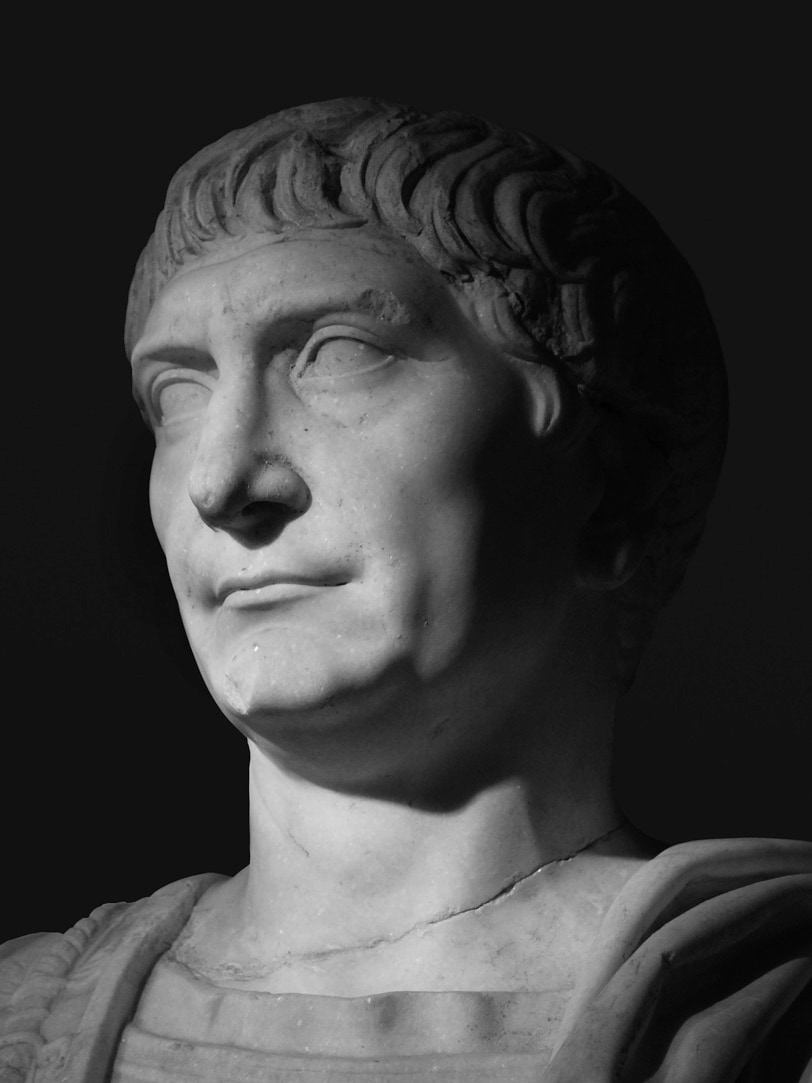
Trajan
Birthday
September 18, 53 AD
Birth Sign
Virgo
Birthplace
Italica, Hispania Baetica (modern-day Andalusia, Spain)
Age
Died at 63
About
Trajan, born Marcus Ulpius Traianus, was a Roman emperor who governed from 98 AD to 117 AD. He holds a place in history as the second of the "Five Good Emperors" and is remembered for his exceptional military skill, ambitious public works, and commitment to social welfare. Under his leadership, the Roman Empire reached its largest territorial spread, a feat that continues to define his legacy. The Roman Senate honored him with the title Optimus Princeps, meaning "Best Ruler," a rare and significant commendation that speaks to his esteemed reputation among his contemporaries.
Today, Trajan is recognized for his enduring impact on Roman infrastructure and the sheer scale of his conquests. His architectural projects, like the magnificent Trajan's Forum and the iconic Trajan's Column in Rome, stand as powerful reminders of his reign. These structures not only served practical purposes but also showcased the power and grandeur of the empire under his command. He is often studied for his administrative competence and the stability he brought during a pivotal period for Rome, leaving a lasting imprint on how emperors were perceived and what they could achieve.
Early Life & Background
Marcus Ulpius Traianus entered the world in 53 AD in Italica, a Roman town in Hispania Baetica, an area now part of southern Spain. He came from a respected senatorial family, the Ulpii, who originally hailed from Umbria in Italy. His father, also named Marcus Ulpius Traianus, was a distinguished general and a senator himself, serving under Emperor Vespasian. This lineage provided a strong foundation for Trajan's own rise.
Trajan's early career was deeply rooted in the military. He served as a military tribune in Syria and later as a legate in Hispania Tarraconensis, gaining practical experience in various regions of the empire. A pivotal moment came in 89 AD when he played a key role in suppressing a revolt along the Rhine frontier during Emperor Domitian's reign. This success brought him significant recognition and paved the way for his election as consul in 91 AD. His military acumen and growing popularity made him an appealing choice when the elderly Emperor Nerva, seeking to stabilize the empire after Domitian's assassination, adopted Trajan as his heir in 97 AD, setting the stage for his imperial future.
Career Growth
Trajan ascended to the imperial throne in 98 AD following Nerva's death, immediately setting a tone for an active and expansive reign. His military achievements began in earnest with the conquest of Dacia, a series of two demanding wars from 101-102 AD and again from 105-106 AD. These campaigns against the Dacian King Decebalus were famously depicted on Trajan's Column in Rome, a monumental structure that still tells the story of these victories. The annexation of Dacia, corresponding to modern-day Romania, brought vast gold reserves into the Roman treasury, significantly enriching the empire.
Not content with securing the northern frontier, Trajan turned his attention east, launching a major offensive against the Parthian Empire from 114-117 AD. He captured the Parthian capital of Ctesiphon and annexed Mesopotamia and Assyria, pushing the Roman Empire's borders further than ever before. He also formally absorbed the Nabataean Kingdom, a move that helped consolidate Roman control over important eastern trade routes.
Beyond military might, Trajan was a tireless builder and administrator. He commissioned numerous infrastructure projects across the empire, with the crown jewel being Trajan's Forum in Rome. This immense complex featured a grand basilica, libraries, and his commemorative column. Adjacent to it, Trajan's Market, often called an ancient shopping mall, showcased his vision for urban development. He also expanded the *alimenta* program, a social welfare initiative providing support for impoverished children, demonstrating a genuine concern for the well-being of his subjects. His reign remains a high point in Roman history, marked by both territorial expansion and internal prosperity.
Career Timeline
Public Image & Style
Trajan cultivated the public image of a benevolent yet firm ruler, a leader deeply involved in the welfare of his people and the strength of the empire. His military campaigns reinforced his reputation as a formidable commander, but his extensive public works and social programs, like the *alimenta*, showcased his concern for Roman citizens. This blend of martial prowess and civic dedication earned him profound respect.
The Roman Senate's bestowal of the title Optimus Princeps, or "Best Ruler," was not just an honorific; it reflected a widespread perception of his exemplary leadership. He was seen as a pragmatic emperor, less autocratic than some of his predecessors, who worked closely with the Senate. His image was one of a down-to-earth leader who shared in the hardships of his soldiers and invested in the prosperity of his empire, forging a strong connection with both the army and the populace.
Fame & Fandom
The global attention commanded by Trajan remains a matter of historical record rather than contemporary media consumption, with his reputation sustained through academic study and the enduring presence of his monuments in Rome. iFANN has evaluated this figure as part of its ongoing assessment of historical personalities, yet Trajan currently holds no placement within the published Global Top 1,000 or any Top-100 scope list maintained by the engine. This absence of a numeric ranking reflects the nature of his fame, which exists outside the metrics of modern celebrity culture. While he is revered by historians and archaeologists, there is no documented fandom name associated with him; no organized group identifies as 'Trajan Fans,' nor do rituals such as birthday billboards, streaming campaigns, or fan clubs exist for an individual who died nearly two millennia ago. The public interest that does surface is limited to museum audiences engaging with exhibitions like Ancient Splendor: Roman Art in the Time of Trajan, which represents a curatorial event rather than a dedicated fanbase. Consequently, the legacy of Trajan stands as a singular historical phenomenon where influence is measured by the longevity of infrastructure and the preservation of imperial virtue, not by the fluctuating signals of search volume or social engagement.
Interesting Facts and Legends
Trajan was renowned for his imposing physical stature, often described by ancient historians as tall and robust, a fitting image for a warrior emperor. He holds the distinction of being the first Roman emperor born outside of Italy, specifically in Hispania Baetica, a fact that underscored the empire's increasing multicultural nature. The construction of Trajan's Forum required the leveling of a large hill between the Capitoline and Quirinal hills, a monumental engineering feat for its time. Legend holds that Trajan personally led his troops on foot during campaigns, sharing their hardships and earning their deep loyalty. Historical records further preserve a maxim attributed to him regarding accountability: if he fulfilled his duties, use the sword for him; if he failed, use it against him. This philosophy reinforced his status as the Optimus Princeps. His military campaigns, particularly the Dacian Wars between 101–102 CE and 105–106 CE, are depicted in intricate detail on Trajan's Column, serving as a primary source for his conquests. He also funded the alimenta program, a social welfare initiative that provided support for children, demonstrating how state wealth was utilized for the benefit of citizens. Trajan passed away in Selinus, Cilicia, on August 8, 117 CE, marking the end of the empire's peak territorial expansion.
Notable Quotes
“Optimus Princeps" (Best Ruler) - bestowed upon him by the Roman Senate, reflecting his esteemed leadership.”
Family & Personal Life
Marcus Ulpius Traianus was born into a distinguished Roman family, with his father, also named Marcus Ulpius Traianus, being a highly respected general and senator. His mother's name is not widely recorded in historical accounts, but his sister, Ulpia Marciana, was a notable figure within the imperial family. She held considerable influence and was honored by her brother, including having a city in Dacia named Colonia Ulpia Traiana Marciana after her.
Trajan married Pompeia Plotina, a woman recognized for her intellect and integrity. She was a steadfast supporter of his policies and was held in high esteem by the Roman populace. The couple did not have any known biological children, a circumstance that would later play a significant role in the imperial succession. Plotina was influential in ensuring that Hadrian, a relative, was adopted as Trajan's heir, helping to secure a smooth transition of power after his death.
Notable Connections
Trajan is closely associated with Hadrian, his successor, who was instrumental in consolidating the Roman Empire's borders after Trajan's expansive campaigns. He is also linked to Apollodorus of Damascus, the brilliant architect responsible for designing many of his monumental projects, including Trajan's Forum and Trajan's Column. His legacy is also intertwined with King Decebalus of Dacia, his formidable opponent in the Dacian Wars, whose defeat was a defining moment of Trajan's military career.
Relationships & Dating History
Trajan's personal life, particularly his marriage, was notable for its stability and the influence of his wife. He married Pompeia Plotina, a woman who came from a respectable Roman family. Their union was a long-standing one, and Plotina was known for her intelligence, virtue, and strong character. She was not just an empress by title; she actively supported Trajan's policies and was deeply respected by the Roman people and the Senate.
The couple did not have any known biological children. This fact became especially significant as Trajan approached the end of his life, creating a potential succession crisis for the empire. Plotina played a pivotal role in the succession, advocating for and helping to secure the adoption of Hadrian, a distant relative, as Trajan's heir. This ensured a smooth transition of power after Trajan's passing in 117 AD. As of 117 AD, Trajan was married to Pompeia Plotina.
- MarriedPompeia Plotina? - 117Trajan was married to Pompeia Plotina, who was known for her intelligence and influence in imperial affairs.
Death & Aftermath
Died
August 9, 117 AD (aged 63)
Death Place
Selinus, Cilicia, Roman Empire
Cause of Death
Stroke or apoplexy (reported)
The Roman Empire mourned the loss of its leader with a depth of grief that transcended political boundaries, treating the passing of Trajan as a national calamity. The Senate deified him immediately upon hearing the news, and cities across the known world held moments of silence and religious observances to honor the man they revered as the Best Ruler. This collective sentiment reflected a profound sense of personal loss among subjects who had benefited from his extensive public works and military victories. Trajan died on August 9, 117 AD, in Selinus, a city in Cilicia while returning to Rome from his Parthian campaign. Historical accounts describe his final days as marked by a sudden illness, traditionally identified as a stroke or apoplexy, though some ancient sources later circulated rumors suggesting he was hastened by poison administered by his successor, Hadrian.
Modern historians generally regard these allegations of foul play as unconfirmed political speculation rather than established fact, as primary records from Cassius Dio and the Historia Augusta mention only a natural decline without evidence of criminal intervention. His funeral took place shortly after his death in September 117 AD, necessitating cremation due to the logistical impossibility of transporting a body over such distances. His ashes were interred in the base of the Column of Trajan within the Forum of Trajan in Rome, marking the end of a reign that saw the empire reach its greatest territorial extent. The event was conducted as a state funeral involving high-ranking officials and military leaders, emphasizing his status as a divine figure in the eyes of the Roman people.
Posthumously, Trajan received enduring honors that cemented his legacy as the ideal ruler, including the continued prominence of his forum and market complex in Rome. His estate and titles were managed by his adopted son and successor, Hadrian, who assumed the throne and initially continued many of Trajan's policies before eventually halting further eastern expansion.
Net Worth (Estate Value)
$5 Billion
iFANN Editorial Team estimate
As a Roman emperor at the height of the empire's power, Trajan commanded resources on an unparalleled scale. Per iFANN's editorial analysis, his net worth is estimated at $5 Billion as of 2026, reflecting not personal liquid assets in the modern sense, but rather the immense wealth of the state he controlled and could deploy. His reign saw the Roman treasury significantly bolstered by the gold mines of newly conquered Dacia, providing substantial revenue for his ambitious projects. Much of this imperial wealth was directed towards public works, like the construction of Trajan's Forum and Trajan's Market, which were among the most expensive and grand architectural endeavors in Roman history. He also funded social welfare programs, such as the alimenta, demonstrating how state wealth under his leadership was used for the benefit of Roman citizens. While emperors did not have personal bank accounts as we understand them today, the power to allocate and utilize the empire's vast resources effectively made him one of the wealthiest and most influential figures of all time. His estate, upon his death, would have primarily consisted of the imperial holdings and assets, which then passed to his adopted heir, Hadrian, maintaining the continuity of imperial control.
Awards & Accolades
View 4 records, honours and achievementsKnown For
Trajan's Column
113 · Commissioned
Conquest of Dacia
106 · Military Leader
Trajan's Forum
112 · Commissioned
Keywords
Quick Facts
Personal Details
- Full Name
- Marcus Ulpius Traianus
- Spouse
- Pompeia Plotina
- Children
- Education
Frequently Asked Questions
Who was Trajan?
What was Trajan famous for?
Where was Trajan born?
Who succeeded Trajan as emperor?
What is Trajan's Column?
Join the community
fans discussing