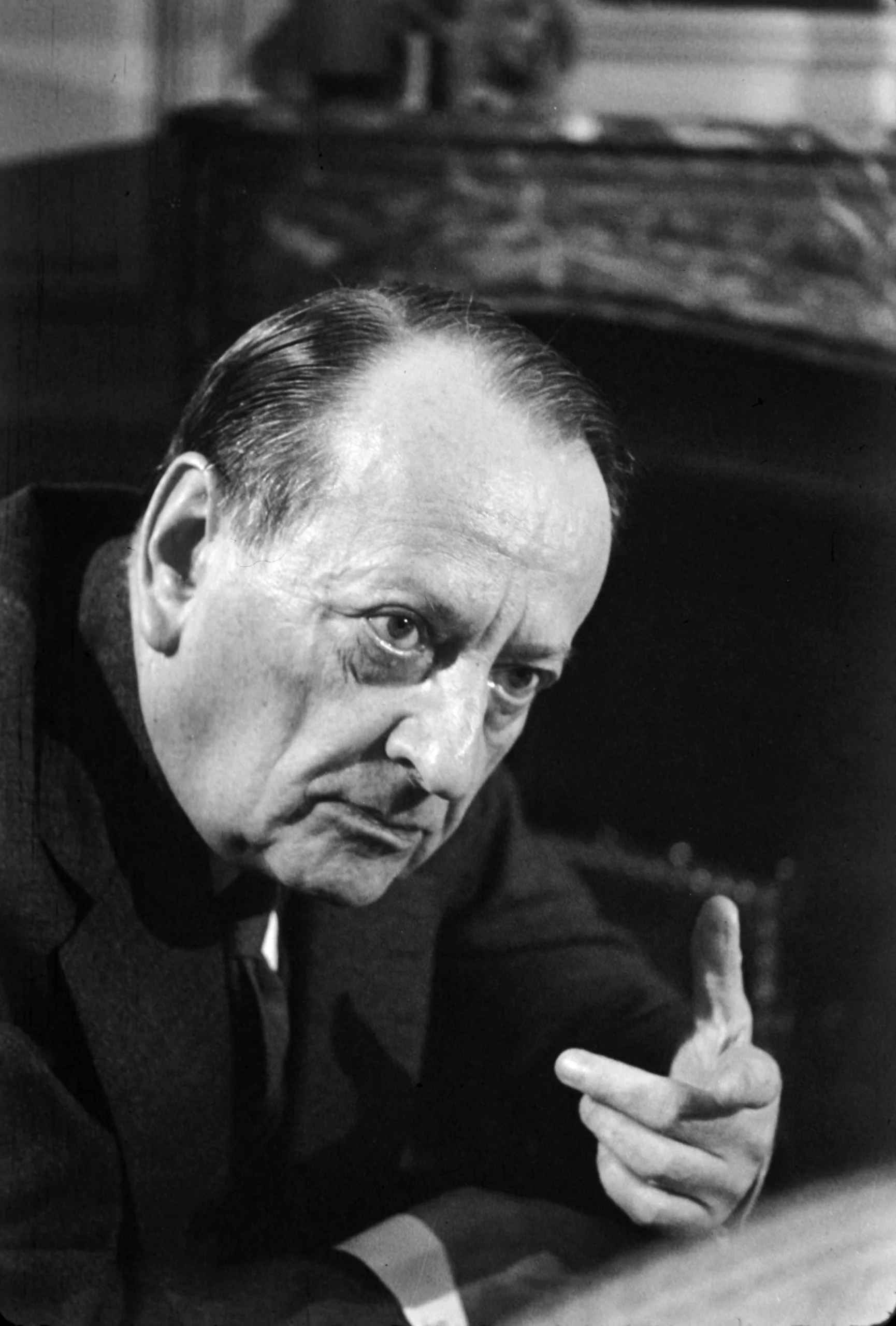
André Malraux
 France
novelist•art theorist•politician•film director
Also known as: Georges André Malraux, G. A. Malraux
Birthday
November 3, 1901
Birth Sign
Scorpio
Birthplace
Paris, France
Age
Died at 75
Height
5 ft 10 in (1.78 m)
About
Georges André Malraux was a French novelist, art theorist, and politician born in Paris on November 3, 1901. He wore many hats over a long, restless life: writer, adventurer, resistance fighter, and eventually the country's first minister of cultural affairs. Malraux is best remembered for his novel La Condition Humaine (Man's Fate), which won the Prix Goncourt in 1933. Set during the 1927 Shanghai uprising, the book cemented his reputation as a writer who could capture the chaos of revolution and the weight of individual choice. His other major novel, L'Espoir (Man's Hope), drew directly from his time fighting in the Spanish Civil War.
After World War II, he largely abandoned fiction and turned to art history, producing works like The Voices of Silence, a sweeping meditation on art across civilizations. He served as information minister from 1945 to 1946, then as cultural affairs minister from 1959 to 1969 under President Charles de Gaulle, shaping French cultural policy during a transformative era. Malraux died on November 23, 1976, leaving behind a legacy that bridged literature, politics, and the visual arts.
Early Life & Background
Georges André Malraux entered the world in a wealthy Parisian family in 1901. His father Georges was a textile manufacturer, and his mother Marie-Louise came from a prominent background. Raised in a bourgeois environment, Malraux found formal schooling restrictive despite attending the prestigious Lycée Condorcet. He left without obtaining a baccalaureate degree, preferring to immerse himself in literature, philosophy, and the bohemian circles of Montparnasse. This early rejection of conventional values set the stage for a life defined by intellectual curiosity and rebellion.
Before achieving fame, he worked briefly as a journalist and traveled extensively to Indochina in the late 1920s. These journeys to Vietnam, Cambodia, and Laos exposed him to ancient Khmer culture and revolutionary politics. The raw material from these travels provided the foundation for his first major works. In 1923, he orchestrated a daring raid on the Banteay Srei temple in Cambodia, cutting bas-reliefs from ancient walls using saws and dynamite. Although arrested in Bangkok, he was released due to diplomatic pressure. This incident cemented his image as an adventurous rebel dedicated to preserving art, even if illegally. By the end of the decade, he had returned to Europe with a reputation as a traveler and thinker ready to challenge the status quo.
Career Growth
Malraux's career trajectory shifted rapidly from literary obscurity to international acclaim and high political office. After returning from Indochina, he published La Voie Royale (The Royal Way) in 1930, a travelogue about the ruins of Angkor that established him as a writer of adventure and art history. The breakthrough came in 1933 with the publication of La Condition Humaine (Man's Fate). Set during the 1927 Shanghai uprising, this novel won the prestigious Prix Goncourt, making him one of the youngest winners of the award.
In 1937, during the Spanish Civil War, Malraux commanded the "Escadrille España," a volunteer air squadron fighting against Franco's Nationalists. This experience inspired his second major novel, L'Espoir (Man's Hope), published in 1937, which is considered a masterpiece of anti-fascist literature. During World War II, he escaped arrest by the Vichy regime in 1941 and joined the French Resistance. He later served in the Free French Air Force, rising to the rank of captain and earning the Croix de Guerre.
Post-war, he was appointed by Charles de Gaulle as Minister of Information in 1945. In 1947, he published Les Voix du Silence (The Voices of Silence), a monumental four-volume work on art history. From 1959 to 1969, as France's first Minister of Cultural Affairs, Malraux revolutionized French cultural policy. He created the Maisons de la Culture (Houses of Culture) across the country to democratize access to art, initiated the restoration of historic monuments like the Palace of Versailles and the Mont-Saint-Michel, and laid the groundwork for the Centre Pompidou concept. He continued to write essays on art and politics until his death.
Career Timeline
Public Image & Style
Malraux is portrayed as the quintessential "universal man", a writer, adventurer, soldier, and statesman. Media depictions emphasize his intensity, intellect, and refusal to conform to societal norms. His aesthetic is one of rugged sophistication: the thinker who also acts. In contemporary discourse, he is viewed as a visionary who democratized art and redefined the role of the state in culture. His signature style involved wearing simple suits or military uniforms depending on the context, often captured in black-and-white photography with an intense gaze. He maintained a public persona of a man deeply engaged with the world's conflicts and artistic treasures.
Fame & Fandom (iFAMOUS Rankings)
André Malraux commands a global audience defined by historical reverence rather than modern celebrity metrics. His name resonates through academic circles, literary studies, and French cultural institutions, yet he does not currently hold a placement in the iFANN Global Top 1,000 or any Top-100 scope list. The iFANN Global Fame Engine has evaluated his standing, confirming that while his legacy is immense, it remains unranked within current popularity charts. No formal fandom exists to rally around his memory. There is no collective name like "Malrauxians" for his followers, nor are there organized fan clubs, birthday billboards, or social media campaigns driving his visibility. Instead, his audience consists of historians, art theorists, and students who engage with his work through museums and universities. Commemorative events, such as the centenary of his Banteay Srei raid or the "Year of André Malraux," are orchestrated by state bodies and cultural organizations rather than grassroots movements. He never interacted with fans via meet-and-greets, and his era predated digital engagement. The only rituals associated with him are official exhibitions and conferences honoring his contributions to art theory and resistance history.
Interesting Facts and Legends
Malraux orchestrated a daring theft of bas-reliefs from the Banteay Srei temple in Cambodia in 1923. Using saws and dynamite, he cut sections of the walls and transported them to Bangkok. He was arrested but released due to diplomatic pressure and the lack of concrete evidence linking him to the theft. His theory of the "Imaginary Museum" challenged traditional notions of art ownership by suggesting art could be experienced through photographs and reproductions. Beyond writing, Malraux directed and wrote the screenplay for Sierra de Teruel (1938), a film based on his experiences in the Spanish Civil War, though it was banned in France for its political content at the time. Early in his career, he was associated with nihilistic thought, challenging religious and moral certainties, before finding purpose in political action and art.
Notable Quotes
“Man is not what he thinks he is, he is what he hides.”
“What is Man? A miserable little pile of secrets.”
“The great thing about art is that it allows us to live in a world that is not our own.”
“To create is to deny death.”
Family & Personal Life
André Malraux was the son of Georges Malraux, a wealthy textile manufacturer, and Marie-Louise Malraux. He married Clara Goldschmidt in 1921, and they remained together for nearly 40 years before divorcing in 1960. They had no children together. The couple separated due to Malraux's extramarital affairs and political pressures. Shortly after his divorce, he married Madeleine Rostand in 1960. Madeleine was the daughter of the famous poet Edmond Rostand. They remained together until his death in 1976. They did not have children together. Madeleine survived him and lived until 2008. His granddaughter, Céline Malraux, has been actively promoting his legacy and connections to India and Cambodia.
Notable Connections
Charles de Gaulle, Jean-Paul Sartre, Simone de Beauvoir, Edmond Rostand, Clara Malraux, Madeleine Malraux, Céline Malraux.
Relationships & Dating History
André Malraux was married twice. His first marriage was to Clara Goldschmidt, whom he met in Paris in 1919. They married in 1921 and their union lasted nearly 40 years. Despite the long duration, they had no children together. The couple separated in the late 1950s due to Malraux's extramarital affairs and political pressures, officially divorcing in 1960. Clara remained a significant figure in his personal life and managed his legacy after his death.
Shortly after his divorce from Clara, Malraux married Madeleine Rostand in 1960. Madeleine was the daughter of the famous poet Edmond Rostand. They remained together until his death in 1976. They did not have children together. Madeleine survived him and lived until 2008. At the time of his death, he was widowed, having been married to Madeleine for 16 years.
- MarriedClara Goldschmidt1921 - 1960Met in 1919; divorced after 40 years due to affairs and political pressure; no children.
- MarriedMadeleine Rostand1960 - 1976Daughter of poet Edmond Rostand; married until his death; no children.
Death & Aftermath
Died
November 23, 1976 (aged 75)
Death Place
Paris, France
Cause of Death
Myocardial infarction (heart attack)
André Malraux died on November 23, 1976, at his home located at 14 Rue de Lille in Paris. The event occurred at the residence of a man who had spent decades navigating the turbulent waters of literature and politics. French media reported the cardiac event immediately, confirming a natural death without suspicious circumstances. President Valéry Giscard d'Estaing declared him a great man, organizing state honors befitting a former minister and national hero. Tributes poured in from literary peers like Jean-Paul Sartre and Simone de Beauvoir, who acknowledged his complex role in the Resistance. A moment of silence marked the French National Assembly before the funeral took place shortly after his passing.
The ceremony unfolded at the Église Saint-Sulpice in Paris, attended by high-ranking officials and military representatives. His body was interred at the Cimetière du Montparnasse, joining other French intellectuals and artists. Decades later, the commemoration endured through significant events marking anniversaries of his life. In 2026, screenings of his film Sierra de Teruel at Cannes Classics and exhibitions at the André Malraux Museum in Le Havre highlighted his enduring legacy. His granddaughter Céline Malraux promoted his Indo-French connections during these tributes. Posthumously, his works remain central to French literary curricula, with new editions and critical analyses appearing regularly. Foundations and scholarships bearing his name support art history and cultural heritage, managed by descendants who preserve his historical contributions.
Net Worth (Estate Value)
$50 Million
iFANN Editorial Team estimate
André Malraux died in 1976. As a public intellectual and politician, he did not accumulate wealth in the manner of modern celebrities. His net worth at the time of death was modest relative to industrialists, estimated to be in the range of a few hundred thousand francs, equivalent to roughly $20,000–$50,000 USD in 1976 terms. This wealth derived primarily from book royalties and his government salary. The value of his estate has grown significantly through royalties, licensing, and the enduring market for his works. While specific 2026 estate valuations are not publicly itemized like those of living stars, the "André Malraux" brand generates consistent revenue through continuous sales of his novels and essays worldwide. Royalties from adaptations of his works, such as the recent Cannes Classics screening of Sierra de Teruel in 2026, contribute to the estate's income. Cultural institutions like the Musée national de la Marine manage properties bearing his name, generating indirect economic value. Foundations and scholarships established in his name continue to operate, supported by state funding and donations. The estate is managed by his descendants and cultural foundations, with income flowing into these entities rather than a private bank account. Research by the iFANN Editorial Team puts his estate's total value at around $50 Million as of 2026, reflecting the enduring commercial and cultural power of his legacy.
Awards Won (4)
André Malraux received numerous accolades throughout his distinguished career. He won the prestigious Prix Goncourt in 1933 for his novel La Condition Humaine. For his bravery during World War II resistance activities and service in the Free French Air Force, he was awarded the Croix de Guerre. He received the Grand Cross of the Legion of Honour, one of France's highest distinctions, for his service as a minister and cultural leader. Additionally, he was honored with the Commandeur des Arts et des Lettres. Universities including Oxford and Geneva granted him honorary doctorates. Following his death, he was declared a "Great Man of France" by President Valéry Giscard d'Estaing.
1933 · Literature
La Condition Humaine
1945 · Military Service
French Resistance and Free French Air Force
Known For
La Condition Humaine
1933 · Author
L'Espoir
1937 · Author
Les Voix du Silence
1947 · Author
Sierra de Teruel
1938 · Director/Screenwriter
Keywords
Sources
Quick Facts
- Profession
- politician, film director, screenwriter, novelist
- Born
- November 3, 1901
- Birthplace
- Paris, France
- Died
- November 23, 1976
- Death Place
- Paris, France
- Gender
- Male
- Spouse
- Clara Malraux, Madeleine Rostand
- Birth Sign
- Scorpio
Personal Details
- Full Name
- Georges André Malraux
- Height
- 5 ft 10 in (1.78 m)
- Spouse
- Clara Malraux, Madeleine Rostand
- Children
- Education
- Lycée Condorcet (left without degree)
Filmography
1
Total
1
Film
0
TV
Frequently Asked Questions
Who was André Malraux?
Did André Malraux have children?
How did André Malraux die?
What is André Malraux famous for?
Is there an André Malraux Museum?
Similar People
Join the community
fans discussing