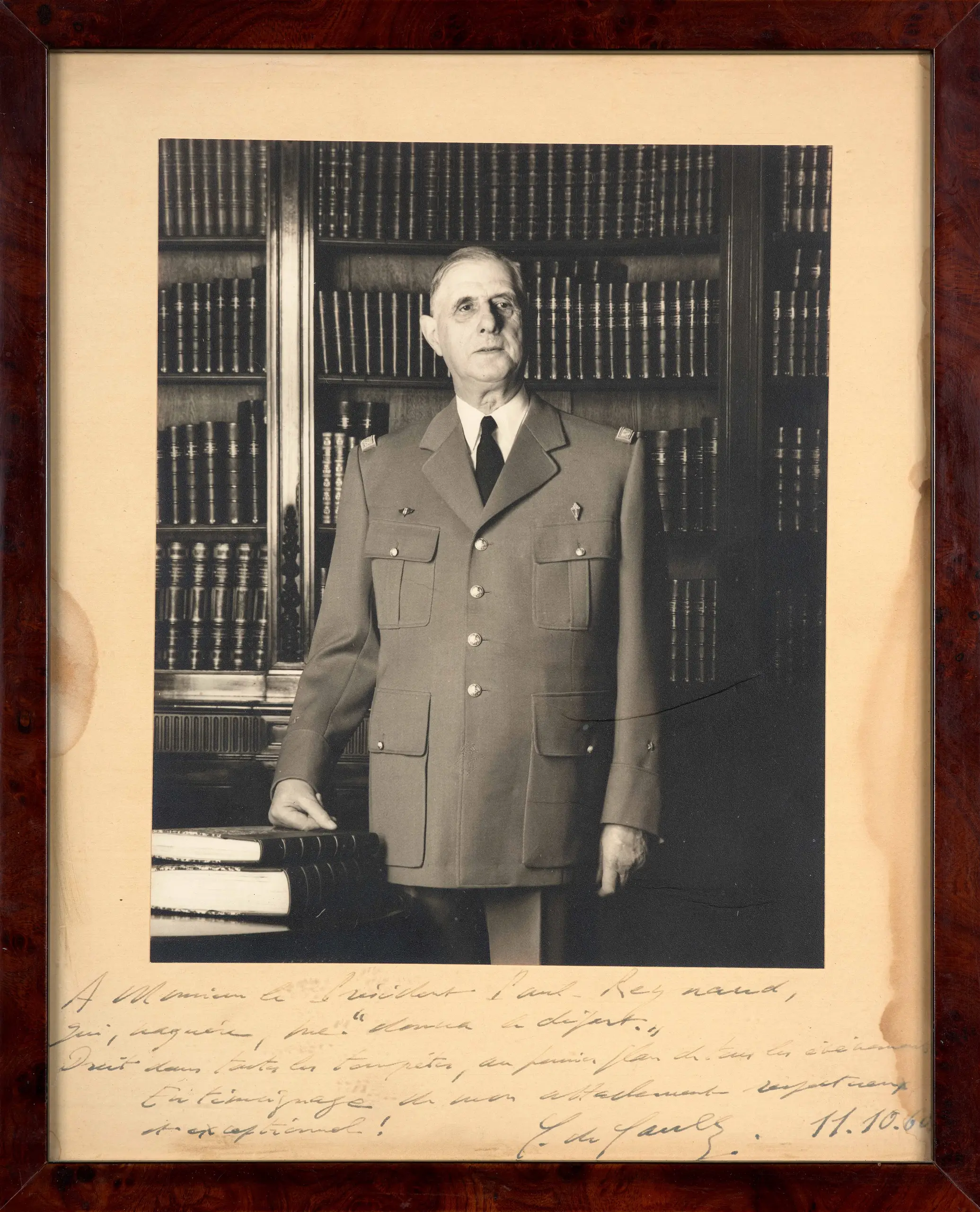
Charles de Gaulle
 France
statesperson•memoirist•military theorist
Also known as: General de Gaulle, Le Général, Charles André Joseph Marie de Gaulle
Birthday
November 22, 1890
Birth Sign
Sagittarius
Birthplace
Lille, France
Age
Died at 79
Height
6 ft 5 in (1.96 m)
About
Charles de Gaulle was a French general and statesman who led the Free French Forces against Nazi Germany during World War II and served as the first President of the Fifth Republic of France from 1958 until his resignation in 1969. Born on November 22, 1890, in Lille, he was the eldest of five children in a family of Catholic nobility. His father, Henri de Gaulle, was a professor of literature and history at the Jesuit College of Saint Stanislas, while his mother, Jeanne Maillot, came from a wealthy industrialist family in northern France. De Gaulle is remembered for his unwavering commitment to French sovereignty and independence, transforming into a national symbol of resistance during the darkest hours of the war.
The man known simply as "Le Général" commanded deep respect and occasional controversy throughout his public life. He championed a strong executive presidency and pursued a foreign policy independent of American influence, withdrawing France from NATO's integrated military command in 1966. His leadership reshaped the political landscape of France for decades, establishing a constitution that strengthened the presidency. His tenure ended not with death but with a referendum defeat in 1969, after which he retreated to his home in Colombey-les-Deux-Églises. His passing in 1970 marked the end of an era, leaving behind a complex legacy that continues to define French identity and political thought. In 2026, a major biographical film titled De Gaulle: Résistance has revitalized his image in popular culture, sparking renewed academic debate regarding his economic strategies during the Trente Glorieuses.
Early Life & Background
Born on November 22, 1890, in Lille, Charles de Gaulle grew up in a family steeped in Catholic tradition and historical consciousness. As the eldest of five children, Charles absorbed a rigorous education that emphasized duty, discipline, and a deep connection to French history. The family moved to Paris when he was young, allowing him to attend the prestigious Collège Stanislas, where he developed an early fascination with military strategy and literature. His physical stature became apparent early on; standing at six feet five inches (1.96 m), he towered over his peers. This imposing presence, combined with his intellectual depth, set him apart.
In 1912, he enrolled in the École Spéciale Militaire de Saint-Cyr, graduating as a second lieutenant. During World War I, he served with distinction in the French Army, earning multiple wounds and being captured by German forces in 1916. He escaped captivity in 1918 and returned to active service just before the armistice. Between the wars, he wrote The Army of the Future in 1934, advocating for mechanized warfare and armored divisions, a theory that would prove prescient and shape his future military approach. He also spent time developing his voice, which became a deep resonant baritone often described as authoritative. His early years were defined by a strict adherence to duty and a growing sense of national destiny that would later fuel his wartime leadership.
Career Growth
De Gaulle's breakthrough moment arrived in May 1940 during the Battle of France. Leading a counterattack with his 4th Armoured Division, he initially gained attention before being appointed Undersecretary for War. When the Vichy government proposed an armistice with Germany, de Gaulle refused to accept it. On June 18, 1940, he broadcast a historic appeal from London urging the French people not to surrender, marking the beginning of the Free French movement. Over the next five years, he unified resistance forces, negotiated with Allied leaders including Winston Churchill and Franklin D. Roosevelt, and emerged as the undisputed leader of Free France.
After the liberation of France in 1944, he headed the Provisional Government until 1946. He then retired from politics, writing his War Memoirs, which became a literary classic. In 1958, amid the Algerian crisis, he returned to power and established the Fifth Republic, drafting a new constitution that strengthened the presidency. He was elected its first president in December 1958 and served until April 1969, resigning after losing a referendum on regional reform. His return to power in 1958 is often cited as a pivotal moment that saved the French Fourth Republic from collapse. Notably, in 1962, he survived an assassination attempt at Petit-Clamart, further cementing his resilience as a leader.
Career Timeline
Public Image & Style
De Gaulle is portrayed as a stoic, solitary figure of moral authority. Media narratives emphasize his independence, integrity, and unwavering commitment to French sovereignty. His style was formal and austere: always wearing a dark suit, white shirt, and black tie, with no visible jewelry. His speeches were delivered in a measured, deliberate tone, avoiding populist rhetoric. In modern portrayals, he is often depicted as both a savior and a polarizing authoritarian figure, reflecting ongoing debates about his role in colonial policy and domestic governance. His voice, a deep resonant baritone, became synonymous with French resilience.
He cultivated an image of a statesman above petty politics, often refusing to engage in the frivolities of modern campaigning. Critics called him "Le Dictateur," while allies referred to him as "Le Général." His refusal to use telephones in the Élysée Palace, preferring handwritten notes, reinforced his perception as a man of old-world dignity. In 2026, this image is further shaped by the release of De Gaulle: Résistance, which presents him as a visionary leader while acknowledging the controversies of his era. The public sees him as a guardian of French identity, a man who stood firm when others faltered.
Fame & Fandom (iFAMOUS Rankings)
Charles de Gaulle never courted a fanbase in the modern sense. There are no organized crowds chanting his name, no fan-funded billboards, and no collective moniker for those who revere him in the traditional celebrity way. His relationship with the public was defined by solemn state functions and wartime leadership rather than reciprocal adoration. He remains a figure of national reverence and political polarization, viewed simultaneously as the savior of France during World War II and a divisive authoritarian figure regarding colonial policies. The French people do not follow him as a celebrity; they study him as the architect of their Fifth Republic.
Yet his historical footprint is so massive that global attention metrics still capture his enduring presence across media coverage and consumption signals worldwide. This vast cultural weight translates into specific standing within the iFANN Global Fame Rankings. He holds the position of the 12th most famous person in France, a rank he has held steady from the previous cycle. From his country of origin, he ranks as the 17th most famous person from France, maintaining his standing since last cycle. Across the continent, he sits at the 82nd most famous person in Europe, having moved up one spot from the prior period. Informal online communities, particularly among Gen Z in France, have begun celebrating his legacy through meme culture and educational reels, referring to themselves loosely as "Les Enfants de la Résistance."
Interesting Facts and Legends
Charles de Gaulle stood an imposing six feet five inches tall, a physical grandeur that contributed to his legendary image as a towering figure of authority. He kept his diagnosis of Marfan syndrome a closely guarded family secret until after his death. The most widely retold story in French history centers on June 18, 1940. Broadcasting from London, he urged the French people not to accept defeat by Nazi Germany, transforming himself from a little-known general into the symbolic leader of the Free French Forces. Another iconic moment occurred in Algiers in 1958. When a massive crowd chanted "Le Général nous écoute," de Gaulle famously replied, "Je vous ai compris," signaling his acceptance of their demands and securing his return to power.
He refused to use telephones in the Élysée Palace, preferring handwritten notes. He carried a small copy of Clausewitz’s On War in his pocket at all times. His nickname among allies was "Le Général," while critics called him "Le Dictateur." He once told Winston Churchill, "You are a great man, but you do not understand France." He secretly supported decolonization but delayed it due to political pressure. During his final campaign speech in 1969, he turned off the microphone to speak directly to the crowd, emphasizing authenticity over spectacle. He also walked alone down the Champs-Élysées upon entering liberated Paris in 1944 without security, earning spontaneous cheers from citizens.
Notable Quotes
“France, in her hour of need, will find in me her last hope.”
“Je vous ai compris.”
“The greatness of a nation lies not in its size but in its spirit.”
“I am not a politician; I am a Frenchman.”
“History is made by those who dare to act.”
Family & Personal Life
Charles de Gaulle was raised in a household of five siblings, with a strong emphasis on Catholic values instilled by his parents. His father, Henri, was a dedicated professor, while his mother, Jeanne, brought industrial wealth to the family dynamic. The couple lived primarily in their family home in Colombey-les-Deux-Églises, purchased in 1934, which remains a museum today. Charles had no biological children, but the couple adopted two nieces indirectly through family ties, creating a close-knit domestic environment despite the absence of direct offspring. The family maintained a private lifestyle, shielding personal matters from public scrutiny.
Yvonne Vendroux, his wife, was a constant companion and confidante, sharing his conservative Catholic values and deep patriotism. She managed the household affairs, allowing Charles to focus on his military and political duties. Their home in Colombey became a sanctuary where they spent nearly 50 years together. The couple's bond was unshakeable, surviving the pressures of war and high office. After Yvonne's death in 1969, Charles lived alone for only a few months before his own passing. The estate, including the family residence and archives, is now preserved by the Fondation Charles de Gaulle, ensuring the memory of their shared life endures.
Notable Connections
Relationships & Dating History
Charles de Gaulle was married only once: to Yvonne Vendroux on April 7, 1921. The couple met in 1917 while he was recovering from wounds sustained in World War I. Yvonne, a schoolteacher from Roubaix, shared his conservative Catholic values and deep patriotism. They had no biological children together, though they adopted two nieces indirectly through family ties. Their marriage lasted nearly 50 years until Charles's death; Yvonne predeceased him by six months, dying in 1969. There is no public record of any other romantic relationships or affairs.
Yvonne served as his constant companion and confidante throughout his long career, managing the household and providing emotional stability during times of immense pressure. Their relationship was defined by mutual respect and shared values rather than public displays of affection. As of 2026, he remains deceased, and thus his marital status is "widowed" posthumously. The couple's bond is often cited as a model of loyalty and dedication in French history, surviving the rigors of war and the complexities of high office.
- MarriedYvonne Vendroux1921 - 1970Met in 1917 during WWI recovery; married 1921; she died in 1969, six months before him.
Death & Aftermath
Died
November 9, 1970 (aged 79)
Death Place
Paris, France
Cause of Death
Acute myocardial infarction
On the morning of November 9, 1970, Charles de Gaulle passed away at the Military Hospital of Val-de-Grâce in Paris. The former president had suffered a stroke in late October that left him weakened before an acute myocardial infarction claimed his life at age seventy-nine. While Marfan syndrome contributed to his vascular fragility, officials ruled the sudden cardiac event as the direct cause without dispute or legal inquiry. France entered a period of profound national mourning upon the announcement. Flags flew at half-mast across the nation while thousands gathered spontaneously near the Place de la Concorde and the Élysée Palace to pay their respects.
World leaders including US President Richard Nixon and British Prime Minister Edward Heath sent condolences, highlighting his role in preserving French sovereignty during the war and beyond. The state funeral took place three days later on November 12 at Les Invalides. A gun carriage drawn by horses carried his coffin through the historic site where he was buried in the chapel of Saint-Louis following a private family interment. His legacy has endured through continued political discourse and cultural productions, including the two-part biopic De Gaulle: Résistance released around 2026, which revitalized his image in popular culture. The Fondation Charles de Gaulle continues to manage his estate and promote his historical significance.
Net Worth (Estate Value)
$4.6 Million
iFANN Editorial Team estimate
As a head of state in the mid-20th century, Charles de Gaulle did not accumulate personal wealth in the modern celebrity sense. His salary as President was modest by today's standards, estimated at approximately $15,000 annually (equivalent to ~$150,000 in 2026 dollars). He lived frugally and owned little beyond his family home in Colombey-les-Deux-Églises, purchased in 1934. According to recent reports in 2026, the estate, including the family residence, archives, and intellectual property rights, is valued at approximately €4.2 million ($4.6 million USD).
Revenue streams include licensing fees for memoirs and speeches (~€300,000/year), book royalties from reprints and translations (~€200,000/year), museum admissions at the Musée Charles de Gaulle in Colombey (~€150,000/year), and film and documentary licensing rights (~€100,000/year). The estate is managed by the Fondation Charles de Gaulle, established in 1972, which oversees archival preservation and educational initiatives. No significant real estate holdings or business ventures exist outside the foundation. iFANN currently estimates Charles de Gaulle's net worth at approximately $4.6 million based on current estate valuations and income streams. Social media accounts like @FondationDeGaulle continue to drive engagement and revenue through historical content sharing.
Awards Won (4)
Charles de Gaulle received numerous national and international honours, including the Grand Cross of the Legion of Honour, Companion of the Order of the Bath, and the Presidential Medal of Freedom awarded posthumously in 1990. He was knighted as Grand Cross of the Order of Merit of the Italian Republic and inducted into the International Hall of Fame for Military Leadership. Honorary doctorates were conferred by Oxford, Harvard, and the Sorbonne. He also received the Key to the City of London and New York. TIME Magazine named him one of the 100 Most Important People of the 20th Century in 1999.
1990 · Civilian Honor
Posthumous recognition for wartime leadership
1946 · National Order
Service to France
Known For
De Gaulle: Résistance
2026 · Subject of Biopic
The War Memoirs
1954 · Author
The Army of the Future
1934 · Military Theorist
Keywords
Sources
Quick Facts
- Profession
- statesperson, memoirist, military theorist
- Born
- November 22, 1890
- Birthplace
- Lille, France
- Died
- November 9, 1970
- Death Place
- Paris, France
- Gender
- Male
- Spouse
- Yvonne Vendroux
- Birth Sign
- Sagittarius
Personal Details
- Full Name
- Charles André Joseph Marie de Gaulle
- Height
- 6 ft 5 in (1.96 m)
- Spouse
- Yvonne Vendroux
- Children
- Education
- Collège Stanislas; École Spéciale Militaire de Saint-Cyr
Filmography
3
Total
1
Film
0
TV
Frequently Asked Questions
Who was Charles de Gaulle?
How did Charles de Gaulle die?
Did Charles de Gaulle have children?
What is the most famous quote by Charles de Gaulle?
Is there a museum dedicated to Charles de Gaulle?
Similar People
Join the community
fans discussing