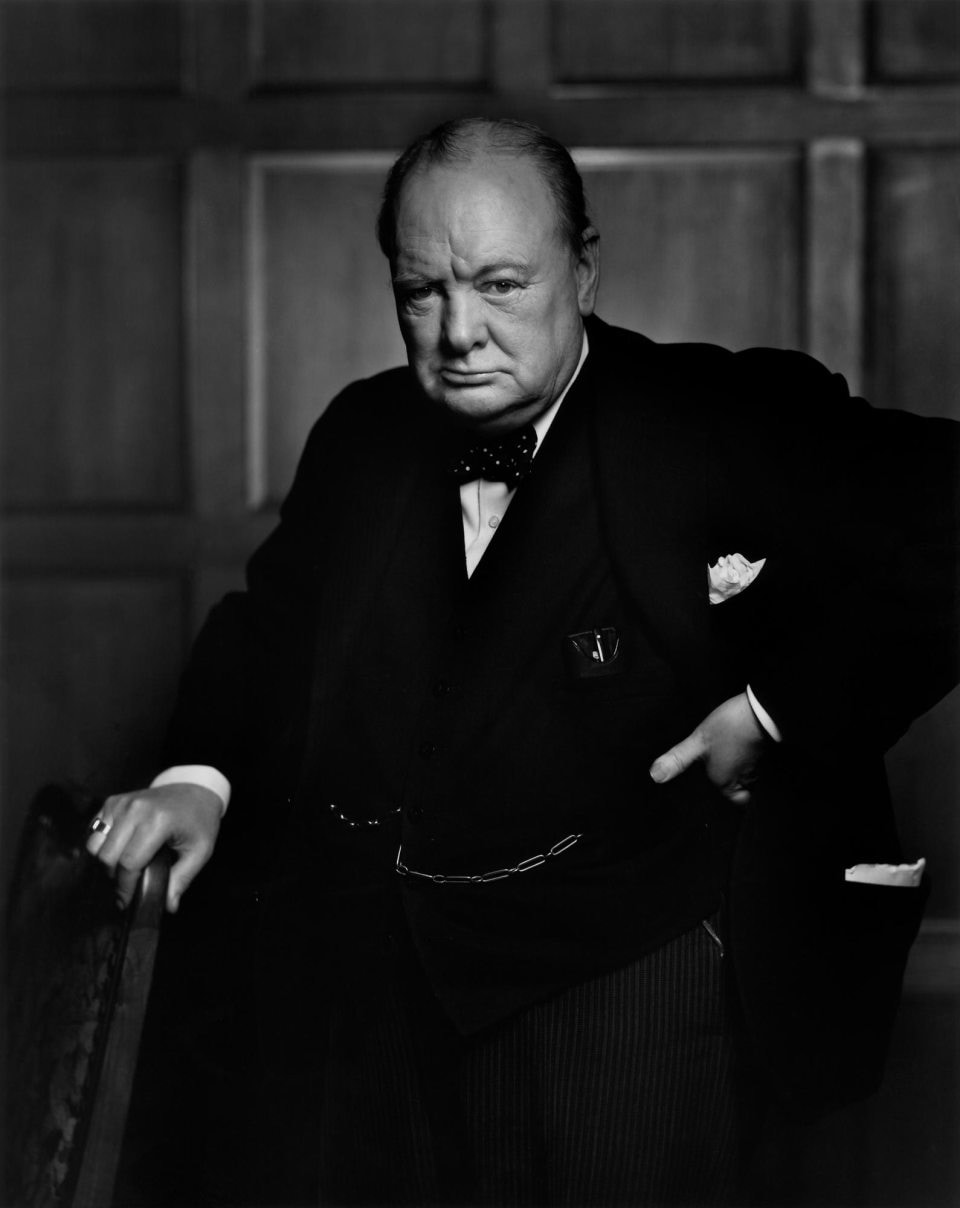
Winston Churchill
 United Kingdom
British statesman•military officer•writer
Also known as: Winston Leonard Spencer Churchill, Sir Winston Churchill
Birthday
November 30, 1874
Birth Sign
Sagittarius
Birthplace
Blenheim Palace, Oxfordshire, England
Age
Died at 90
Height
5 ft 6 in (168 cm)
About
Winston Churchill was a British statesman, military officer, and writer who served as Prime Minister of the United Kingdom twice: from 1940 to 1945 during the Second World War, and again from 1951 to 1955. Born on November 30, 1874, at Blenheim Palace in Oxfordshire, he came from a wealthy aristocratic family with mixed English and American roots. His political career spanned over six decades, during which he was a Member of Parliament for 62 years, representing five different constituencies. Ideologically, he championed economic liberalism and imperialism, and though he led the Conservative Party from 1940 to 1955, he also spent two decades as a Liberal.
Churchill joined the British Army in 1895, seeing action in India, the Mahdist War, and the Second Boer War. He gained fame as a war correspondent and wrote books about his campaigns, including The Story of the Malakand Field Force and The River War. Elected as a Conservative MP in 1900, he crossed the floor to the Liberals in 1904. In H. H. Asquith's government, he served as President of the Board of Trade and Home Secretary, pushing for prison reform and workers' social security. As First Lord of the Admiralty before and during World War I, he oversaw the disastrous Dardanelles campaign, leading to his demotion. He resigned in 1915 and served on the Western Front with the Royal Scots Fusiliers. Returning to government under David Lloyd George, he held several key posts, including Minister of Munitions and Secretary of State for War. As Chancellor of the Exchequer in the 1920s, he returned Britain to the gold standard, a move that depressed the economy.
During his "wilderness years" in the 1930s, Churchill warned against the rise of Nazi Germany and called for rearmament. When World War II broke out, he was reappointed First Lord of the Admiralty. In May 1940, he became Prime Minister, forming a national government that led Britain to victory in 1945. His speeches, such as "We shall fight on the beaches," rallied the nation. After losing the 1945 election, he served as Leader of the Opposition and coined the term "Iron Curtain" to describe Soviet influence. He also wrote The Second World War, a six-volume memoir that earned him the Nobel Prize in Literature in 1953. Returning to power in 1951, his second term focused on foreign affairs and a successful housebuilding program. He resigned in 1955 due to declining health and died on January 24, 1965, receiving a state funeral.
Churchill remains a towering figure in British history, celebrated for his wartime leadership in defending liberal democracy. However, his staunch imperialism and comments on race have drawn criticism. Historians consistently rank him among the greatest British prime ministers. Beyond politics, he was a prolific writer, producing some 40 books, and an amateur painter. His life and career have been depicted in numerous films and television shows, including Darkest Hour and The Crown.
Early Life & Background
Churchill's childhood at Blenheim Palace was one of aristocratic privilege but emotional distance. His father, Lord Randolph Churchill, was a Conservative MP, and his American mother, Jennie Jerome, was a socialite. Raised largely by a nanny, he was sent to St. George's School at Ascot in 1882, where he was unhappy. He later transferred to Brighton and entered Harrow School in 1888, placing at the bottom of his class on entrance exams. He excelled in English and history and won the Public Schools' fencing championship.
His father concluded he was "not clever enough to go to the Bar" and steered him toward a military career. Churchill attended the Royal Military College at Sandhurst, graduating in 1894. He joined the British Fourth Hussars in 1895, just months after his father's death. He served in India, the Sudan, and South Africa, distinguishing himself in battle. As a war correspondent, he gained fame through his writings, including The Story of the Malakand Field Force (1898) and The River War (1899). During the Second Boer War, he was captured as a prisoner of war but escaped on the night of December 12-13, 1899, by jumping a fence when guards turned their backs. This daring escape made him a national hero and helped him win his first election to Parliament in 1900.
Career Growth
Churchill's political breakthrough came with his election as Conservative MP for Oldham in 1900. He crossed the floor to the Liberal Party in 1904, a move that shocked the political establishment. His appointment as First Lord of the Admiralty in 1911 allowed him to modernize the British Navy and prepare for World War I. However, the disastrous Dardanelles campaign in 1915 forced his resignation. He then served on the Western Front with the Royal Scots Fusiliers, a humbling experience.
His greatest moment arrived on May 10, 1940, when he became Prime Minister and Minister of Defence, forming a national government that led Britain through World War II. His speeches, including "We shall fight on the beaches" and "This was their finest hour," became legendary. After the war, he lost the 1945 election but continued as Leader of the Opposition. He coined the term "Iron Curtain" in a 1946 speech in Fulton, Missouri, shaping Cold War rhetoric. He returned as Prime Minister from 1951 to 1955, focusing on foreign policy and domestic housebuilding. He also wrote The Second World War (six volumes, 1948-1953), which won him the Nobel Prize in Literature in 1953. He resigned in 1955 due to declining health.
Career Timeline
Public Image & Style
Churchill's public persona is defined by his bow tie, cigar, and V-for-Victory hand sign. He popularized the siren suit, a one-piece jumpsuit he wore during WWII. His speeches are among the most quoted in the English language, and his defiant stance against Nazi Germany made him a symbol of British resolve. Media portrayals, from Darkest Hour to The Crown, emphasize his gruff wit and determination. Modern scholarship has increasingly critiqued his imperialist views and comments on race, sparking debate about his legacy. He has a dedicated following among historians and military enthusiasts, with the International Churchill Society maintaining a global membership. His quotations are frequently invoked by politicians across the spectrum.
Fame & Fandom (iFAMOUS Rankings)
Winston Churchill commands a legacy that transcends the fleeting nature of modern celebrity, sustained not by active fan campaigns or viral trends, but by the enduring weight of his historical impact and the reverence of scholars. His audience is less a fandom in the contemporary sense and more a global community of history enthusiasts and political students who keep his words alive through study and citation. The International Churchill Society serves as the primary hub for this devotion, functioning as a scholarly preservation society rather than a pop-culture movement, with no formal name attached to a general fanbase beyond this specific organization. There are no recorded rituals, subway ad campaigns, or crowd-shutting events akin to Beatlemania; instead, his presence is felt through the circulation of his speeches and the preservation of his artifacts. Despite the passage of time since his death in 1965, his status remains formidable within the iFANN Global Fame Rankings, which track global attention across media coverage, search, and consumption signals worldwide. This authority places him as the 157th most famous person in the world, holding steady from the previous cycle. Within his homeland, he stands as the 13th most famous person in United Kingdom, also maintaining his position. He ranks as the 24th most famous person from United Kingdom and the 19th most famous person in Europe. In the specific sphere of leadership, he is recognized as the 27th most famous person in Politics. These placements confirm that while he lacks a living fanbase, his influence remains a dominant force in how the world remembers its most significant figures.
Interesting Facts and Legends
Churchill adopted the pen name "Winston S. Churchill" to distinguish himself from an American novelist of the same name, with whom he maintained a friendly correspondence. An accomplished amateur painter, he created over 500 works throughout his life, many of which now reside at his home, Chartwell. He personally constructed a dam, swimming pool, and red brick wall at Chartwell using his own hands. His interest in breeding butterflies at Chartwell stemmed from his earlier experiences in India. He also authored an unpublished manuscript titled Are We Alone in the Universe? which explored themes of evolution and fusion power. Notably, he became the first person to be made an honorary citizen of the United States, a title conferred by President John F. Kennedy in 1963. Beyond these personal details, his legend is anchored in verified historical moments, such as his address to a joint session of the U.S. Congress following the attack on Pearl Harbor. This speech, delivered as a leader of the British Empire to the American legislature, remains a widely retold story of diplomatic unity. His oratory skills have become part of cultural folklore, with quotes like "Success is not final, failure is not fatal: it is the courage to continue" frequently cited today. While modern legends often focus on entertainment scandals, Churchill's lore consists of his steadfast leadership during World War II and his multifaceted career as a writer and artist, reinforced by recent exhibitions and the sale of his paintings.
Notable Quotes
“We shall fight on the beaches, we shall fight on the landing grounds, we shall fight in the fields and in the streets, we shall fight in the hills; we shall never surrender.”
“I have nothing to offer but blood, toil, tears and sweat.”
“Never in the field of human conflict was so much owed by so many to so few.”
“An iron curtain has descended across the Continent.”
“Success is not final, failure is not fatal: it is the courage to continue that counts.”
Family & Personal Life
Churchill married Clementine Hozier in September 1908. They had five children: Diana (1909), Randolph (1911), Sarah (1914), Marigold (1918-1921, died of sepsis), and Mary (1922). The family lived at Chartwell in Kent from 1922 onward, a house Churchill bought and renovated extensively. Clementine was a high-principled and highly strung woman; their marriage was long and generally happy, though marked by quarrels, she once threw a dish of spinach at Winston (it missed). Churchill's father, Lord Randolph Churchill, was a Conservative MP who died in 1895. His mother, Jennie Jerome, was an American socialite and daughter of New York financier Leonard Jerome. Churchill had one younger brother, John Strange Spencer-Churchill.
Notable Connections
Churchill's key relationships included his wife Clementine, wartime allies Franklin D. Roosevelt and Joseph Stalin, and political colleagues David Lloyd George, H.H. Asquith, and Anthony Eden. He succeeded Neville Chamberlain as Prime Minister and was succeeded by Anthony Eden. His father Lord Randolph Churchill was a political inspiration, and his mother Jennie Jerome was an American socialite.
Relationships & Dating History
Churchill's first serious romantic interest was Pamela Plowden, whom he dated around 1899-1900. They met in India, but she later married Victor Lytton, 2nd Earl of Lytton. He was also rumored to have been involved with Violet Asquith, daughter of Prime Minister H.H. Asquith, between 1906 and 1908, before his engagement to Clementine. Churchill married Clementine Hozier on September 12, 1908, after meeting her at a dinner party in 1904. Their marriage lasted until his death in 1965, producing five children. It was a loving but sometimes stormy relationship, Clementine once threw a dish of spinach at him. As of his death, he was widowed by Clementine, who survived him by 12 years.
- DatedPamela Plowden1899 - 1900First serious romantic interest; met in India.
- RumouredViolet Asquith1906 - 1908Rumored romantic interest before engagement to Clementine.
- MarriedClementine Churchill1908 - 1965Met at a dinner party in 1904; married September 12, 1908; five children.
Death & Aftermath
Died
January 24, 1965 (aged 90)
Death Place
London
Cause of Death
Cerebral thrombosis
Sir Winston Churchill passed away on the morning of January 24, 1965, at his London residence. His final days had been marked by a rapid decline following a severe bout of pneumonia and a major stroke suffered earlier that month while recovering from a fall at his country estate, Chartwell. He was found unconscious by his family and physician shortly before 11:00 AM, with his son Randolph confirming the end of his life after the condition deteriorated quickly. The official cause was determined to be a cerebral thrombosis, a blood clot in the brain, based on clinical diagnosis.
The nation responded with an unprecedented outpouring of grief, leading the government to declare a state funeral, a rare honor usually reserved for monarchs. Tributes poured in from global leaders, including US President Lyndon B. Johnson, who called him the greatest man of our age, while crowds gathered spontaneously outside Buckingham Palace and St. Paul's Cathedral. Over 300,000 members of the public filed past his coffin during three days of lying-in-state at Westminster Hall before a service conducted by the Archbishop of Canterbury. Following the cathedral service, the coffin traveled down the Thames by river barge to the Chapel of the Guards at Wellington Barracks before being transported to Bladon in Oxfordshire.
The private burial took place at the Parish Church of St. Martin, where he rests beside his parents. A flypast by the Royal Air Force echoed his famous tribute to the Few from the Battle of Britain. Posthumously, his legacy continued through the preservation of his papers at the Churchill Archives Centre and the dedication of the Churchill War Rooms, ensuring his historical contributions remained accessible to future generations.
Net Worth (Estate Value)
$10 Million
iFANN Editorial Team estimate
Per iFANN's editorial analysis, Winston Churchill's estate is valued at approximately $10 Million as of 2026. At the time of his passing in 1965, his estate was worth about £300,000-£400,000, a figure equivalent to roughly £7-10 million in today's value. The estate continues to generate revenue through book royalties from his extensive collection of over 40 titles, including The Second World War and A History of the English-Speaking Peoples. Licensing deals for his name, image, and speeches provide additional income streams, alongside merchandise sold through the International Churchill Society. The Churchill family manages the estate, while the International Churchill Society oversees legacy programming. It is important to note that Chartwell, his former home, is owned by the National Trust and is not included in the estate calculations.
Awards Won (225)
Churchill won the Nobel Prize in Literature in 1953 for his historical and biographical writings, particularly The Second World War. He also received numerous state honors, including the Order of the Garter (1953), the Order of Merit (1946), and the Companion of Honour (1922). He was made an honorary citizen of the United States in 1963.
1953 · Literature
The Second World War and other writings
Armorial achievement of Churchill as a gentleman
Armorial achievement of Churchill as a Knight Companion of the Garter
Armorial achievement of Churchill as a Knight of the Danish Order of the Elephant
The shield of arms on its own
Known For
Prime Minister of the United Kingdom
1940 · Wartime Leader
The Second World War
1948 · Author
Iron Curtain speech
1946 · Speaker
Keywords
Sources
Quick Facts
- Profession
- politician, journalist, painter
- Born
- +1874-11-30
- Birthplace
- Blenheim Palace
- Died
- +1965-01-24
- Death Place
- Hyde Park Gate
- Gender
- Male
- Spouse
- Clementine Churchill
- Birth Sign
- Sagittarius
Personal Details
- Full Name
- Winston Leonard Spencer Churchill
- Height
- 5 ft 6 in (168 cm)
- Spouse
- Clementine Churchill
- Children
- Diana, Randolph, Sarah, Marigold, Mary
- Education
- St. George's School, Ascot; Brighton School; Harrow School; Royal Military College, Sandhurst
Frequently Asked Questions
How old was Winston Churchill when he died?
What was Winston Churchill's net worth in 2026?
Is Winston Churchill still considered a great leader today?
Did Winston Churchill win a Nobel Prize?
How many children did Winston Churchill have?
Similar People
Join the community
fans discussing