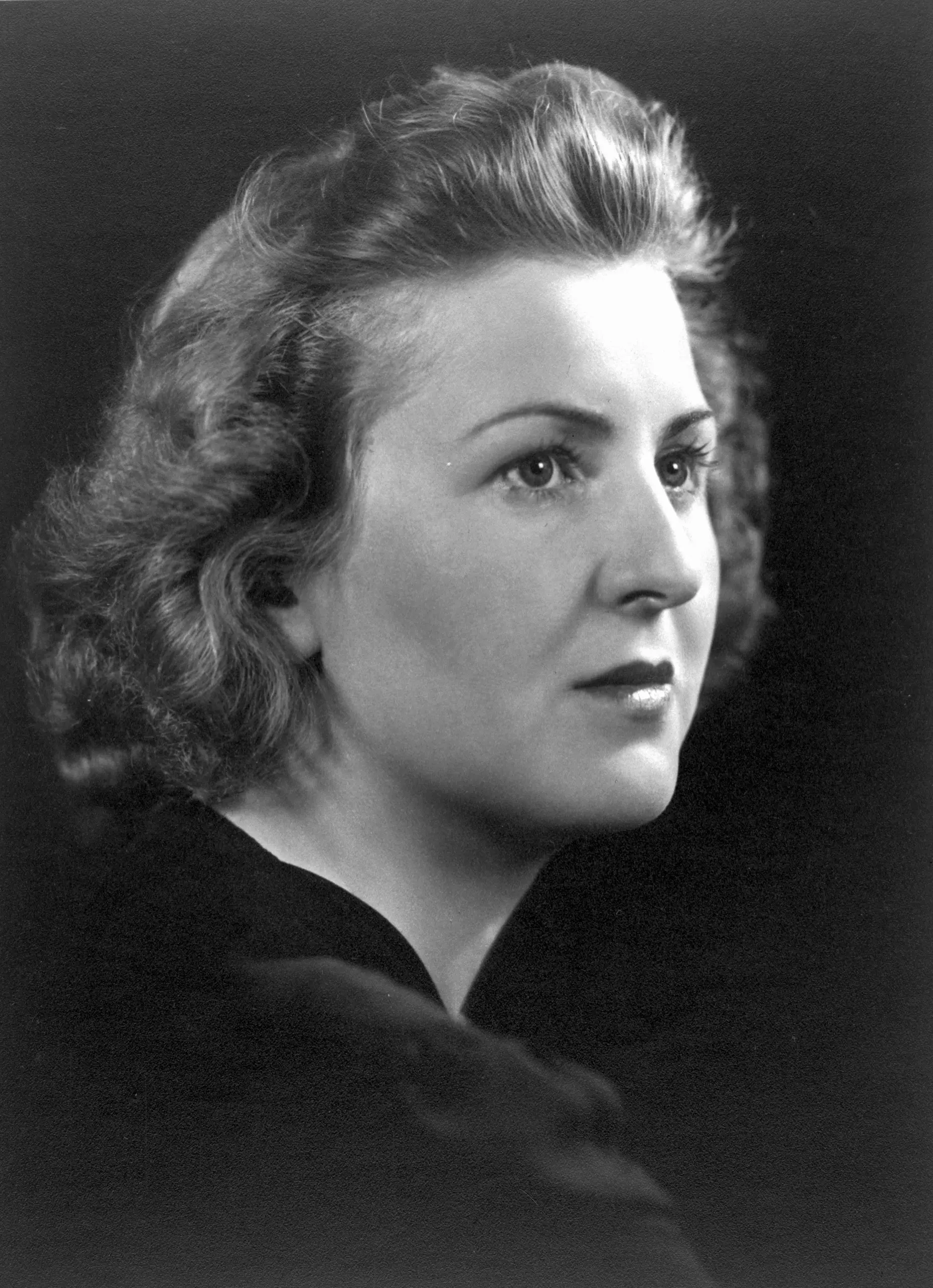
Eva Braun
 Germany
photographer•photo lab technician•model
Also known as: Effie, Eva Anna Paula Braun Blin, Alemania
Birthday
February 6, 1912
Birth Sign
Aquarius
Birthplace
Munich, Bavaria, Germany
Age
Died at 33
Height
5 ft 2 in (157 cm)
About
Eva Braun was a German photographer and the longtime companion, and briefly the wife, of Adolf Hitler. Born in Munich in 1912, she entered the orbit of the Nazi leader in 1929 while working as an assistant and model for his official photographer, Heinrich Hoffmann. Her life became defined by her proximity to power, living primarily at the Berghof in Bavaria where she managed aspects of Hitler's domestic life and maintained a private photo lab. Unlike many figures of her era, she did not hold an official government title but served as a confidante and gatekeeper within the Führer's inner circle.
Her legacy is inextricably linked to the final days of World War II. She married Hitler in a brief civil ceremony in the Führerbunker on April 29, 1945, less than forty hours before they both committed suicide. Braun captured a unique visual archive of the Third Reich's private sphere through color photographs and home movies that remain invaluable historical documents today. She died at age 33 alongside the man she had been with for over a decade.
Early Life & Background
Eva Anna Paula Braun was born into a comfortable middle-class Catholic family in Munich on February 6, 1912. Her father, Franz Braun, worked as a schoolteacher, while her mother, Ida Braun, came from a wealthy background. The family moved to Munich in 1917, where Eva grew up alongside her older sister Ilse and two younger sisters, Gretl and Gertraud. She attended a convent school and later the Lyzeum, a type of secondary school, though she left formal education at age 16 to pursue vocational training.
Braun developed an early interest in photography and practical skills like typing, which led her to seek employment after leaving school. In 1929, at the age of 17, she secured a position as a secretary and later an assistant and model for Heinrich Hoffmann, the official photographer for the Nazi Party. This job placed her in direct contact with the party elite and provided the initial platform for her introduction to Adolf Hitler. Her early years in this environment were marked by a professional association that quickly deepened into a personal relationship, setting the stage for a life that would become one of the most scrutinized in history.
Career Growth
Braun's professional life was inextricably linked to her relationship with Hitler and the Nazi hierarchy. From 1929 to 1932, she worked as an assistant and model for Heinrich Hoffmann, gaining her first significant exposure to the Nazi leadership. By 1932, she had transitioned into a role as a personal assistant to Hitler, often acting as a gatekeeper and confidante. During this period, she began taking photographs of Hitler in informal settings, capturing images that became some of the only surviving records of him in a relaxed state.
From 1936 until 1945, Braun became a fixture in Hitler's private life at the Berghof in Bavaria. While she held no official government title, she managed aspects of the dictator's domestic life and maintained a photo lab at the mountain retreat. She continued to take color photographs and home movies, creating a unique visual archive of the Third Reich's private sphere. In 1944, following her sister Gretl's marriage to SS officer Hermann Fegelein, Braun began attending more public functions with Hitler, including award presentations and military reviews. This shift marked a move from total seclusion to limited public visibility. Her work as a photographer remains her primary historical contribution, offering a rare glimpse into the private persona of Adolf Hitler.
Career Timeline
Public Image & Style
Eva Braun's public image is complex and controversial. Initially portrayed in Western media as a trivial mistress who enabled Hitler's downfall, modern scholarship has painted a more nuanced picture. She is often depicted as a loyal companion who lived in a bubble of privilege, insulated from the horrors of the war. Her signature style was modest and understated, reflecting her desire to remain out of the public eye. Today, she is remembered as a symbol of the moral ambiguity and complicity that characterized the Nazi inner circle. The home movies she shot show Hitler laughing and dancing, a stark contrast to his public image.
Fame & Fandom (iFAMOUS Rankings)
Eva Braun does not have a fandom in the traditional sense. There are no organized fan clubs, unofficial groups, or community rituals dedicated to her. Any attempt to organize around her would be widely condemned as neo-Nazi activity rather than a legitimate cultural movement. Her story is studied by historians, students, and researchers rather than celebrated by fans. The lack of a fanbase underscores the somber nature of her legacy and the global consensus against glorifying the Nazi regime.
Despite the absence of a fanbase, her prominence in global memory remains undiminished. She holds the position of the 62nd most famous person from Germany, a standing that has held steady through recent cycles, while also ranking as the 38th most famous person in Art & Design. These placements reflect her enduring presence in historical discourse and media coverage worldwide. The rankings are derived from the iFANN Global Fame Rankings, which track global attention across diverse signals of consumption and documentation. She is featured at No. 39 in the September 2026 iFAMOUS Rankings.
Interesting Facts and Legends
Eva Braun was one of the few people to capture color photographs of Hitler in casual settings, revealing a side of the dictator rarely seen publicly. Historical accounts suggest she attempted suicide twice during their early relationship, once in 1932 and again in 1935, due to emotional turmoil and fear of losing him. The marriage to Hitler was kept so secret that even many high-ranking Nazi officials were unaware of it until after their deaths. Despite persistent rumors, Braun never had children, and genetic testing of alleged descendants has been inconclusive or debunked. The Soviet Union went to great lengths to destroy all traces of the couple's remains, scattering their ashes to prevent any future veneration.
Notable Quotes
“I am happy to be with him.”
Family & Personal Life
Eva Braun was raised in a devout Catholic household, though she later distanced herself from organized religion. Her father, Franz Braun, was a schoolteacher, and her mother, Ida Braun, came from a wealthy family. She had an older sister named Ilse and two younger sisters, Gretl and Gertraud. The family lived together in Munich until Eva's career took her into the Nazi orbit. Her sister Gretl married SS officer Hermann Fegelein in 1944, which brought Eva closer to the center of the regime's social events. The family lived under the shadow of the regime, with Gretl marrying into the SS aristocracy. Eva never married until the final days of the war, and she had no children with Hitler despite various conspiracy theories suggesting otherwise.
Notable Connections
Relationships & Dating History
Eva Braun's romantic history is singular and definitive. She met Adolf Hitler in 1929 when she was 17 and working for his photographer, Heinrich Hoffmann. Their relationship began as a professional association but quickly deepened into a romantic affair. Despite Hitler's public stance against marriage, they were engaged for several years, though the engagement was kept secret. In April 1945, as Soviet forces closed in on Berlin, they married in a brief civil ceremony in the Führerbunker. They died together less than 40 hours later. There were no children from this union.
There are no documented relationships prior to or concurrent with Hitler, aside from minor, unverified teenage flings that hold no historical significance. As of her death in 1945, she was widowed (by her own hand, effectively) and never remarried.
- MarriedAdolf Hitler1929 - 1945Long-term companion and brief wife; married in the Führerbunker shortly before their joint suicide.
Death & Aftermath
Died
April 30, 1945 (aged 33)
Death Place
Führerbunker, Berlin, Germany
Cause of Death
Cyanide poisoning
The final chapter of Eva Braun's life unfolded within the claustrophobic confines of the Führerbunker beneath the Reich Chancellery in Berlin. As Soviet troops advanced through the city streets in late April 1945, she remained by the side of Adolf Hitler, her partner for sixteen years. On the afternoon of April 30, 1945, the couple ended their lives in a bunker sitting room. Braun ingested a cyanide capsule, while Hitler shot himself with a pistol. Their bodies were carried up to the garden of the Reich Chancellery and set ablaze in a shell crater to prevent them from becoming trophies for the advancing Red Army.
Soviet counter-intelligence units known as SMERSH recovered the charred remains in May 1945. Forensic teams used dental records kept by Hugo Blaschke to confirm the identities of the two deceased. The bodies were subsequently exhumed multiple times and cremated again before the ashes were scattered in the Biederitz river near Magdeburg in 1970 under strict orders from the Soviet Union to ensure no physical trace remained. Public reaction was immediate silence; Allied powers suppressed details of the Nazi leadership's personal end to avoid creating martyrs or relics. It took decades of declassified archives to reveal the full scope of her role and the circumstances of her death.
Net Worth (Estate Value)
$0
iFANN Editorial Team estimate
As a historical figure who died in 1945, Eva Braun has no current net worth. Her estate was dissolved immediately following the war. The bodies of Hitler and Braun were recovered by Soviet SMERSH units, and their remains were burned multiple times to prevent them from becoming relics. The ashes were scattered in the Biederitz river near Magdeburg in 1970 under orders from the Soviet Union. Consequently, there are no assets, royalties, or posthumous earnings managed by an estate. Any financial value attributed to her name today comes from the sale of historical artifacts, such as her photographs or memorabilia, which are owned by museums, collectors, or the state, not by a Braun estate.
Awards & Accolades
Known For
The Downfall
2004 · Portrayed in film
Lost Home Movies of Nazi Germany
2011 · Subject of documentary
Keywords
Sources
Quick Facts
- Profession
- photographer, photo lab technician, model
- Born
- February 6, 1912
- Birthplace
- Munich
- Died
- April 30, 1945
- Death Place
- Führerbunker
- Gender
- Female
- Spouse
- Adolf Hitler
- Birth Sign
- Aquarius
Personal Details
- Full Name
- Eva Anna Paula Braun
- Height
- 5 ft 2 in (157 cm)
- Spouse
- Adolf Hitler
- Children
- Education
- Convent school, Lyzeum secondary school
Frequently Asked Questions
Was Eva Braun ever found?
Did Eva Braun have a baby?
What was Eva Braun and Hitler's relationship like?
Who was Hitler's love of his life?
How old was Eva Braun when she died?
Similar People
Join the community
fans discussing