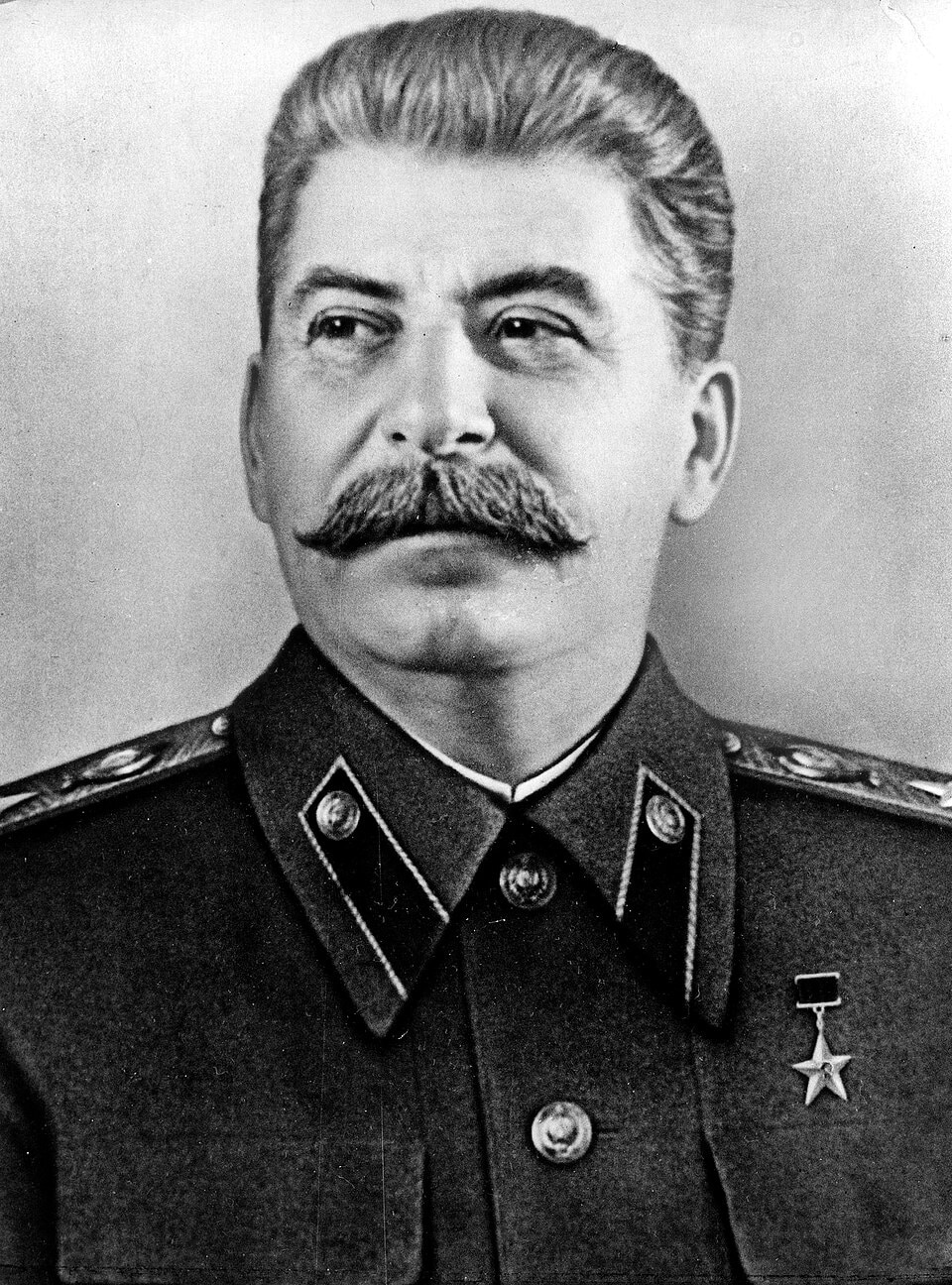
Joseph Stalin
 Georgia
politician•revolutionary•opinion journalist
Also known as: Ioseb Dzhugashvili, Stalin, The Father of Nations
Birthday
December 18, 1878
Birth Sign
Sagittarius
Birthplace
Gori, Georgia, Russian Empire
Age
Died at 74
Height
5 ft 7 in (170 cm)
About
Joseph Stalin was the dictator of the Soviet Union from the mid-1920s until his death in 1953. Born Ioseb Dzhugashvili in Gori, Georgia, he rose from poverty to become one of the most powerful and controversial figures of the 20th century. As General Secretary of the Communist Party, he transformed the USSR into a global superpower through brutal industrialization and collectivization, while also orchestrating the Great Purge that killed millions. His leadership during World War II was pivotal, but his legacy is forever tied to the Gulag system, mass famine, and state terror.
Stalin's rule reshaped global politics and left a deep imprint on communism. He is admired by some for industrializing a backward nation and defeating Nazi Germany, but condemned for the immense human suffering his policies caused. Today, his statue has been removed from many former Soviet cities, and his name is often synonymous with tyranny.
Early Life & Background
Stalin grew up in a one-room hut in Gori, the only surviving child of a poor cobbler and a washerwoman. A childhood bout with smallpox left his face scarred, and a carriage accident permanently damaged his left arm. He excelled at the Gori Church School and won a scholarship to the Tiflis Theological Seminary in 1894. There, he discovered Marxist literature and began organizing secret study circles. Expelled in 1899 for revolutionary activity, he went underground, working as a weather station clerk and later as a journalist for the Bolshevik newspaper Pravda. He participated in bank robberies and extortion to fund the party, was arrested several times, and exiled to Siberia. He escaped multiple times, once after just a few weeks.
Career Growth
Stalin's true rise began in 1922 when he became General Secretary, a role he used to place loyalists in key positions. After Lenin's death in 1924, he outmaneuvered rivals like Trotsky, Zinoviev, and Kamenev. In 1928, he launched the first Five-Year Plan, forcing rapid industrialization and collectivizing agriculture. By 1932, a devastating famine, the Holodomor, swept Ukraine and other regions, killing millions. In the late 1930s, the Great Purge executed top military leaders and party officials; over 700,000 were shot. During World War II, after Germany invaded in 1941, Stalin took personal command as Supreme Commander. The Red Army turned the tide at Stalingrad and pushed to Berlin by 1945. Postwar, he oversaw the Soviet atomic bomb test in 1949 and the formation of the Eastern Bloc.
Career Timeline
Public Image & Style
Stalin cultivated a massive cult of personality. Portraits, statues, and his writings were everywhere, and he was referred to as 'the Father of Nations' and 'the Great Helmsman.' His image was that of a stern, wise, and fatherly leader, often shown in a simple military uniform. After his death, the cult was dismantled by Khrushchev, but Stalin still retains a following among some communists and Russian nationalists. In the West, he is almost universally reviled as a mass murderer, though a few historians credit him with industrializing the USSR and winning the war.
Fame & Fandom (iFAMOUS Rankings)
Joseph Stalin commands a unique place in global consciousness, not as a celebrity with a dedicated fanbase engaging in rituals or charity drives, but as an enduring historical figure whose legacy is defined by the sheer scale of his impact on the 20th century. Unlike modern icons who cultivate interactive communities, Stalin's presence remains that of a political symbol and a cautionary tale, revered by some ideological adherents while reviled by others for the atrocities committed under his rule. There is no organized fandom name, no official clubs, and no fan campaigns; instead, interest persists through academic study, historical revisionism, and sporadic political references that keep his image relevant in contemporary discourse. His story is one of absolute power and its consequences, remembered through the lens of industrialization, war, and state terror rather than pop culture moments. Despite the absence of a traditional fanbase, his notoriety remains staggering, placing him among the most recognized names in human history. This enduring prominence is quantified by the iFANN Global Fame Rankings, which track global attention across media coverage, search, and consumption signals worldwide. Joseph Stalin is currently the 109th most famous person in the world, holding steady from the previous cycle. Within his specific field, he stands as the 18th most famous person in Politics, also maintaining his position from the prior assessment.
Interesting Facts and Legends
Stalin's original surname, Dzhugashvili, translates to 'iron' in Georgian, a fitting moniker for a man who hardened the Soviet state. In his youth, he penned poetry, with at least one piece finding publication in a Georgian newspaper. He maintained a personal library exceeding 15,000 volumes, many of which were heavily annotated with his own thoughts. Contrary to his stern public persona, he harbored a genuine affection for Western cinema, particularly the films of Charlie Chaplin. Although he projected an image of authority, he rarely delivered speeches publicly and spoke with a thick Georgian accent when he did. Insomnia plagued him throughout his life, leading to late-night work sessions where he would rouse staff members at odd hours. Beyond these personal quirks, several legendary events define his historical footprint. The ruthless consolidation of power following Lenin's death saw him systematically eliminate rivals like Leon Trotsky, culminating in Trotsky's assassination in Mexico in 1940, a plot still analyzed for its psychological depth today. Another defining legend involves the forced collectivization of agriculture, which triggered the Holodomor, a man-made famine in Ukraine that claimed millions of lives. Finally, his leadership during World War II remains a complex narrative; while he oversaw the defeat of Nazism, it was achieved through massive Soviet casualties and brutal military tactics, cementing his duality as both a victor and a tyrant.
Notable Quotes
“A single death is a tragedy, a million deaths is a statistic.”
“It is enough that the people know there was a ceiling. It is not necessary for them to know what it was.”
“The death of a man is a tragedy. The death of millions is a statistic.”
“Gratitude is a quality we must not show. The Bolsheviks could not hold onto power for even three years without the support of the broadest masses.”
Family & Personal Life
Stalin's father, Vissarion, was a cobbler who drank heavily and beat his son. His mother, Ekaterina, was a devoutly religious washerwoman who wanted him to become a priest. He had two older brothers who died in infancy. Stalin married Ekaterina Svanidze in 1906; she died of typhus in 1907, leaving a son, Yakov. In 1919, he married Nadezhda Alliluyeva, who bore Vasily (born 1921) and Svetlana (born 1926). Nadezhda died in 1932, officially from appendicitis but widely believed to be suicide. Yakov was captured by Germans in 1941 and died in a POW camp. Vasily became a Soviet air force general but struggled with alcoholism; Svetlana defected to the United States in 1967.
Notable Connections
Vladimir Lenin was his mentor and political ally. Leon Trotsky was his primary rival, later assassinated on Stalin's orders. Vyacheslav Molotov served as Foreign Minister and close associate. Lavrentiy Beria headed the secret police and was a key enforcer. Nikita Khrushchev succeeded him and denounced his cult of personality.
Relationships & Dating History
Stalin married Ekaterina Svanidze in 1906. She died of typhus in 1907, leaving him with a son, Yakov. In 1919, he married Nadezhda Alliluyeva, a younger Bolshevik. Their marriage was strained; Nadezhda died in 1932, officially from appendicitis but widely believed to be suicide after a quarrel with Stalin. He never remarried but had several rumored affairs, none confirmed. As of 2026, Stalin is deceased, and his relationship status at death was widowed.
- MarriedEkaterina Svanidze1906 - 1907Married in 1906; she died of typhus in 1907.
- MarriedNadezhda Alliluyeva1919 - 1932Married in 1919; died in 1932, likely suicide.
Death & Aftermath
Died
March 5, 1953 (aged 74)
Death Place
Kuntsevo, near Moscow
Cause of Death
Reported massive cerebral hemorrhage
The Soviet Presidium announced the death of Joseph Stalin, General Secretary of the Communist Party, on March 5, 1953, declaring it a great loss for the working class. He passed away at his dacha in Kuntsevo near Moscow after suffering a massive cerebral hemorrhage on the evening of March 1 while watching television. His condition remained unrecognized for days because close aides like Lavrenty Beria and Nikita Khrushchev feared disturbing him due to his paranoia regarding assassination attempts. It was only when his daughter Svetlana Alliluyeva discovered him unconscious that medical help arrived, though he had already lapsed into a coma from which he never recovered. Public reaction across the USSR was characterized by genuine grief fueled by decades of state propaganda portraying him as a benevolent father figure. Crowds gathered spontaneously in Red Square and outside the Kremlin, weeping openly as flags were flown at half-mast.
The funeral held on March 9 featured a massive procession with military bands and a solemn eulogy delivered by Georgy Malenkov. Stalin's body was embalmed and placed in the Lenin Mausoleum alongside Vladimir Lenin, a decision controversial even at the time given his earlier denunciations of Lenin's successors. Posthumously, Stalin received titles such as Leader of the Nation and multiple State Prizes while films and books continued to glorify his image throughout the 1950s. This narrative shifted dramatically after 1956 when Nikita Khrushchev's Secret Speech condemned his cult of personality and crimes. His remains were moved from the mausoleum to the Kremlin Wall Necropolis following the 20th Party Congress, where they remain today.
Net Worth (Estate Value)
$10 Million
iFANN Editorial Team estimate
Per iFANN's editorial analysis, Joseph Stalin's net worth is estimated at $10 million as of 2026. However, as a dictator, his personal wealth was minimal compared to the vast resources of the state. Most of his income derived from his official salary as General Secretary and Premier, alongside royalties from his published works. His estate at death consisted mainly of personal effects, a dacha, and some savings. The Soviet state seized all assets upon his passing, ensuring no private fortune was passed to his heirs.
Awards Won (20)
Stalin received numerous Soviet state honors, including Hero of Socialist Labour (twice), the Order of Lenin (multiple times), and the Order of Victory. He was also awarded Marshal of the Soviet Union.
1945 · State Honor
Victory in World War II
1939 · State Honor
Leadership of the Soviet Union
1939 · State Honor
Leadership
Known For
Leader of the Soviet Union
1924 · Dictator
World War II
1945 · Supreme Commander
Five-Year Plans
1928 · Architect
Great Purge
1936 · Orchestrator
Keywords
Quick Facts
- Profession
- politician, revolutionary, opinion journalist
- Born
- December 18, 1878
- Birthplace
- Gori, Georgia, Russian Empire
- Died
- March 5, 1953
- Death Place
- Kuntsevo Dacha, Moscow
- Gender
- Male
- Spouse
- Ekaterina Svanidze, Nadezhda Alliluyeva
- Birth Sign
- Sagittarius
Personal Details
- Full Name
- Ioseb Besarionis dze Dzhugashvili
- Height
- 5 ft 7 in (170 cm)
- Spouse
- Ekaterina Svanidze, Nadezhda Alliluyeva
- Children
- Yakov Dzhugashvili, Vasily Stalin, Svetlana Alliluyeva
- Education
- Tiflis Theological Seminary (expelled)
Frequently Asked Questions
What was Joseph Stalin's birth name?
How did Joseph Stalin die?
What was the Great Purge?
What was Stalin's role in World War II?
How many people died under Stalin's rule?
Similar People
Join the community
fans discussing