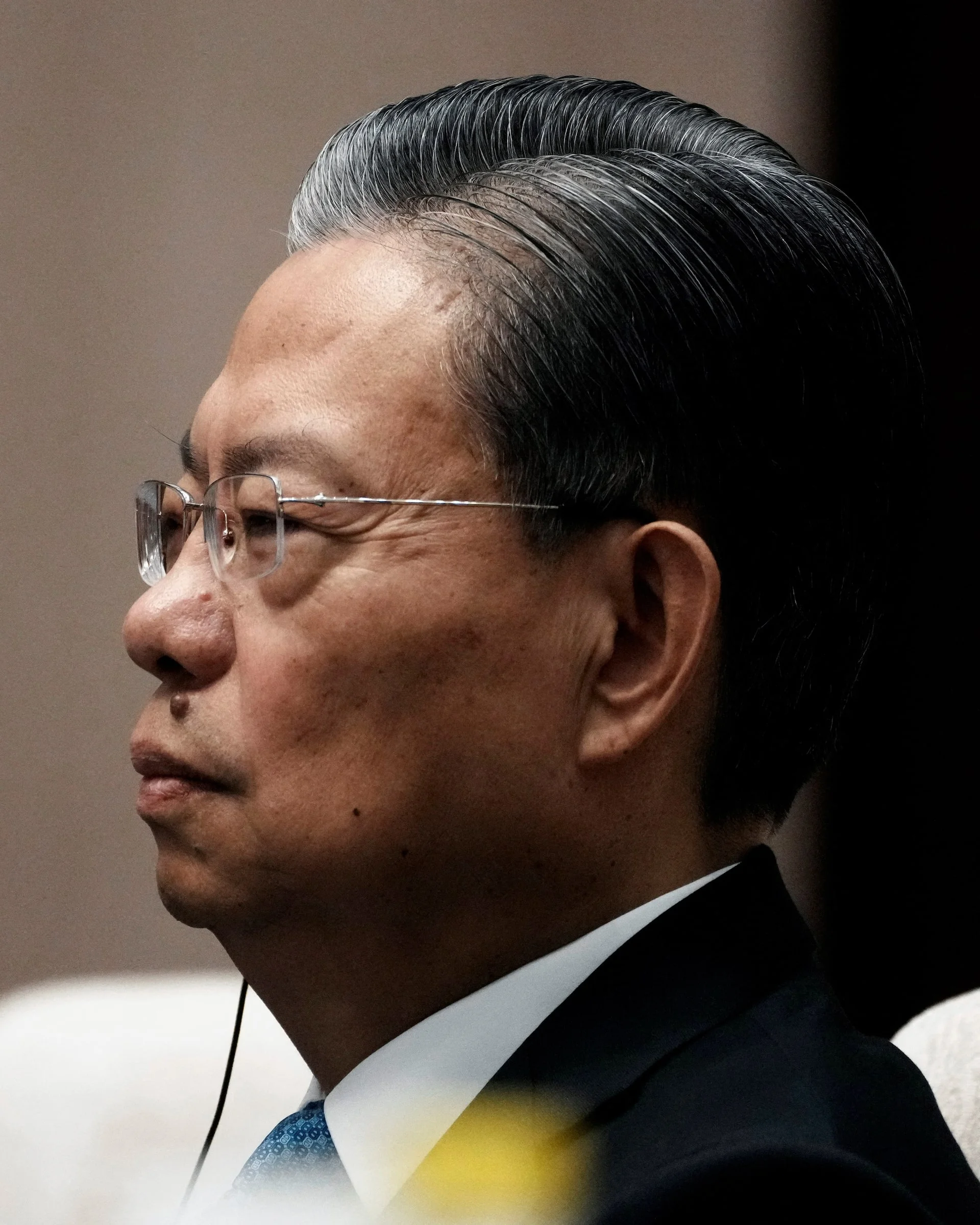
Zhao Leji
 China
ChinaAlso known as: Leji Zhao, 赵乐际
Birthday
March 8, 1957
Birth Sign
Pisces
Birthplace
Xining, Qinghai, China
Age
69 years old
About
Zhao Leji is a Chinese politician who serves as Chairman of the Standing Committee of the National People's Congress, a post he has held since March 2023. He is the third-ranking member of the Chinese Communist Party's Politburo Standing Committee, behind General Secretary Xi Jinping and Premier Li Qiang, which makes him the country's top legislator and one of the most powerful figures in Beijing.
His authority runs through the NPC's Standing Committee, the body that passes and amends national laws between the legislature's full annual sessions. Before that, from 2017 to 2022, he ran the Central Commission for Discipline Inspection, the party's internal anti-corruption apparatus, at a time when investigations reached into the highest levels of the military and provincial governments. He entered the Politburo in 2012 and has been a fixture of the top leadership circle for more than a decade.
His public profile sits far from celebrity culture. There are no fan accounts, no merchandise, no viral moments, and his name rarely trends outside political and China-watching circles. What he does have is procedural weight: he signs off on legislation, chairs meetings with visiting parliamentary speakers, and sets the tone for how China's legislature presents itself to the world.
Early Life & Background
Zhao Leji was born on March 8, 1957, in Xining, the capital of Qinghai Province, a high-altitude region on the northeastern edge of the Tibetan Plateau. Official biographies list his ancestral home as Xi'an in Shaanxi Province, a distinction that reporters and biographers have sometimes blurred over the years, calling him a native of Shaanxi when he was in fact born in Qinghai. His parents both worked as officials, according to biographical profiles, which placed the family within the administrative class of the early People's Republic.
His formal working life began at 17. In September 1974, during the tail end of the Cultural Revolution, he was sent down to the countryside, the compulsory rural relocation that shaped a generation of urban youth. That assignment marked his first job and his first sustained exposure to the party's grassroots machinery. He joined the Chinese Communist Party during the 1970s, the decade when many of his cohort entered political life through similar rural stints.
He studied in both Beijing and Qinghai, building the mix of central and provincial credentials that would define his later career. The whole of his early professional trajectory unfolded inside Qinghai Province, where he moved through party and government roles across roughly three decades. He worked his way up to party secretary of Qinghai, then took the same post in Shaanxi, the province his family claimed as home. From there he moved to Beijing to head the CCP Central Organization Department, the office that oversees appointments to senior party and state positions nationwide.
Career Growth
The breakthrough in Zhao Leji's career came in 2012, when he was elected to the Politburo at the 18th Party Congress, the first time he entered the party's top decision-making body. Five years later, at the 19th Party Congress in October 2017, he was elevated to the Politburo Standing Committee, the seven-member core of Chinese power, and simultaneously handed control of the Central Commission for Discipline Inspection.
That CCDI post put him at the center of the anti-corruption campaign between 2017 and 2022. He presided over investigations that reached into provincial governments, state-owned enterprises, and the military. The role made him a figure of genuine consequence in Beijing, though his public appearances remained tightly scripted and his personal profile stayed deliberately low.
In March 2023, he became Chairman of the Standing Committee of the National People's Congress, succeeding Li Zhanshu. As top legislator he oversees the drafting and passage of national laws, presides over the NPC's twice-yearly Standing Committee sessions, and represents the legislature abroad. His 2026 calendar shows the pattern: in June he met Cambodia's senate president, Myanmar's president, and pledged deeper legislative exchanges with Laos. August brought talks with the Speaker of the Czech Chamber of Deputies and a meeting in Beijing with Jordan's King. September was busier still, with the Egyptian senate speaker, Australia's House of Representatives speaker, Indonesia's People's Consultative Assembly chairman Ahmad Muzani, the president of Angola's National Assembly, and the president of Austria's National Council all in the schedule, plus a September 30 symposium marking the birth centenary of a former senior Chinese legislator. In May 2026 he made a goodwill visit to Kazakhstan, inspecting the CNPC Central Asia Ltd facility in Astana, and conveyed condolences on the passing of Xaysomphone Phomvihane of Laos.
Career Timeline
Public Image & Style
Zhao Leji's public image is that of a disciplined, low-key administrator. He wears dark suits, reads from prepared texts, and rarely deviates from the formal register of Chinese state protocol. There is no signature style, no catchphrase, and no social media voice. His presence is institutional rather than personal.
Foreign media coverage tends to describe him in procedural terms, as the man who runs the legislature or the official who chaired a particular meeting with a visiting parliamentary delegation. He is not a subject of profile writing in the way that Xi Jinping or Li Qiang are. Within China-watching circles, he is read as a reliable executor of party decisions rather than an ideological voice or a factional leader.
His image is also shaped by what is absent. No leaked recordings, no candid photographs, no off-script moments. The overall impression is of a politician who has built his reputation on discretion and procedural competence, and who intends to keep it that way.
Fame & Fandom (iFAMOUS Rankings)
Zhao Leji operates in a sphere defined by state protocol and legislative authority, not celebrity culture. The iFANN Global Fame Engine evaluated him for its October 2026 cycle and found no placement in the published rankings, whether in the Global Top 1,000 or any Top-100 scope list. That result reflects the nature of his visibility: his influence is political and geopolitical, concentrated in China and among the diplomatic and policy communities that track Chinese governance, rather than part of a mass-culture fame index. He is also not on the September 2026 iFAMOUS Rankings flagship list.
There is no organized fanbase around him, and no fandom name, because none has ever been documented. His audience, such as it is, consists of China analysts, foreign ministry officials, parliamentary counterparts, and journalists who cover the National People's Congress. They follow him for what he does, not for who he is. No fan campaigns, birthday tributes, streaming pushes, or viral interactions exist, and his own engagements remain confined to diplomatic meetings, legislative sessions, and state visits. The closest thing to a recurring public ritual is the twice-yearly NPC Standing Committee session, where his opening remarks are parsed for signals about legislative priorities.
Interesting Facts and Legends
His official biography lists Xi'an, Shaanxi, as his ancestral home even though he was born in Xining, Qinghai, a mismatch that has tripped up more than one foreign correspondent over the years.
He was sent down to the countryside at 17, in September 1974, putting him among the last cohorts of urban youth dispatched under the Cultural Revolution's rural relocation program.
His entire early career was spent inside a single province. Qinghai, one of China's least populous regions, produced a Politburo Standing Committee member in Zhao, an unusual path for someone who did not come up through the coastal economic hubs or the Beijing party apparatus.
He holds no personal social media accounts. His public communications flow entirely through state channels, primarily the NPC, Xinhua, and the Ministry of Foreign Affairs.
No verified height, no disclosed salary, and no published net worth figure exists for him, which is standard for senior Chinese officials. Any dollar amount attached to his name online should be treated as unverified.
Family & Personal Life
Zhao Leji was born to parents who both served as officials, according to biographical profiles of his early life. He has kept the rest of his family background almost entirely out of public view, in keeping with the privacy conventions that govern senior Chinese political figures.
He is married and has one son. Neither his spouse's name nor his son's identity appears in credible public sources. There is no documentation of where the family lives, what his spouse does, or whether his son holds any public role. Chinese state media has never published a family photograph or profile.
This level of discretion is not unusual at his rank. Members of the Politburo Standing Committee rarely discuss their households in interviews or official biographies, and their relatives are generally shielded from press attention. For Zhao, the effect is that his family life remains one of the least documented aspects of a career that is otherwise a matter of public record.
Notable Connections
Zhao Leji's professional associations are institutional rather than collaborative. He sits on the Politburo Standing Committee alongside Xi Jinping, Li Qiang, Wang Huning, Cai Qi, Ding Xuexiang, and Li Xi. As NPC Standing Committee chairman he works with the legislature's vice chairpersons and the broader NPC leadership structure. Abroad, his counterparts are parliamentary speakers and senate presidents, including Egypt's Essam El Din Ahmed Mohamed Farid, Indonesia's Ahmad Muzani, and Australia's House of Representatives speaker.
Relationships & Dating History
Zhao Leji is married and has one son. That is the full extent of what credible public sources document about his personal relationships. His spouse's name has never been disclosed in state media or independent reporting, and his son's identity is likewise private.
There is no public record of prior marriages, divorces, or romantic relationships of any kind. This is not unusual for a figure at his rank. Senior Chinese political leaders are expected to keep their family lives out of the public eye, and state media does not cover their personal affairs. Foreign correspondents who profile Politburo Standing Committee members routinely note the same gap: the official biography stops at professional posts and does not extend to the household.
As of 2026, the latest reported status remains married. No further details are verifiable, and none should be assumed from the silence. The absence of information here reflects the privacy conventions of Chinese elite politics rather than any particular secrecy on Zhao's part.
- MarriedNot publicly disclosedCurrentZhao Leji is married and has one son; his spouse's name has never been disclosed in credible public sources.
Salary, Net Worth In 2026
No credible net worth figure exists for Zhao Leji. As a senior Chinese state official, his compensation and personal assets are not reported by celebrity-net-worth outlets, and Chinese government officials at his level do not publish financial disclosures in the way that, say, US cabinet members or members of Congress do. Any dollar amount circulating online should be treated as unverified.
What can be said is structural. His income comes from state and party salaries tied to his positions on the Politburo Standing Committee and as Chairman of the NPC Standing Committee. There are no known business ventures, endorsement deals, speaking fees, book royalties, or investment vehicles attached to his name in public records. He does not appear on any wealth lists, and no property holdings have been documented in credible reporting.
This is consistent with the broader pattern for China's top leadership. Where foreign leaders often have publicly traded assets, book deals, and paid speaking circuits, senior CCP officials operate under strict internal rules that bar most private business activity and require disclosure to party organs rather than the public. That makes any external estimate of Zhao's personal wealth speculative by definition. iFANN does not publish a figure for him because there is no reliable basis for one.
Awards & Accolades
View 2 records, honours and achievementsKnown For
Chairman of the Standing Committee of the National People's Congress
2023-present · Top legislator of China
Politburo Standing Committee of the Chinese Communist Party
2017-present · Third-ranking member
Central Commission for Discipline Inspection
2017-2022 · Head of the party's anti-corruption body
CCP Central Organization Department
2012-2017 · Head of nationwide cadre appointments
Keywords
Sources
Quick Facts
- Profession
- Politician
- Born
- March 8, 1957
- Birthplace
- Xining, Qinghai, China
- Ancestral Home
- Xi'an, Shaanxi, China
- Gender
- Male
- Birth Sign
- Pisces
- Current Position
- Chairman, Standing Committee of the National People's Congress
- Party Rank
- Third-ranking member of the Politburo Standing Committee
- Children
- 1 son
Personal Details
- Full Name
- Zhao Leji
- Children
- 1 son
- Education
- Studied in Beijing and Qinghai
Frequently Asked Questions
Who is Zhao Leji?
How old is Zhao Leji?
Where was Zhao Leji born?
What is Zhao Leji's net worth?
Is Zhao Leji married and does he have children?

Join the community
fans discussing