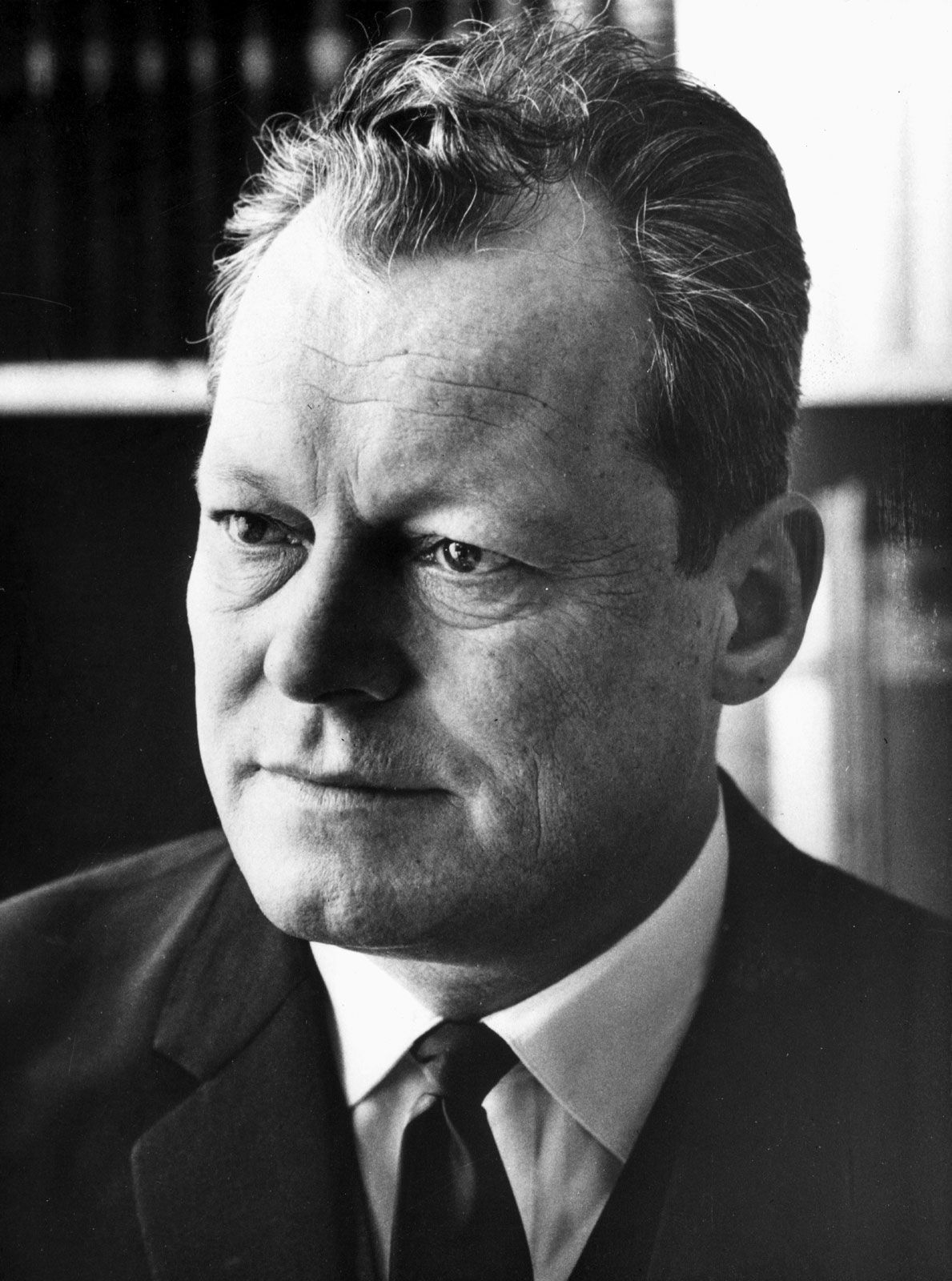
Willy Brandt
 Germany
politician•statesman•journalist
Also known as: Herbert Ernst Karl Frahm
Birthday
December 18, 1913
Birth Sign
Sagittarius
Birthplace
Lübeck, Germany
Age
Died at 78
About
Willy Brandt was a German statesman who served as Chancellor of West Germany from 1969 to 1974, the first Social Democrat to hold the office since 1930. Born Herbert Ernst Karl Frahm, he adopted the name Willy Brandt during his exile from Nazi Germany. He is best remembered for his policy of Ostpolitik, which sought reconciliation with Eastern Europe and the Soviet Union, earning him the Nobel Peace Prize in 1971.
Brandt's political career spanned decades, from his early days as a journalist and resistance fighter to his roles as Governing Mayor of West Berlin, Foreign Minister, and leader of the Social Democratic Party. His legacy includes the famous Warsaw Genuflection, a gesture of humility before the Warsaw Ghetto Memorial that became a symbol of post-war atonement. After his resignation in 1974, he continued to influence global politics as president of the Socialist International and chairman of the Brandt Commission, which addressed North-South economic inequality.
He died on October 8, 1992, in Unkel, Germany, leaving behind a legacy of peace and reconciliation that continues to inspire.
Early Life & Background
Brandt was born into a working-class family in the port city of Lübeck. His mother, Martha Frahm, worked as a cashier, and his father, a teacher, left before his birth. Raised primarily by his maternal grandfather, Ludwig Frahm, a socialist factory worker, Brandt absorbed political ideas early. He joined the Socialist Youth at 15 and the SPD at 16, despite the minimum age of 18.
In 1931, he broke from the SPD to help form the more radical Socialist Workers' Party. When the Nazis came to power, he fled to Norway, adopting the pseudonym Willy Brandt. He studied philosophy and history in Oslo and worked as a journalist, reporting from the Spanish Civil War. After Germany occupied Norway, he escaped to Sweden, where he continued his political work until the war's end.
Returning to Germany in 1945, he covered the Nuremberg trials as a correspondent and reclaimed his citizenship. He rejoined the SPD in 1948, beginning a rapid rise in Berlin politics.
Career Growth
Brandt's political ascent was meteoric. In 1957, he became Governing Mayor of West Berlin, a post he held until 1966. His leadership during the construction of the Berlin Wall in 1961 made him a symbol of Western resolve. He then served as Foreign Minister and Vice Chancellor in the Grand Coalition from 1966 to 1969.
As Chancellor from 1969, Brandt launched Ostpolitik, negotiating treaties with the Soviet Union, Poland, and East Germany that normalized relations and recognized post-war borders. This policy earned him the Nobel Peace Prize in 1971. Domestically, he expanded the welfare state and promoted democratic reforms.
His chancellorship ended abruptly in 1974 when his aide Günter Guillaume was exposed as a Stasi spy. Brandt resigned, taking responsibility. He later chaired the Brandt Commission, which produced the influential Brandt Report on global development, and served as president of the Socialist International from 1976 to 1992.
Career Timeline
Public Image & Style
Brandt was seen as a charismatic, pragmatic statesman who embodied reconciliation. His Warsaw Genuflection in 1970 was a powerful image of humility. He was admired for his ability to bridge East and West, and his folksy manner endeared him to many. He was also criticized by some for being too conciliatory toward communism. His legacy is preserved by the Federal Chancellor Willy Brandt Foundation.
Fame & Fandom (iFAMOUS Rankings)
Willy Brandt never courted a fanbase in the modern sense. His supporters were voters and party members who aligned with his policies, particularly his Ostpolitik and social liberalization. There are no fan clubs, birthday billboards, or streaming pushes dedicated to his personal life. The legacy organizations that bear his name function as political foundations or documentary award bodies rather than fan clubs. Streets named after him serve as physical tributes rather than gathering spots for adoration. His public image was built on statesmanship and moral courage, not celebrity spectacle. While he remains a towering figure in German history, his influence is channeled through institutional memory and political discourse rather than fandom rituals. This distinction separates him from pop culture icons whose legends rely on crowd-shutting-down-street moments. Instead, Brandt's lore consists of solemn political acts and documented historical events that define post-war reconciliation. The Warsaw Genuflection stands as the defining image of his chancellorship, symbolizing a willingness to accept the complete consequences of defeat. His resignation amid the Guillaume affair further cemented his reputation for integrity, viewed by historians as a legendary act of principle. These stories are retold in educational contexts and history books, forming a mythology of moral leadership rather than entertainment. Despite his global stature, the iFANN Global Fame Rankings place him at specific points of recognition based on current attention metrics. He holds the position of the 33rd most famous person in Germany, a ranking holding steady from the previous cycle.
Interesting Facts and Legends
Willy Brandt learned to play the mandolin as a child, though he admitted he lacked talent. He loved singing workers' songs at party gatherings well into old age and gave up fishing after his chancellorship. His private library was eclectic, ranging from classics to political pamphlets, and he never met his biological father, a fact that shaped his early life. In 1933, he attended an illegal party conference in Dresden under the codename 'Willy Brandt.' Beyond these personal quirks, three stories define how history remembers him. The first is the Warsaw Genuflection of December 1970, where Brandt spontaneously fell to his knees before the monument to the victims of the Warsaw Ghetto Uprising, turning a moment of silence into a global symbol of reconciliation. Another legend involves his dramatic resignation in May 1974; despite no personal wrongdoing in the Guillaume Affair spy scandal, he stepped down immediately to uphold the rule of law, a rare act of integrity for a head of government. Finally, his 1970 visit to East Berlin marked the beginning of the end for Germany's division, a step toward unity that historians still cite as a precursor to the fall of the Berlin Wall.
Notable Quotes
“I think my real success was in having contributed to the fact that in the world in which we live the name of our country, Germany, and the concept of peace can again be mentioned in the same breath.”
“The discipline of the Third Reich is grovelling and not freedom. Fascism is intellectual slavery.”
“We will never accept the brutal division of this city, the unnatural partition of our country.”
Family & Personal Life
Brandt was married three times. His first wife, Anna Carlotta Thorkildsen, was Norwegian; they had a daughter, Ninja, born in 1940. His second wife, Rut Hansen, a Norwegian writer, bore him three sons: Peter, Lars, and Matthias. They divorced in 1980 after 32 years. His third wife, Brigitte Seebacher, an academic, was with him from 1983 until his death. His son Matthias became a respected actor.
Notable Connections
Relationships & Dating History
Brandt's first marriage to Anna Carlotta Thorkildsen lasted from 1941 to 1948, producing a daughter, Ninja. He then married Rut Hansen in 1948; they had three sons and divorced in 1980. After 32 years, they never saw each other again. In 1983, he married Brigitte Seebacher, who remained his wife until his death in 1992.
- MarriedAnna Carlotta Thorkildsen1941 - 1948First wife, mother of his daughter Ninja.
- MarriedRut Hansen1948 - 1980Second wife, mother of his three sons.
- MarriedBrigitte Seebacher1983 - 1992CurrentThird wife, married until his death.
Death & Aftermath
Died
October 8, 1992 (aged 78)
Death Place
Unkel am Rhein
Cause of Death
Laryngeal cancer
Willy Brandt died on October 8, 1992, at his home in Unkel am Rhein. The former West German Chancellor passed away after a long battle with laryngeal cancer, a diagnosis confirmed by medical professionals following surgery in 1989. His final days were spent in private. Tributes poured in immediately upon the announcement, with President Richard von Weizsäcker honoring him as one of the most outstanding statesmen of the twentieth century who shaped post-war Europe. The Socialist International issued a formal statement mourning the loss of its president, while the German Bundestag observed moments of silence to mark the end of an era defined by reconciliation and social democracy. The funeral service took place six days later on October 14, 1992, at St. Hedwig's Cathedral in Berlin.
High-ranking officials including Chancellor Helmut Kohl attended the ceremony, which blended state protocol with the personal wishes of Brandt's family. Following the service, Brandt was cremated, and his ashes were interred at Waldfriedhof Zehlendorf cemetery alongside other notable German figures. Eulogies focused on his commitment to peace and his historic gesture in Warsaw, reinforcing his legacy as a champion of human rights. In the years following his death, the Willy Brandt Foundation continued to promote social democratic ideals and support research on European integration. Numerous scholarships and awards bearing his name were established to honor his contributions to global development and human rights. His estate remained under the care of his family, who maintained a low profile while preserving his archive through the foundation.
Net Worth (Estate Value)
$10 Million
iFANN Editorial Team estimate
Per iFANN's editorial analysis, Willy Brandt's net worth is estimated at $10 million as of 2026, derived from his political career, book royalties, and estate management. As a chancellor, he earned a substantial salary and later received a pension. His autobiography and other writings continue to generate royalties. The Federal Chancellor Willy Brandt Foundation manages his archive and licenses his name and image. The estate's value has been maintained through these sources, with no major commercial ventures.
Awards Won (2)
Brandt won the Nobel Peace Prize in 1971 for his efforts to reconcile West Germany with Eastern Europe. He also received the International Rescue Committee Freedom Award in 1957.
1971 · Peace
Ostpolitik
1957 · Freedom
Political leadership
Known For
Ostpolitik
1970 · Architect
Nobel Peace Prize
1971 · Recipient
Warsaw Genuflection
1970 · Participant
Keywords
Sources
Quick Facts
- Profession
- Politician, Statesman, Journalist
- Born
- December 18, 1913
- Birthplace
- Lübeck, Germany
- Died
- October 8, 1992
- Death Place
- Unkel, Germany
- Gender
- Male
- Spouse
- Brigitte Seebacher
- Birth Sign
- Sagittarius
- Children
- Ninja Frahm, Peter Brandt, Lars Brandt, Matthias Brandt
- Education
- Gymnasium in Lübeck; University of Oslo
Personal Details
- Full Name
- Herbert Ernst Karl Frahm
- Spouse
- Brigitte Seebacher
- Children
- Ninja Frahm, Peter Brandt, Lars Brandt, Matthias Brandt
- Education
- Gymnasium in Lübeck; studied philosophy and history at the University of Oslo
Frequently Asked Questions
What was Willy Brandt's real name?
Why did Willy Brandt resign as chancellor?
What was Willy Brandt's Ostpolitik?
How many children did Willy Brandt have?
What was the Brandt Report?
Join the community
fans discussing