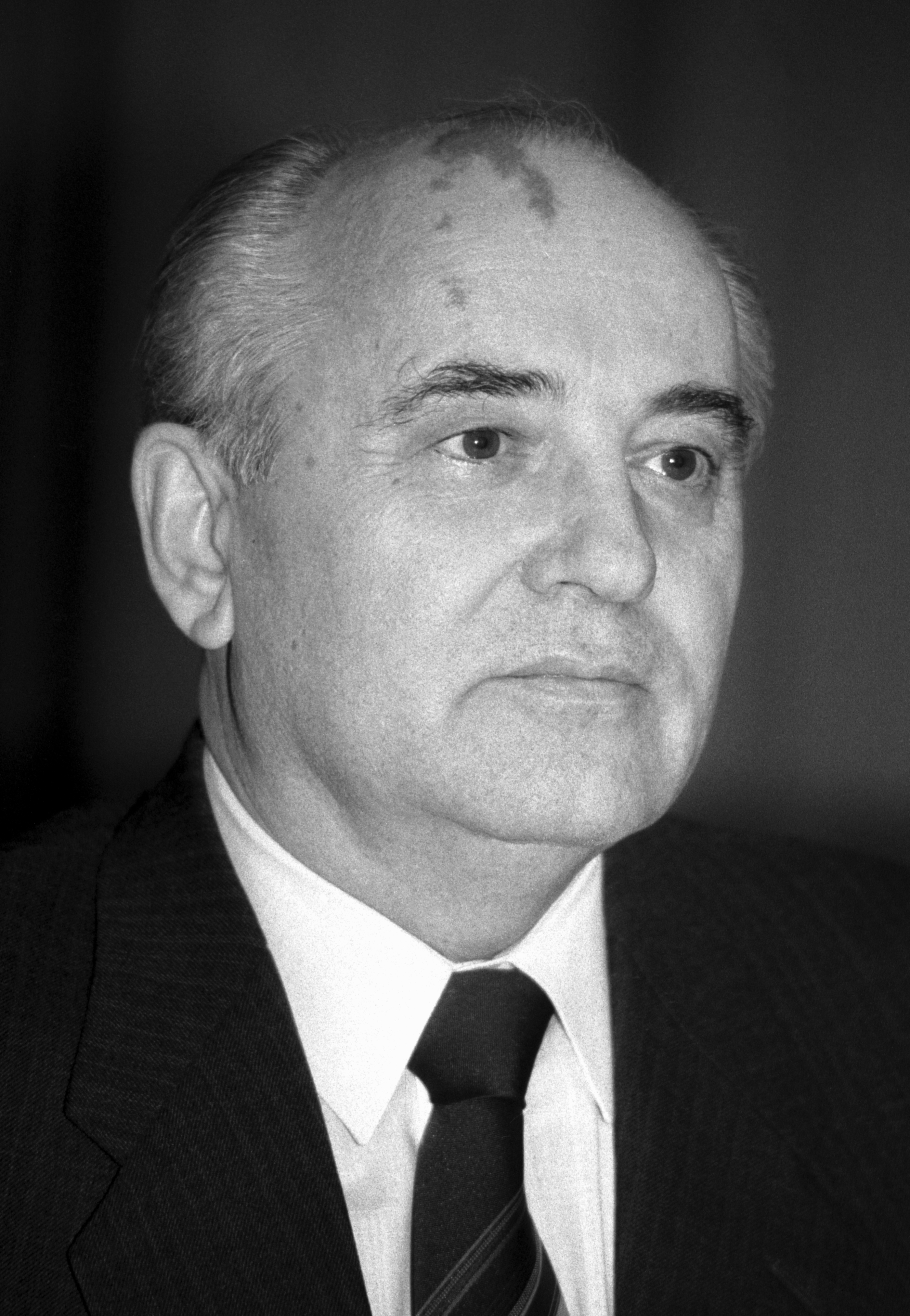
Mikhail Gorbachev
 Russia
politician•jurist•environmentalist
Birthday
+1931-03-02
Birth Sign
Pisces
Birthplace
Privolnoye
Age
Died at 91
About
Mikhail Sergeyevich Gorbachev, born March 2, 1931, in the village of Privolnoye, was a Russian politician and the final leader of the Soviet Union. His tenure as General Secretary of the Communist Party began in 1985, and he also served as head of state from 1988 until the Soviet Union's dissolution in 1991. Gorbachev's political journey saw him evolve from an adherent of Marxism-Leninism to a proponent of social democracy by the early 1990s. He rose through the ranks of Soviet politics, eventually becoming a prominent figure in Moscow. As General Secretary, Gorbachev initiated sweeping reforms. He pursued a policy of glasnost, or openness, which encouraged greater freedom of speech and the press, alongside perestroika, a restructuring aimed at decentralizing economic decision-making. On the international stage, he played a significant role in ending the Cold War, notably through summits with U.S. President Ronald Reagan and by withdrawing troops from the Soviet-Afghan War. His decision not to intervene militarily when Eastern Bloc countries abandoned communist rule in 1989 was a pivotal moment. Despite his intentions to preserve the Soviet state, Gorbachev's reforms ultimately led to its fragmentation. Nationalist movements within the republics grew, and an attempted coup by hardliners in August 1991 hastened the Soviet Union's collapse, an outcome Gorbachev did not desire. After leaving office, he established the Gorbachev Foundation and remained an active public figure, often critical of subsequent Russian leadership. He was awarded the Nobel Peace Prize in 1990 for his role in ending the Cold War. Gorbachev passed away on August 30, 2022, at the age of 91, leaving a complex legacy as a transformative figure in late 20th-century history.
Fame & Fandom
Mikhail Gorbachev never cultivated a fandom in the manner of pop stars or athletes, for his audience consisted of citizens, politicians, and global leaders rather than devotees bound by shared rituals or inside jokes. His supporters were organized as civic movements advocating for perestroika and glasnost, while his detractors viewed him through the lens of ideological betrayal; no formal name ever emerged to describe either group. The legacy of his interactions was defined by diplomatic engagement with figures like Ronald Reagan and Margaret Thatcher rather than fan-funded campaigns or celebrity-style adoration. Despite this absence of traditional fandom, his standing in historical memory remains immense, a status quantified by contemporary metrics. According to the iFANN Global Fame Rankings, he is currently the 11th most famous person from Russia, a position holding steady from the previous cycle. This placement reflects a sustained level of global attention across media coverage, search activity, and cultural consumption signals worldwide. While he did not inspire street frenzies or fainting crowds, his presence continues to spark passionate debate regarding the end of the Cold War. The image of him being booed by Russian nationalists stands as a recurring motif, illustrating the deep division within his homeland long after his tenure ended. His death in 2022 marked the close of an era, yet the data suggests his profile has not diminished. He remains a figure whose name triggers immediate recognition among those who study the geopolitical shifts of the late twentieth century. The rankings confirm that his influence persists in the collective consciousness, transcending the political factions that once opposed him.
Interesting Facts and Legends
Mikhail Gorbachev received the Nobel Peace Prize in 1990 for his role in ending the Cold War and fostering international cooperation. A widely retold story concerns the Reykjavík Summit of October 1986, where he and U.S. President Ronald Reagan nearly agreed to abolish all nuclear weapons before disagreements over the Strategic Defense Initiative caused the talks to collapse. This event serves as a cornerstone of Cold War lore, frequently dramatized in modern films such as The Brink of War to highlight the tension of that moment. Another verified historical fact is his speech at the United Nations in December 1988, where he unilaterally announced the withdrawal of 500,000 Soviet troops from Eastern Europe. This announcement effectively signaled the end of the Brezhnev Doctrine and paved the way for the revolutions of 1989 across Eastern Europe. The resulting celebrations in Warsaw, Prague, Budapest, and Berlin are often described as the moment the Iron Curtain fell. In his later years, Gorbachev remained active through the Gorbachev Foundation, advocating for environmental causes and nuclear disarmament until his death on August 30, 2022.
Death & Aftermath
Died
+2022-08-30 (aged 91)
Death Place
Moscow, Russia
Cause of Death
Long illness
Mikhail Gorbachev spent his final days in a Moscow hospital following a prolonged illness that preceded his passing on August 30, 2022. The circumstances of his death were treated as a natural occurrence, with no criminal inquiry or civil litigation initiated by any authority to investigate the timeline of his decline. Global reaction to the news was immediate, characterized by tributes from world leaders and institutions rather than public vigils typical of entertainment figures. The Kennedy Center for the Performing Arts and the Harvard Davis Center issued statements honoring his role in ending the Cold War, while the Nobel Prize Foundation reiterated his significance as the 1990 Peace Prize laureate. Streaming platforms saw increased visibility for biographies and historical documentaries featuring him, though music services recorded no significant surges linked to his name.
The funeral service took place on September 3, 2022, at the House of Unions in Moscow, attended by dignitaries including Russian President Vladimir Putin and former U.S. President George H.W. Bush via video message. Representatives from over 50 countries gathered for the Orthodox Christian burial conducted at Novodevichy Cemetery, where eulogies were delivered by Russian officials and performances provided by the Moscow Conservatory orchestra. His estate was handled privately by his daughter Irina Voronova and son-in-law Viktor Ilyin. The Gorbachev Foundation continues to operate, maintaining archives and promoting environmental and peace initiatives established during his lifetime.
Awards & Accolades
Keywords
Quick Facts
- Profession
- politician, jurist, environmentalist
- Born
- +1931-03-02
- Birthplace
- Privolnoye
- Died
- +2022-08-30
- Death Place
- Central Clinical Hospital
- Gender
- Male
- Spouse
- Raisa Gorbacheva
- Birth Sign
- Pisces
Personal Details
- Spouse
- Raisa Gorbacheva
Join the community
fans discussing