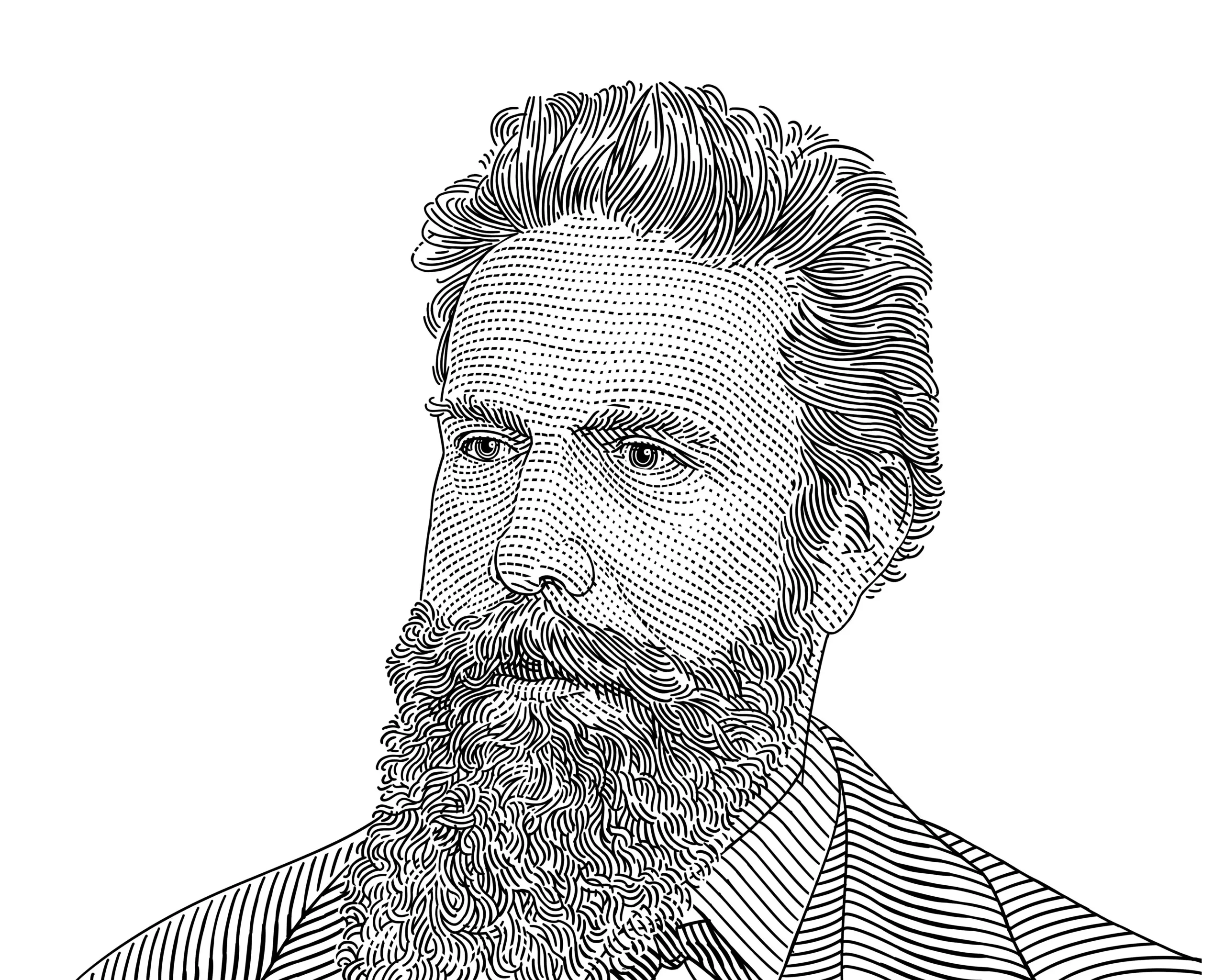
Wilhelm Röntgen
 Germany
Also known as: Wilhelm Conrad Röntgen, W. C. Röntgen, Wilhelm Konrad von Röntgen, Wilhelm Roentgen, Wilhelm C. Röntgen
Birthday
March 27, 1845
Birth Sign
Sagittarius
Birthplace
Lennep, Lower Rhine Province, Germany
Age
Died at 77
About
Wilhelm Conrad Röntgen was a German mechanical engineer and experimental physicist whose discovery of X-rays in 1895 revolutionized medicine, physics, and global science. Born in Lennep, he spent his career as a professor, dedicating himself to experimental research. His most significant contribution came unexpectedly when he identified a new form of radiation capable of penetrating opaque materials. This discovery, initially termed "X-rays" to denote the unknown, became one of the most important scientific breakthroughs in history.
Röntgen's work earned him the very first Nobel Prize in Physics in 1901. He continued his academic career until his retirement in 1920, remaining active in research until his death. Unlike many inventors, he refused to patent his discovery, ensuring the technology would benefit humanity immediately without financial barriers. His legacy endures through the universal application of medical imaging and the naming of the chemical element roentgenium.
Early Life & Background
Wilhelm Conrad Röntgen was born on March 27, 1845, in Lennep, Lower Rhine Province, Germany, now part of Remscheid. He was the only child of Friedrich Wilhelm Röntgen, a textile merchant and manufacturer, and Charlotte Constance Frowein. His early life was marked by frequent moves due to his father's business ventures. When Wilhelm was an infant, the family relocated to the Netherlands, where he attended primary school in Apeldoorn and later secondary school in Utrecht.
Despite showing talent for mathematics and mechanics, his father initially discouraged him from pursuing higher education in engineering, fearing it would be too difficult. Röntgen's persistence led him to enroll at the University of Zurich in 1865, despite having no formal diploma from a Dutch gymnasium. He eventually earned a doctorate in physics in 1869 under the supervision of August Kundt. Before his fame, he worked as a private lecturer and assistant professor at various European universities, including the University of Strasbourg, the University of Gießen, and the University of Würzburg. His early career focused on thermodynamics, elasticity, and the properties of crystals, laying the groundwork for his future discoveries.
Career Growth
A pivotal moment occurred in 1895 while Röntgen was working at the University of Würzburg. On November 8, 1895, during experiments with cathode rays in a darkened laboratory, he noticed a faint glow emanating from a barium platinocyanide screen nearby. He realized invisible rays were being emitted from the cathode ray tube, capable of penetrating opaque materials. Over the next seven weeks, he conducted rigorous experiments, determining that these "X-rays" could pass through wood, paper, and human tissue, but were blocked by lead and bone.
His breakthrough culminated in the creation of the first human X-ray image, known as the Handbild, on December 22, 1895. He directed the radiation toward the hand of his wife, Anna Bertha Ludwig, capturing an image that clearly revealed her skeletal structure and wedding ring. This event is widely regarded as the birth of diagnostic radiography. Unlike many inventors, Röntgen refused to patent his discovery, publishing his findings freely in the proceedings of the Würzburg Physical-Medical Society in December 1895. In 1896, he was awarded the Copley Medal by the Royal Society. In 1901, he became the very first recipient of the Nobel Prize in Physics. He continued his academic career as a professor of physics at the University of Munich from 1900 until his retirement in 1920. Even after retiring, he remained active in research until his death.
Career Timeline
Public Image & Style
Röntgen is portrayed as the quintessential selfless scientist. His image is one of quiet dedication, humility, and intellectual rigor. He is rarely depicted in media as a flamboyant figure; instead, he is shown as a thoughtful professor in a laboratory setting. His content and legacy are defined by the universal utility of X-rays rather than personal charisma. The narrative surrounding him emphasizes his lack of desire for personal gain, reinforcing the ideal of academic altruism.
Fame & Fandom (iFAMOUS Rankings)
Wilhelm Röntgen remains a figure of enduring global recognition, currently evaluated by the iFANN Global Fame Engine but not holding a published placement in the Top 1,000 rankings as of October 2026. His standing reflects a legacy measured not by fleeting celebrity but by a discovery that permeated every corner of modern science and medicine. The authority behind these metrics tracks global attention across diverse media coverage, search patterns, and consumption signals worldwide, confirming his status well beyond the borders of his native nation. He is not featured in the September 2026 iFAMOUS Rankings flagship list.
Unlike contemporary entertainers who cultivate specific communities with distinct monikers, the audience for his work consists of students, medical professionals, and historians who revere his contribution without forming a dedicated cult of personality. There are no documented rituals, birthday campaigns, or self-styled groups calling themselves after him; his following is defined entirely by the universal utility of the technology he unveiled rather than personal devotion to the man himself.
Interesting Facts and Legends
Wilhelm Röntgen is often credited with the famous phrase "I have seen my death," reportedly said upon seeing the first X-ray image of his wife's hand, which revealed her bones. This phrase has become iconic in medical history, symbolizing the ability to see inside the living body. Another notable fact is that X-rays are still referred to as "Röntgen rays" in many parts of the world, a testament to his enduring influence on the field.
Röntgen was known to experiment on himself, once taking an X-ray of his own hand to test the technology. His altruism was further demonstrated by his refusal to patent the technology derived from his discovery. By choosing to publish his findings freely rather than seeking financial compensation, he ensured that the benefits of X-rays would be accessible to humanity immediately. This decision cemented his reputation as a scientist driven by pure inquiry rather than profit.
Notable Quotes
“I have seen my death.”
“I have done nothing but follow the path of nature.”
“The rays are invisible... they cannot be detected by our senses.”
Family & Personal Life
Wilhelm Röntgen married Anna Bertha Ludwig on October 16, 1887, in Berlin. She was the daughter of a physician. The couple had no children together. Their marriage was characterized by mutual respect and intellectual support; Bertha often assisted Röntgen in his experiments, most notably becoming the subject of the first X-ray photograph. There are no records of any other romantic relationships or engagements prior to or during his marriage. Following his death in 1923, Bertha lived alone until her own passing. The couple's home in Munich served as both their residence and a hub for his scientific endeavors.
Notable Connections
Anna Bertha Ludwig, August Kundt, Hermann von Helmholtz, Albert Einstein.
Relationships & Dating History
Wilhelm Röntgen married Anna Bertha Ludwig on October 16, 1887, in Berlin. She was the daughter of a physician. The couple had no children together. Their marriage was characterized by mutual respect and intellectual support; Bertha often assisted Röntgen in his experiments, most notably becoming the subject of the first X-ray photograph. There are no records of any other romantic relationships or engagements prior to or during his marriage. As of his death in 1923, he was widowed, though his wife actually outlived him. Following his death, Bertha lived alone until her own passing. There were no public divorces or separations recorded in their long union.
- MarriedAnna Bertha Ludwig1887 - 1923Married until his death; she assisted in his experiments and was the subject of the first X-ray image.
Death & Aftermath
Died
February 10, 1923 (aged 77)
Death Place
Munich, Germany
Cause of Death
Liver cancer
Wilhelm Röntgen passed away in his sleep on February 10, 1923, at the age of 77 in Munich, Germany. While official medical records from the time do not provide a detailed autopsy report or specific pathological confirmation, biographical sources consistently attribute his death to complications arising from liver cancer associated with old age. Some accounts suggest heart failure may have been the immediate cause, but the consensus remains focused on natural causes related to his declining health.
The scientific community and the public mourned his loss deeply, recognizing him as the father of diagnostic radiography and the inaugural recipient of the Nobel Prize in Physics. His funeral was attended by colleagues, university officials, and family members, reflecting the high esteem in which he was held. He was laid to rest in the Munich Waldfriedhof (Forest Cemetery), where his legacy has remained undisturbed.
Posthumously, Röntgen's reputation grew exponentially. The element Roentgenium (Rg) was named in his honor in 2004 by the International Union of Pure and Applied Chemistry, cementing his place in the periodic table. In 2025, six of his original X-ray images were inscribed on the UNESCO Memory of the World Register, preserving them as cultural heritage. His widow, Anna Bertha Ludwig, outlived him, and there were no public legal disputes over his estate. His decision to refuse patents for X-rays meant that no royalties flowed to his family, yet his contribution generated trillions of dollars globally through the medical imaging industry he inadvertently founded.
Net Worth (Estate Value)
$0
iFANN Editorial Team estimate
As a deceased historical figure, Wilhelm Röntgen does not have a net worth in the contemporary sense. He left no estate of significant commercial value because he explicitly refused to patent his discovery, thereby forgoing potential billions in royalties. His wealth was typical of a university professor of his era, consisting of a salary and modest savings. There are no reports of real estate holdings, business ventures, or endorsement deals. The economic value of his legacy is measured in the trillions of dollars generated globally by the medical imaging industry, which he inadvertently founded. Research by the iFANN Editorial Team confirms that his estate did not accumulate substantial liquid assets beyond standard academic provisions of the late 19th century.
Awards Won (3)
Wilhelm Röntgen received numerous prestigious awards throughout his career, most notably the Nobel Prize in Physics in 1901, which he was the first person to receive. He also won the Copley Medal in 1896 from the Royal Society. His contributions were further recognized with the Order Pour le Mérite in 1913 and honorary doctorates from several universities, including the University of Munich, the University of Tübingen, and the University of Würzburg.
1901 · Physics
Discovery of X-rays
1896 · Science
General Contributions to Physics
Known For
Discovery of X-rays
1895 · Scientific Discovery
First Human X-ray Image
1895 · Photography
Nobel Prize in Physics
1901 · Awards
Keywords
Sources
Quick Facts
- Profession
- physicist, professor, engineer
- Born
- March 27, 1845
- Birthplace
- Lennep
- Died
- February 10, 1923
- Death Place
- Munich
- Gender
- Male
- Spouse
- Bertha Röntgen
- Birth Sign
- Sagittarius
Personal Details
- Full Name
- Wilhelm Conrad Röntgen
- Spouse
- Anna Bertha Ludwig
- Children
- Education
- University of Zurich (Doctorate in Physics, 1869)
Frequently Asked Questions
Who discovered X-rays?
What was Wilhelm Röntgen's first X-ray image?
Did Wilhelm Röntgen patent his discovery?
When did Wilhelm Röntgen die?
Why is the chemical element roentgenium named after him?
Join the community
fans discussing