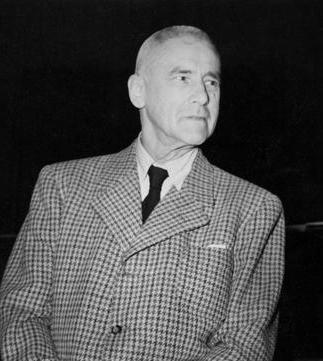
Wilhelm Frick
 Germany
Birthday
+1877-03-12
Birth Sign
Pisces
Birthplace
Alsenz
Age
Died at 69
About
Wilhelm Frick was a German Nazi politician and convicted war criminal, born on March 12, 1877, in the small town of Alsenz. A lawyer by training, he climbed the ranks of the Nazi Party to become one of its most powerful figures during the Third Reich. Frick served as Minister of the Interior in Adolf Hitler's cabinet from 1933 to 1943, and later as the last governor of the Protectorate of Bohemia and Moravia. His career, however, was marred by his involvement in the regime's most heinous policies, leading to his execution after the Nuremberg trials. Frick's political journey began in Munich, where he headed the criminal police. In 1923, he participated in Hitler's failed Beer Hall Putsch, for which he was convicted of high treason. Remarkably, he avoided imprisonment and soon became a leading Nazi in the Reichstag. By 1930, he made history as the first Nazi to hold a ministerial-level post, becoming the state Minister of the Interior in Thuringia. When Hitler became Chancellor in 1933, Frick joined the national government as Minister of the Interior. In this role, he was instrumental in drafting laws that consolidated Nazi power, a process known as Gleichschaltung. He also played a key part in shaping the regime's racial policies, most notoriously the Nuremberg Laws of 1935. Additionally, he was appointed General Plenipotentiary for the Administration of the Reich in May 1935, and in August 1939, he became a member of the six-person Council of Ministers for Defense of the Reich, which functioned as a war cabinet. Despite his early influence, Frick's power waned as the SS rose. In 1943, Heinrich Himmler replaced him as interior minister, and Frick was relegated to a minister without portfolio until Hitler's death in 1945. After World War II, he was tried at Nuremberg for war crimes and crimes against humanity, found guilty, and hanged on October 16, 1946. His life stands as a grim reminder of how legal expertise and bureaucratic efficiency can be twisted to serve tyranny.
Fame & Fandom
Wilhelm Frick commands a global attention defined entirely by historical infamy rather than contemporary celebrity, existing as a permanent fixture in the archives of the Third Reich and the Nuremberg Trials. In August 2026, the iFANN Global Fame Engine evaluated his standing and determined that he holds no placement within the published rankings, including the Global Top 1,000 or any scope-specific lists. Consequently, there is no ordinal rank to assign him among living figures or historical personalities currently tracked by the system. This absence of a numerical position reflects the reality that his legacy is one of condemnation rather than adoration. The concept of a fanbase for Wilhelm Frick is similarly non-existent; no organized group identifies as his supporters, nor does a formal fandom name exist in the cultural record. While fringe extremist elements may revere him as a martyr, these groups are universally condemned as neo-Nazi or white supremacist organizations and do not constitute a legitimate fandom with rituals, inside jokes, or positive cultural engagement. There are no fan-funded projects, streaming pushes, or social media communities dedicated to celebrating his life. Instead, his presence in public discourse is limited to educational documentaries, historical exhibitions, and anti-fascist counter-protests designed to condemn his actions. He interacts with the modern world solely through trial transcripts and museum exhibits where he is presented as a perpetrator of genocide. The overwhelming historical consensus views him as a symbol of cold, calculating evil, devoid of the charismatic appeal required to generate a following.
Interesting Facts and Legends
Wilhelm Frick was born on March 12, 1877, in Alsenz and trained as a lawyer before entering politics. He participated in Adolf Hitler's failed Beer Hall Putsch in November 1923, an event during which he was wounded and subsequently convicted of high treason. Serving as Minister of the Interior from 1933 to 1943, Frick drafted the legislation that stripped Jews and other minorities of their citizenship, effectively organizing the German state for Nazism. His career concluded as the last governor of the Protectorate of Bohemia and Moravia until the end of World War II. At the International Military Tribunal in Nuremberg, he was found guilty of crimes against peace, war crimes, and crimes against humanity. On October 16, 1946, he was executed by hanging, marking the final chapter of his involvement in the regime's most heinous policies. Historical records document his role as the administrative brain of the Nazi bureaucracy, a function that cemented his status as a primary architect of the Holocaust rather than a figure of folklore or charm. No stories of crowd adoration or viral moments surround his life; instead, his narrative is defined by grim historical events and legal accountability.
Death & Aftermath
Died
+1946-10-16 (aged 69)
Death Place
Nuremberg, Bavaria, Germany
Cause of Death
Judicial execution by hanging
The ashes of Wilhelm Frick were scattered into the Isar River in Munich, a measure taken by Allied authorities to ensure his remains would not become a site for neo-Nazi pilgrimage. This final disposition followed an execution carried out at 01:00 AM on October 16, 1946, within the grounds of Stadelheim Prison in Nuremberg. Frick joined twelve other high-ranking officials, including Joachim von Ribbentrop and Wilhelm Keitel, in a coordinated series of hangings ordered by the Allied Control Council. His death marked the conclusion of the Trial of the Major War Criminals, where he had been found guilty of war crimes and crimes against humanity for his role in establishing concentration camps and implementing racial laws. The legal judgment delivered on October 1, 1946, sentenced Frick to death for his complicity in aggressive wars and atrocities committed against civilians and prisoners of war.
The sentence required no further appeal or investigation, as the International Military Tribunal statutes allowed no process for review once the verdict was read. Frick spent his final months defending himself during trial proceedings that concluded in late 1945 and early 1946, yet these efforts yielded no reprieve from the capital punishment imposed for his service as Reich Minister of the Interior and later as governor of the Protectorate of Bohemia and Moravia. Public reaction to his demise was characterized by grim satisfaction rather than mourning, with the international community viewing the execution as a necessary step toward denazification.
Awards & Accolades
Keywords
Quick Facts
- Profession
- politician, diplomat, lawyer
- Born
- +1877-03-12
- Birthplace
- Alsenz
- Died
- +1946-10-16
- Death Place
- Nuremberg
- Gender
- Male
- Birth Sign
- Pisces
Join the community
fans discussing