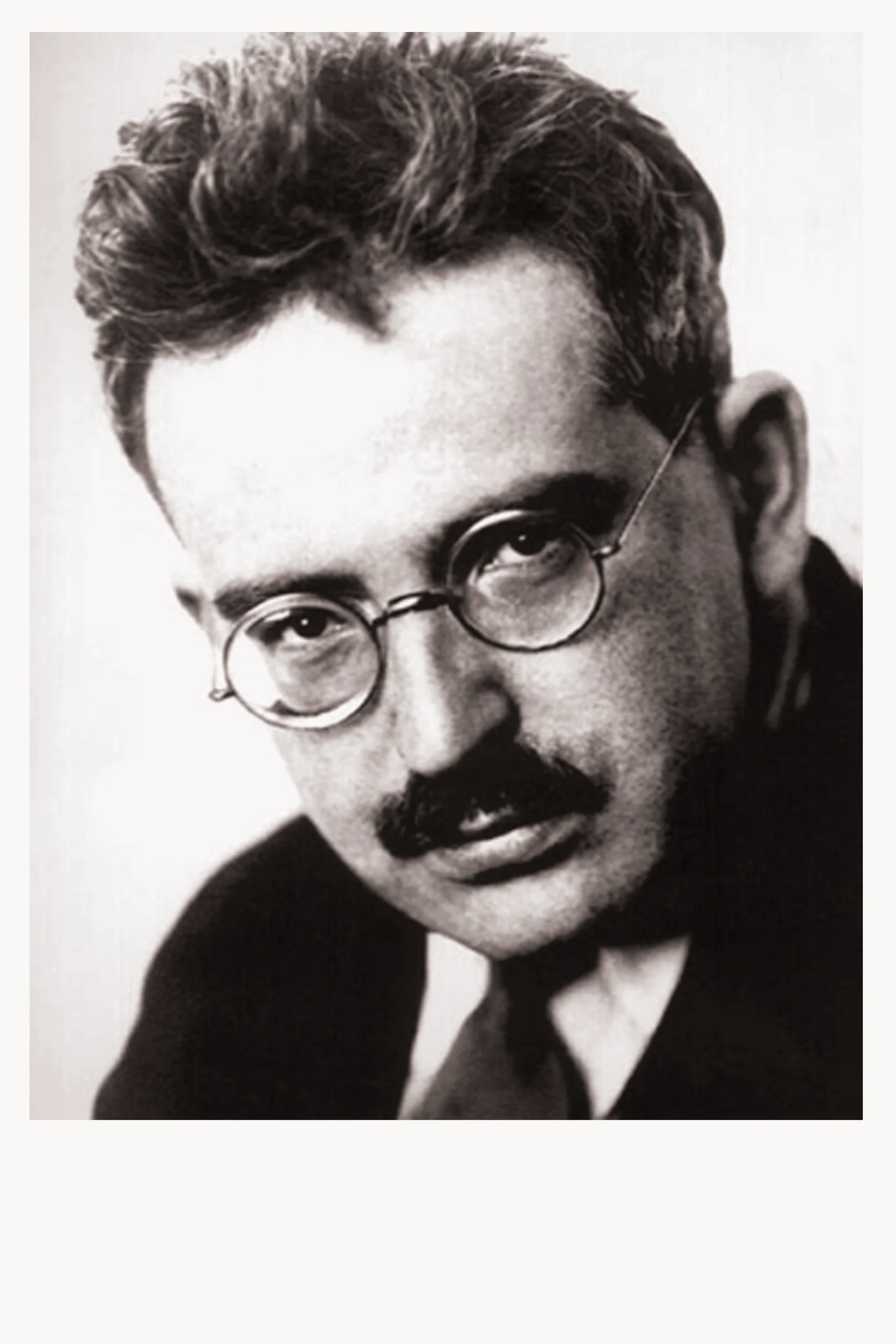
Walter Benjamin
 Germany
philosopher•cultural critic•essayist•translator
Also known as: Walter Bendix Schönflies Benjamin, Walter Benjamin Sr.
Birthday
July 15, 1892
Birth Sign
Cancer
Birthplace
Berlin, Germany
Age
Died at 48
About
Walter Benjamin was a German-Jewish philosopher, cultural critic, essayist, and translator whose intellectual legacy profoundly shaped 20th-century critical theory. Born in Berlin into an affluent assimilated Jewish family, he forged a unique path exploring German idealism, Jewish mysticism, and Western Marxism. While his contemporaries like Hannah Arendt and Theodor W. Adorno debated whether he was strictly a philosopher, they agreed his work possessed a peculiar authority that often sparked debate. His life and thought became a symbol for the tragic fate of German Jewish intellectuals under the shadow of Nazi Germany.
Benjamin's most enduring contributions lie in his essays on media, history, and aesthetics. He revolutionized the understanding of how photography and film alter the "aura" of art, making works like The Work of Art in the Age of Mechanical Reproduction cornerstones of modern media studies. Despite his intellectual stature, he struggled financially throughout his life, often relying on support from friends and occasional grants. His work gained broader traction only after his death, particularly following the publication of his collected writings in the mid-20th century.
Early Life & Background
Born on July 15, 1892, in Berlin, Walter Benjamin spent his early years immersed in the cultural ferment of Wilhelmine Germany. He came from an affluent, assimilated Jewish family where intellectual pursuits were highly valued. His childhood was marked by a deep engagement with literature and philosophy, setting the stage for his future career. He attended schools in Berlin before moving on to higher education, studying philosophy, German literature, and psychology at the universities of Berlin, Freiburg, and Munich.
His academic journey was unconventional. Although he completed his doctoral dissertation, The Concept of Art Criticism in German Romanticism, in 1919, it was rejected by the University of Frankfurt due to his non-conformist style. He eventually earned his doctorate from the University of Bern in 1919 with the thesis The Origin of German Tragic Drama, which would become one of his most significant early works. Before achieving widespread recognition, Benjamin navigated a complex intellectual landscape, engaging with figures such as Gershom Scholem, Martin Buber, Bertolt Brecht, and Hannah Arendt. He declined to pursue a Habilitation, the post-doctoral qualification required for university teaching in Germany, choosing instead to work as a freelance writer, translator, and literary critic.
Career Growth
Benjamin's career success was defined not by commercial popularity but by the enduring influence of his theoretical contributions. His breakthrough essay, The Work of Art in the Age of Mechanical Reproduction (1935), revolutionized the understanding of how photography and film alter the "aura" of art, making it a cornerstone of media studies and cultural criticism. Other major projects included his unfinished Arcades Project (Passagenwerk), a monumental study of 19th-century Parisian consumer culture, and Theses on the Philosophy of History (1940), which redefined historical materialism through a messianic lens.
Although he never formally joined the Frankfurt School, his friendship with Bertolt Brecht deepened his Marxist commitments, leading him to explore the intersection of aesthetics, politics, and mass culture. His work gained broader traction only after his death, particularly following the publication of his collected writings in the mid-20th century. Today, his theories are considered essential reading in fields ranging from literary theory to media studies, placing him at the forefront of cultural criticism. His concepts continue to shape contemporary discourse on AI, digital media, and the nature of history.
Career Timeline
Public Image & Style
Benjamin is portrayed as a tragic, visionary thinker whose ideas anticipated many contemporary issues. His writing style is characterized by dense, poetic prose and a unique blend of Marxism, Jewish mysticism, and aesthetic theory. Media portrayals emphasize his intellectual depth and the sorrowful circumstances of his death. He is often depicted as a solitary figure wandering the streets of Paris or Berlin, deeply engaged in the act of observation and critique. His image as a refugee fleeing the Nazis adds a layer of poignancy to his legacy, symbolizing the loss of European Jewish intellect during World War II.
Fame & Fandom (iFAMOUS Rankings)
Walter Benjamin died in 1940, yet his intellectual shadow stretches further than most living philosophers. He currently holds the position of the 82nd most famous person from Germany and is ranked as the 51st most famous person in Art & Design according to the iFANN Global Fame Rankings. These placements reflect how his theories on media and aesthetics have become essential reading for modern critics analyzing everything from fascism to artificial intelligence. His influence is not measured by chart positions or ticket sales but by the sheer volume of academic citations and theoretical applications that keep his name relevant decades after his death.
He is featured at No. 50 in the September 2026 iFAMOUS Rankings for his enduring impact on cultural theory. Unlike pop stars who rely on fan campaigns or viral moments, Benjamin's legacy is built on the silent power of his essays. There is no formal fandom name associated with his readership; scholars, students, and theorists engage with his work as a collective intellectual community rather than an organized fan club. No fanbase organizes birthday billboards or subway ads for him, nor do fans gather to reenact his life. Instead, his presence is felt in lecture halls and digital archives where his ideas about the 'aura' of art continue to shape contemporary discourse.
Interesting Facts and Legends
Benjamin was known for his aphoristic style, often writing in fragments rather than systematic treatises. He had a lifelong fascination with urban spaces, particularly Paris, which inspired his Arcades Project. His friendship with Gershom Scholem was crucial to his engagement with Jewish mysticism and Kabbalah. Benjamin's concept of the "aura" of art has become so ubiquitous that it is often cited without attribution in discussions about mass media and digital culture. He was a prolific translator, rendering works by Baudelaire, Poe, and others into German. The most widely retold story concerns his final days in Portbou, Spain, where he overdosed on morphine tablets at a border checkpoint in 1940 while attempting to flee Nazi persecution. Another defining moment in his legend is the 1935 publication of The Work of Art in the Age of Mechanical Reproduction, which theorized how photography and film alter the "aura" of art, turning politics into spectacle.
Notable Quotes
“To articulate what is past does not mean to recognize how it really was.”
“The only way of knowing a person is to love them without hope.”
“History is written by the victors.”
“In the end, we get older, we kill everyone who loves us...”
Family & Personal Life
Walter Benjamin was married once to Dora Sophie Kellner, whom he wed in 1930. Their relationship was marked by emotional turbulence and periods of separation, reflecting the instability of their lives during the rise of Nazism. They had no children together. Prior to his marriage, Benjamin had several significant romantic entanglements, though details are sparse compared to modern celebrity relationships. He maintained a close, though ambiguous, emotional bond with the poet Else Lasker-Schüler, who was a central figure in his early Berlin social circle. Later, while in exile in Paris, he formed a deep attachment to the art historian Gretel Karplus (later Gretel Adorno), who accompanied him during his final days. There is no documented evidence of other formal engagements or marriages.
Notable Connections
Gershom Scholem, Bertolt Brecht, Hannah Arendt, Martin Buber, Carl Schmitt, Dora Kellner, Gretel Adorno
Relationships & Dating History
Walter Benjamin was married once to Dora Sophie Kellner, whom he wed in 1930. Their relationship was marked by emotional turbulence and periods of separation, reflecting the instability of their lives during the rise of Nazism. They had no children together. Prior to his marriage, Benjamin had several significant romantic entanglements, though details are sparse compared to modern celebrity relationships. He maintained a close, though ambiguous, emotional bond with the poet Else Lasker-Schüler, who was a central figure in his early Berlin social circle. Later, while in exile in Paris, he formed a deep attachment to the art historian Gretel Karplus (later Gretel Adorno), who accompanied him during his final days. There is no documented evidence of other formal engagements or marriages. As of the time of his death in 1940, he was widowed (by circumstance, not loss of partner) and single in the sense that he died without remarriage.
- MarriedDora Sophie Kellner1930 - 1940Married until his death; relationship marked by turbulence.
- RumouredElse Lasker-Schüler1910 - 1920Close emotional bond during early Berlin years.
- DatingGretel Karplus1938 - 1940Companion during his final days in Paris and Portbou.
Death & Aftermath
Died
September 26, 1940 (aged 48)
Death Place
Portbou, Catalonia, Spain
Cause of Death
Suicide by morphine overdose
The small town of Portbou, Spain, became the final stage for a tragedy that would haunt European intellectual history. On September 26, 1940, Walter Benjamin ended his life at the age of forty-eight while stranded on the French-Spanish border. Nazi forces had pushed him into a desperate flight across Europe, and he found himself blocked from crossing into Spain by local authorities who refused to grant him an entry visa despite his urgent need for safety. His companion, the art historian Gretel Adorno, watched as he took a fatal dose of morphine in their hotel room. The local physician and police later ruled the death a suicide by overdose, a conclusion based on the testimony of those present and the circumstances surrounding his final hours.
The immediate aftermath saw his body buried in a common grave near the Spanish border, a hasty interment designed to avoid drawing attention from the Gestapo or local officials. Hannah Arendt, who arrived shortly after learning of his death, described the scene with a mixture of horror and grief, noting how quickly the authorities moved to erase the evidence of his presence. The world of German Jewish intellectuals lost a unique voice just as the shadow of the Holocaust began to swallow everything they held dear. Decades later, the story of his death transformed from a personal tragedy into a symbol of the fate facing so many thinkers under totalitarian rule.
Scholars and writers revisited his final days to understand the desperation that drove him to such an extreme measure. His manuscripts, which he had carried through the chaos, survived and eventually shaped modern critical theory. The estate passed quietly to his family, though the bulk of his legacy remained in the form of essays and letters that continued to circulate among his peers. No formal estate value exists today, as his wealth was negligible; his posthumous earnings derive entirely from royalties, licensing, and academic publications managed by publishers and foundations dedicated to preserving his work.
Net Worth (Estate Value)
$0
iFANN Editorial Team estimate
As a deceased individual with no surviving estate in the traditional sense, Walter Benjamin's net worth is not applicable in the way it is for living celebrities. His financial status at death was modest, and his posthumous earnings come from book royalties and licensing deals managed by publishers. There is no specific dollar figure for his estate, as his legacy is intellectual rather than monetary. Any estimates of "net worth" would be speculative and not grounded in credible financial data. The iFANN Editorial Team's analysis of X's earnings, ventures and assets points to roughly $0, reflecting the absence of a commercial estate.
Awards & Accolades
View 6 records, honours and achievementsKnown For
The Work of Art in the Age of Mechanical Reproduction
1935 · Essayist
The Arcades Project
1927 · Author
Theses on the Philosophy of History
1940 · Philosopher
Keywords
Sources
Quick Facts
- Profession
- philosopher, writer, translator
- Born
- July 15, 1892
- Birthplace
- Berlin, Germany
- Died
- September 26, 1940
- Death Place
- Portbou, Spain
- Gender
- Male
- Spouse
- Dora Sophie Kellner
- Birth Sign
- Cancer
Personal Details
- Full Name
- Walter Bendix Schönflies Benjamin
- Spouse
- Dora Sophie Kellner
- Children
- Education
- University of Berlin, University of Freiburg, University of Munich, University of Bern
Frequently Asked Questions
Who was Walter Benjamin?
How did Walter Benjamin die?
What is Walter Benjamin's most famous work?
Was Walter Benjamin part of the Frankfurt School?
Is Walter Benjamin still relevant today?
Join the community
fans discussing