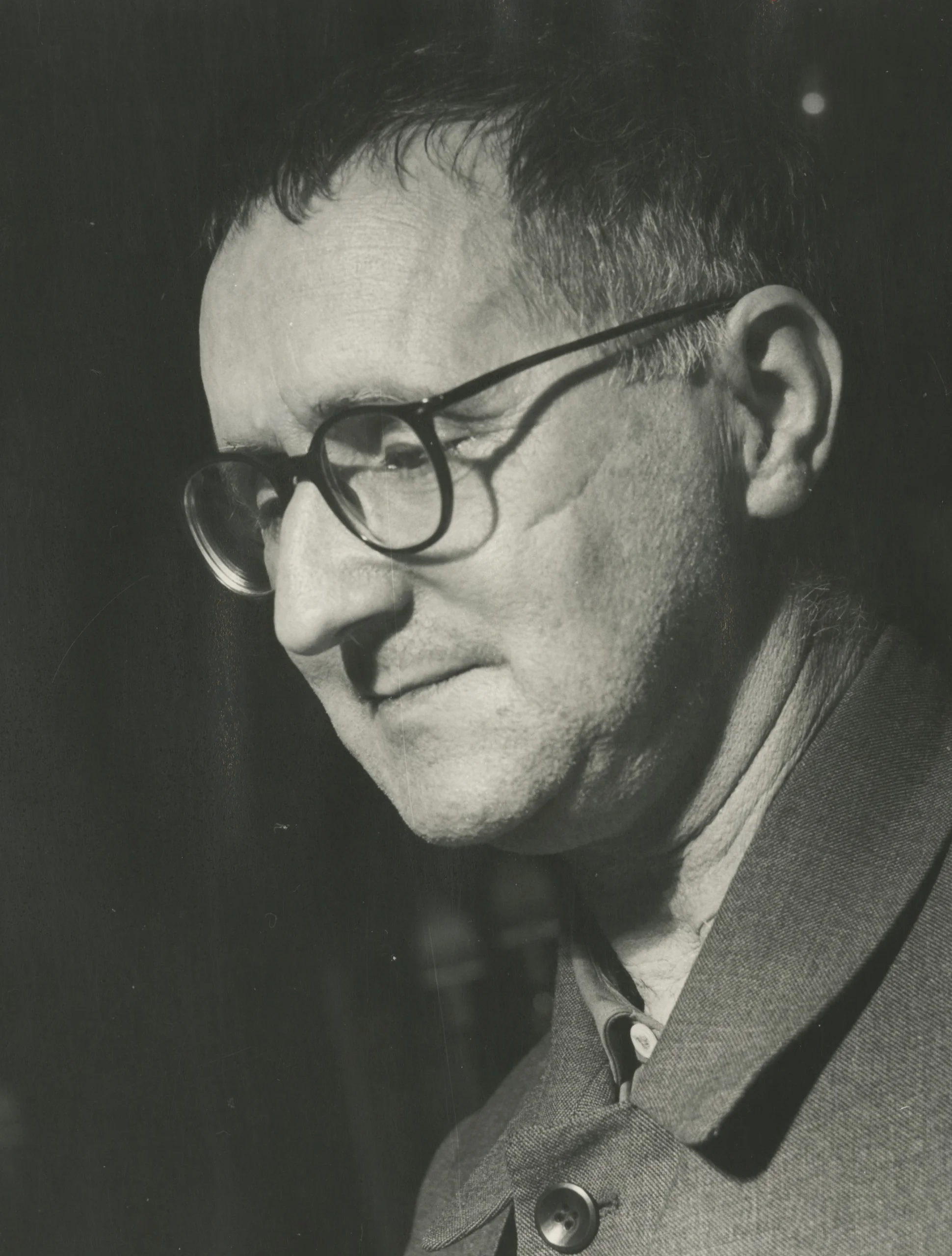
Bertolt Brecht
 Germany
playwright•lyricist•screenwriter
Also known as: Bert Brecht, Eugen Berthold Friedrich Brecht
Birthday
February 10, 1898
Birth Sign
Aquarius
Birthplace
Augsburg, Germany
Age
Died at 58
About
Bertolt Brecht was a German playwright, poet, and theater director whose work reshaped twentieth-century drama. Born Eugen Berthold Friedrich Brecht in Augsburg, he became one of the most influential figures in modern theater, developing the theory of epic theater and the Verfremdungseffekt, or alienation effect, which challenged audiences to think critically rather than simply feel. His plays, including The Threepenny Opera and Mother Courage and Her Children, are performed worldwide and remain staples of the theatrical repertoire.
Brecht's work was deeply political, rooted in Marxist thought, and he spent years in exile during the Nazi era, eventually settling in East Berlin after World War II. There he founded the Berliner Ensemble with his wife, Helene Weigel, and directed productions that would define his legacy. His influence extends beyond theater into poetry and film, and his writings on drama continue to be studied and debated. As of 2026, Brecht's plays are still regularly revived, and his theories remain central to theatrical training.
Early Life & Background
Bertolt Brecht was born into a comfortable middle-class family in Augsburg, Bavaria. His father, Berthold Brecht, was a Catholic factory director for a paper mill, and his mother, Sophie, was a Protestant. Raised in a household that valued education, Brecht showed an early aptitude for languages and literature, though he disliked physical education and often clashed with authority. He attended the Maximiliansgymnasium in Munich, where his writing talents began to emerge.
In 1917, Brecht enrolled at the Ludwig Maximilian University of Munich to study medicine, following his father's wishes. But his studies were interrupted by World War I, and in 1918 he served as a hospital orderly in Augsburg. The horrors he witnessed there left a deep impression and fueled his anti-war sentiments. During this period, he began writing poetry and his first plays, including Baal and Drums in the Night, which were raw and expressionistic.
After the war, Brecht abandoned medicine for the arts. He moved to Munich and then to Berlin in 1924, where he quickly became part of the vibrant theatrical scene. His early works were marked by a cynical view of humanity and a fascination with the darker aspects of society, setting the stage for his later political radicalism. He also began experimenting with form, moving away from naturalism toward a more didactic and fragmented style.
Career Growth
Brecht's breakthrough came in 1928 with the premiere of The Threepenny Opera in Berlin. With music by Kurt Weill, the play was a sensation, making Brecht a household name and sparking intense debate. The collaboration with Weill continued with The Rise and Fall of the City of Mahagonny (1930), which further developed his epic theater techniques.
The rise of the Nazis forced Brecht into exile in 1933. He fled to Scandinavia and then to the United States, where he settled in Hollywood in 1941. During his American years, he wrote some of his most famous plays, including Mother Courage and Her Children, The Life of Galileo, and The Good Person of Szechwan, though they were not performed widely at the time. He also worked as a screenwriter, though with little success and much frustration.
After testifying before the House Un-American Activities Committee in 1947, Brecht left the US and eventually settled in East Berlin in 1949. There, with his wife Helene Weigel, he founded the Berliner Ensemble, which became a showcase for his productions. His work in the 1950s, including productions of Mother Courage and The Caucasian Chalk Circle, cemented his reputation as a master director. He continued to write and direct until his death in 1956, leaving behind a body of work that would influence generations of theater makers.
Career Timeline
Public Image & Style
Brecht's public persona was as provocative as his plays. He was known for his sharp intellect, his Marxist convictions, and his willingness to challenge bourgeois conventions. In photographs, he often appears with a cigar and a leather jacket, exuding a certain gruff charisma. His image was that of a committed artist who saw theater as a tool for social change, not mere entertainment.
His personal style extended to his writing and directing. He favored a spare, functional aesthetic on stage, with exposed lighting and minimal sets, all in service of the alienation effect. This approach was part of his broader critique of capitalist society and its cultural institutions. Brecht's public statements and essays often carried a confrontational tone, and he was unafraid to court controversy. He remains a figure who polarizes opinion, admired by many for his political commitment and artistic innovation, and criticized by others for his dogmatism and personal flaws.
Fame & Fandom (iFAMOUS Rankings)
Bertolt Brecht's fame rests on a paradox: he is a canonical figure in world theater, yet his audience has never been a typical fandom. There is no official name for his followers, no fan clubs, no conventions. Instead, his community consists of scholars, actors, directors, and political activists who engage with his work through study and performance. This is a fandom of ideas, not of personality, and it is global in scope, with productions of his plays happening constantly in theaters from Berlin to Hong Kong.
In the iFANN Global Fame Rankings, Brecht holds the 42nd most famous person in Germany, and the 56th most famous person from Germany. His influence in the arts is also recognized, with the 29th most famous person in Art & Design. These rankings, part of the iFANN Global Fame Rankings, reflect his enduring presence in cultural discourse, a presence sustained not by viral moments but by the continued relevance of his work.
What sets Brecht's fandom apart is its intellectual rigor. Fans of Brecht are often deeply engaged with the political and philosophical questions his plays raise. They debate interpretations, study his theories, and apply his methods to contemporary issues. His plays are frequently revived in times of political crisis, as seen in 2026 productions of The Resistible Rise of Arturo Ui that drew explicit parallels to modern authoritarianism. This is a fandom that lives in the theater, in the classroom, and in the streets, and it shows no signs of fading.
Interesting Facts and Legends
Bertolt Brecht was a chess enthusiast and often played with fellow exiles. He also had a lifelong love of cigars, which became part of his iconic image. One of his most famous quotes, "Art is not a mirror held up to reality but a hammer with which to shape it," encapsulates his view of theater's purpose.
A legend often told among theater students is that Brecht once said he wanted his plays to be performed in a way that made the audience smoke and think, rather than sit in passive awe. He also had a habit of writing in a small notebook that he carried everywhere, jotting down ideas and observations. After his death, his unpublished works were collected and published, revealing a vast body of poetry and prose that had not been seen before.
Notable Quotes
“Art is not a mirror held up to reality but a hammer with which to shape it.”
“The aim of science is not to open the door to infinite wisdom, but to set a limit to infinite error.”
“Because things are the way they are, things will not stay the way they are.”
“What is the robbing of a bank compared to the founding of a bank?”
“Intelligence is not to make no mistakes, but quickly to see how to make them good.”
Family & Personal Life
Bertolt Brecht was born to Berthold Brecht, a factory director, and Sophie Brecht, a homemaker. He had one sibling, a brother named Walter, who was born in 1900. His family was middle-class and Protestant, though his father was Catholic. Brecht rejected religion early in life, embracing atheism and later Marxism.
Brecht was married twice. His first wife, Marianne Zoff, was an actress, and they had a daughter, Hanne Hiob, born in 1922. Hanne later became an actress as well. In 1929, he married Helene Weigel, with whom he had two children: Stefan, born in 1926, and Barbara, born in 1930. Stefan became a writer and philosopher, while Barbara became an actress. The family lived in various places during Brecht's exile, including Denmark, Sweden, and the United States, before settling in East Berlin.
The Brecht household was often filled with artistic and political discussions, and his children were exposed to a world of intellectual ferment. After Brecht's death, Helene Weigel continued to manage the Berliner Ensemble and remained a central figure in East German theater until her death in 1971.
Notable Connections
Bertolt Brecht collaborated closely with composer Kurt Weill on The Threepenny Opera and other works. His wife, Helene Weigel, was a leading actress in his plays and co-founded the Berliner Ensemble with him. He also worked with the composer Hanns Eisler, who scored several of his plays, and with the actress and writer Margarete Steffin, who was his secretary and lover.
Relationships & Dating History
Bertolt Brecht's personal life was as complicated as his politics. His first marriage was to the actress Marianne Zoff in 1922. The couple had a daughter, Hanne Hiob, but the marriage was strained by Brecht's infidelities and his growing political radicalism. They divorced in 1927.
In 1929, Brecht married the actress Helene Weigel, who would become his most important artistic collaborator. Weigel was the first to perform many of his female roles, including Mother Courage, and she co-directed the Berliner Ensemble with him. Their partnership was both personal and professional, lasting until Brecht's death. They had two children together: Stefan, born in 1926, and Barbara, born in 1930.
Despite his marriage to Weigel, Brecht had numerous affairs, including with the actress Elisabeth Hauptmann and the writer Margarete Steffin, who was also his secretary and collaborator. These relationships were often open and intertwined with his work. At the time of his death, Brecht was still married to Weigel, and she remained devoted to his legacy, managing the Berliner Ensemble until her own death in 1971.
- MarriedMarianne Zoff1922 - 1927Married in 1922, divorced in 1927. They had a daughter, Hanne Hiob.
- MarriedHelene Weigel1929 - 1956CurrentMarried in 1929, remained together until Brecht's death. They had two children, Stefan and Barbara.
- DatedElisabeth Hauptmann1924 - 1931Long-term collaborator and lover, worked closely on several plays.
- DatedMargarete Steffin1931 - 1941Actress and writer who became Brecht's secretary and lover, died in exile.
Death & Aftermath
Died
August 14, 1956 (aged 58)
Death Place
East Berlin, Germany
Cause of Death
Heart failure
Brecht died on August 14, 1956, in East Berlin, at the age of 58. He had been in declining health for some time, suffering from a heart condition, and passed away at the Berlin-Weißensee District Hospital. The official cause was heart failure. His death marked the end of an era for political theater, but his influence only grew in the decades that followed.
The funeral was a major public event in East Berlin, attended by colleagues from the Deutsches Theater, government officials, and thousands of mourners. He was cremated and his ashes interred at the Dorotheenstadt Cemetery, in a section reserved for notable citizens. His widow, Helene Weigel, took over leadership of the Berliner Ensemble and ran it until her own death in 1971, ensuring Brecht's productions continued to reach audiences.
In the years after his death, Brecht's plays became staples of world theater. The Threepenny Opera, Mother Courage and Her Children, and The Life of Galileo are performed constantly, and his theories on epic theater are taught in drama schools everywhere. The Bertolt Brecht Prize was established in his honor, and numerous foundations and scholarships support research and productions of his work. His legacy as a theatrical reformer and political voice remains unmatched, and his plays continue to be revived and reinterpreted, often drawing direct parallels to contemporary political events.
Net Worth (Estate Value)
$50 Million
iFANN Editorial Team estimate
Bertolt Brecht's financial legacy is modest compared to that of modern celebrities, but his estate continues to generate income through royalties, licensing, and the ongoing performance of his plays. At the time of his death in 1956, his estate was not particularly wealthy, but the Berliner Ensemble, which he co-founded with Helene Weigel, continued to produce his works, and the rights to his plays became increasingly valuable as his reputation grew.
Today, the estate is managed by the Bertolt Brecht Estate, which oversees the licensing of his plays, translations, and adaptations. Major revenue streams include performances of The Threepenny Opera, Mother Courage, and other classics, which are staged worldwide. The estate also earns from the sale of his writings, including poetry and theoretical essays, and from adaptations in film and television. In recent years, there has been a resurgence of interest in Brecht, with major productions and festivals, which has boosted royalties.
Research by the iFANN Editorial Team estimates the current value of the Bertolt Brecht estate at approximately $50 million as of 2026. This figure reflects the steady income from his plays, the value of his literary and theatrical rights, and the enduring cultural significance of his work. While not among the wealthiest estates in the arts, it is a testament to the lasting financial and cultural impact of a playwright whose ideas continue to resonate.
Awards Won (4)
Brecht received the National Prize of East Germany in 1951 and 1954, and the Stalin Peace Prize in 1954. He was also awarded the GDR's Fatherland Order of Merit in 1955.
1954 · Peace
1954 · Arts
1951 · Arts
Known For
The Threepenny Opera
1928 · Playwright
Mother Courage and Her Children
1939 · Playwright
The Life of Galileo
1943 · Playwright
The Caucasian Chalk Circle
1948 · Playwright
The Resistible Rise of Arturo Ui
1941 · Playwright
Keywords
Sources
Quick Facts
- Profession
- playwright, lyricist, screenwriter
- Born
- February 10, 1898
- Birthplace
- Augsburg, Germany
- Died
- August 14, 1956
- Death Place
- East Berlin, Germany
- Gender
- Male
- Spouse
- Marianne Zoff, Helene Weigel
- Birth Sign
- Aquarius
- Nationality
- German
Personal Details
- Full Name
- Eugen Berthold Friedrich Brecht
- Spouse
- Marianne Zoff, Helene Weigel
- Children
- Hanne Hiob, Stefan Brecht, Barbara Brecht
- Education
- Ludwig Maximilian University of Munich (medicine)
Frequently Asked Questions
Why is Bertolt Brecht famous?
Was Bertolt Brecht a communist?
What is Bertolt Brecht's net worth in 2026?
How did Bertolt Brecht die?
Where did Bertolt Brecht live in exile?
Similar People
Join the community
fans discussing