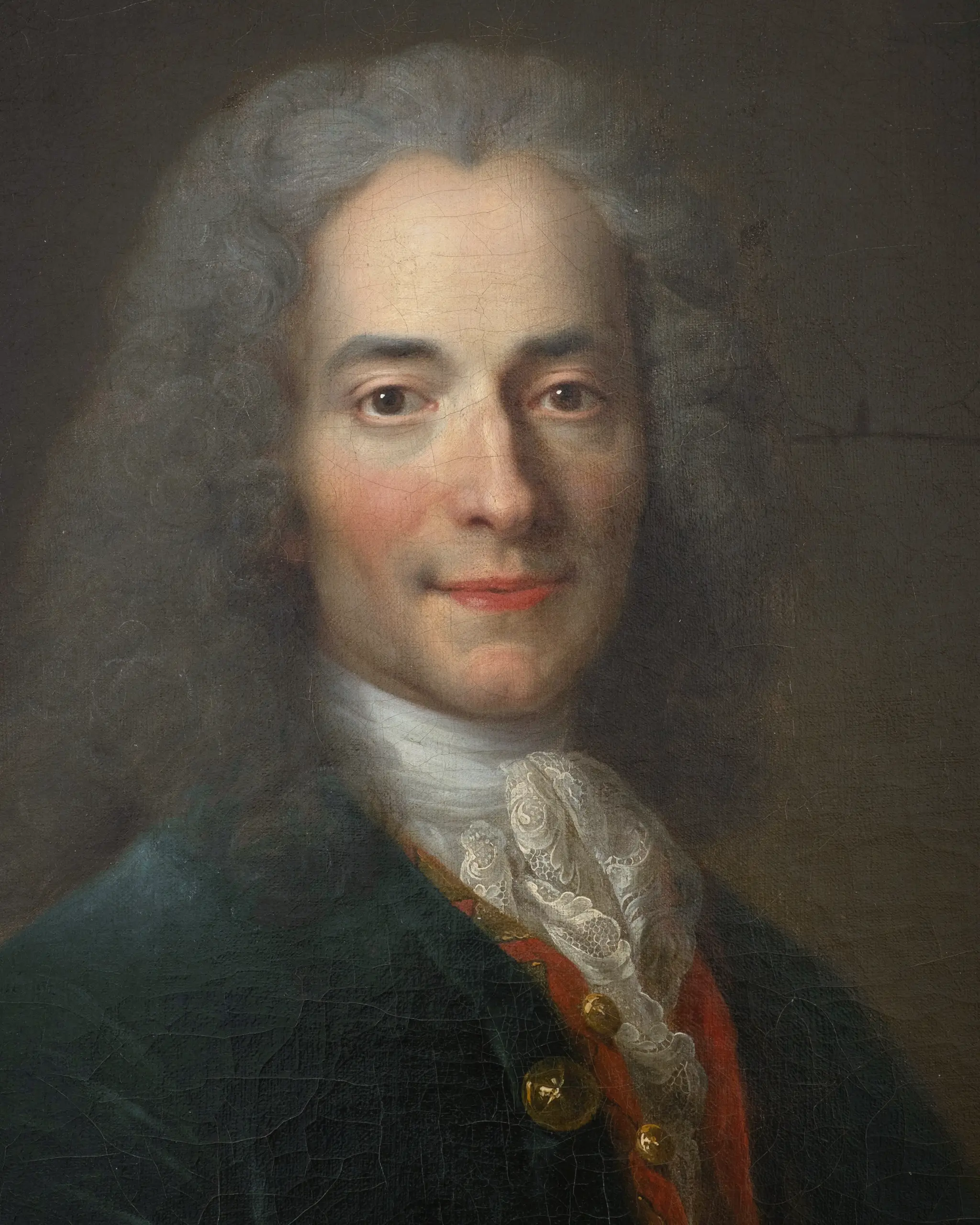
Voltaire
 France
Also known as: François-Marie Arouet, The Sieur de Voltaire
Birthday
November 21, 1694
Birth Sign
Scorpio
Birthplace
Paris, France
Age
Died at 83
Height
5 ft 4 in (163 cm)
About
Born François-Marie Arouet in Paris on November 21, 1694, Voltaire became one of the most influential figures of the French Enlightenment. He was a writer, philosopher, satirist, and historian whose sharp intellect and biting wit left an indelible mark on the 18th century. Voltaire's sharp criticisms targeted religious intolerance, particularly from the Catholic Church, and he was a staunch opponent of slavery. Throughout his life, he championed fundamental freedoms, advocating fiercely for freedom of speech, freedom of religion, and the separation of religious institutions from governmental power.
Early Life & Background
Voltaire entered the world as the youngest son of François Arouet, a prosperous notary for the King's court, and Marie Marguerite Daumard, who came from a prominent legal family. He received his education at the Jesuit Collège Louis-le-Grand, where he mastered classical literature, rhetoric, and philosophy. While he excelled academically, he often chafed against the rigid religious dogma taught there. From a young age, he displayed a sharp wit and a rebellious streak that clashed with his father's desire for him to study law.
His first major step toward fame came in his late teens when he began circulating satirical verses that mocked the nobility and the clergy. These writings led to his first significant conflict with authority: in 1716, he was exiled to Sully-sur-Loire after composing biting poems about the Regent, Philippe II, Duke of Orléans. In 1717, he was imprisoned in the Bastille for nine months for writing La Henriade and other works deemed seditious. It was during this confinement that he adopted the name "Voltaire" as a pseudonym, reportedly an anagram of "Arouet l[e] j[une]" (Arouet the younger). After his release, he moved to England in 1726, exiled again due to conflicts with the Chevalier de Rohan. This three-year exile in England profoundly shaped his intellectual development, exposing him to the works of John Locke, Isaac Newton, and the English system of constitutional monarchy and religious tolerance.
Career Growth
Upon returning to France in 1729, Voltaire published Letters on the English, a work that championed English liberty and criticized French absolutism and the Catholic Church, leading to its ban and his temporary flight to Lorraine. His career milestones include establishing himself as a successful playwright in the 1730s with hits like Œdipe and Brutus. In 1743, he was appointed Historiographer of France by King Louis XV, though he was dismissed shortly after due to political intrigue.
He moved to Prussia in the 1750s at the invitation of Frederick the Great, serving as his court philosopher until their relationship deteriorated in 1753. His most famous novella, Candide, was published in 1759 and became an instant bestseller across Europe despite being banned in many places. From the 1760s to the 1770s, he settled in Ferney near the Swiss border, where he lived for nearly 20 years. During this period, he engaged in numerous high-profile legal cases defending victims of injustice, most notably the Calas affair in 1762, which cemented his reputation as a defender of civil liberties. Throughout his life, he produced over 2,000 books and pamphlets, more than 50 plays, dozens of scientific treatises, and over 20,000 letters.
Career Timeline
Public Image & Style
Voltaire is portrayed as a witty, sharp-tongued critic of tyranny and superstition. His public image is that of a champion of reason, free speech, and secularism. He is often depicted in art and literature as a man of intellect, sometimes with a mischievous smile, reflecting his satirical nature. His distinctive appearance, often featuring a wig and dress reflecting his status as a man of letters, contributed to his recognizable persona. He was known for his relentless attacks on intolerance and his ability to navigate complex political landscapes while maintaining his independence.
Fame & Fandom (iFAMOUS Rankings)
Voltaire's renown, centuries after his death, remains a fixture of global cultural awareness, sustained by the enduring relevance of his wit and his defense of civil liberties. In the iFANN Global Fame Rankings, his standing reflects a persistent presence in public discourse. He currently holds the 19th most famous person in France, a position he has held steady from the previous cycle. Within his country of origin, he is also the 35th most famous person from France, again unchanged. In his professional sphere, he ranks the 58th most famous person in Books & Literature, a placement that has also remained stable. These figures, drawn from the iFANN Global Fame Rankings, track his enduring impact across media, scholarship, and public conversation.
His audience is not a conventional fanbase with a formal name; rather, it consists of scholars, students, and advocates of free expression who engage with his work through academic institutions and intellectual traditions. The Voltaire Foundation at the University of Oxford stands as a dedicated research center, and the annual Prix Voltaire, awarded by the International Publishers Association, honors those who champion freedom of expression. There are no recorded fan campaigns or organized rituals; his legacy is maintained through scholarly editions, continued publication of his writings, and his status as a foundational figure in libertarian thought.
Interesting Facts and Legends
The famous quote "I disapprove of what you say, but I will defend to the death your right to say it" is widely attributed to Voltaire but was actually written by his biographer, Evelyn Beatrice Hall, in 1906. It encapsulates his spirit but never appeared in his writings. Voltaire wrote over 20,000 letters, making him one of the most prolific letter writers in history. Despite being a philosopher, he was deeply interested in science and helped introduce Newtonian physics to France. He spent much of his later life fighting wrongful convictions, using his fame to influence public opinion and legal outcomes. The story of his wit in correspondence with monarchs such as Frederick the Great and Catherine the Great is legendary, though many specific anecdotes are likely embellished.
Notable Quotes
“Common sense is not so common.”
“It is dangerous to be right when the government is wrong.”
“Judge a man by his questions rather than by his answers.”
“Those who can make you believe absurdities can make you commit atrocities.”
Family & Personal Life
Voltaire was born into a bourgeois family; his father was a prosperous notary, and his mother came from a prominent legal family. He never married and had no legitimate children. His personal life was marked by intense friendships and romantic attachments, primarily with women of the aristocracy and the stage. His most significant long-term relationship was with the mathematician Gabrielle Émilie du Châtelet, whom he met in 1733. They lived together at her estate in Cirey until her death in 1749. Following her death, he formed a close relationship with his niece, Marie-Louise Mignot, who managed his household at Ferney until her death in 1769.
Notable Connections
Émilie du Châtelet, Frederick the Great, Jean Calas, Denis Diderot, David Hume.
Relationships & Dating History
Voltaire never married and had no legitimate children. His personal life was marked by intense friendships and romantic attachments, primarily with women of the aristocracy and the stage. His most significant long-term relationship was with the mathematician and physicist Gabrielle Émilie Le Tonnelier de Breteuil, Marquise du Châtelet. They met in 1733 and began a passionate affair that lasted 16 years until her death in 1749. They lived together at her estate in Cirey, where they conducted scientific experiments and translated Newton's Principia. While they had a deep intellectual and romantic bond, there is some debate among historians about whether they had biological children; however, Émilie gave birth to a daughter, Françoise, in 1748, whom Voltaire raised as his own, though paternity is unconfirmed. The relationship ended only with Émilie's death from complications following childbirth.
Following Émilie's death, Voltaire formed a close relationship with his niece, Marie-Louise Mignot (Madame Denis). Their relationship was complex, involving both familial affection and a rumored romantic dimension, though it was never officially confirmed as a marriage or formal engagement. She managed his household at Ferney until her death in 1769. Voltaire had fleeting romances with various actresses and noblewomen throughout his youth, including Adrienne Lecouvreur, with whom he had a brief affair in the 1720s. He also maintained correspondence and friendships with many women, including Madame de Pompadour, though these were largely platonic or professional. As of his death in 1778, Voltaire was single and widowed (from his partnership with Émilie du Châtelet).
- DatedGabrielle Émilie du Châtelet1733 - 1749Passionate affair lasting 16 years; intellectual collaborators; she died in childbirth.
- DatedMarie-Louise Mignot1750 - 1769Niece and household manager; complex relationship with rumored romantic elements.
- DatedAdrienne Lecouvreur1720 - 1725Brief affair with the actress in the 1720s.
Death & Aftermath
Died
May 30, 1778 (aged 83)
Death Place
Paris, France
Cause of Death
Gangrene and severe chest infection
François-Marie Arouet spent his final months in Paris after returning from a long exile in February 1778. His health deteriorated rapidly during late May as he suffered from a persistent cough, high fever, vomiting, and extreme pain, culminating in a brief catheterization procedure on May 29 that may have worsened his condition. He died the following morning around 5:00 AM at his residence on the Rue de la Chaussée-d'Antin, succumbing to a combination of gangrene and a severe chest infection likely caused by pneumonia or bronchitis. The cause was established through the testimony of his attending physician, Dr. Louis-Jean-Baptiste Le Roy, and his nephew, Jean-François de Saint-Lambert.
Public reaction to his passing was immediate and deeply polarized, with Archbishop Christophe de Beaumont refusing to grant him a Christian burial due to his unrepentant atheism and satirical works against the clergy. This ecclesiastical ban sparked significant public outcry as thousands gathered in the streets of Paris to mourn him as a martyr for free thought, while the French Academy initially sought to suppress his memory. Despite the religious restrictions, a compromise allowed his body to be secretly transported out of Paris under the cover of night to avoid further confrontation with church authorities. Voltaire's remains were interred on June 24, 1778, at the Abbey of Selles in Champagne during a private affair attended by close friends including the Marquis de Condorcet and the writer Charles Palissot.
In the posthumous era, his legacy received extensive honor when his remains were exhumed and transferred to the Panthéon in Paris on July 11, 1791, an event marked by a massive ceremony attended by King Louis XVI and Queen Marie Antoinette. Since then, numerous statues and memorials have been dedicated to him, most notably the statue in Place Saint-Michel in Paris and the Voltaire Foundation at Oxford University, while his estate was managed by his heirs who ensured his financial legacy supported his continued influence on European thought.
Net Worth (Estate Value)
$0
iFANN Editorial Team estimate
As a historical figure who died in 1778, Voltaire does not have a modern net worth in the contemporary sense. However, his estate was substantial for his time. He accumulated significant wealth through his publishing ventures, pensions, and investments. His estate was valued at approximately 100,000 livres at the time of his death, a massive sum that supported his lifestyle and allowed him to fund charitable causes. Today, the value of his intellectual property and the enduring revenue from the sale of his works are managed by publishers and academic institutions, contributing to the ongoing economic value of his legacy.
Awards Won (2)
While Voltaire did not receive modern awards, he was appointed Historiographer of France in 1743 by King Louis XV. His remains were transferred to the Panthéon in 1791, the highest posthumous honour in France. The Prix Voltaire, awarded annually by the International Publishers Association, honors those who champion freedom of expression in his memory. The Voltaire Foundation at the University of Oxford was established to promote research on his life and work.
1743 · Official Title
Appointment by King Louis XV
1791 · Posthumous Honour
Transfer of remains
Known For
Candide
1759 · Author
Letters on the English
1734 · Author
Zaire
1732 · Playwright
Keywords
Sources
Quick Facts
- Profession
- philosopher, poet, historian
- Born
- November 21, 1694
- Birthplace
- Paris
- Died
- May 30, 1778
- Death Place
- Paris
- Gender
- Male
- Birth Sign
- Scorpio
Personal Details
- Full Name
- François-Marie Arouet
- Height
- 5 ft 4 in (163 cm)
- Children
- Education
- Jesuit Collège Louis-le-Grand
Frequently Asked Questions
What was Voltaire's real name?
Did Voltaire ever get married?
Why was Voltaire imprisoned?
What is Voltaire's most famous work?
How did Voltaire die?
Join the community
fans discussing