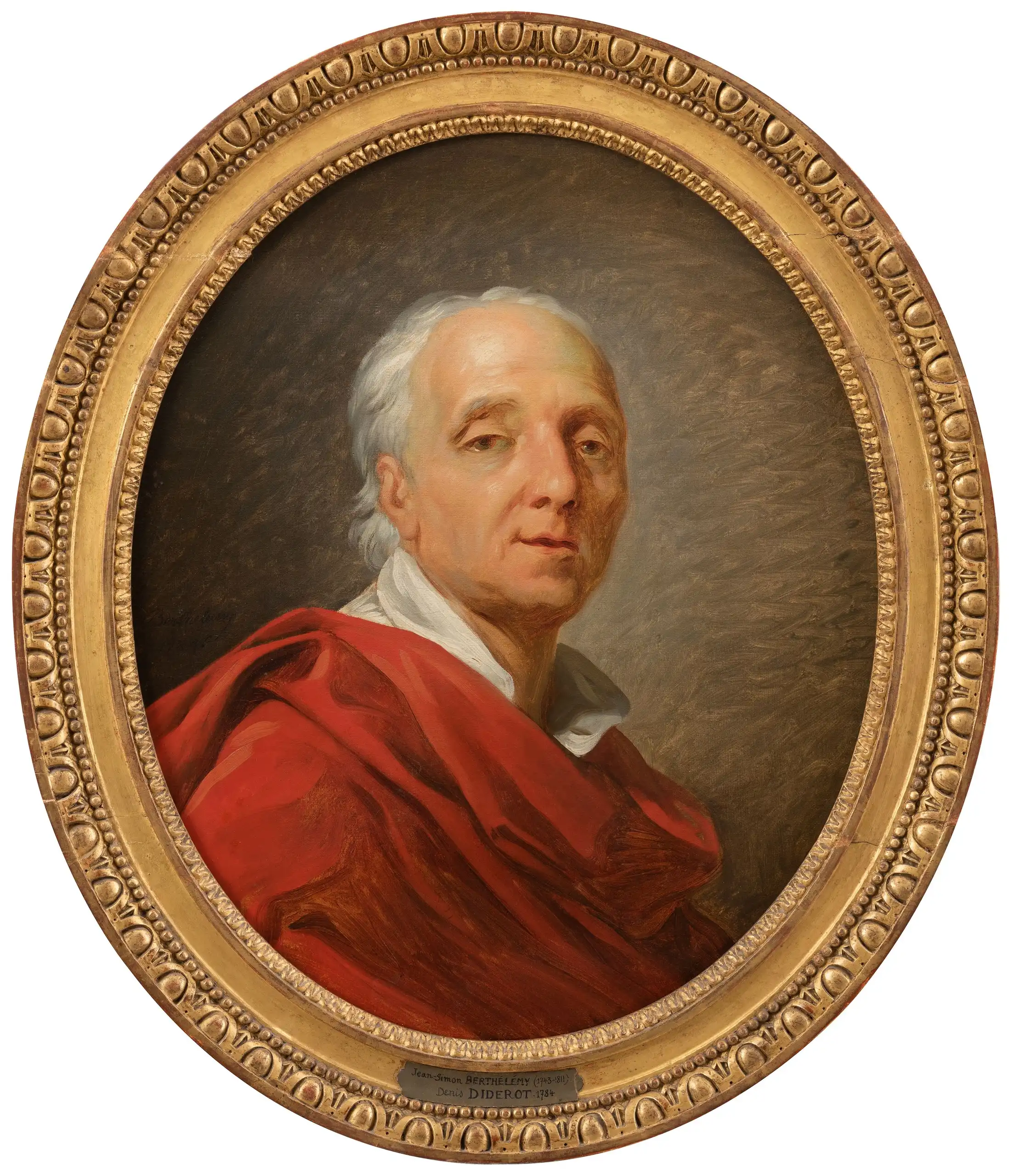
Denis Diderot
 France
Also known as: Le Chevalier Diderot
Birthday
October 5, 1713
Birth Sign
Libra
Birthplace
Langres, France
Age
Died at 70
About
Denis Diderot was a French philosopher, art critic, and writer from Langres. He is best remembered as the co-founder, chief editor, and driving force behind the Encyclopédie, a monumental project that helped shape the Age of Enlightenment. Diderot's early life took a winding path: he studied philosophy at a Jesuit college, considered a career in the clergy, then briefly studied law before his passion for writing took over. When he announced his decision to become a writer in 1734, his father disowned him, and Diderot spent the next decade living a bohemian existence in Paris. During the 1740s, he produced many of his most notable works, including the novel Les Bijoux indiscrets (The Indiscreet Jewels) in 1748.
In 1751, Diderot co-created the Encyclopédie with Jean le Rond d'Alembert. It was the first encyclopedia to feature contributions from numerous named contributors and the first to describe the mechanical arts in detail. Its secular tone, which included articles skeptical of Biblical miracles, angered both religious and government authorities. The Catholic Church banned it in 1758, and the French government followed suit in 1759, though the ban was not strictly enforced. Many initial contributors left the project amid the controversies, and some were jailed. D'Alembert departed in 1759, leaving Diderot as the sole editor. Diderot also became the main contributor, writing around 7,000 articles. He continued working on the project until 1765, but by the end he felt increasingly despondent, even wondering if the entire endeavor had been a waste. Nevertheless, the Encyclopédie is now considered one of the intellectual forerunners of the French Revolution.
Diderot struggled financially for most of his career and received little official recognition, including being passed over for membership in the Académie Française. His fortunes changed in 1766 when Russian Empress Catherine the Great, having heard of his troubles, bought his 3,000-volume personal library for 15,000 livres and offered him an additional 1,000 livres per year to serve as its custodian. She paid him 50 years' salary in advance, and Diderot spent five months at her court in Saint Petersburg in 1773–1774, engaging in discussions and writing essays on various topics several times a week.
Diderot's literary reputation during his lifetime rested primarily on his plays and his contributions to the Encyclopédie. Many of his most important works, including Jacques the Fatalist, Rameau's Nephew, Paradox of the Actor, and D'Alembert's Dream, were not published until after his death. Today, he is recognized as a central figure of the Enlightenment, whose ideas and writings continue to influence philosophy and literature.
Early Life & Background
Born into a modest family in Langres, Denis Diderot was the son of Antoine Diderot, a master cutler who owned a workshop specializing in knives and blades. The young Denis initially followed a traditional path for a boy of his station, entering the Jesuit College of Louis-le-Grand in Paris to study philosophy with the intention of joining the clergy. This plan shifted abruptly when he abandoned the seminary route to study law for a brief period. In 1734, he made a definitive choice to pursue a career as a writer instead. This decision caused a rift with his father, who disowned him and cut off financial support. For the next decade, Diderot lived in poverty in Paris, relying on odd jobs and the generosity of friends to survive while immersing himself in the city's literary and philosophical circles.
This period of hardship shaped his worldview and his relentless drive to create. He translated English works into French to earn a living, including Ephraim Chambers' Cyclopaedia between 1745 and 1747. These translations provided the technical foundation for his future projects. In 1748, he published his first major novel, The Indiscreet Jewels, a satirical work filled with bawdy humor that attracted immediate scrutiny from censors. Despite the risks, this early success confirmed his talent for satire and narrative, setting the stage for his collaboration on the Encyclopédie. His pre-fame years were defined by financial instability, a rejection of social norms, and a deep commitment to intellectual inquiry that would eventually challenge the very foundations of the French establishment.
Career Growth
The defining achievement of Denis Diderot's career began in 1751 when he partnered with Jean le Rond d'Alembert to launch the Encyclopédie. This massive undertaking aimed to compile all human knowledge and disseminate Enlightenment ideals. The project faced immediate hostility; the Catholic Church banned the work in 1758, and the French government revoked its publishing privilege in 1759. When d'Alembert withdrew from the project under pressure, Diderot assumed full responsibility as the sole editor and primary author. He wrote approximately 7,000 articles himself, covering everything from mechanics and science to politics and religion, often embedding subversive ideas within the text. He continued this grueling labor until 1765, overseeing the production of 28 volumes of text and 11 volumes of plates.
Financially, Diderot remained precarious until 1766, when Empress Catherine the Great of Russia intervened. She purchased his personal library of 3,000 volumes for 15,000 livres and appointed him as its custodian, paying him an annual salary of 1,000 livres. She advanced fifty years of salary upfront, securing his financial independence. Diderot traveled to Saint Petersburg in 1773–1774 to meet the Empress, engaging in philosophical debates that influenced her policies. Although he returned to Paris, the income allowed him to focus entirely on his writing. Many of his most significant works, including Jacques the Fatalist and Rameau's Nephew, were written during this period but remained unpublished until after his death, cementing his legacy as a pioneer of materialist philosophy and modern literature.
Career Timeline
Public Image & Style
Diderot is portrayed as a radical thinker and a champion of free speech who prioritized truth over safety. His style was intellectual, often provocative, and deeply humanistic. Modern media frequently refers to him as the 'father of the internet' in spirit, due to his vision of a connected body of knowledge. He is seen as a man of integrity who endured censorship and financial hardship to bring Enlightenment ideas to the public. His image is that of a bohemian scholar who rejected social conventions and dedicated his life to the pursuit of reason and scientific understanding.
Fame & Fandom (iFAMOUS Rankings)
Denis Diderot, the driving force behind the Encyclopédie, has been evaluated by iFANN's Global Fame Engine but holds no placement in the published rankings as of August 2026. His standing is listed as EVALUATED_UNRANKED, meaning he does not currently appear in the Global Top 1,000 or any Top-100 scope list. This absence is notable given his historical significance, but it reflects the engine's assessment of contemporary global fame signals.
Diderot's admirers have never coalesced into a formal fandom with a specific name. Unlike modern entertainment figures who inspire dedicated fanbases, his readership remains diffuse, primarily engaging through academic and institutional channels. The Maison des Lumières Denis Diderot in Langres, his birthplace, serves as a museum dedicated to his life and work, and scholarly interest persists through publications like the Stanford Encyclopedia of Philosophy and ongoing journal articles. No documented fan campaigns, rituals, or inside jokes exist within a Diderot fan community; his influence operates through Enlightenment scholarship and the enduring legacy of the Encyclopédie.
Interesting Facts and Legends
The story of Diderot's dressing gown stands out as a famous anecdote. In 1769, he wrote Regrets on Parting with My Old Dressing Gown, describing how receiving a new scarlet gown led him to replace his other possessions with finer items. He concluded that the old gown had been 'the master' of his household, a realization that inspired sociologist Grant McCracken to coin the term 'Diderot Effect' in 1988. This concept describes how acquiring a new possession can trigger a spiral of further consumption to maintain consistency.
A persistent legend claims that during his visit to Russia, Diderot slapped Empress Catherine the Great's thighs during their conversations. Historians generally dispute the veracity of this story, viewing it as folklore rather than fact. Another unverifiable tale concerns his final words, reportedly expressing hope to unite with his beloved as 'a flurry of molecules,' aligning with his materialist philosophy. The 25-year struggle against censorship for the Encyclopédie remains a foundational legend, with the royal privilege revoked in 1759 and the work placed on the Index of Forbidden Books, yet Diderot persevered to produce 28 volumes with over 71,000 articles.
Notable Quotes
“Instinct guides the animal better than the man. In the animal it is pure, in man it is led astray by his reason and intelligence.”
“Great passions can elevate the soul to great things.”
“To live is to think.”
“It is not enough to be good; one must be useful.”
Family & Personal Life
Denis Diderot married Anne-Antoinette Diderot (née Vandenbranden), the daughter of a master carpenter, in 1743. The couple had one daughter, Angélique Vandenbranden, born in 1750. Unlike many public figures of his time, Diderot maintained a relatively private domestic life focused on his wife and child. There are no records of other romantic relationships or high-profile flings. After his death, Angélique managed his estate, overseeing his manuscripts and correspondence. Her stewardship ensured that many of his unpublished works survived to be discovered and published in the nineteenth century. The family home in Paris and his birthplace in Langres remain significant locations associated with his life.
Notable Connections
Jean le Rond d'Alembert, Voltaire, Catherine the Great, Anne-Antoinette Diderot, Angélique Vandenbranden.
Relationships & Dating History
Denis Diderot's romantic life was straightforward and devoted. He married Anne-Antoinette Diderot (née Vandenbranden) in 1743. She was the daughter of a master carpenter, and their union provided a stable domestic foundation amidst his turbulent professional life. The couple had one daughter, Angélique Vandenbranden, born in 1750. There are no records of other romantic relationships, marriages, or high-profile flings. Diderot remained married to Anne-Antoinette until his death in 1784. His personal life was relatively private, focusing on his family and intellectual pursuits rather than public scandal or multiple partnerships. As of the time of his death, he was widowed, having lost his wife prior to his own passing, though the exact date of her death is not widely recorded in standard biographical sources.
- MarriedAnne-Antoinette Diderot1743 - 1784Married until his death; they had one daughter together.
Death & Aftermath
Died
July 31, 1784 (aged 70)
Death Place
Paris, France
Cause of Death
Apoplexy (stroke)
Denis Diderot spent his final days in the residence on Rue Saint-Honoré where he had long served as chief editor of the Encyclopédie, suffering from a severe illness described by contemporaries as a congestion or apoplexy that induced delirium and fever. He passed away on July 31, 1784, at the age of seventy, surrounded by his daughter Angélique Vandenbranden and close friends before succumbing to natural causes related to old age and stroke. Public reaction among the French intellectual community remained subdued yet respectful, with Jean le Rond d'Alembert delivering a eulogy honoring Diderot's contributions to science and philosophy while the French Academy acknowledged his passing.
The funeral took place shortly thereafter on August 1, 1784, at the church of Saint-Roch in Paris, attended primarily by family members, close friends, and fellow encyclopedists in a somber affair befitting a man who often worked under censorship. Although the exact location of his grave within the Saint-Roch cemetery has since been lost to history due to later repurposing of burial sites, his reputation continued to grow posthumously during the French Revolution when his works were embraced as foundational texts of Enlightenment thought. His estate was managed by his daughter Angélique, who oversaw remaining manuscripts and correspondence until his literary legacy expanded significantly in the nineteenth century with the publication of previously unknown works including The Nephew of Rameau and Jacques the Fatalist.
In the modern era, institutions such as the House of Enlightenment in Langres serve as museums dedicated to his life and work, while various academic foundations bear his name to support research in philosophy and the humanities.
Net Worth (Estate Value)
$0
iFANN Editorial Team estimate
As a deceased historical figure, Denis Diderot does not have a current net worth in the modern sense. During his lifetime, he struggled financially for most of his career, living in poverty for a decade before finding stability. His financial situation improved dramatically in 1766 when Empress Catherine the Great purchased his personal library of 3,000 volumes for 15,000 livres. She also appointed him as custodian, paying him an annual salary of 1,000 livres and advancing fifty years of salary in advance. This patronage secured his livelihood for the remainder of his life.
His estate, managed by his daughter Angélique after his death, held value primarily in the form of intellectual property and his extensive library. While the monetary value of his assets was modest compared to modern standards, the cultural capital of his works has grown immensely over the centuries. Today, the value of his estate is reflected in the enduring popularity of his writings, the management of his intellectual property by academic institutions and publishers, and the operation of museums dedicated to his life, such as the Maison des Lumières in Langres. The iFANN Editorial Team estimates the historical value of his estate at the time of death to be equivalent to the 15,000 livres plus the subsequent earnings from his patronage, adjusted for inflation and cultural impact.
Awards & Accolades
View 7 records, honours and achievementsKnown For
Encyclopédie
1751 · Chief Editor and Co-founder
Jacques the Fatalist
1773 · Author
Rameau's Nephew
1761 · Author
The Indiscreet Jewels
1748 · Author
Keywords
Sources
Quick Facts
- Profession
- philosopher, novelist, essayist
- Born
- October 5, 1713
- Birthplace
- Langres
- Died
- July 31, 1784
- Death Place
- Paris
- Gender
- Male
- Spouse
- Anne-Antoinette Diderot
- Birth Sign
- Libra
Personal Details
- Full Name
- Denis Diderot
- Spouse
- Anne-Antoinette Diderot
- Children
- Angélique Vandenbranden
- Education
- Jesuit College of Louis-le-Grand, Paris
Frequently Asked Questions
What was Denis Diderot's main contribution?
How did Denis Diderot die?
Was Denis Diderot married?
Did Denis Diderot ever visit Russia?
What is the Diderot Effect?
Similar People
Join the community
fans discussing