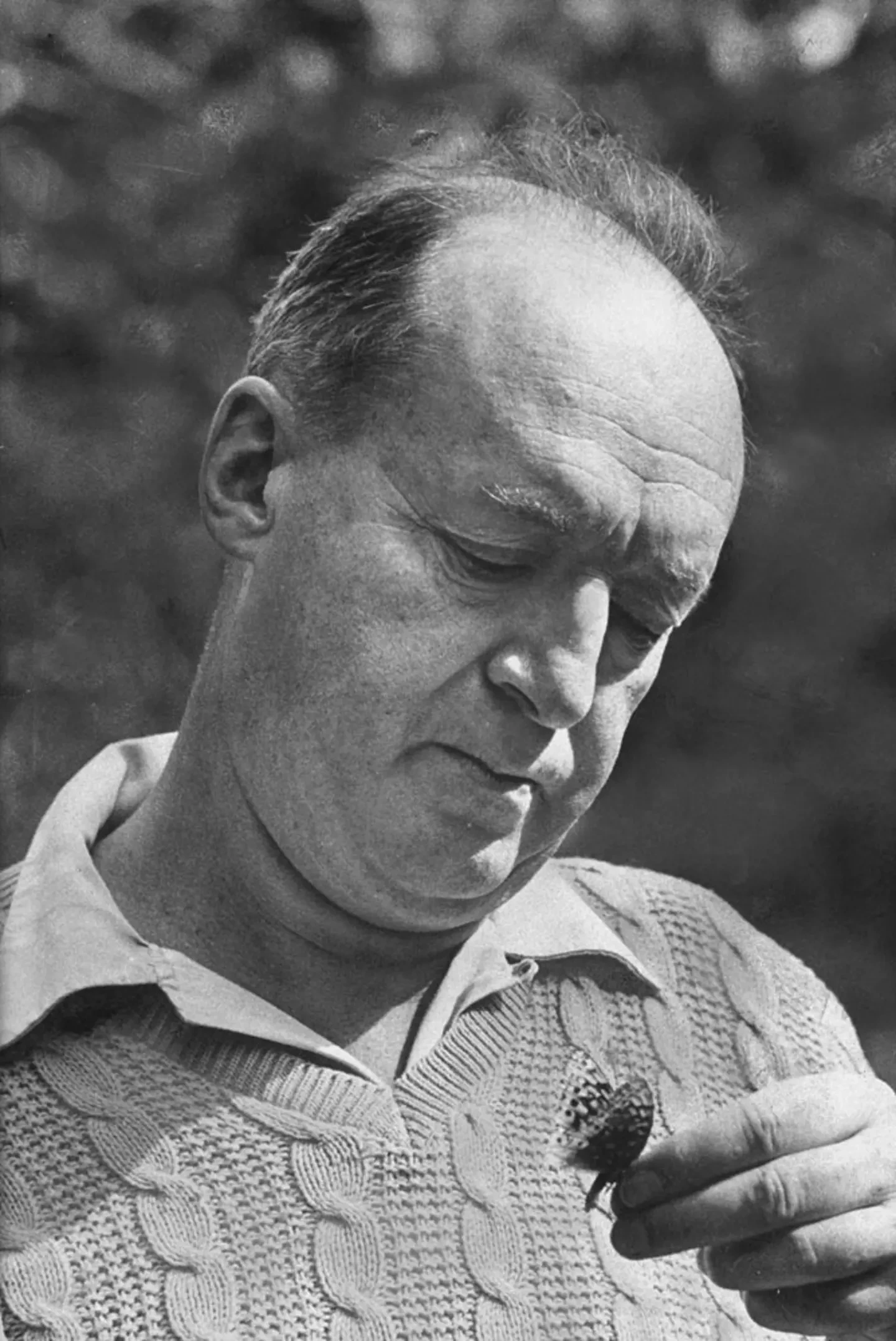
Vladimir Nabokov
 Russia
novelist•poet•translator•entomologist
Also known as: V. Sirin, Vladimir Vladimirovich Nabokov
Birthday
April 22, 1899
Birth Sign
Aries
Birthplace
Saint Petersburg, Imperial Russia
Age
Died at 78
Height
6 ft 1 in (185 cm)
About
Vladimir Nabokov was the Russian-American novelist, poet, translator, and lepidopterist who reshaped twentieth-century literature with his intricate prose and metafictional daring. His most famous work, Lolita (1955), remains both a commercial phenomenon and a critical touchstone, selling over 100,000 copies in its first three weeks in America and ranking fourth on Modern Library's list of the best novels of the century. Today his reputation rests on a body of work that includes the dizzying Pale Fire (1962), the autobiographical masterpiece Speak, Memory (1951), and the sprawling Ada or Ardor (1969). Nabokov's style, dense with wordplay, literary allusion, and a scientist's precision, has drawn comparisons to James Joyce and Marcel Proust. Beyond the page, he was a respected entomologist who contributed to the study of butterflies, with a genus named in his honor. His estate continues to generate steady revenue from royalties, film adaptations, and posthumous publications, sustaining his legacy as one of the most distinctive voices in modern letters.
Early Life & Background
Vladimir Nabokov was born into a wealthy aristocratic family in Saint Petersburg, the eldest of five children. His father, Vladimir Dmitrievich Nabokov, was a prominent liberal politician and jurist who served in the Russian Provisional Government; his mother, Elena Ivanovna Rukavishnikova, was a heiress who nurtured his love of nature and literature. The family divided time between a townhouse on Bolshaya Morskaya Street and the country estate Vyra near Siverskaya, where young Nabokov developed a lifelong passion for butterflies. He was raised trilingual, with English and French taught by governesses and tutors before he attended the Tenishev School, a progressive private school, from 1911 to 1917. The Bolshevik Revolution forced the family to flee Russia in 1919, first to Crimea and then into exile in England. Nabokov entered Trinity College, Cambridge, where he studied Russian and French literature, graduating in 1922. That same year, his father was assassinated in Berlin by a monarchist gunman, a trauma that would echo through his fiction. After Cambridge, Nabokov settled in Berlin, where he began writing poetry and novels in Russian under the pseudonym V. Sirin. His first novel, Mary (1926), was published to modest acclaim, followed by The Defense (1930) and Invitation to a Beheading (1938), which established his reputation within the Russian émigré community but provided little financial security. The rise of Nazi Germany forced him and his Jewish wife Véra to flee to France in 1937, and then to the United States in 1940.
Career Growth
After arriving in the United States, Nabokov struggled to establish himself as an English-language writer. He took a position as a lecturer in comparative literature at Wellesley College and later became a curator of lepidoptery at Harvard's Museum of Comparative Zoology. His first English novel, The Real Life of Sebastian Knight (1941), received modest attention, and his acclaimed memoir Speak, Memory (1951) solidified his reputation among critics. From 1948 to 1959, he taught Russian literature at Cornell University, where he was known for his exacting lectures. The breakthrough came in 1955 with the Paris publication of Lolita by Olympia Press. The novel's controversial subject matter caused an immediate scandal, it was banned in France and the United States for a time, but its literary brilliance was undeniable. After G.P. Putnam's Sons published it in the U.S. in 1958, it became a massive bestseller, selling over 100,000 copies in three weeks. The financial windfall allowed Nabokov to quit teaching and focus on writing full-time. He moved to Montreux, Switzerland, in 1961, where he produced Pale Fire (1962), a metafictional novel now considered one of the greatest of the twentieth century. He followed with Ada or Ardor (1969) and Transparent Things (1972). He was working on an unfinished novel, The Original of Laura, at the time of his death in 1977; it was published posthumously in 2009.
Career Timeline
Public Image & Style
Nabokov cultivated the image of an aristocratic, intellectually aloof dandy, a persona reinforced by his precise suits, butterfly net, and disdain for popular culture. The Lolita controversy permanently branded him as a genius of questionable subject matter, a label he both resented and leveraged. Critics and readers admire his style above all: a dense, playful prose that rewards rereading and resists easy interpretation. His fandom is intensely academic, with the International Vladimir Nabokov Society publishing Nabokov Studies and organizing conferences. Devotees often call themselves Nabokovians. The author's social media presence is managed posthumously by the Vladimir Nabokov Literary Foundation, which maintains modest followings on Facebook and Twitter/X (@NabokovLitFdn).
Fame & Fandom
The admirers of Vladimir Nabokov have never coalesced into a unified movement with a specific name or organized chapters. Instead, his audience remains a dispersed collection of academics, critics, and serious readers who identify simply as scholars of his work or devotees of his prose. There are no recorded instances of fan-funded campaigns, birthday billboards, or street parades; the legacy is sustained through intellectual discourse rather than public spectacle. This quiet reverence stands in stark contrast to the frenzied reactions his most controversial work once provoked. While he did not engage directly with fans during his life, preferring his wife Vera to manage all correspondence, the mythos surrounding him has only grown more intricate posthumously. In the landscape of global celebrity metrics, Nabokov maintains a significant position among historical figures. According to the iFANN Global Fame Rankings, he is currently the 29th most famous person from Russia, a standing that has held steady across recent assessment cycles. His reputation rests on a body of work that continues to generate discussion and study, ensuring his presence in contemporary cultural conversations without the need for modern marketing machinery.
Interesting Facts and Legends
Vladimir Nabokov was a serious chess composer who published a book of chess problems titled Poems and Problems in 1969. He experienced synesthesia, associating letters and sounds with specific colors, such as the letter B being burnt sienna. A dedicated critic of Freudian psychoanalysis, he frequently mocked the theory within his novels. In a unique literary feat, he translated his own novel Lolita back into Russian, describing the effort as a labor of love. During his tenure teaching at Cornell University, he supplemented his income by giving tennis lessons. His scientific contributions were recognized by the naming of the butterfly genus Nabokovia after him, along with several species of butterflies and moths. A persistent legend involves the publication history of Lolita in 1955. The story goes that the book was deemed too scandalous for American publishers, leading Oulipo member Maurice Girodias to release it via Olympia Press in Paris. Copies were reportedly smuggled into the United States and United Kingdom, sparking moral panics and library burnings that cemented its status as forbidden fruit. Another widely retold narrative concerns the tension between Nabokov and director Stanley Kubrick regarding the 1962 film adaptation. While the movie achieved massive commercial success, folklore suggests Nabokov felt the film sanitized the darker themes of the novel, a sentiment that fueled decades of debate about the true meaning of the story.
Notable Quotes
“Lolita, light of my life, fire of my loins. My sin, my soul.”
“I think it is all a matter of love: the more you love a memory, the stronger and stranger it is.”
“The cradle rocks above an abyss, and common sense tells us that our existence is but a brief crack of light between two eternities of darkness.”
“Human life is but a series of footnotes to a vast obscure unfinished masterpiece.”
Family & Personal Life
Nabokov's father, Vladimir Dmitrievich Nabokov, was a leading figure in the Constitutional Democratic Party and was assassinated in Berlin in 1922. His mother, Elena Ivanovna Rukavishnikova, came from a wealthy family and encouraged his literary and scientific interests. He had two brothers, Sergey and Kirill, and two sisters, Olga and Elena. Nabokov married Véra Evseyevna Slonim in 1925; she became his editor, typist, driver, and literary executor, famously carrying a pistol to protect him after the Lolita controversy. Their only child, Dmitri Nabokov (1934–2012), was an opera singer and translator who managed his father's estate until his own death. The family lived in Montreux, Switzerland, from 1961 onward, in the Montreux Palace Hotel. Nabokov kept no pets, but his passion for butterflies was a constant presence in the household.
Notable Connections
Véra Nabokov, his wife and literary executor, was his constant collaborator and protector. Their son Dmitri managed the estate until 2012. Edmund Wilson, a friend and later literary rival, engaged in a famous public feud with Nabokov over translation and literary taste. Stanley Kubrick directed the 1962 film adaptation of Lolita.
Relationships & Dating History
Nabokov's romantic life was remarkably stable. In 1922, shortly after his father's death, he became engaged to Svetlana Siewert, a young woman from a wealthy Russian émigré family. Her parents broke off the engagement in early 1923 because Nabokov lacked a stable career. He then met Véra Evseyevna Slonim at a Russian émigré ball in Berlin in 1923; she was a fan of his work under the pseudonym Sirin. They married on April 15, 1925, and remained together until his death. Véra served as his editor, driver, and protector, famously carrying a pistol after the Lolita controversy. They had one son, Dmitri. Nabokov dedicated all his books to her. He was never divorced or widowed during his lifetime.
- EngagedSvetlana Siewert1922 - 1923Engagement broken off by her parents due to Nabokov's lack of career stability.
- MarriedVéra Nabokov1925 - 1977Met at a Russian émigré ball in Berlin in 1923; she was a fan of his work. They had one son, Dmitri.
Death & Aftermath
Died
July 2, 1977 (aged 78)
Death Place
Montreux, Vaud, Switzerland
Cause of Death
Pneumonia following respiratory infection
The literary world marked the passing of Vladimir Nabokov with immediate tributes from major institutions and a surge in sales for his backlist, particularly Lolita, Pale Fire, and Ada, as critics and peers honored his contributions to lepidopterology and fiction. The New York Times and other publications ran obituaries highlighting his status as a defining voice of the twentieth century, while universities and the Academy of Arts and Letters issued statements recognizing his unique prose style and scientific precision. His widow Véra oversaw the publication of remaining works including Look at the Harlequins! and managed the estate until her death in 1991, ensuring that adaptations adhered to his artistic vision.
Nabokov passed away on July 2, 1977, at the Monte Carlo Hotel in Montreux, Switzerland, where he had resided with his wife. He died peacefully in his sleep at the age of 78, having been admitted to a local clinic in Lausanne shortly before to treat bronchial pneumonia contracted during a respiratory infection. His final days were spent writing and working on memoirs despite declining health caused by chronic heart conditions and respiratory issues. A private funeral service was held on July 6, 1977, in Montreux, conducted according to Russian Orthodox tradition and attended exclusively by close family members including his wife Véra and son Dmitri.
Following the ceremony, Nabokov was cremated and his ashes interred in the cemetery of Montreux near Lake Geneva. Posthumous releases included The Original of Laura, published in 2009, alongside numerous honors such as the establishment of the Nabokov Scholarship at Cornell University and the founding of the Vladimir Nabokov Foundation to support scholars and writers.
Net Worth (Estate Value)
$25 Million
iFANN Editorial Team estimate
As of 2026, the literary estate of Vladimir Nabokov is valued at approximately $25 million per iFANN's editorial analysis. The primary source of income remains the continuous sale of his novels, particularly Lolita, which moves over 200,000 copies annually worldwide. The estate also collects substantial fees from film and television licensing, including Stanley Kubrick's 1962 adaptation of Lolita and Adrian Lyne's 1997 version. Posthumous publications, notably The Original of Laura in 2009, generated significant revenue streams. The estate was managed by his son Dmitri until 2012 and is now administered by the Nabokov literary trust, which controls all rights to his works, correspondence, and unpublished materials. Royalties from translations and annotated editions add steady income, while the Nabokov Museum in Saint Petersburg sustains cultural interest in his work without serving as a direct revenue source. The estate's value has grown steadily since his death, buoyed by the enduring popularity of his major titles.
Awards Won (5)
Nabokov was a seven-time finalist for the National Book Award for Fiction but never won. He received the National Medal for Literature in 1973, a major U.S. literary honor. He was awarded Guggenheim Fellowships in 1943 and 1953, the American Academy of Arts and Letters Award of Merit in 1953, and the Brandeis University Creative Arts Award in 1963. He was elected to the American Academy of Arts and Letters in 1961 and received honorary doctorates from Harvard University (1959) and Cambridge University (1962).
1973 · Literature
Lifetime achievement
1963 · Fiction
Pale Fire
Known For
Lolita
1955 · Author
Pale Fire
1962 · Author
Speak, Memory
1951 · Author
Ada or Ardor
1969 · Author
Keywords
Quick Facts
- Profession
- novelist, poet, translator, entomologist
- Born
- +1899-04-10
- Birthplace
- Saint Petersburg, Imperial Russia
- Died
- +1977-07-02
- Death Place
- Montreux, Switzerland
- Gender
- Male
- Spouse
- Véra Nabokov
- Birth Sign
- Aries
- Height
- 6 ft 1 in (185 cm)
Personal Details
- Full Name
- Vladimir Vladimirovich Nabokov
- Height
- 6 ft 1 in (185 cm)
- Spouse
- Véra Nabokov
- Children
- Dmitri Nabokov
- Education
- Tenishev School, Saint Petersburg; Trinity College, Cambridge (Bachelor's in Russian and French Literature, 1922)
Frequently Asked Questions
How old was Vladimir Nabokov when he died?
Did Vladimir Nabokov win the Nobel Prize?
What is Vladimir Nabokov's most famous book?
Did Vladimir Nabokov have any children?
Why is Nabokov considered a great writer?
Join the community
fans discussing