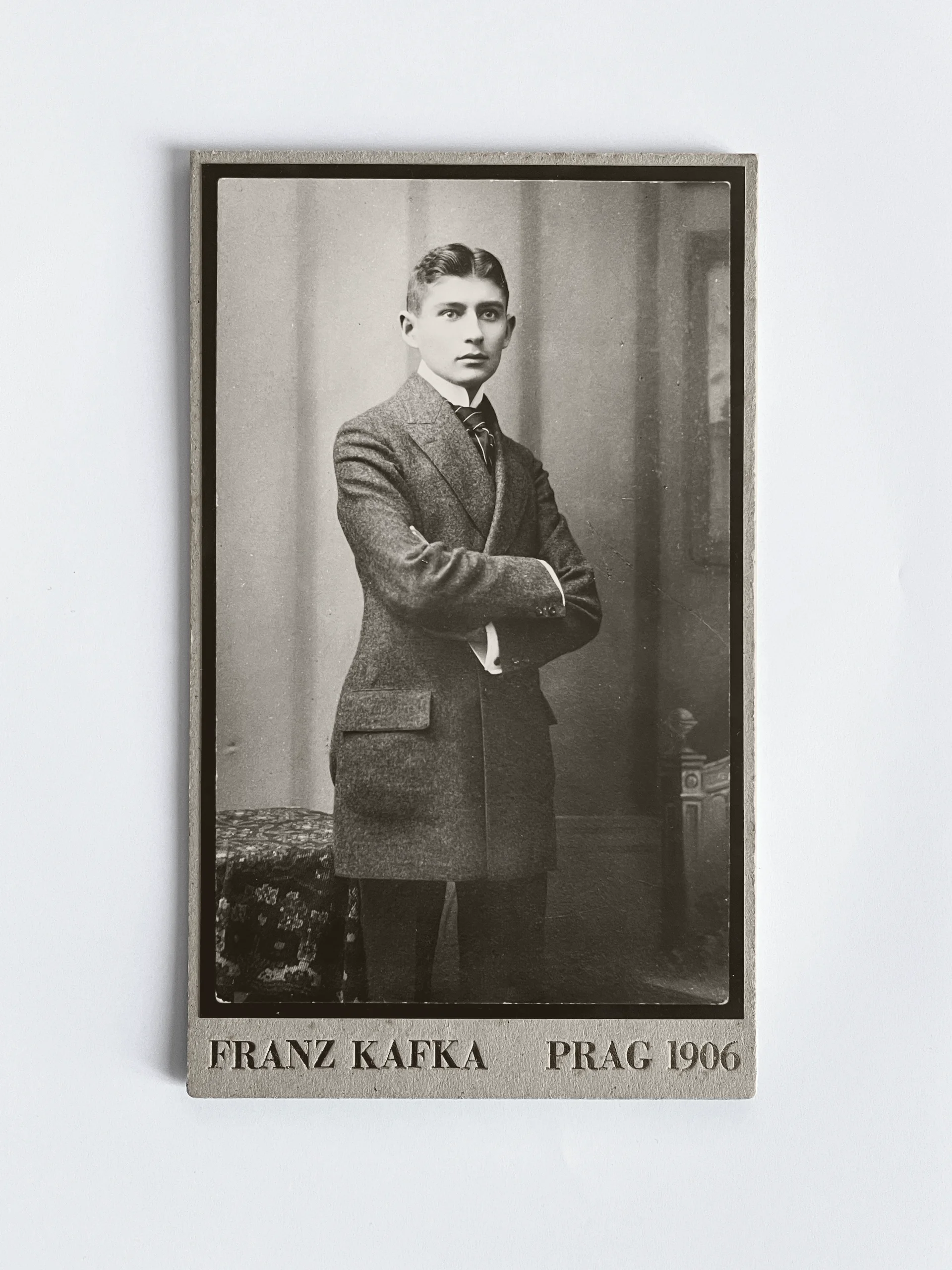
Franz Kafka
 Czechia
novelist•fabulist•short story writer
Birthday
July 3, 1883
Birth Sign
Cancer
Birthplace
Prague, Bohemia, Austria-Hungary (now Czech Republic)
Age
Died at 40
Height
5 ft 9 in (175 cm)
About
Franz Kafka was a German-language Jewish Czech writer and novelist born in Prague, then part of the Austro-Hungarian Empire. Widely regarded as one of the most influential writers of the 20th century, his works fuse elements of realism with the fantastique, featuring isolated protagonists facing bizarre predicaments and incomprehensible bureaucratic powers. The term "Kafkaesque" entered the global lexicon to describe situations characterized by nightmarish complexity and absurdity.
Though he earned a doctorate in law and worked for years in legal offices and an insurance agency, he felt those obligations stifled his creativity. He wrote late at night after exhausting shifts, driven by a need to capture the strange realities of modern existence. His career remained largely hidden from the public eye while he lived. Only a small fraction of his output saw print before his death, yet those scattered stories planted seeds that would eventually grow into a global literary movement.
Early Life & Background
Franz Kafka grew up in a tense household where he felt overshadowed by his father's authoritarian nature. He described this dynamic in his famous "Letter to His Father," written in 1919 but never sent, detailing how his father's loud voice and physical presence instilled a deep sense of inadequacy and fear in him. Kafka attended the German-speaking New Town Gymnasium in Prague, graduating in 1901. Despite his father's wishes that he pursue a practical career, Kafka enrolled at Charles University in Prague, initially studying chemistry before switching to law. He earned his doctorate in law in 1906.
Following his degree, Kafka began a rigorous professional life that would continue until his death. He worked for the Royal Bohemian Court Office, then joined the Workers' Accident Insurance Institute, where he served as a senior legal officer from 1908 until 1922. This job required long hours and travel, which he found exhausting and alienating, yet it provided him with financial stability and material for his writing. His literary journey began in earnest during his university years. In 1902, he met Max Brod, a fellow student who became his closest friend, confidant, and literary executor. Brod encouraged Kafka to write and read his work aloud to him. Kafka's first published story, "Description of a Struggle," appeared in 1904. However, his early career was marked by silence and self-doubt. He wrote primarily late at night after his exhausting day job, often feeling that his creative output was insufficient or unintelligible. For much of his life, he remained largely unknown to the public, publishing only a small fraction of his work in obscure literary journals.
Career Growth
Kafka's career was defined not by commercial success during his lifetime but by the profound impact of his posthumous publications. While alive, he published very little. His major breakthroughs occurred after his death, orchestrated by Max Brod against Kafka's explicit instructions to burn his unpublished manuscripts.
In 1915, The Metamorphosis was published as a standalone novella, becoming his first widely recognized work. It tells the story of Gregor Samsa, who wakes up transformed into a giant insect. In 1925, The Trial was published posthumously by Brod. It depicts the surreal nightmare of Josef K., arrested and prosecuted by an inaccessible authority for a crime never revealed. In 1926, The Castle was published. It follows a land surveyor's futile attempts to gain access to the mysterious authorities governing a village. In 1927, Amerika was published, though Brod heavily edited the unfinished manuscript. In 1931–1936, In the Penal Colony, A Country Doctor, and other short stories were collected and published, cementing his reputation.
These works established Kafka as a pioneer of modernist literature, influencing existentialism, surrealism, and magical realism. His writing style, characterized by precise, clinical language describing impossible events, created a unique aesthetic that remains relevant today.
Career Timeline
Public Image & Style
Kafka is portrayed as a brooding, introspective figure, often associated with themes of alienation, bureaucracy, and the absurd. His image is frequently linked to the concept of the "Kafkaesque," representing the nightmare of modern life. Media portrayals often emphasize his sensitivity and the tragic nature of his short life. He is remembered as a man who lived quietly but spoke volumes about the human condition through his fiction.
Fame & Fandom (iFAMOUS Rankings)
iFANN has not yet collected fame data for this person. As of September 2026, there is no published ranking in the iFANN Global Fame Rankings. The fanbase has no formal name, though readers often refer to themselves as "Kafkians" or simply "Kafka readers." The Franz Kafka Society and the Franz Kafka Museum organize events, lectures, and exhibitions globally. Fans engage in deep analysis of his works, often discussing the philosophical implications of his stories. Annual readings of The Metamorphosis and The Trial are common in literary circles. Campaigns often focus on preserving his manuscripts and promoting translations.
Interesting Facts and Legends
Kafka was left-handed, a trait that was sometimes stigmatized in his time. He was known to sleep in a chair rather than a bed, believing it helped him stay awake longer for writing. Although he lived in Prague, he wrote exclusively in German, a language that was not the majority language of the city. Later in life, Kafka became a vegetarian, influenced by his health issues and philosophical views. A story fans still retell is that he reportedly woke up with the idea for The Metamorphosis after a dream, though the exact origin is debated. The decision by Max Brod to ignore Kafka's wish to burn his manuscripts is one of the most pivotal moments in literary history, saving Kafka's legacy from oblivion.
Notable Quotes
“I cannot make you understand. I cannot make anyone understand what is happening inside me. I cannot even explain it to myself.”
“The cage went in search of the bird.”
“It is not necessary to hope in order to persevere.”
“Man is not alone in the world; he is surrounded by others, but he is still alone.”
Family & Personal Life
Kafka was the eldest of six children; three of his sisters died in infancy, leaving him with two younger brothers, Georg and Heinrich, who both died young, and three surviving sisters: Gabriele ("Ellie"), Valerie ("Valli"), and Ottilie ("Ottla"). His father, Hermann Kafka, was a successful but domineering merchant of dry goods, while his mother, Julie Löwy, came from a well-to-do family but struggled with the domestic demands of her husband's large household. Kafka maintained close ties with his sisters throughout his life, particularly Ottla, who cared for him during his final illness.
Notable Connections
Relationships & Dating History
Franz Kafka never married and had no children. His romantic life was marked by anxiety, hesitation, and several broken engagements. He met Felice Bauer, a Berlin-based secretary, in 1912. Their relationship was intense and tumultuous, involving multiple periods of separation and reconciliation. They became engaged twice, in 1914 and 1917, but both times Kafka called off the engagement, citing his inability to reconcile his marriage obligations with his writing. The relationship ended in 1917, though they remained in contact sporadically until 1920.
In 1920, Kafka began a passionate correspondence with Milena Jesenská, a Czech journalist and translator. Their relationship was intellectual and fraught with jealousy and insecurity. Kafka wrote some of his most intimate letters to her, later known as the Letters to Milena. They broke up in 1923 due to the strain of their distance and Kafka's deteriorating health. Jesenská later translated his works into Czech and was murdered in the Auschwitz concentration camp during the Holocaust. In his final year, Kafka moved to Berlin and began living with Dora Diamant, a kindergarten teacher. She was his last partner and cared for him during his final illness. They lived together until his death in June 1924. There is no evidence they were formally engaged or married, but she was his companion in his final days.
- EngagedFelice Bauer1912 - 1917Engaged twice but broke off both times due to fear of domestic life interfering with writing.
- DatingMilena Jesenská1920 - 1923Passionate lover and correspondent; relationship ended due to distance and ill health.
- DatingDora Diamant1923 - 1924Final companion who cared for him during his last illness.
Death & Aftermath
Died
June 3, 1924 (aged 40)
Death Place
Kierling, Lower Austria, Austria
Cause of Death
Pulmonary tuberculosis
Franz Kafka died on June 3, 1924, at the Sanatorium Kierling in Kierling, a village near Klosterneuburg, Austria. The cause was pulmonary tuberculosis, which had caused severe physical deterioration and an inability to swallow that led to starvation and dehydration by early May. His final days were spent bedridden, unable to speak clearly as the infection spread through his throat and lungs.
The service was private, attended by family members and a small circle of literary acquaintances including Brod and Felix Weltsch. He was cremated and his ashes interred in the same cemetery. Brod famously ignored Kafka's instruction to burn his unpublished papers, leading to the posthumous publication of major works such as The Trial, The Castle, and Amerika. His estate was managed entirely by Brod until 1968, after which rights passed to his niece Esther Hoffe and the Kafka Estate Foundation. Decades later, Kafka has been honored with the Franz Kafka Museum in Prague and numerous statues worldwide.
Net Worth (Estate Value)
$50 Million
iFANN Editorial Team estimate
As a deceased author, Franz Kafka does not have a personal net worth in the traditional sense. However, research by the iFANN Editorial Team puts his estate value at around $50 million. The estate generates significant revenue through book royalties, film and theater adaptations, merchandise, and licensing of his name and image. Primary sources include translations into over 100 languages and ongoing interest in his works. The estate is currently managed by the Franz Kafka Estate Foundation, which oversees the preservation of his works and manages licensing agreements. Recent developments in 2026 include new adaptations like the biopic Franz directed by Agnieszka Holland, which premiered in August 2026, generating renewed interest and revenue.
Awards Won (2)
Kafka received no major awards during his lifetime. Posthumously, his influence has been cited as a primary factor in the success of Nobel Prize-winning authors. The Franz Kafka Prize was established in 2001 by the City of Prague and the Franz Kafka Society to honor individuals who have made significant contributions to world literature. The Franz Kafka Ring Award is given by the Austrian government to authors who have enriched European culture. Many of his manuscripts have been inscribed on UNESCO's Memory of the World Register.
2001 · Literature
Posthumous recognition
2001 · Culture
Posthumous recognition
Known For
The Metamorphosis
1915 · Author
The Trial
1925 · Author
The Castle
1926 · Author
Amerika
1927 · Author
Keywords
Sources
Quick Facts
- Profession
- novelist, fabulist, short story writer
- Born
- July 3, 1883
- Birthplace
- Prague
- Died
- June 3, 1924
- Death Place
- Kierling
- Gender
- Male
- Birth Sign
- Cancer
Personal Details
- Full Name
- Franz Kafka
- Height
- 5 ft 9 in (175 cm)
- Children
- Education
- Charles University, Prague
Frequently Asked Questions
What caused Franz Kafka's death?
Did Franz Kafka ever get married?
Who managed Franz Kafka's estate after his death?
What is the meaning of "Kafkaesque"?
Why did Max Brod publish Kafka's works?
Similar People
Join the community
fans discussing