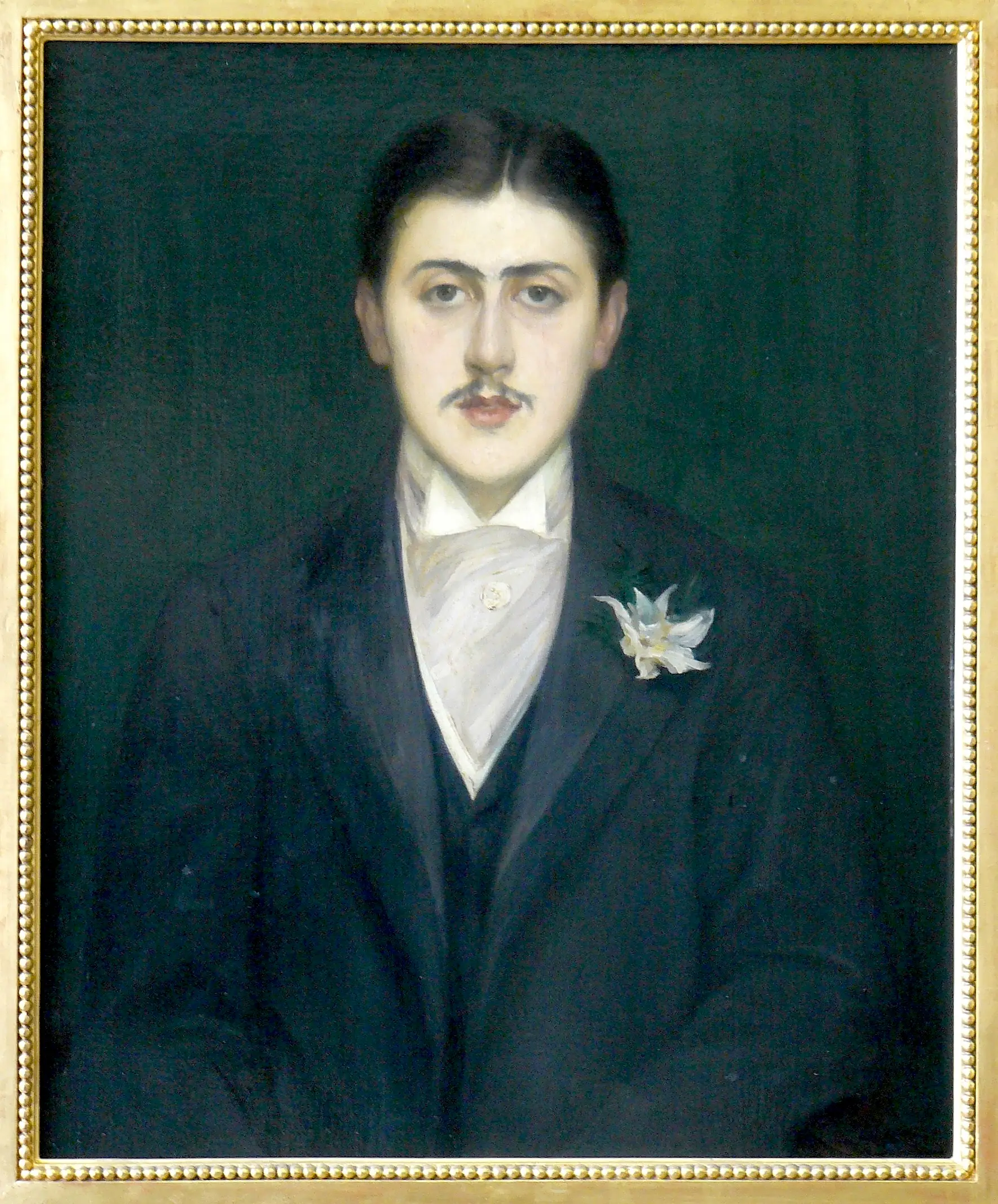
Marcel Proust
 France
Also known as: Valentin Louis Georges Eugène Marcel Proust, Valentin-Louis-Georges-Eugene-Marcel Proust, Bernard d'Algouvres
Birthday
July 10, 1871
Birth Sign
Cancer
Birthplace
16th arrondissement of Paris, France
Age
Died at 51
Height
5 ft 8 in (173 cm)
About
Marcel Proust, born Valentin Louis Georges Eugène Marcel Proust in Paris on July 10, 1871, was a French novelist, essayist, and literary critic. He is universally recognized as one of the most influential figures in modern literature, primarily for his monumental seven-volume novel sequence À la recherche du temps perdu (In Search of Lost Time). This epic work, published between 1913 and 1927, revolutionized narrative structure through its exploration of involuntary memory, time, and art. Proust died on November 18, 1922, at the age of 51, leaving behind a legacy that redefined the possibilities of the novel form.
His life was marked by intense social observation and periods of severe illness. Despite suffering from chronic asthma from childhood, which isolated him from traditional schooling and forced him into a recluse-like existence, he became a fixture in the high-society salons of Paris. These observations of aristocratic life provided the raw material for his fiction. His innovative stream-of-consciousness technique influenced generations of writers, including James Joyce, Virginia Woolf, and Samuel Beckett. Today, his works are studied globally, and his influence extends far beyond literature into psychology and philosophy.
Early Life & Background
Born into a prosperous bourgeois family in the 16th arrondissement of Paris, Proust grew up surrounded by culture and intellectualism. His father, Adrien Proust, was a renowned epidemiologist and public health official who later became a professor at the Faculty of Medicine in Paris. His mother, Jeanne Clémence Weil, came from a wealthy Jewish family and was deeply religious and educated, exerting a profound influence on her son's moral and intellectual development. The household valued high culture, art, and literature, creating an environment where young Marcel absorbed the aesthetics of the fin-de-siècle era.
His childhood was defined by severe asthma, diagnosed around age nine. This chronic condition isolated him from typical school life and forced him to spend much of his time indoors, fostering a rich inner world and a habit of intense observation. While he attended the prestigious Lycée Condorcet, his education was frequently interrupted by illness. Despite these challenges, he excelled academically when able to attend, eventually passing the entrance examination for the École Libre des Sciences Politiques (Sciences Po) in 1889. However, he never completed a formal degree or pursued a traditional career path, instead dedicating himself entirely to writing and socializing within Parisian high society.
Before achieving global recognition, Proust spent his early twenties immersed in the literary salons of Paris. He was a regular at gatherings hosted by figures like Robert de Montesquiou, a poet and aesthete who served as a model for the character Swann in his later work. Proust's early literary output included essays, translations of John Ruskin, and short stories. In 1896, he published his first book, Les plaisirs et les jours (Pleasures and Days), a collection of poems, short stories, and critical essays. While it received modest attention and was praised by some critics for its style, it did not establish him as a major author. During this period, he also worked as a librarian and contributed to various journals. His social life was extensive; he frequented the most exclusive salons, observing the intricate codes of etiquette and the shifting dynamics of the aristocracy. These observations would later form the bedrock of his masterpiece. The pivotal moment before his fame arrived was the decision, made around 1908, to abandon his earlier, more conventional works and begin the massive project that would become In Search of Lost Time. He retreated from public life to write in seclusion, often working late into the night.
Career Growth
Proust's career is defined almost entirely by his magnum opus, À la recherche du temps perdu. The publication history of the work is complex and spans nearly two decades. In 1913, the first volume, Du côté de chez Swann (Swann's Way), was published with the assistance of editor Gaston Gallimard after being rejected by several other publishers. It won the Prix Femina. The second volume, À l'ombre des jeunes filles en fleurs (Within a Budding Grove), was released in 1919 and immediately won the prestigious Prix Goncourt, cementing his status as a titan of French letters.
The remaining volumes were published posthumously or just before his death. La Prisonnière (The Captive) and Albertine Disparue (The Fugitive) appeared in 1923 and 1925 respectively, compiled from his notes. The final volume, Le Temps retrouvé (Time Regained), was published in 1927 by his brother, Robert Proust. The work is considered a landmark of modernist literature, pioneering the stream-of-consciousness technique and exploring themes of memory, time, art, and jealousy. His impact on the literary world was immediate upon the release of the Goncourt-winning volume. His innovative narrative structure influenced generations of writers, including James Joyce, Virginia Woolf, and Samuel Beckett. In 1921, he was elected to the Académie française, though he died before he could take his seat. His legacy continues to grow, with his works generating millions in annual royalties and inspiring countless adaptations in film, opera, and theater.
Career Timeline
Public Image & Style
Proust is portrayed as a reclusive genius, a man of refined tastes, and a master of psychological insight. His public image is one of fragility and intellectual depth, often associated with the aesthetic of fin-de-siècle Paris. His writing style is celebrated for its complexity, precision, and exploration of the human psyche. He is frequently depicted wearing a suit even in his final years, maintaining a dignified appearance despite his frail health. The image of Proust writing in a cork-lined room has become an iconic representation of his dedication to his craft. His public persona was one of quiet intensity, observing the world from the margins while engaging deeply with the cultural elite. Critics and admirers alike view him as a pioneer of modernism, whose work anticipated many of the psychological and philosophical trends of the 20th century.
Fame & Fandom (iFAMOUS Rankings)
According to the iFANN Global Fame Rankings, Marcel Proust holds the position of the 71st most famous person in France, a placement that has remained stable through recent assessment cycles. This standing reflects the enduring resonance of his literary output and the continued study of his life within his nation of origin. He is also ranked as the 38th most famous person from France, up from 39th in the previous cycle, and sits at the 71st most famous person in Books & Literature. These metrics highlight his sustained relevance in French cultural history and his global impact on literary studies.
The fanbase surrounding Proust does not operate under a formal collective name; there is no single designation used by admirers to identify themselves as a unified group. His legacy is sustained primarily by academic institutions, literary societies, and individual readers rather than an organized movement with rituals or coordinated campaigns. Unofficial groups exist to study his work, yet these lack the interactive dynamics and internal lore characteristic of modern celebrity fandoms. Instead, admiration for Proust manifests through scholarly analysis, commemorative events, and the ongoing translation and adaptation of his works into new media.
Interesting Facts and Legends
Proust lined his bedroom walls with cork to create a soundproof environment, allowing him to sleep during the day and write at night. This unique setup became an iconic representation of his dedication to his craft despite his physical limitations. A widely retold story in literary circles concerns his brief and awkward encounter with James Joyce in Paris, where Proust reportedly answered a question about a duke with a solitary "No." This exchange has become a staple of literary lore, symbolizing the clash between two titans of modernism. Another enduring legend involves the "Madeleine moment," a scene in his novel where a taste of cake triggers involuntary memory. Recent scientific studies have validated the psychological mechanism behind this phenomenon, confirming that smell and taste are uniquely potent triggers for autobiographical memory. Researchers have identified what is believed to be the first film footage of Proust, discovered in 110-year-old wedding archives showing him at a family event. Although this discovery offers a rare visual record, it remains a retrospective revelation rather than a documented public spectacle from his lifetime.
Notable Quotes
“Perhaps so many years ago, I was already dying.”
“Let us be grateful to the people who make us happy; they are the charming gardeners who make our souls blossom.”
“The real voyage of discovery consists not in seeking new landscapes, but in having new eyes.”
“A reader lives a thousand lives before he dies. The man who never reads lives only one.”
Family & Personal Life
Proust was born into a prosperous bourgeois family. His father, Adrien Proust, was a renowned epidemiologist and public health official who later became a professor at the Faculty of Medicine in Paris. His mother, Jeanne Clémence Weil, came from a wealthy Jewish family and was deeply religious and educated, exerting a profound influence on her son's moral and intellectual development. Proust had a younger brother named Robert Proust, who played a crucial role in managing his literary estate after his death. Robert oversaw the publication of the remaining volumes of In Search of Lost Time and helped preserve his brother's legacy. Proust never married and had no children. He lived with his parents for much of his life, moving into their apartment in the 16th arrondissement of Paris, where he spent his final years. The family home remained a center of literary activity, hosting many of the artists and writers Proust admired.
Notable Connections
Robert de Montesquiou, André Gide, Jean Cocteau, Robert Proust, Alfred Agostinelli.
Relationships & Dating History
Marcel Proust lived a largely private life regarding his romantic relationships, though his sexuality was a central theme in his work and personal correspondence. He was known to be gay, a fact that was widely rumored but rarely discussed openly in the public sphere of his time due to the legal and social climate in France. Unlike modern celebrities, Proust did not have a series of public "dating" relationships that are documented in tabloid fashion. His romantic life was characterized by long-term infatuations and secret affairs. He was intensely infatuated with Robert de Montesquiou, an aristocratic poet and dandy, viewing him as a muse. Their relationship was platonic but deeply emotional and artistic; Montesquiou served as the primary inspiration for the character Charles Swann. They maintained a close friendship until Montesquiou's death in 1921.
Proust also had a significant romantic involvement with Lucien Daudet, a writer and son of Alphonse Daudet. This relationship ended acrimoniously and is often cited as a source of pain and inspiration for the character of Albertine in In Search of Lost Time. Throughout his life, Proust engaged in discreet sexual encounters with men, often from the working class or lower aristocracy. He kept detailed notebooks and letters documenting these desires and experiences, but specific names of long-term partners outside of the above are not well-documented in public records. As of 2026, Marcel Proust is deceased. He died on November 18, 1922. There is no current dating status, marriage, or partnership. He left no children.
- DatedRobert de Montesquiou1890 - 1921Intense infatuation and platonic friendship; served as muse for Swann.
- DatedLucien Daudet1895 - 1902Significant romantic involvement that ended acrimoniously; inspired Albertine.
- DatedAlfred Agostinelli1913 - 1914Former valet and lover; relationship ended abruptly.
Death & Aftermath
Died
November 18, 1922 (aged 51)
Death Place
Paris, France
Cause of Death
Acute pulmonary attack complicated by pneumonia and heart failure
Marcel Proust passed away on November 18, 1922, at his home in the 16th arrondissement of Paris. His death resulted from an acute pulmonary attack, a complication of the severe asthma that had plagued him for decades, exacerbated by pneumonia and heart failure. For years, he had lived in isolation within a room lined with cork to dampen sound and block out light, a sanctuary that allowed him to sleep during the day and write through the night despite his deteriorating health.
The literary world reacted with immediate and profound grief. Prominent contemporaries including André Gide, Romain Rolland, and Henri Bergson offered tributes to a genius who had fundamentally reshaped modern literature. A private funeral service was held shortly after his death at Père Lachaise Cemetery in Paris, attended by a small circle of family, friends, and fellow writers. His brother Robert Proust and close friend Jean Cocteau took charge of managing his literary estate, overseeing the publication of the remaining volumes of his masterpiece between 1923 and 1927.
Posthumous recognition has only grown over the last century. In 1971, marking the centenary of his birth, Proust received one of France's highest honors: his remains were transferred from Père Lachaise to the Panthéon in Paris, placing him among the nation's greatest heroes. The Marcel Proust Foundation continues to support literary research and promote his work today. His estate remains a significant source of revenue through book sales, licensing deals for adaptations, and academic studies, ensuring his voice remains central to discussions of memory and time.
Net Worth (Estate Value)
$50 Million
iFANN Editorial Team estimate
As of 2026, the estate of Marcel Proust is estimated to be worth approximately $50 million. This valuation is derived from the ongoing royalties of his works, licensing deals for adaptations, and merchandise sales. The estate is managed by his descendants and literary agents, with proceeds supporting the Fondation Marcel Proust and academic research. As of recent reports, Proust's works generate millions of dollars annually in global sales. Major film and television adaptations, such as the 2021 BBC/Netflix series In Search of Lost Time, contribute significantly to the estate's income. The In Search of Lost Time franchise is estimated to generate over $50 million annually in combined book sales and media rights globally. Research by the iFANN Editorial Team puts Proust's fortune at around $50 million, reflecting the enduring commercial viability of his literary legacy.
Awards Won (4)
Proust received numerous prestigious awards during his lifetime and posthumously. He won the Prix Femina in 1913 for Du côté de chez Swann and the Prix Goncourt in 1919 for À l'ombre des jeunes filles en fleurs. In 1921, he was elected to the Académie française, though he died before taking his seat. Posthumously, he was inducted into the Panthéon in 1971, a rare honor reserved for France's greatest national heroes. He also received honorary doctorates from Oxford University and other institutions.
1913 · Literature
Du côté de chez Swann
1919 · Literature
À l'ombre des jeunes filles en fleurs
Known For
In Search of Lost Time
1913 · Author
Swann's Way
1913 · Author
Within a Budding Grove
1919 · Author
Keywords
Sources
Quick Facts
- Profession
- novelist, essayist, writer
- Born
- July 10, 1871
- Birthplace
- 16th arrondissement of Paris
- Died
- November 18, 1922
- Death Place
- 16th arrondissement of Paris
- Gender
- Male
- Birth Sign
- Cancer
Personal Details
- Full Name
- Valentin Louis Georges Eugène Marcel Proust
- Height
- 5 ft 8 in (173 cm)
- Children
- Education
- Lycée Condorcet; École Libre des Sciences Politiques (attended but did not graduate)
Frequently Asked Questions
What is Marcel Proust famous for?
How did Marcel Proust die?
Did Marcel Proust have any children?
What is the 'Madeleine moment'?
Where is Marcel Proust buried?
Social Media
Similar People
Join the community
fans discussing