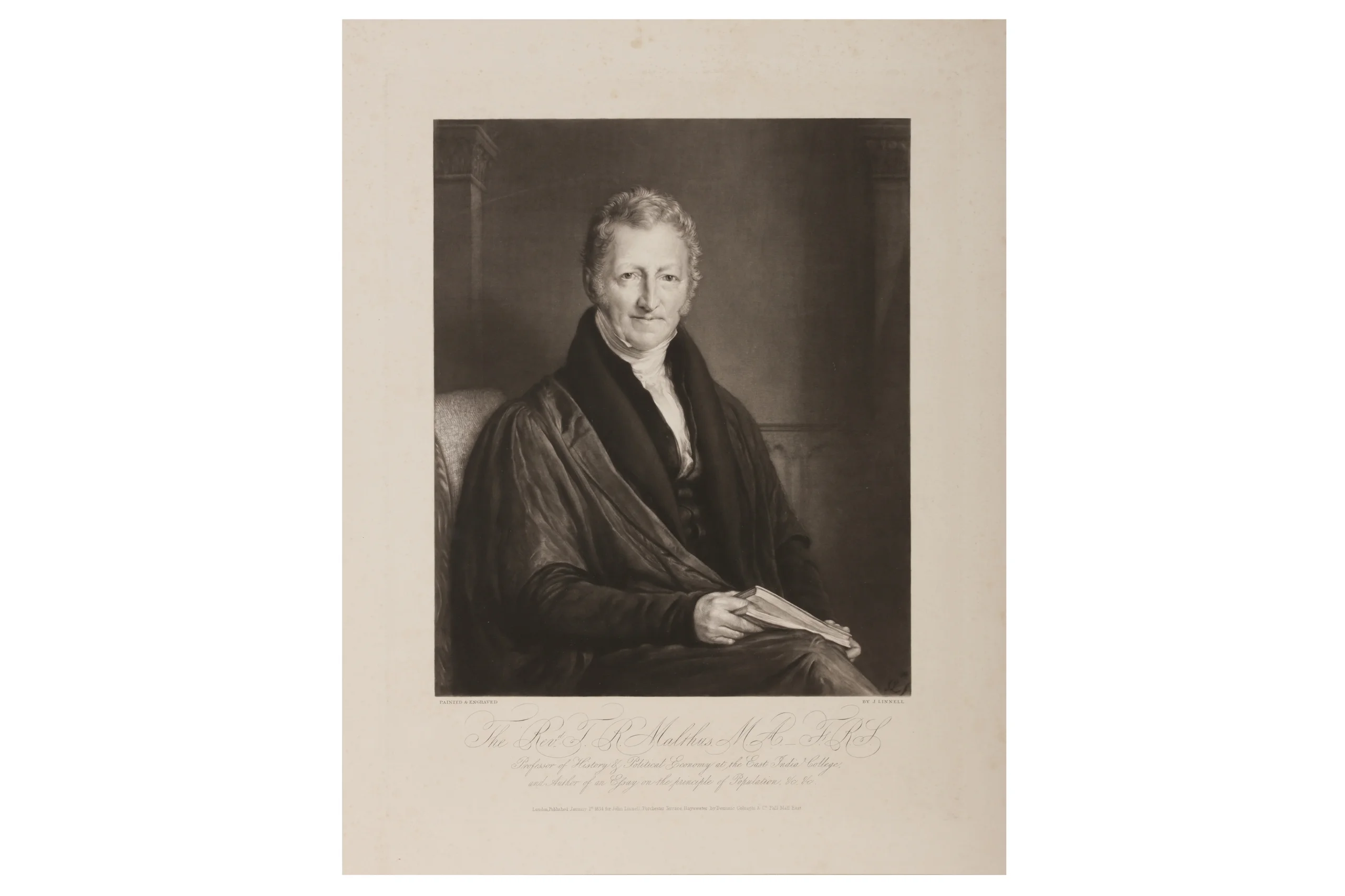
Thomas Robert Malthus
 United Kingdom
Also known as: T.R. Malthus, The Reverend Thomas Malthus
Birthday
February 13, 1766
Birth Sign
Aquarius
Birthplace
Westcott, Surrey, England
Age
Died at 68
About
Thomas Robert Malthus was an English cleric and economist whose writings on population dynamics reshaped how humanity understood its own growth. Born in Westcott, Surrey, he spent his life analyzing the relationship between food production and human numbers. His most famous work, An Essay on the Principle of Population, argued that population grows geometrically while resources only grow arithmetically. This theory created a framework for understanding poverty and resource scarcity that dominated economic thought for nearly two centuries.
Malthus died in Bath in 1834 after a long career as a professor and writer. His ideas influenced thinkers across disciplines including Charles Darwin, who applied Malthusian concepts to biological evolution. Despite criticism regarding his pessimistic outlook and failure to predict industrial agricultural advances, his core arguments remain central to discussions on sustainability and demography today.
Early Life & Background
Thomas Robert Malthus entered the world in February 1766 within the comfortable confines of Westcott House in Surrey. He was the sixth child born to Daniel Malthus, a wealthy landowner with a keen interest in philosophy and politics. Daniel Malthus maintained friendships with prominent Enlightenment figures like Jean-Jacques Rousseau, creating an intellectual atmosphere in the household that encouraged rigorous debate and critical thinking from a young age. This environment provided Thomas with access to high-quality education and early exposure to complex political theories.
At age eighteen, he enrolled at Jesus College, Cambridge, in 1784. The university years solidified his academic foundation and introduced him to influential contemporaries like Jeremy Bentham and David Ricardo. These friendships would later shape his economic theories significantly. After graduating in 1788, Malthus did not immediately seek fame or fortune. Instead, he served as a tutor and prepared for ordination in the Church of England, becoming a deacon shortly after graduation and a full priest in 1793. During this period, he worked quietly in academia and the church, building a reputation as a serious scholar before publishing his first major work anonymously in 1798.
Career Growth
The publication of An Essay on the Principle of Population in 1798 marked the turning point in Malthus's life. Released without his name attached, the pamphlet caused immediate controversy across Europe by challenging the optimistic belief that society could progress indefinitely through reason. Malthus argued that unchecked population growth would inevitably outstrip food supplies, leading to misery unless checked by moral restraint or disaster. The backlash was so intense that he felt compelled to revise and expand the essay multiple times over the next three decades, refining his arguments with new data in editions published in 1803, 1806, 1807, 1817, and 1826.
In 1805, he secured a prestigious position as the first Professor of History and Political Economy at the East India Company College in Haileybury. He held this chair until his death, influencing generations of British administrators and economists who studied under him. His tenure allowed him to disseminate his theories directly to future leaders of the British Empire. Beyond teaching, he continued to write extensively on economics, including Principles of Political Economy in 1820, where he engaged in debates with contemporaries like David Ricardo. His work remained relevant throughout the 19th century, shaping policy discussions on the Poor Laws and international trade.
Career Timeline
Public Image & Style
During his lifetime, Malthus was viewed as a stern and uncompromising thinker willing to challenge prevailing beliefs. Contemporary media portrayals were mixed; some saw him as a visionary who exposed uncomfortable truths about human nature, while others labeled him a cynic or even a villain for his grim predictions. His meticulous attention to data and his refusal to sugarcoat the consequences of population growth defined his public persona.
Today, historians and scholars tend to view him more sympathetically, recognizing the limitations of his knowledge and the historical context in which he wrote. He is remembered as a foundational figure in demography and economics rather than a mere pessimist. Modern assessments often highlight his role in sparking necessary debates about resource management and sustainability, acknowledging that his work laid the groundwork for future scientific inquiry into ecological limits.
Fame & Fandom (iFAMOUS Rankings)
The devotion surrounding Thomas Robert Malthus is not the frenzied adoration of a pop idol but the rigorous, enduring engagement of scholars and economists who have debated his theories for over two centuries. Unlike modern celebrity culture, there are no fan clubs, birthday billboards, or organized campaigns to promote his name. His "fanbase" consists entirely of academics, historians, and students who analyze his work on population dynamics, often with a critical eye that acknowledges his influence while rejecting his grim predictions. The term "Malthusian" has entered the lexicon as a shorthand for resource pessimism, a legacy that keeps his name relevant in classrooms and policy debates long after his death in 1834. This intellectual following is defined by study rather than worship, with his seminal work, An Essay on the Principle of Population, serving as a foundational text that sparked intense debate rather than casual fandom. While some view him as a visionary who exposed uncomfortable truths about human nature, others regard him as a cynic whose lack of compassion for the poor makes his ideas difficult to embrace. There is no formal name for his fanbase; the fanbase has no documented name. The iFANN Global Fame Rankings do not yet include him, leaving his current standing unmeasured against living figures. Consequently, no specific placement can be assigned within the global hierarchy of fame. His impact remains historical and theoretical, anchored in the 1798 publication of his essay and the profound influence it exerted on Charles Darwin's development of natural selection. These events form the core of his legend, marking moments where his ideas reshaped scientific and economic thought without ever seeking the spotlight of modern stardom.
Interesting Facts and Legends
One of the most persistent stories about Malthus involves the origin of his name. Some accounts suggest he was named after the philosopher Thomas Hobbes due to his father's admiration, though others claim it was simply a family tradition. A lesser-known fact is his deep involvement in the Poor Law debates. Malthus strongly opposed the existing system of poor relief in England, arguing that it encouraged dependency and overpopulation rather than self-reliance. His stance made him a polarizing figure among reformers and politicians alike.
Another interesting detail concerns his relationship with technology. Critics often note that Malthus failed to anticipate the Industrial Revolution's impact on agriculture. He believed technological improvements were temporary fixes that would only accelerate population growth. This specific blind spot became a focal point for later economists who argued that innovation could break the cycle he described. Additionally, he was elected a Fellow of the Royal Society in 1820, a rare honor for an economist of his time.
Notable Quotes
“The power of population is indefinitely greater than the power in the earth to produce subsistence for man.”
“The passion between the sexes is necessary and will remain nearly in its present state.”
“It is not wisdom but force that governs the world.”
Family & Personal Life
Thomas Robert Malthus came from a prosperous family that valued education and intellectual pursuit. His father, Daniel Malthus, was a well-to-do landowner and a friend of the philosopher Jean-Jacques Rousseau. Thomas was one of seven children, growing up in a household filled with books and lively discussions about politics and philosophy. This upbringing instilled in him a lifelong appreciation for empirical evidence and logical argumentation.
In 1804, he married Harriet Eckersall, the daughter of a clergyman. They had three children together: two sons and a daughter. The couple remained married until Malthus's death in 1834. Little is known about their private life beyond the fact that they shared a stable domestic existence. Malthus never remarried, and there are no records of romantic relationships prior to his marriage. His family life remained relatively quiet compared to the public storm his writings generated.
Notable Connections
Relationships & Dating History
Thomas Robert Malthus's personal life was largely confined to professional and familial spheres, typical of men in his social class and era. There are no records of prior romantic relationships or engagements before his marriage. In 1804, he wed Harriet Eckersall, the daughter of a clergyman. The couple remained married until Malthus's death in 1834. They had three children together: two sons and one daughter.
Little is known about their private life beyond the fact that they shared a stable domestic existence. Malthus did not engage in the kind of public dating culture seen in modern eras, and there is no evidence of infidelity or public scandals involving his personal life. As a man of his time, his relationships were largely focused on family duties and academic pursuits. Upon his death, Harriet survived him, leaving her status as a widow.
- MarriedHarriet Eckersall1804 - 1834Remained married until Malthus's death; they had three children together.
Death & Aftermath
Died
December 29, 1834 (aged 68)
Death Place
Bath, Somerset, England
Cause of Death
Unknown
Thomas Robert Malthus spent his final years residing in Bath, Somerset. He passed away at his home on December 29, 1834, at the age of sixty-eight. Historical records describe his final days as private and uneventful, with no public appearances or dramatic events recorded immediately preceding his passing. Following his death, tributes from contemporaries remained confined to academic and professional circles rather than public gatherings. While highly respected by peers like David Ricardo, no specific eulogies delivered by institutions are detailed in the historical record. He was buried in the parish churchyard of St Peter's in Bath, the community where he had lived for many years.
In the posthumous era, Malthus received significant scholarly attention and re-evaluation rather than commercial releases or film adaptations. Notable developments include new biographies such as Robert J. Mayhew's Malthus and various articles in journals like The Conversation , Scientific American , and Econlib between 2014 and 2024 that re-examined his theories on population growth. A 2024 article titled "Books That Shook the Business World" highlighted his seminal work, An Essay on the Principle of Population . His literary works remain in the public domain and continue to be studied in economics and ecology courses globally.
Net Worth (Estate Value)
$0
iFANN Editorial Team estimate
As a deceased historical figure from the 19th century, Thomas Robert Malthus does not possess a net worth in the modern financial sense. He earned income primarily through his salary as a professor at the East India Company College and through royalties from his published works during his lifetime. His estate, consisting of his intellectual property and writings, continues to generate academic interest and revenue through reprints, translations, and scholarly commentary.
The value of his intellectual estate cannot be quantified in monetary terms like a living celebrity. However, his works remain widely cited in economics, sociology, and environmental studies textbooks and journals worldwide. No major commercial ventures or real estate holdings are attributed to him personally, and his legacy is measured in academic influence rather than accumulated wealth. The iFANN Editorial Team estimates that while his personal assets were modest by modern standards, his intellectual contributions hold immense value to the field of study he helped create.
Awards Won (2)
Malthus received few formal honors during his lifetime, though he was elected a Fellow of the Royal Society in 1820, a significant recognition of his contributions to science and scholarship. He was also awarded an honorary degree from the University of Edinburgh. While no major awards named after him existed during his lifetime, numerous academic institutions and organizations now use his name in lectureships, fellowships, and research grants dedicated to population studies and economic theory.
1820 · Science
General Contributions to Science and Economics
1820 · Education
University of Edinburgh
Known For
An Essay on the Principle of Population
1798 · Author
Principles of Political Economy
1820 · Author
Keywords
Sources
Quick Facts
- Profession
- economist, essayist, statistician
- Born
- February 13, 1766
- Birthplace
- Westcott, Surrey
- Died
- December 29, 1834
- Death Place
- Bath, Somerset
- Gender
- Male
- Spouse
- Harriet Eckersall
- Birth Sign
- Aquarius
Personal Details
- Full Name
- Thomas Robert Malthus
- Spouse
- Harriet Eckersall
- Children
- Three (two sons and one daughter)
- Education
- Jesus College, Cambridge
Frequently Asked Questions
What is the Malthusian trap?
Why was Malthus controversial?
Did Malthus predict the Industrial Revolution?
How did Malthus influence Charles Darwin?
What is Malthus's legacy today?

Join the community
fans discussing