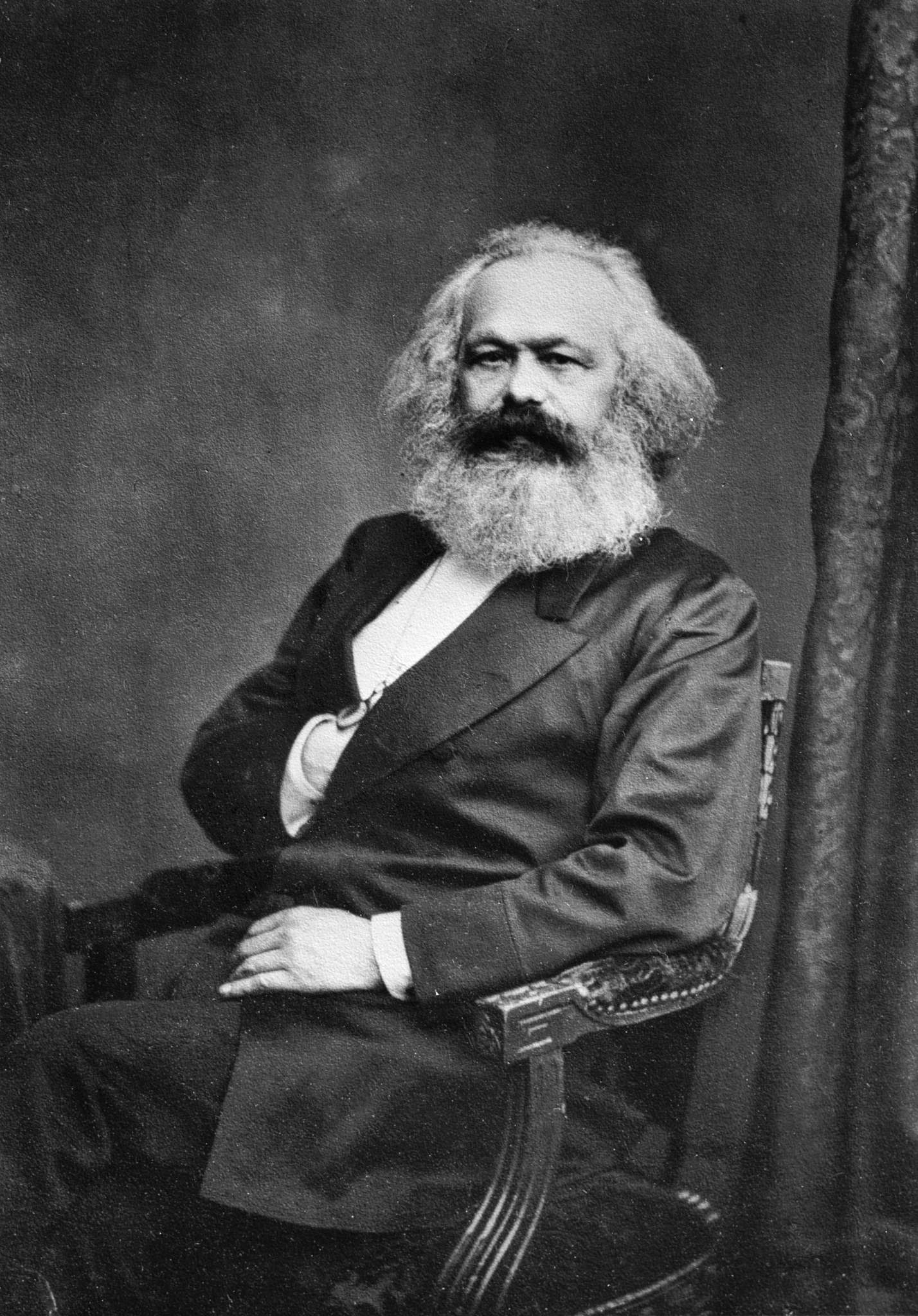
Karl Marx
 Germany
philosopher•economist•journalist•revolutionary socialist
Also known as: Karl Heinrich Marx, Mohr
Birthday
May 5, 1818
Birth Sign
Taurus
Birthplace
Trier, Kingdom of Prussia (now Germany)
Age
Died at 64
Height
5 ft 9 in (175 cm)
About
Karl Marx was a German philosopher, economist, journalist, and revolutionary socialist born on May 5, 1818, in Trier, then part of the Kingdom of Prussia. He is best known for developing historical materialism, a framework that analyzes class struggle under capitalism and predicts its overthrow by the working class. With his lifelong friend Friedrich Engels, Marx co-authored The Communist Manifesto (1848), a political pamphlet that became a blueprint for communist revolutions. His magnum opus, Das Kapital (three volumes, 1867–1894), critiques classical political economy and dissects the dynamics of capital accumulation. Marx's ideas, collectively called Marxism, have shaped socialist thought and inspired revolutions in countries like Russia, China, and Cuba, making him one of the most influential thinkers of the modern era.
Marx earned a doctorate in philosophy from the University of Jena in 1841. He worked as a radical journalist in Cologne and Paris, where he met Engels in 1844. Expelled from several countries, he settled in London after the Revolutions of 1848. There, he wrote the Grundrisse notebooks and the three volumes of Das Kapital. Marx also led the International Workingmen's Association (First International), clashing with anarchist Mikhail Bakunin. His Critique of the Gotha Programme (1875) outlined his vision of a communist society. Marx died on March 14, 1883, at age 64, and is buried in Highgate Cemetery.
Marx's work argues that human history progresses through class conflict. Under capitalism, the bourgeoisie (owners of production) exploit the proletariat (workers who sell their labor). He predicted that capitalism's internal crises would lead to revolution, creating a classless, stateless society. Though his predictions have been debated, his analysis of economic systems remains foundational in sociology and economics.
Early Life & Background
Marx was born into a middle-class Jewish family that converted to Lutheranism to avoid legal restrictions. His father, Heinrich Marx, was a successful lawyer who ensured Karl received a classical education at the Trier Gymnasium. At 17, he enrolled at the University of Bonn to study law, but his father transferred him to the University of Berlin after a year of rowdy behavior. In Berlin, Marx fell in with the Young Hegelians, a group of radical philosophers who applied Hegel's dialectic to criticize religion and the Prussian state. He abandoned law for philosophy, writing a doctoral thesis on ancient Greek atomism and earning his PhD from the University of Jena in 1841.
Unable to secure an academic post due to his radical views, Marx turned to journalism. In 1842, he began writing for the Rheinische Zeitung, a liberal newspaper in Cologne, and soon became its editor. His articles attacking the Prussian government led to the paper's suppression by censors in 1843. That same year, he married his childhood sweetheart, Jenny von Westphalen, and the couple moved to Paris, where Marx encountered socialist circles and began his lifelong collaboration with Friedrich Engels.
Career Growth
In Paris, Marx published the Deutsch-Französische Jahrbücher and wrote the Economic and Philosophic Manuscripts of 1844, which remained unpublished until the 20th century. Expelled from France in 1845, he moved to Brussels, where he and Engels co-authored The German Ideology (1845-1846), laying the groundwork for historical materialism. They joined the secret Communist League, and in 1848, the League commissioned them to write The Communist Manifesto, published in London just weeks before the February Revolution in France.
During the Revolutions of 1848, Marx returned to Germany and edited the Neue Rheinische Zeitung, a radical daily. After the revolution's defeat, he was expelled and moved permanently to London in 1849. The 1850s were a decade of poverty; Marx and his family lived in two cramped rooms in Soho while he wrote for the New-York Daily Tribune (over 500 articles) and produced the Grundrisse notebooks (1857-1858), a draft of his critique of political economy. In 1864, he helped found the International Workingmen's Association (First International) and served as its de facto leader. Volume I of Das Kapital was published in 1867, but he died before completing the later volumes, which Engels edited from his notes.
Career Timeline
Public Image & Style
Marx's public image is dominated by the iconic photograph of him with a wild, bushy grey beard and a shock of white hair, usually in a dark suit. This image, widely reproduced on posters and T-shirts, has become a universal symbol of revolution and radical critique. In popular culture, he is often portrayed as a brilliant but impoverished scholar, living in London's Soho slums while writing Das Kapital. His followers, known as Marxists, organize reading groups and annual pilgrimages to his grave in Highgate Cemetery on his birthday (May 5) and death anniversary (March 14). Marx's social media presence is managed by the Marx-Engels Foundation, whose Facebook page has over 5 million followers, posting his quotes and commentary on modern capitalism.
Fame & Fandom (iFAMOUS Rankings)
The audience for Karl Marx is less a fandom in the modern sense and more a global coalition of political adherents, scholars, and activists who engage with his work as a living ideology rather than mere entertainment. There is no formal name like 'Swifties' or 'Beyhive' for those who follow his legacy; instead, they identify as Marxists, socialists, or communists, organizing through intellectual study groups and political movements rather than fan clubs or charity drives. While contemporary discourse occasionally invokes his theories to analyze artificial intelligence or critique modern capitalism, these are acts of ideological application rather than the ritualistic celebrations found among pop culture icons. His enduring presence is defined by the sheer scale of his influence on human history, tracked across media coverage, search trends, and consumption signals worldwide. This vast reach is quantified by the iFANN Global Fame Rankings, which place him firmly among the most recognized figures of all time. He stands as the 443rd most famous person in the world, a position he has held steady from the previous cycle. Within his homeland, his stature remains towering at the 49th most famous person in Germany, while among those born there, he ranks as the 17th most famous person from Germany. In the specific realm of Books & Literature, his contributions secure him the 25th most famous person in Books & Literature.
Interesting Facts and Legends
Marx was a heavy smoker who once remarked that Capital is a curse. Throughout his life, he endured chronic boils, known medically as carbuncles, on his back and bottom, making the act of sitting down to write a source of constant pain. Despite his focus on economics, he penned a novel and a book of love poems for his wife, Jenny, though neither saw publication during his lifetime. A voracious reader fluent in German, French, English, Italian, Spanish, and Russian, he attempted to write a play about the Roman emperor Tiberius before abandoning the project. Among close friends, he was affectionately called Mohr, meaning Moor, due to his dark complexion and hair. The legend of his exile in London's Soho slums, where he lived in poverty while supported by Friedrich Engels, remains a central part of his biography. His funeral in 1883 was attended by only a small circle of intimates, including Engels, as many potential mourners were barred from entering Britain due to his radical status. Modern discussions sometimes sensationalize his life with unverified claims, such as allegations of an obsession with Satan, but these remain polemical interpretations rather than historical fact.
Notable Quotes
“Workers of the world, unite! You have nothing to lose but your chains!”
“The philosophers have only interpreted the world, in various ways; the point is to change it.”
“Religion is the sigh of the oppressed creature, the heart of a heartless world, and the soul of soulless conditions. It is the opium of the people.”
“From each according to his ability, to each according to his needs.”
“Capital is dead labor, which, vampire-like, lives only by sucking living labor, and lives the more, the more labor it sucks.”
Family & Personal Life
Marx's father, Heinrich Marx (1777-1838), was a lawyer who converted from Judaism to Lutheranism in 1816 to retain his legal practice. His mother, Henriette Pressburg (1788-1863), was a Dutch-Jewish woman who managed the household. Karl was the third of nine children, but several died young. He married Jenny von Westphalen on June 19, 1843; she was the daughter of a Prussian aristocrat and supported his work despite extreme poverty. They had seven children, but only three daughters survived to adulthood: Jenny (1844-1883), Laura (1845-1911), and Eleanor (1855-1898). Marx also fathered an illegitimate son, Frederick Demuth (1851-1929), with the family's housekeeper, Helene Demuth. Engels publicly claimed paternity to protect Marx's reputation.
Notable Connections
Marx's most important collaborator was Friedrich Engels, who co-authored The Communist Manifesto and edited the later volumes of Das Kapital. Engels also provided financial support for Marx's family. In Paris, Marx befriended the poet Heinrich Heine. Within the First International, he clashed with the anarchist Mikhail Bakunin. After Marx's death, his work was edited and popularized by Karl Kautsky and Eduard Bernstein. His daughters married French socialist Paul Lafargue and Italian socialist Carlo Cafiero.
Relationships & Dating History
Marx married his childhood sweetheart, Jenny von Westphalen, on June 19, 1843. Jenny was the daughter of a Prussian aristocrat, and their marriage was a love match despite social differences. She supported his work tirelessly, copying his manuscripts and managing the household through years of poverty. They had seven children, but only three daughters survived: Jenny, Laura, and Eleanor. Jenny died of cancer on December 2, 1881, devastating Marx. There is strong historical evidence that Marx fathered an illegitimate son, Frederick Demuth (born 1851), with the family's housekeeper, Helene Demuth. Engels publicly claimed paternity to shield Marx's reputation, but letters later revealed the truth. Marx did not have any other known romantic relationships. He died a widower on March 14, 1883.
- MarriedJenny von Westphalen1843 - 1881Childhood sweethearts; she supported his work despite poverty; died of cancer in 1881.
- RumouredHelene Demuth1850 - 1883Family housekeeper; evidence suggests she bore his illegitimate son Frederick Demuth in 1851.
Death & Aftermath
Died
March 14, 1883 (aged 64)
Death Place
London, England
Cause of Death
Complications from bronchitis and pleurisy
Karl Marx spent his final months in a state of deepening frailty at his residence on 41 Maitland Park Road in the Brompton district of London, England. Once a figure who could command international socialist movements from a cramped Soho flat, he had become bedridden by severe bronchitis and pleurisy, suffering from abscesses and general physical decline that left him largely isolated. His last public appearance likely occurred weeks prior when he attended the funeral of Jenny Longuet, but by early 1883, his mobility was too restricted for any further engagement with the world outside his home.
He passed away on March 14, 1883, at the age of 64. Historical consensus relies on family accounts and the observations of close associates to determine that natural causes related to his chronic respiratory conditions and depression brought his life to a close. The reaction to his passing was immediate yet modest, reflecting his status as an exiled revolutionary with limited financial resources and a controversial profile among mainstream European institutions. Friedrich Engels delivered a eulogy at his graveside, describing Marx as "the greatest living thinker" and noting his profound contributions to science and revolution. The funeral service took place privately on March 17, 1883, at Highgate Cemetery, where only about ten people gathered, including his daughters Eleanor and Laura, son-in-law Charles Longuet, and close allies like Edward Aveling and Helene Demuth.
Following the burial, the intellectual legacy of the man continued to grow under the stewardship of his colleagues. Friedrich Engels dedicated himself to editing and publishing the remaining volumes of Das Kapital, releasing Volume II in 1885 and Volume III in 1894 based on Marx's notes. While the estate initially remained in debt, Engels managed the publication rights to support the family, and decades later, statues, street names, and university buildings would rise globally to commemorate the philosopher whose ideas shaped the modern political landscape.
Net Worth (Estate Value)
$0
iFANN Editorial Team estimate
As a historical figure who died in poverty, Marx had no personal net worth at the time of his death. He left behind significant debts and few assets. His estate today generates substantial revenue from royalties on Das Kapital, The Communist Manifesto, and the 50-volume Marx-Engels Werke. These works are published by academic presses such as Lawrence & Wishart and Dietz Verlag. The International Institute of Social History (IISH) in Amsterdam holds the majority of his original manuscripts. There is no single publicly available figure for the estate's total value, as rights are distributed across multiple entities. Per iFANN's editorial analysis, the estimated net worth is $0.
Awards & Accolades
View 12 records, honours and achievementsKnown For
The Communist Manifesto
1848 · Co-author
Das Kapital (Volume I)
1867 · Author
Das Kapital (Volumes II & III)
1894 · Author (posthumous, edited by Engels)
Critique of the Gotha Programme
1875 · Author
The Civil War in France
1871 · Author
Keywords
Quick Facts
- Profession
- philosopher, economist, journalist, revolutionary socialist
- Born
- May 5, 1818
- Birthplace
- Trier, Kingdom of Prussia (now Germany)
- Died
- March 14, 1883
- Death Place
- London, England
- Gender
- Male
- Spouse
- Jenny von Westphalen
- Birth Sign
- Taurus
- Height
- 5 ft 9 in (175 cm)
Personal Details
- Full Name
- Karl Heinrich Marx
- Height
- 5 ft 9 in (175 cm)
- Spouse
- Jenny von Westphalen
- Children
- Jenny, Laura, Eleanor (surviving daughters); Frederick Demuth (illegitimate son); four other children died in infancy
- Education
- University of Bonn (law), University of Berlin (philosophy), University of Jena (PhD in philosophy, 1841)
Frequently Asked Questions
What is Karl Marx's theory called?
Is Karl Marx's Das Kapital worth reading?
How did Karl Marx die?
Did Karl Marx have children?
What is Karl Marx's real name?
Social Media
Join the community
fans discussing