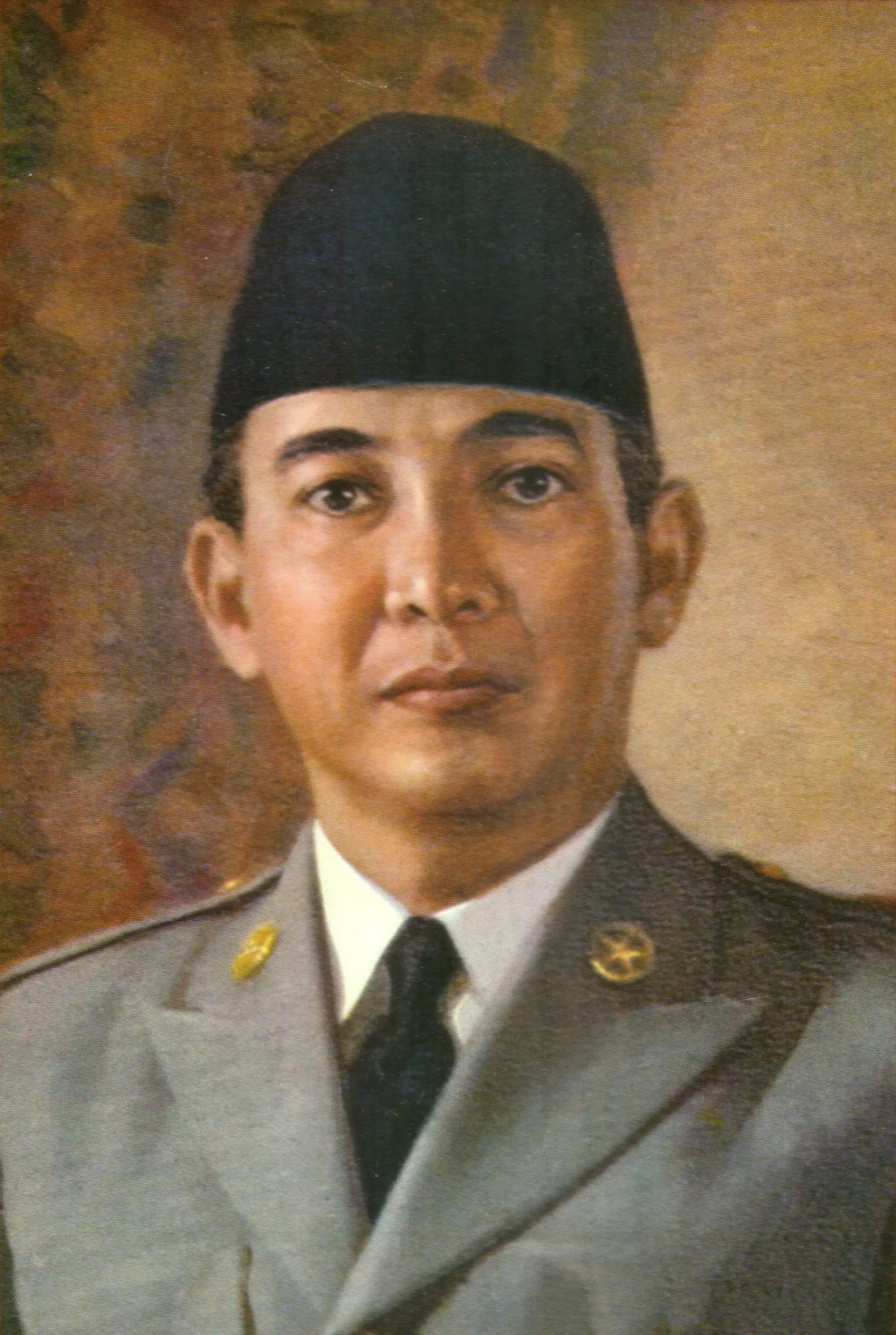
Sukarno
 Indonesia
Also known as: Bung Karno, Kusno Sosrodihardjo, Achmed Soekarno, Ir. Soekarno
Birthday
June 6, 1901
Birth Sign
Gemini
Birthplace
Surabaya, Dutch East Indies
Age
Died at 69
Height
5 ft 9 in (1.75 m)
About
Sukarno was the founding father and first president of Indonesia, serving from 1945 until his forced removal in 1967. A master orator and charismatic nationalist, he is globally recognized for leading the struggle against Dutch colonial rule and establishing Indonesia as a sovereign nation. He passed away on June 21, 1970, at the age of 68 in Jakarta due to kidney and heart failure while under house arrest.
Early Life & Background
Born Koesno Sosrodihardjo on June 6, 1901, in Surabaya, Sukarno entered a world defined by Dutch colonial dominance. His father, Raden Soekemi Sosrodihardjo, worked as a primary school teacher, and his mother, Ida Ayu Nyoman Rai, was Balinese. The family moved frequently across Java as his father sought employment, exposing young Koesno to diverse cultures and early social stratifications. He attended the Europeesche Lagere School in Mojokerto, where he learned Dutch, before progressing to the Hogere Burger School in Surabaya. It was here that he developed a keen interest in architecture and engineering, skills that would later shape his vision for an independent Indonesia.
In 1920, he graduated from high school and enrolled at the Technische Hoge School in Bandung, now known as the Bandung Institute of Technology. During these university years, he became deeply involved in nationalist politics. He joined the Algemeene Studieclub and co-founded the Indonesian National Party in 1927. His fiery speeches advocating for immediate independence drew the attention of Dutch authorities, leading to his first arrest in 1929. This marked the beginning of a decade-long struggle involving imprisonment in Sukabumi and exile to remote locations like Ende, Flores, and Boven Digoel in Papua. In 1932, he was transferred to Bengkulu, where he met Inggit Garnasih, who would become his wife. Released in 1938, he returned to Java to continue his activism, laying the groundwork for the movement that would soon erupt into a full-scale revolution.
Career Growth
The Japanese occupation of Indonesia in 1942 provided a turning point. Recognizing Sukarno's immense popularity, the Japanese released him from prison and utilized his platform to organize the population for their war effort. On August 17, 1945, following Japan's surrender, Sukarno and Mohammad Hatta proclaimed Indonesia's independence. He was inaugurated as the first President of the Republic of Indonesia. From 1945 to 1949, he navigated the Indonesian National Revolution, a bitter armed and diplomatic conflict with the Dutch who attempted to reassert control. This period culminated in the Dutch recognizing Indonesian sovereignty in December 1949.
In 1950, Sukarno established a parliamentary democracy, but political instability persisted. In 1959, he dissolved the parliament and introduced "Guided Democracy," centralizing power in his hands. Throughout the early 1960s, he pursued an aggressive foreign policy, positioning Indonesia as a leader of the Non-Aligned Movement. He hosted the historic Asian-African Conference in Bandung in 1955, fostering solidarity among newly independent nations. His administration also saw the construction of grand architectural projects, including the Monumen Nasional and the Gelora Bung Karno Stadium. However, his pro-Soviet leanings and the Konfrontasi campaign against Malaysia strained relations with the West. The turning point came with the September 30 Movement in 1965, a failed coup attempt blamed on the Communist Party of Indonesia. General Suharto seized control, initiating a violent anti-communist purge. By March 1967, Suharto had formally assumed executive power, stripping Sukarno of his presidency. Sukarno was placed under house arrest in Jakarta, where he lived in isolation until his death.
Career Timeline
Public Image & Style
Sukarno is portrayed as a charismatic, fiery, and visionary leader. His image is one of a unifying figure who bridged diverse ethnic and religious groups in Indonesia. Media portrayals emphasize his oratory skills, his role as a revolutionary, and his complex relationship with Western powers. He often wore traditional Javanese attire such as the batik shirt and sarong, combined with a military-style uniform during official functions. His distinctive appearance and commanding presence made him a recognizable symbol of Indonesian nationalism.
Fame & Fandom
The reverence for Sukarno differs from modern celebrity worship; there is no formal fandom name, nor are there digital campaigns or fan clubs. Instead, the entire citizenry of Indonesia acts as a collective custodian of his legacy, addressing him with the affectionate title Bung Karno and treating his memory through state rituals rather than grassroots activism. His influence remains institutionalized, anchored by annual independence celebrations and government efforts to preserve sites like the house where he proclaimed freedom. This unique relationship blends political history with cultural mythology, where his fiery oratory and direct connection to the masses are remembered as foundational national truths rather than mere entertainment.
His enduring prominence places him firmly among the most recognized figures globally. According to the iFANN Global Fame Rankings, he holds the position of the 4th most famous person in Indonesia, a standing that has remained steady across cycles. He is also ranked as the 3rd most famous person from Indonesia, reflecting his singular role as the nation's founder. On a broader scale, he sits at the 4th most famous person in Southeast Asia. These placements reflect a sustained global attention that tracks media coverage, historical significance, and consumption signals worldwide, ensuring his status as a defining figure of the region remains unchallenged.
Interesting Facts and Legends
Sukarno was a polyglot fluent in Indonesian, Javanese, Arabic, Dutch, English, and some French. He was an avid art collector and designed many of the buildings in Jakarta, including the Istiqlal Mosque and the National Monument. He famously distinguished between the "New Emerging Forces" (NEFO) and the "Old Established Forces" (OLDEFO) during the Bandung Conference. The site of his historic proclamation on August 17, 1945, is so sacred that the government plans to reconstruct it to ensure its physical legacy remains accessible. He was a fan of the Beatles and invited them to perform in Indonesia, though they never accepted the invitation.
Notable Quotes
“I am a nationalist, but I am not a narrow nationalist. I am a nationalist who loves all people.”
“We must build a new world order based on justice and peace.”
“Independence is not a gift, but a right that must be fought for.”
Family & Personal Life
Sukarno was born into a Javanese family; his father, Raden Soekemi Sosrodihardjo, was a primary school teacher of Javanese descent, and his mother, Ida Ayu Nyoman Rai, was Balinese. He married multiple times throughout his life, reflecting both personal desire and political alliances. His children include Megawati Sukarnoputri, who later became President of Indonesia, as well as Guntur, Rachmawati, Sukmawati, Guruh Irianto, Taufik, and Kartika. His daughter Megawati served as the fifth President of Indonesia from 2001 to 2004. As of 2026, Sukarno has been deceased since 1970; there are no current romantic relationships. His legacy continues through his descendants, particularly his daughter Megawati, who served as the fifth President of Indonesia from 2001 to 2004.
Notable Connections
Relationships & Dating History
Sukarno was married multiple times, reflecting both personal desire and political alliances. His marriages were: Siti Oetari (married 1920, divorced 1923), Inggit Garnasih (married 1923, separated 1943), Fatmawati (married 1943, divorced 1954), Djauhariyah Hartini (married 1952, divorced 1959), Yurike Sanger (married 1959, divorced 1960), Heldy Djafar (married 1962, divorced 1963), Amelia de la Rama (married 1962, divorced 1963), Sakiko Kanase (married 1962, divorced 1963), Maharani Wisma Susana Siregar (married 1964, divorced 1965), Kartini Manoppo (married 1966, divorced 1966), Haryati (married 1966, divorced 1967), and Dewi Sukarno (married 1967, divorced 1968). He had a total of 12 wives and 12 children. As of 2026, Sukarno has been deceased since 1970; there are no current romantic relationships.
- DivorcedSiti Oetari1920 - 1923Married when Sukarno was 19; ended due to her opposition to his political activities.
- SeparatedInggit Garnasih1923 - 1943Former stepmother who acted as a mother figure; relationship ended due to her refusal to accompany him to Bandung.
- DivorcedFatmawati1943 - 1954Mother of five children; famous for sewing the first Indonesian flag.
- DivorcedDjauhariyah Hartini1952 - 1959Nurse whom he met at her workplace; marriage ended due to infidelity.
- DivorcedYurike Sanger1959 - 1960French-Indonesian woman; short-lived marriage.
- DivorcedHeldy Djafar1962 - 1963Young dancer; brief marriage.
- DivorcedAmelia de la Rama1962 - 1963Filipino-Indonesian woman; brief marriage.
- DivorcedSakiko Kanase1962 - 1963Japanese woman; brief marriage.
- DivorcedMaharani Wisma Susana Siregar1964 - 1965Young woman from a prominent family.
- DivorcedKartini Manoppo1966 - 1966Young woman from Sulawesi; very brief marriage.
- DivorcedHaryati1966 - 1967Nurse; marriage ended shortly before his death.
- DivorcedDewi Sukarno1967 - 1968Young woman from a noble family; short-lived marriage.
Death & Aftermath
Died
June 21, 1970 (aged 69)
Death Place
Jakarta, Indonesia
Cause of Death
Kidney failure and heart failure
By the late 1960s, Sukarno lived under strict surveillance in Jakarta while recovering from a long decline that began after his political removal. The first president of Indonesia passed away on June 21, 1970, at the age of 68 within the Panglima Polim Military Hospital, where he had been receiving treatment for chronic kidney disease and heart failure. His final days were marked by isolation and organ failure resulting from years of stress. The immediate public reaction remained muted due to the tense political climate under General Suharto's New Order regime, which had stripped Sukarno of his presidency in March 1967. While large-scale vigils were suppressed, the government eventually acknowledged his status as the Father of the Nation through gradual institutional tributes.
A state funeral followed shortly after his death, featuring military honors and a procession to the Kalibata Heroes' Cemetery, though open public participation was restricted to dignitaries and family members to manage the narrative of his passing. Decades later, Sukarno received posthumous recognition as a National Hero and the Great Leader of the National Revolution during the Reformasi era. The establishment of the Sukarno Foundation helped preserve his artistic collections and personal artifacts, while the Sukarno Museum in Blitar now stands as a dedicated site for his legacy. His estate was managed by his surviving family without major public disputes.
Net Worth (Estate Value)
$0
iFANN Editorial Team estimate
As a head of state who lived in a developing nation with significant state-controlled resources, Sukarno did not accumulate personal wealth in the modern sense. His net worth is estimated to be negligible or non-existent in terms of liquid assets, as his lifestyle was largely funded by the state. Posthumously, his estate, managed by his family, includes personal artifacts, art collections, and properties, but these are not valued in the billions like modern celebrity estates. The value of his estate is difficult to quantify precisely, but it is generally considered to be modest compared to contemporary billionaires. There are no credible reports of a multi-million dollar estate, and any figures suggesting otherwise are likely speculative or conflated with the value of national monuments bearing his name.
Awards Won (5)
Sukarno received numerous posthumous honours and distinctions, including the National Hero of Indonesia declaration in 1965. He was awarded the Order of the Star of the Republic of Indonesia, the highest civilian award in Indonesia. Internationally, he received the Order of the Golden Heart from the Philippines, the Order of the White Lotus from Thailand, and the Order of the Rising Sun from Japan. UNESCO recognized his contributions to international peace, and he received honorary doctorates from Moscow State University and Cairo University.
1965 · National Honour
Presidential Decree No. 086/TK/1965
1959 · Civilian Award
Indonesia
Known For
Proclamation of Indonesian Independence
1945 · Leader
Asian-African Conference
1955 · Host
Guided Democracy
1959 · President
Keywords
Sources
Quick Facts
- Profession
- politician, art collector
- Born
- June 6, 1901
- Birthplace
- Surabaya
- Died
- June 21, 1970
- Death Place
- Jakarta
- Gender
- Male
- Spouse
- Siti Oetari, Inggit Garnasih, Fatmawati, Hartini, Kartini Manoppo, Dewi Sukarno, Haryati, Yurike Sanger, Heldy Djafar, Amelia de la Rama, Sakiko Kanase, Maharani Wisma Susana Siregar
- Birth Sign
- Gemini
Personal Details
- Full Name
- Koesno Sosrodihardjo
- Height
- 5 ft 9 in (1.75 m)
- Spouse
- Siti Oetari, Inggit Garnasih, Fatmawati, Djauhariyah Hartini, Yurike Sanger, Heldy Djafar, Amelia de la Rama, Sakiko Kanase, Maharani Wisma Susana Siregar, Kartini Manoppo, Haryati, Dewi Sukarno
- Children
- Megawati Sukarnoputri, Guntur Sukarnoputri, Rachmawati Sukarnoputri, Sukmawati Sukarnoputri, Guruh Irianto Sukarnoputri, Taufik Sukarnoputri, Kartika Sari Dewi Sukarnoputri, and others
- Education
- Europeesche Lagere School, Hogere Burger School, Technische Hoge School (now Bandung Institute of Technology)
Frequently Asked Questions
Who was Sukarno?
When did Sukarno die?
How many wives did Sukarno have?
What was Sukarno's role in the Non-Aligned Movement?
Is Sukarno's daughter the president of Indonesia?
Join the community
fans discussing