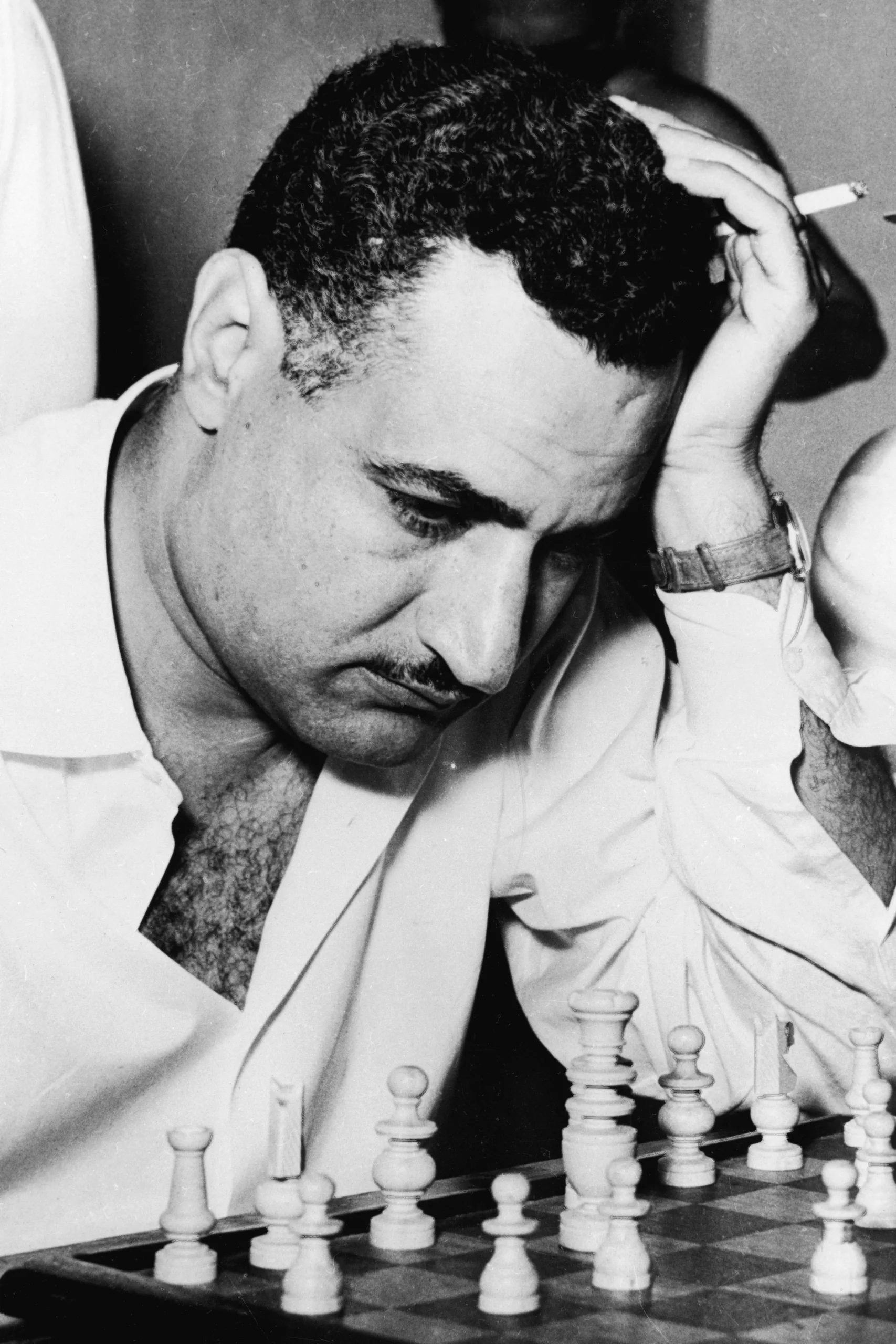
Gamal Abdel Nasser
 Egypt
Egyptpolitician•military leader•revolutionary
Also known as: Gamal Abdel Nasser Hussein, Colonel Nasser
Birthday
January 15, 1918
Birth Sign
Capricorn
Birthplace
Bakos, Alexandria, Egypt
Age
Died at 52
Height
5 ft 9 in (175 cm)
About
Gamal Abdel Nasser Hussein was an Egyptian military officer and revolutionary who served as the second president of Egypt from 1954 until his death in 1970. He is widely credited with founding the modern Egyptian republic and championing pan-Arab nationalism. His leadership defined an era of intense anti-imperialism, most notably through the nationalization of the Suez Canal in 1956. Supporters view him as a symbol of dignity and social justice, while critics cite his authoritarian governance and the long-term entrenchment of military rule in Egypt.
Born into a working-class family in Alexandria, Nasser rose through the ranks of the army to lead the Free Officers Movement. This group successfully overthrew King Farouk I in 1952 without bloodshed. After consolidating power in 1954, he became the de facto leader of the nation. His tenure saw sweeping land reforms, industrialization projects, and the construction of the Aswan High Dam. Although he suffered a devastating defeat in the Six-Day War of 1967, he returned to office amidst massive public demonstrations demanding his reinstatement.
Early Life & Background
Gamal Abdel Nasser Hussein was born on January 15, 1918, in the Bakos neighborhood of Alexandria, Egypt. He was the youngest of five children born to Abdel Nasser Hussein, a postal worker, and Fahima Abul-Naga. His father died when Gamal was only four years old, leaving the family in financial straits. This early loss instilled in him a deep sense of responsibility and resilience. The family moved frequently within Alexandria and later to the village of Bani Mur in Upper Egypt, where Nasser spent his formative years exposed to rural poverty and the harsh realities of British colonial influence.
Nasser attended primary school in Bani Mur before returning to Alexandria for secondary education at the Sidna Ibrahim School. He was an academically average student but possessed a fierce interest in politics, history, and literature. He was particularly influenced by the writings of nationalist thinkers and the struggles of the Egyptian people against British occupation. In 1936, he joined the "Free Officers" movement, a secret organization of junior army officers dedicated to overthrowing the monarchy and ending British control.
In 1937, Nasser entered the Royal Military Academy, graduating in July 1938 as a second lieutenant. His early military career was marked by postings in Sudan and various training exercises. During this period, he developed a reputation for discipline, leadership, and a keen strategic mind. The pivotal moment before his rise to fame occurred during World War II and the subsequent 1948 Arab-Israeli War. Nasser served as a company commander in Palestine, where he witnessed the disorganization and corruption of the Egyptian monarchy's military command. The failure of the Egyptian army in the 1948 war radicalized him and solidified his resolve to overthrow King Farouk I. Alongside figures like Anwar Sadat and Zakaria Mohieddin, he formed the core of the Free Officers Movement, which would eventually execute the 1952 Revolution.
Career Growth
Nasser played a central role in the Egyptian Revolution of 1952, which successfully overthrew King Farouk I without bloodshed. The monarchy was abolished, and the Republic of Egypt was declared. Initially, General Muhammad Naguib served as the nominal head of state, but Nasser emerged as the de facto leader of the Revolutionary Command Council (RCC). Following an assassination attempt by a Muslim Brotherhood member in October 1954, Nasser cracked down on the Brotherhood, arrested President Naguib, and assumed full executive power as Prime Minister and Minister of Defense.
On June 23, 1956, Nasser was formally elected President of Egypt in a referendum where 99.95% of voters supported him. Later that year, he nationalized the Suez Canal Company, triggering the Suez Crisis. Britain, France, and Israel invaded Egypt but were forced to withdraw under international pressure. This victory cemented his status as a hero across the Arab world. In 1958, Nasser spearheaded the formation of the United Arab Republic (UAR), a political union between Egypt and Syria, aiming to unify the Arab world under a single banner.
During the 1960s, he launched ambitious socialist reforms, including land redistribution, industrialization projects, and the construction of the Aswan High Dam, which became a symbol of Egyptian self-reliance. The Six-Day War in 1967 resulted in a devastating defeat for Egypt, with the loss of the Sinai Peninsula and the Gaza Strip. Nasser briefly resigned but returned to office amidst massive public demonstrations demanding his reinstatement. From 1967 to 1970, he initiated the War of Attrition against Israel to reclaim the Sinai and worked to depoliticize the military. He also appointed himself Prime Minister in 1969, consolidating his control over all branches of government until his death.
Career Timeline
Public Image & Style
Nasser is portrayed in media as the "Lion of the Desert," a charismatic and decisive leader who stood up to superpowers. His style was characterized by a mix of military rigor and populist charm. He was known for his direct communication style, often speaking directly to the masses via radio and television, bypassing traditional elites. He frequently smoked a cigarette or pipe, projecting an image of rugged simplicity and authority. His signature look often featured his military uniform or a simple suit, reinforcing his connection to the common soldier and citizen.
Fame & Fandom
iFANN has not yet collected fame data for this person. While there is no formal fandom ranking available in the current dataset, Nasser commands a massive base of admirers known as "Nasserists" or "Pan-Arabists." This group is highly organized through political parties, academic societies, and cultural groups across the Arab world. Annual commemorations of his birthday on January 15 and his death anniversary on September 28 involve large gatherings, concerts, and political rallies. Fan-driven campaigns often push for the restoration of his policies in current political discourse. While he cannot interact with fans today, his family and the Egyptian state maintain his legacy through museums, statues, and educational programs.
Interesting Facts and Legends
Before becoming a revolutionary, his full name was Gamal Abdel Nasser Hussein. He dropped "Hussein" from his public name to emphasize his identity as a citizen of the nation rather than a member of a specific tribe or family. He was known for his simple diet, often eating plain rice and bread, rejecting the lavish banquets offered by foreign dignitaries. Nasser was a voracious reader, particularly of Arabic poetry and European political philosophy, which heavily influenced his speeches and writings. Even decades after his death, "Nasserism" remains a distinct political ideology in the Arab world, advocating for Arab unity, socialism, and non-alignment.
A story fans still retell involves his resignation after the 1967 defeat. Millions of Egyptians flooded the streets to demand his return, forcing him to stay in office. This event is legendary for its display of mass loyalty. Another notable fact is that his 1961 Cadillac was dismantled piece by piece by a suspect in 2026 before authorities realized what it was, highlighting the high symbolic value of his possessions rather than their monetary worth.
Notable Quotes
“We are not afraid of the enemy's strength, but of our own weakness.”
“The Suez Canal is Egyptian. It belongs to us.”
“I am a servant of the people, and if they wish to remove me, they can do so.”
“The revolution is not a party, it is a people.”
Family & Personal Life
Gamal Abdel Nasser married Tahia Kazem, a former dancer and actress, in 1944. Their relationship was often strained due to his demanding political life, yet they remained married until his death. They met through mutual acquaintances in the military community, and their marriage was arranged by her father, who was a friend of Nasser's mother. Tahia adopted the stage name "Tahia," meaning "Life," after marrying him. Together they had two daughters: Hoda, born in 1945, and Mona, born in 1946. Tahia survived him and lived until 2012. The family maintains a low profile regarding personal wealth, focusing instead on preserving his archives through the Gamal Abdel Nasser Foundation.
Notable Connections
Anwar Sadat, Abdel Hakim Amer, Muhammad Naguib, Tahia Kazem, Kwame Nkrumah, Jawaharlal Nehru
Relationships & Dating History
Gamal Abdel Nasser was married only once. His wife was Tahia Kazem, a former dancer and actress who adopted the stage name "Tahia" (meaning "Life") after marrying him. They met through mutual acquaintances in the military community, and their marriage was arranged by her father, who was a friend of Nasser's mother. Despite Tahia's background in the arts and Nasser's rigid political persona, they remained married until his death in 1970. They had two daughters: Hoda (born 1945) and Mona (born 1946). There are no records of other romantic relationships or marriages. Tahia survived him and lived until 2012.
- MarriedTahia Kazem1944 - 1970Married until his death; had two daughters together.
Death & Aftermath
Died
September 28, 1970 (aged 52)
Death Place
Cairo, Egypt
Cause of Death
Heart attack (myocardial infarction)
On September 28, 1970, Gamal Abdel Nasser died in Cairo at the age of 52. He suffered a fatal heart attack while presiding over a meeting of the National Assembly. The official medical report cited myocardial infarction as the cause, though he had been managing chronic health issues including diabetes and heart disease for several years. Conspiracy theories suggesting poisoning circulated immediately after his death but were dismissed by medical historians and family members who maintained the natural causes narrative.
The scale of the public reaction was unprecedented in modern history. An estimated five to six million mourners attended his funeral procession in Cairo, making it one of the largest gatherings in human history. The line of people stretching from his home to the mosque spanned miles, reflecting a depth of grief that transcended political lines. Leaders from around the world sent tributes, including Jawaharlal Nehru of India, Kwame Nkrumah of Ghana, and Fidel Castro of Cuba, all hailing him as a martyr for the Arab cause and a symbol of anti-colonial resistance.
Nasser was succeeded by his close ally Anwar Sadat, who immediately began shifting Egypt's foreign policy away from the socialist and non-aligned stance Nasser had championed toward closer alignment with the West. Despite this political pivot, Nasser's legacy remained potent. His image appeared on Egyptian currency and stamps, and numerous public monuments, stadiums, and cities were named in his honor. In the decades following his death, his family managed his estate with modest means. Recent events in 2026 highlighted the enduring symbolic value of his personal effects; in August, his son accused a nephew of attempting to auction a Rolex watch believed to belong to the late president, and in July, a man was arrested for trying to dismantle Nasser's 1961 Cadillac for scrap metal. These incidents underscored that while his financial estate was negligible, his cultural capital remained immense.
Net Worth (Estate Value)
$0
iFANN Editorial Team estimate
As a head of state who died in 1970, Gamal Abdel Nasser did not accumulate personal wealth in the modern celebrity sense. His net worth at death is estimated to be negligible, as he lived frugally and rejected personal enrichment. Upon his death, his estate was valued at approximately $1,000 to $2,000, consisting mainly of modest furniture, books, and personal effects. The iFANN Editorial Team estimates the total value of his estate at roughly $0 given the lack of significant commercial assets derived from his estate compared to modern celebrities.
The Nasser family manages his legacy through the Gamal Abdel Nasser Foundation, established to preserve his archives and promote Arab nationalism. The family does not hold significant commercial assets derived from his estate, unlike modern celebrities. Recent news in 2026 highlights the ongoing disputes over minor memorabilia rather than substantial wealth. In August 2026, Nasser's son accused his nephew of attempting to auction off a Rolex watch allegedly belonging to the late president. In July 2026, a man was arrested for attempting to dismantle Nasser's 1961 Cadillac for scrap metal, indicating the high symbolic value of his possessions rather than their monetary worth.
Awards Won (2)
Nasser received the Order of the Nile, Egypt's highest distinction, multiple times throughout his presidency. He was awarded the Lenin Peace Prize from the Soviet Union in 1961, recognizing his contributions to peace and anti-imperialism. Posthumously, he was named one of the "Greatest Arabs of the 20th Century" by various Pan-Arab organizations. His image appears on Egyptian currency, stamps, and public monuments.
1956 · National Honour
Service to Egypt
1961 · International Peace
Anti-imperialism efforts
Known For
Egyptian Revolution of 1952
1952 · Leader
Suez Crisis
1956 · President
United Arab Republic
1958 · Founder
Keywords
Sources
Quick Facts
- Profession
- politician, military leader, revolutionary
- Born
- January 15, 1918
- Birthplace
- Bakos, Alexandria, Egypt
- Died
- September 28, 1970
- Death Place
- Cairo, Egypt
- Gender
- Male
- Spouse
- Tahia Kazem
- Birth Sign
- Capricorn
Personal Details
- Full Name
- Gamal Abdel Nasser Hussein
- Height
- 5 ft 9 in (175 cm)
- Spouse
- Tahia Kazem
- Children
- Hoda Nasser · Mona Nasser
- Education
- Royal Military Academy, Sidna Ibrahim School
Frequently Asked Questions
Who was Gamal Abdel Nasser?
How did Gamal Abdel Nasser die?
What is Gamal Abdel Nasser's legacy?
Did Gamal Abdel Nasser have any children?
Is Gamal Abdel Nasser still influential today?
Join the community
fans discussing