“George Lucas has created a universe that is both familiar and strange, a place where the old myths of heroism meet the new realities of digital cinema.”
Roger Ebert
Chicago Sun-Times
 United States
"The saga begins."
User Score
125000 votes
Part of a Collection
Star Wars Saga
George Lucas returned to the director's chair in 1999 with The Phantom Menace, launching a three-film arc that chronicles the fall of the Galactic Republic and the rise of the Empire. Released between 1999 and 2005, these films serve as the first chronological act of the Skywalker Saga, set roughly 32 to 19 years before the events of the original 1977 movie. The project marked Lucas's first directing effort in 22 years and represented a massive technological leap for cinema, relying heavily on digital environments and computer-generated imagery.
The narrative follows the life of Anakin Skywalker from his discovery as a slave boy on Tatooine to his transformation into the Sith Lord Darth Vader. Alongside this personal tragedy, the story depicts the political maneuvering of Chancellor Palpatine, the corruption of the Jedi Order, and the outbreak of a galaxy-wide civil war known as the Clone Wars. While the initial release of the first two films drew mixed reactions for their dialogue and pacing, later installments gained significant appreciation for their emotional weight and visual spectacle.
Stream
Rent
Availability and pricing can change. Confirm on the provider's site before purchasing.
The journey starts in Episode I – The Phantom Menace, where the Trade Federation blockades the peaceful planet Naboo. Two Jedi Knights, Qui-Gon Jinn and Obi-Wan Kenobi, arrive to negotiate a resolution but are forced to flee with young Anakin Skywalker, a nine-year-old slave who possesses an unusually high concentration of midi-chlorians. They discover that the blockade is orchestrated by Darth Sidious, a Sith Lord hiding in plain sight as Senator Palpatine. After escaping Naboo, Qui-Gon takes Anakin to Coruscant to seek training from the Jedi Council. Although the Council remains skeptical due to the boy's fear and lack of discipline, Qui-Gon insists he is the prophesied Chosen One destined to bring balance to the Force. The film culminates in a duel against Darth Maul, Qui-Gon's death, and Obi-Wan taking Anakin as his apprentice.
Ten years later, Episode II – Attack of the Clones finds Anakin as a restless teenager while Obi-Wan investigates a secret clone army being built on Kamino. Senator Padmé Amidala survives an assassination attempt, leading her to hire Obi-Wan as a bodyguard. On Tatooine, Anakin reunites with Padmé, and they develop a forbidden romantic relationship that violates the Jedi Code. Obi-Wan discovers the clones were commissioned by Count Dooku, a former Jedi turned Sith apprentice. The tension escalates into the First Battle of Geonosis, sparking the Clone Wars between the Republic and the Separatists. During the conflict, Anakin kills Dooku after Mace Windu is slain, signaling the beginning of the end for the Jedi Order.
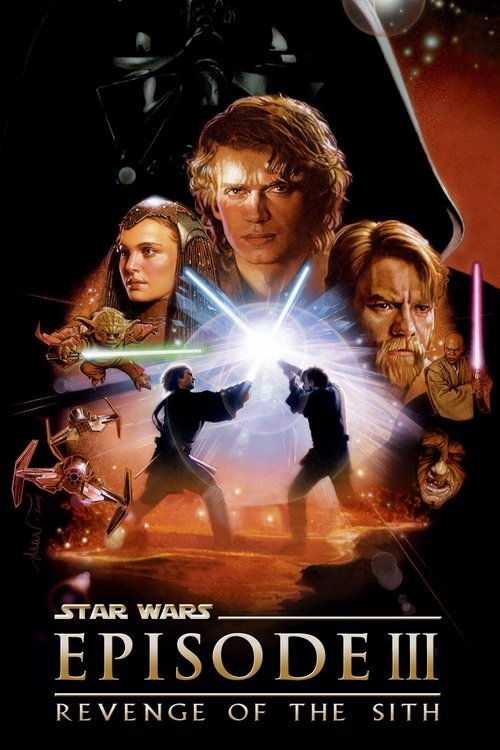
In Episode III – Revenge of the Sith, the galaxy is engulfed in a brutal civil war. Chancellor Palpatine manipulates the political climate to consolidate power, framing the Jedi as traitors. Plagued by nightmares of Padmé dying in childbirth, Anakin turns to Palpatine, who promises him the power to save her. He becomes Darth Vader and leads the 501st Legion to attack the Jedi Temple. When the Jedi attempt a coup against the Chancellor, it proves to be a trap. Order 66 is issued, causing the clone troopers to turn on their Jedi generals. Obi-Wan and Yoda barely escape execution. Anakin confronts Obi-Wan on Mustafar, believing the Jedi have betrayed the Republic. Their fierce lightsaber duel ends with Anakin maimed and left to burn on the volcanic lava flows. Palpatine rescues him, encasing him in black armor. The film concludes with the birth of Luke Skywalker and Leia Organa, the death of Padmé, and the establishment of the Galactic Empire under Palpatine's rule.
Official Trailer
Critical Consensus
While the prequels faced initial criticism for dialogue and pacing, they are now widely recognized for their groundbreaking visual effects, ambitious world-building, and emotional depth, particularly in the third installment which successfully bridges the gap to the original trilogy. Critics increasingly praise the trilogy's tragic structure and its exploration of political decay and the nature of evil.
“George Lucas has created a universe that is both familiar and strange, a place where the old myths of heroism meet the new realities of digital cinema.”
Roger Ebert
Chicago Sun-Times
“Revenge of the Sith is the best of the prequels, a dark and powerful conclusion that finally delivers on the promise of the saga.”
Peter Travers
Rolling Stone
“The prequels are a triumph of technology over storytelling, a dazzling display of visual effects that sometimes obscures the human drama beneath.”
A.O. Scott
The New York Times
Ewan McGregor
Obi-Wan Kenobi
Natalie Portman
Padmé Amidala
Ian McDiarmid
Palpatine / Darth Sidious
Samuel L. Jackson
Mace Windu
Hayden Christensen
Anakin Skywalker / Darth Vader
Christopher Lee
Count Dooku
Temuera Morrison
Jango Fett / Clone Troopers
Liam Neeson
Qui-Gon Jinn
Jake Lloyd
Young Anakin Skywalker
Pernilla August
Shmi Skywalker
Director
George Lucas
Writers
George Lucas, Jonathan Hales
Composer
John Williams
Cinematographers
David Tattersall, David Estrada
Producers
Rick McCallum, George Lucas
Academy Awards (2000)
Best Sound Effects Editing: Won
Saturn Awards (2000)
Best Science Fiction Film: Won
BAFTA Awards (2000)
Best Special Visual Effects: Nominated
Join the community
fans discussing