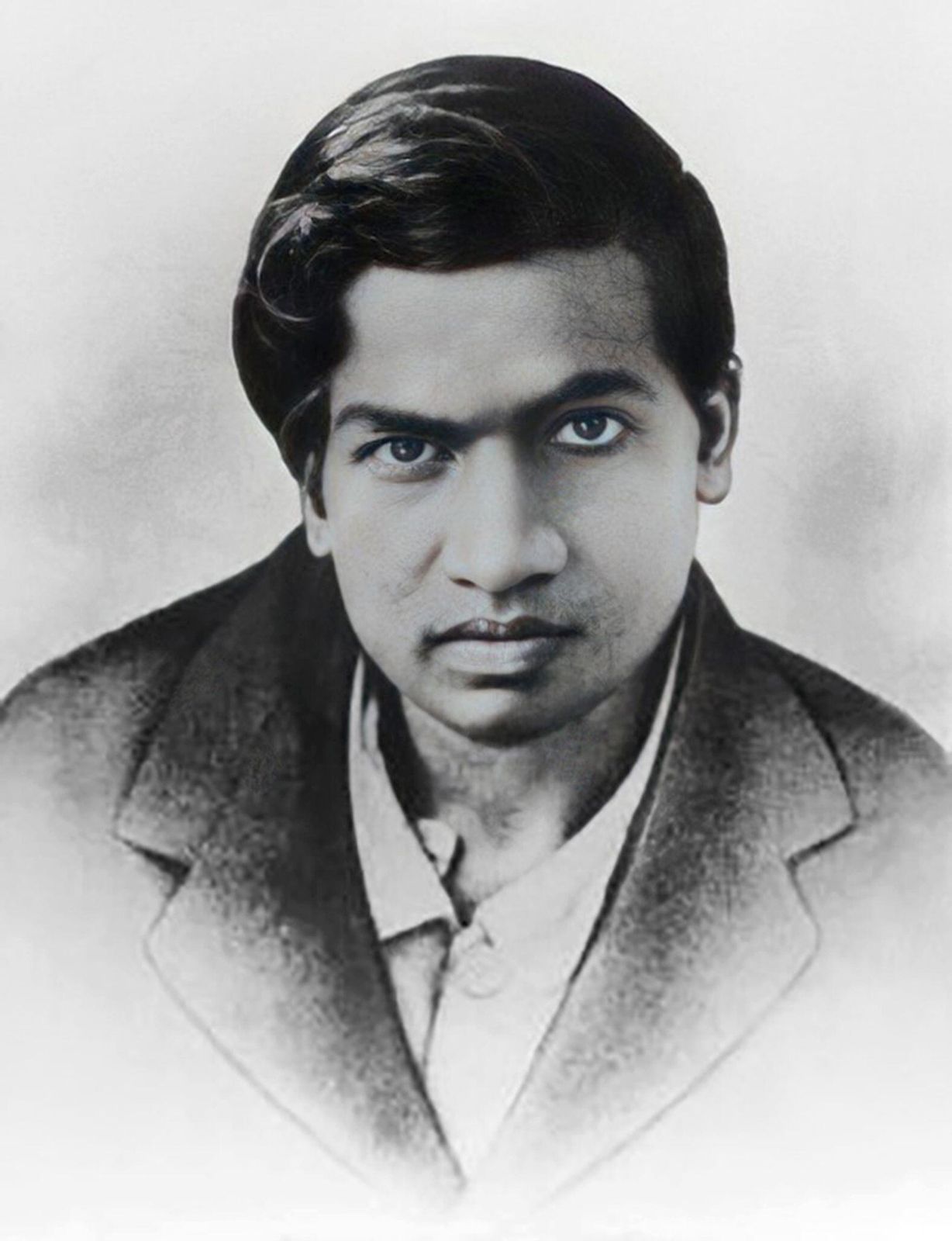
Srinivasa Ramanujan
 India
IndiaBirthday
December 22, 1887
Birth Sign
Sagittarius
Birthplace
Erode, Madras Presidency, British India (now Tamil Nadu, India)
Age
Died at 32
Height
5 ft 6 in (168 cm)
About
Srinivasa Ramanujan was an Indian mathematician whose work in number theory, infinite series, and continued fractions reshaped modern mathematics. He independently compiled nearly 3,900 results, most of which have been proven correct. His breakthroughs include the Ramanujan prime, the Ramanujan theta function, and mock theta functions, which opened new fields of research. Ramanujan became one of the youngest Fellows of the Royal Society in 1918 and the first Indian Fellow of Trinity College. His insights continue to influence mathematics, with the Ramanujan Journal dedicated to his legacy. Fans celebrate his story as a testament to raw talent and perseverance, and his life was dramatized in the 2015 film The Man Who Knew Infinity.
Early Life & Background
Srinivasa Ramanujan Iyengar was born on December 22, 1887, in Erode, Madras Presidency, British India (now Tamil Nadu, India). From a young age, Ramanujan displayed an extraordinary mathematical ability. By the age of 10, while attending Town High School in Kumbakonam, he was already outperforming students significantly older than himself. At 11, he encountered G. S. Carr's A Synopsis of Elementary Results in Pure and Applied Mathematics, a pivotal book containing thousands of formulas without proofs. This volume became his primary source of mathematical education, shaping his unique approach to the subject.
In 1904, Ramanujan successfully passed the Matriculation Examination and was awarded a scholarship to attend Government College, Kumbakonam. However, his intense and obsessive focus on mathematics led him to neglect all other subjects, causing him to fail them and subsequently lose his scholarship. His academic struggles continued; he later failed the Fine Arts exam at Pachaiyappa's College, Madras, and ultimately left in 1907 without earning a formal degree. Despite this lack of conventional academic success, his dedication to mathematics never waned. For several years, Ramanujan lived in poverty, taking on work as an accountant to support himself while tirelessly pursuing his independent mathematical research.
His profound insights eventually led him to seek recognition beyond India. In 1913, Ramanujan wrote a letter to the eminent British mathematician G. H. Hardy at Cambridge University. This letter contained approximately 120 theorems, showcasing his remarkable talent and original work. Hardy immediately recognized the genius within Ramanujan's submissions, a discovery that culminated in an invitation for Ramanujan to travel to England.
Career Growth
Ramanujan arrived at Trinity College, Cambridge in 1914, beginning a fruitful collaboration with Hardy. In 1916, he was awarded a Bachelor of Arts by research for his work on highly composite numbers. He was elected to the London Mathematical Society in 1917. The pinnacle came in 1918 when he was elected a Fellow of the Royal Society, the second Indian to receive that honor. Later that year, he became the first Indian Fellow of Trinity College. His output included groundbreaking results on partitions, mock theta functions, and the Hardy-Ramanujan number 1729. Ill health forced his return to India in 1919, but he continued producing theorems until his death in 1920. His lost notebook, rediscovered in 1976, contained hundreds more formulas that continue to inspire research.
Career Timeline
Public Image & Style
Ramanujan is often romanticized as the self-taught genius who transcended poverty. He is typically depicted in traditional Indian attire or a formal suit, surrounded by chalkboards of equations. The 2015 film The Man Who Knew Infinity cemented his image as a tragic hero. Fans, often called Ramanujan enthusiasts, celebrate National Mathematics Day on his birthday (December 22) with competitions and lectures. Social media pages share his quotes and puzzles, maintaining a reverent tone. His story resonates as a symbol of raw talent overcoming lack of opportunity.
Fame & Fandom (iFAMOUS Rankings)
Srinivasa Ramanujan remains a towering figure whose influence stretches far beyond the chalkboards of Cambridge. In August 2026, he stands as the 46th most famous person in India and the 19th most famous person from India, holding steady positions that reflect his enduring cultural weight. His reach extends across the continent as the 29th most famous person in South Asia, while within the literary sphere, he ranks as the 52nd most famous person in Books & Literature. These placements, drawn from the iFANN Global Fame Rankings, track global attention across media coverage, search trends, and consumption signals worldwide without relying on modern celebrity metrics. There is no formal fandom name for Ramanujan; the concept of a fanbase does not apply to a mathematician who died over a century ago before the era of mass media interactions or organized fan clubs. Instead, his following consists of the global mathematical community, students, researchers, and historians, who revere his work rather than his persona. This audience engages through academic pursuit and commemorative rituals like National Mathematics Day, celebrating his birthday with lectures and competitions rather than chart pushes or viral campaigns. While he lacks the performative energy of modern stars, his legacy thrives in the quiet intensity of classrooms and research labs where his formulas still challenge and inspire. Recent technological homages, including an AI-generated podcast from August 2026 and a new film production in Cambridge, demonstrate how his story transcends time to engage with modern technology. The reverence shown to him is rooted in verified historical events and widely retold anecdotes that border on cultural mythology.
Interesting Facts and Legends
Ramanujan claimed the goddess Namagiri appeared in his dreams and revealed mathematical formulas, which he would write down upon waking. He could calculate pi to 18 decimal places from memory. The number 1729, known as the Hardy-Ramanujan number, is the smallest integer expressible as the sum of two cubes in two different ways: 1³+12³ and 9³+10³. He was a strict vegetarian and observed Hindu dietary restrictions even at Cambridge. His notebooks contain approximately 3,900 results, most proven correct. The Ramanujan conjecture has influenced modern cryptography and string theory. A legendary moment occurred when G.H. Hardy visited Ramanujan in Putney, London. Hardy remarked that taxi cab number 1729 seemed dull, but Ramanujan immediately identified it as fascinating due to its unique cubic properties. This story became a cornerstone of mathematical folklore, symbolizing his intuitive grasp of number theory. Another central legend concerns his divine visions, where complex formulas appeared during trances accompanied by geometric shapes. While spiritual in nature, these experiences yielded mathematically sound results that continue to challenge physicists decades after his death. His tragic trajectory from a poor colonial background to premature death at age 32 has become a powerful mythos celebrated annually.
Notable Quotes
“An equation means nothing to me unless it expresses a thought of God.”
“I am not a mathematician. I am a man who has been given a gift.”
“I have found a number that is very interesting. It is the smallest number expressible as the sum of two cubes in two different ways.”
Family & Personal Life
Ramanujan was born to Kuppillai Srinivasa Iyengar, a clerk in a sari shop, and Komalatammal, a homemaker. His mother was deeply religious and instilled devotion to the goddess Namagiri. He had no known siblings. In 1909, he married Janakiammal in an arranged marriage; she was 10 at the time and lived with her parents until reaching maturity. The couple had no children. After his death, Janakiammal preserved his legacy, managing his copyrights and receiving a government pension until her death in 1994.
Notable Connections
Ramanujan was mentored by G. H. Hardy, who brought him to Cambridge and co-authored key papers. He also collaborated with J. E. Littlewood. His wife Janakiammal preserved his legacy. Mathematician George Andrews rediscovered his lost notebook in 1976. K. S. Krishnan was a friend and collaborator.
Relationships & Dating History
Ramanujan's only documented relationship is his arranged marriage to Janakiammal in 1909. She was 10 years old at the time; they lived together only after she reached maturity. The couple had no children. After Ramanujan's death in 1920, Janakiammal dedicated herself to his legacy, managing his copyrights and receiving a government pension. She died in 1994 at age 95. As of 2026, Ramanujan is deceased with no further relationships documented.
- MarriedJanakiammal1909 - 1920Arranged marriage; she was 10 at marriage, they lived together after she reached maturity; no children.
Death & Aftermath
Died
April 26, 1920 (aged 32)
Death Place
Adyar, Madras, India
Cause of Death
Reported as tuberculosis and liver abscess
The mathematical world mourned a loss G.H. Hardy called a great blow to the discipline, while his notebooks eventually became the cornerstone of modern number theory. Ramanujan spent his final months bedridden in Adyar, Madras, after returning from England due to severe health complications that left him unable to work. Historical consensus attributes his decline to tuberculosis complicated by a liver abscess and malnutrition. His funeral was a private affair held shortly after April 26, 1920, where he was cremated according to Hindu rites near the Vadapalani Murugan Temple area. Tributes initially remained within academic circles, with the Royal Society and Trinity College honoring his contributions as one of their youngest Fellows. Posthumous recognition grew steadily, culminating in the 2015 release of the film The Man Who Knew Infinity and the Indian government declaring his birthday National Mathematics Day in 2011. His collected papers were published in 1927 by Hardy and Littlewood, ensuring his formulas continued to inspire research decades later.
Net Worth (Estate Value)
$1 Million
iFANN Editorial Team estimate
Heading into 2026, the Ramanujan Estate Trust, based in Chennai, manages his estate valued at approximately $1 million according to iFANN's editorial analysis. Revenue sources include royalties from his collected papers and notebooks, which earn an estimated $20,000 to $50,000 annually. Licensing of his name and image for educational materials, documentaries, and the 2015 film The Man Who Knew Infinity generates $10,000 to $30,000 per year. Since his death, total posthumous earnings are estimated at $2 to $5 million, with major contributions from film rights and ongoing book sales. The estate supports mathematics education and scholarships.
Awards Won (2)
Ramanujan was elected a Fellow of the Royal Society in 1918, the highest scientific honour in Britain, and a Fellow of Trinity College, Cambridge, the first Indian to receive that distinction. These honors recognized his groundbreaking contributions to mathematics.
1918 · Scientific Honor
Mathematical contributions
1918 · Academic Honor
Mathematical contributions
Known For
Ramanujan prime
1913 · Discoverer
Mock theta functions
1920 · Originator
Hardy-Ramanujan number 1729
1918 · Co-discoverer
Keywords
Quick Facts
- Profession
- mathematician
- Born
- +1887-12-22
- Birthplace
- Erode
- Died
- +1920-04-26
- Death Place
- Chetput, Madras
- Gender
- Male
- Spouse
- Janakiammal
- Birth Sign
- Sagittarius
Personal Details
- Full Name
- Srinivasa Ramanujan Iyengar
- Height
- 5 ft 6 in (168 cm)
- Spouse
- Janakiammal
- Children
- None
- Education
- No formal degree; attended Town High School, Kumbakonam; Government College, Kumbakonam; Pachaiyappa's College, Madras
Frequently Asked Questions
How did Ramanujan die?
What is Ramanujan's IQ?
Did Ramanujan have a wife?
What is 1729 and why is it famous?
How did Ramanujan learn math?
Similar People
Join the community
fans discussing