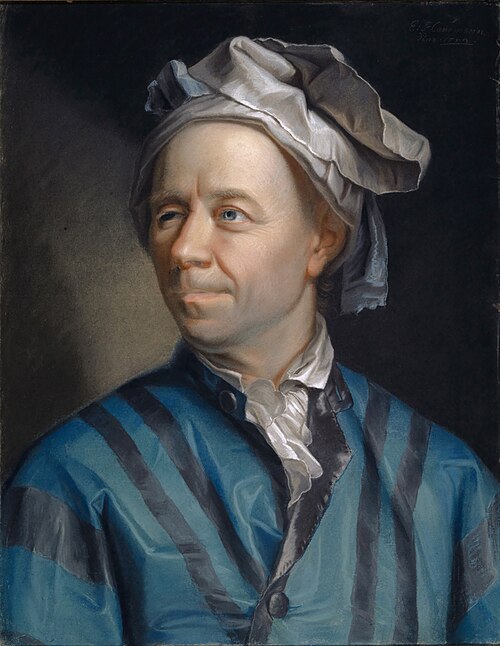
Leonhard Euler
 Switzerland
Swiss mathematician•physicist•astronomer•logician•geographer•music theorist and engineer
Birthday
April 15, 1707
Birth Sign
Aries
Birthplace
Basel, Switzerland
Age
Died at 76
About
Leonhard Euler was a Swiss polymath who made foundational contributions to mathematics, physics, astronomy, and engineering. He is widely regarded as the greatest mathematician of the 18th century and one of the most prolific in history. Euler introduced much of modern mathematical notation, including the use of π for the circle constant, f(x) for functions, i for the imaginary unit, and Σ for summations. His work spans graph theory, topology, number theory, complex analysis, and infinitesimal calculus. He also reformulated Newton's laws of motion and laid the foundations of fluid dynamics and potential theory. Euler's 866 publications and vast correspondence were collected in the Opera Omnia Leonhard Euler. His influence is so profound that Pierre-Simon Laplace said, 'Read Euler, read Euler, he is the master of us all.' Carl Friedrich Gauss also remarked, 'The study of Euler's works will remain the best school for the different fields of mathematics, and nothing else can replace it.' Euler is remembered for his foundational work in graph theory, topology, number theory, complex analysis, and infinitesimal calculus, as well as his contributions to physics and engineering.
Early Life & Background
Leonhard Euler was born on April 15, 1707, in Basel, Switzerland, to Paul Euler, a Reformed Church pastor, and Marguerite Brucker. He showed an early gift for mathematics, studying under his father before attending the University of Basel at age 13. There, he befriended Johann Bernoulli's sons and received private lessons from Johann Bernoulli, who recognized his talent. Euler earned his Master of Philosophy in 1723 after comparing the philosophies of Descartes and Newton. His father wanted him to become a pastor, but Bernoulli convinced Paul to allow Leonhard to pursue mathematics. In 1727, Euler entered the Imperial Russian Academy of Sciences in Saint Petersburg, where his career began. He also demonstrated an early aptitude for languages and could recite the entire Aeneid of Virgil from memory.
Career Growth
Euler joined the St. Petersburg Academy in 1727 and became a professor of physics in 1731. He solved the Basel problem in 1735, establishing the sum of the reciprocals of squares as π²/6. He lost sight in his right eye around 1738 but continued working. In 1741, he moved to the Berlin Academy, where he published the influential Introductio in analysin infinitorum (1748) and solved the Seven Bridges of Königsberg problem, founding graph theory. He returned to St. Petersburg in 1766 and, despite nearly total blindness, produced over half his total work, including major contributions to lunar theory and the calculus of variations. He died in 1783 while working on the motion of balloons. He also developed Euler's identity, e^{iπ} + 1 = 0, considered one of the most beautiful equations in mathematics. He once calculated the orbit of a comet in three days, a task that other mathematicians had found months long. He was elected to the St. Petersburg Academy of Sciences in 1731, the Berlin Academy of Sciences in 1744, and the Royal Society of London in 1747.
Career Timeline
Public Image & Style
Euler is revered as a symbol of mathematical genius and productivity. His persona is that of a tireless, methodical researcher who made even the most complex ideas accessible. He is often depicted in portraits as a dignified scholar with a gentle expression. The mathematical community celebrates his birthday with Euler Day. His name appears in countless textbooks and theorems. Fans of mathematics admire his ability to work through blindness and personal tragedy. His legacy is that of a universal genius who shaped modern science. He is remembered for his humility and dedication, often working with the help of his children and colleagues after losing his sight.
Fame & Fandom
Leonhard Euler never sought a cult following, for the concept of celebrity was centuries away from his era. His admirers were not fans who fainted at public appearances but scholars and students who dissected his letters across Europe. The only rituals surrounding him are academic: the quiet observance of Euler Day on April 15 and specialized contests like the $10,000 Leonhard Euler Idea Contest that honor his graph theory work in modern tech circles. No official fandom name exists; his legacy is carried by mathematicians, physicists, and historians who treat his equations as foundational texts rather than pop culture artifacts. While crowds never blocked streets for him, the sheer volume of concepts named after him, over 600 items ranging from the Euler characteristic to the Euler line, creates a unique form of reverence where the man himself becomes synonymous with the discipline. Recent discoveries in 2026, such as quantum solutions to his '36 officers problem,' have revitalized interest in his combinatorial puzzles, proving his constraints were transcended by new physics decades after his death.
Euler remains a titan of intellect whose influence spans from fluid dynamics to complex analysis. He is currently the 5th most famous person from Switzerland, a ranking that has held steady through recent cycles within the iFANN Global Fame Rankings. This placement reflects global attention measured across media coverage, search trends, and consumption signals worldwide.
Interesting Facts and Legends
Leonhard Euler's collected works, the Opera Omnia, span 76 volumes containing 866 publications. He had 13 children, yet only five survived to adulthood. After losing sight in both eyes, his productivity surged; he dictated approximately 500 more papers while relying on his sons and assistants to record his calculations. Historical accounts verify he could recite Virgil's Aeneid from memory and perform complex astronomical math mentally without writing a single note. His estate, filled with manuscripts and books, was preserved by the St. Petersburg Academy upon his death. He once expressed gratitude for being spared the ravages of war and the ruin of his country.
A legendary moment in mathematical history involves the Seven Bridges of Königsberg. In 1736, Euler proved it was impossible to cross each bridge exactly once and return to the start, effectively birthing graph theory. Another enduring story concerns his blindness; despite total loss of vision by 1766, he produced half of his lifetime output. The most culturally significant icon attributed to him is Euler's Identity ($e^{i\pi} + 1 = 0$), often hailed as the most beautiful equation in mathematics for uniting five fundamental constants. Modern lore also includes a 2026 discovery showing quantum entanglement can solve his '36 officers problem,' a puzzle he originally proved unsolvable in classical logic.
Notable Quotes
“Read Euler, read Euler, he is the master of us all.”
“The study of Euler's works will remain the best school for the different fields of mathematics.”
“There are more questions than can be answered in a lifetime.”
“I am so grateful to God that I have been spared the ravages of war and the ruin of my country.”
“Mathematical analysis is as extensive as nature itself.”
Family & Personal Life
Euler's father, Paul Euler, was a pastor of the Reformed Church, and his mother was Marguerite Brucker. He had no known siblings. In 1734, Euler married Katharina Gsell, the daughter of a Swiss painter. They had 13 children, but only five survived to adulthood: Johann Albert, Karl, Christoph, Charlotte, and Helene. Katharina died in 1773. The following year, Euler married her half-sister, Salomea Abigail Euler, who cared for him in his final years. His son Johann Albert Euler became a noted mathematician and astronomer.
Notable Connections
Euler studied under Johann Bernoulli and collaborated with Daniel Bernoulli at the St. Petersburg Academy. He influenced later mathematicians including Joseph-Louis Lagrange, Pierre-Simon Laplace, and Carl Friedrich Gauss. His correspondence with Christian Goldbach helped develop number theory. Euler also worked with his son Johann Albert Euler on astronomy.
Relationships & Dating History
Euler married Katharina Gsell in 1734. They had 13 children, though only five survived to adulthood. Katharina died in 1773. In 1774, Euler married her half-sister, Salomea Abigail Euler, who cared for him in his final years. As of 2026, Euler is deceased and his relationship status is widowed.
- MarriedKatharina Gsell1734 - 1773Married in 1734, had 13 children, died in 1773.
- MarriedSalomea Abigail Euler1774 - 1783Married in 1774, half-sister of his first wife, cared for him until his death.
Death & Aftermath
Died
September 18, 1783 (aged 76)
Death Place
Saint Petersburg, Russia
Cause of Death
Cerebral hemorrhage (stroke)
On the afternoon of September 18, 1783, Leonhard Euler sat in his armchair within a Saint Petersburg home, having just finished lunch with his family. He engaged his student in a discussion about the newly discovered planet Uranus before suffering a cerebral hemorrhage and dying almost instantly. The cause was established solely by the immediate observation of those present. The scientific community and the Russian imperial court mourned the loss of the man widely regarded as the most prolific mathematician in history. Tributes focused on his immense productivity, noting that he continued to produce significant work even after losing sight in one eye and eventually becoming completely blind. His funeral took place shortly after his death at the Alexander Nevsky Monastery, a traditional resting place for prominent figures in the city.
The service was a private affair attended by members of the academy, his family, and close colleagues rather than a massive public gathering. Euler's estate passed quietly to his widow Katharina Gsell and their children, who managed his extensive library and unpublished manuscripts without dispute. The St. Petersburg Academy of Sciences systematically compiled and published his works over the following decades. Centuries later, the Leonhard Euler International Mathematical Institute stands in Moscow, and the Euler Medal honors outstanding contributions to combinatorics. Modern tributes include Google Doodles commemorating his birthday and annual celebrations of E-Day, ensuring his influence remains ubiquitous in science.
Net Worth (Estate Value)
As of 2026, As a historical figure, Euler's net worth is not applicable. He earned a salary as a professor and academician, but lived modestly. His true wealth was his intellectual output. Today, the value of his collected works and legacy is immeasurable, but no modern financial estimate exists. He did not accumulate significant personal wealth, focusing instead on his research and teaching.
Awards & Accolades
View 7 records, honours and achievementsKnown For
Euler's identity
1748 · Mathematician
Seven Bridges of Königsberg
1736 · Mathematician
Introduction to graph theory
1736 · Mathematician
Euler's formula for polyhedra
1758 · Mathematician
Mechanica
1736 · Physicist
Keywords
Quick Facts
- Profession
- mathematician, physicist, university teacher
- Born
- +1707-04-15
- Birthplace
- Basel
- Died
- +1783-09-18
- Death Place
- Saint Petersburg
- Gender
- Male
- Spouse
- Salomea Abigail Euler, Katharina Euler
- Birth Sign
- Aries
Personal Details
- Full Name
- Leonhard Euler
- Spouse
- Katharina Gsell, Salomea Abigail Euler
- Children
- 13 children, 5 survived to adulthood
- Education
- University of Basel (Master of Philosophy, 1723)
Frequently Asked Questions
Who was Leonhard Euler?
What is Leonhard Euler famous for?
When did Leonhard Euler live?
What is Euler's identity?
Did Euler have any children?
Similar People
Join the community
fans discussing