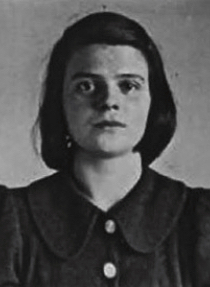
Sophie Scholl
 Germany
university student•resistance fighter•student
Birthday
+1921-05-09
Birth Sign
Taurus
Birthplace
Forchtenberg
Age
Died at 21
About
Sophia Magdalena Scholl was born on May 9, 1921, in the small town of Forchtenberg, Germany. A university student and passionate anti-Nazi activist, she became one of the most recognizable faces of the White Rose, a non-violent resistance group that dared to speak out against Hitler's regime. Raised in a family that encouraged open discussion and critical thinking, Scholl's early enthusiasm for the Hitler Youth's female branch, the Bund Deutscher Mädel, gradually gave way to deep disillusionment as she witnessed the regime's brutality. Influenced by philosophy, theology, and the writings of Theodor Haecker, she and her brother Hans, along with fellow students at the University of Munich, began producing and distributing leaflets that called for passive resistance, citing ethical and philosophical grounds for opposing the Nazi state. Their work was dangerous, and in February 1943, Scholl and her brother were caught tossing leaflets from a balcony at the Ludwig-Maximilians-Universität München. Arrested by the Gestapo, they were subjected to intense interrogation and then put on trial for high treason before the notorious judge Roland Freisler. On February 22, 1943, at just 21 years old, Scholl was executed by guillotine, her final words reportedly expressing hope for a better future. Her bravery did not die with her; the Allies air-dropped copies of the White Rose's last leaflet over Germany, and in the decades since, her story has inspired countless books, films, and memorials. The 2005 Oscar-nominated film Sophie Scholl – The Final Days brought her story to a global audience, ensuring that her quiet courage continues to resonate. Today, schools and streets across Germany bear her name, a testament to the enduring power of ordinary people who choose to resist tyranny.
Fame & Fandom
Sophie Scholl does not currently hold a placement in the iFANN Global Top 1,000 rankings or any scope-specific list published by the evaluation engine; she is evaluated but unranked. While the data confirms her status as a historical martyr rather than an entertainer with chart metrics, the iFANN system has processed her profile to reflect this absence of commercial ranking. Her influence operates outside the parameters of modern celebrity fame cycles, existing instead within the realm of historical remembrance and educational legacy. There is no formal fandom name documented for her supporters; she lacks a moniker like "Schollers" or organized fan clubs that engage in birthday campaigns or charity drives. The audience dedicated to her memory consists primarily of historians, educators, students, and political activists who honor her through commemorative events and academic study rather than digital engagement. These groups gather annually around the anniversaries of her birth and execution, utilizing her story as a tool for teaching moral courage against tyranny. Cultural tributes such as the film Sophie Scholl: The Final Days serve as primary touchstones for these adherents, providing verified narratives of her defiance rather than the viral anecdotes typical of living stars. The lack of a specific fandom structure reflects her nature as a deceased figure whose legacy is sustained through institutional preservation and scholarly reference rather than active fan interaction.
Interesting Facts and Legends
Sophie Scholl was born on May 9, 1921, in Forchtenberg, Germany, and died by guillotine on February 22, 1943, at the age of 21. She co-founded the White Rose resistance group alongside her brother Hans while studying at the University of Munich. A defining moment in her legend occurred on February 18, 1943, when she distributed leaflets titled The White Rose from a second-floor window before being caught in the act. During her trial before the People's Court presided over by Judge Roland Freisler, she refused to recant her beliefs or beg for mercy. Her final words, reportedly stating that the sun still shines, are widely retold as a reflection of her enduring hope despite imminent death. This account of her refusal to compromise her conscience has become a central pillar of her mythology. The movement she helped lead is frequently cited in educational contexts as a beacon of non-violent resistance. In 2021, Germany officially commemorated the centenary of her birth, reinforcing her status as a national icon. Recent cultural projects include nursery schools named after her, ensuring her story remains relevant to new generations.
Death & Aftermath
Died
+1943-02-22 (aged 21)
Death Place
Munich, Bavaria, Germany
Cause of Death
Beheading by guillotine
The Nazi judicial system executed Sophie Scholl at 07:30 on February 22, 1943, following a summary trial before the People's Court presided over by Judge Roland Freisler. She was taken to Stadelheim Prison in Munich where she was beheaded by guillotine shortly after the court ruled her actions constituted high treason during an hour-long proceeding that offered no opportunity for defense or appeal. Her final public appearance occurred earlier that day when she attempted to distribute leaflets in the University of Munich atrium before being apprehended by a custodian who alerted the Gestapo. The body was interred in an unmarked grave within the Munich Waldfriedhof alongside her brother Hans and friend Christoph Probst, with the regime suppressing any public memorialization or return of remains to the family.
In the immediate post-war period, Scholl remained relatively unknown outside academic circles until her legacy grew substantially from the 1970s onward. The proceedings were retrospectively condemned as illegal and unjust after the fall of the Third Reich, though no formal legal redress or compensation was granted to the Scholl family in the immediate aftermath. Annual commemorations now occur on February 22nd across Germany, involving moments of silence and educational programs, while landmarks such as the Sophie-Scholl-Platz in Munich bear her name. Her letters and diaries were preserved by her sister Elisabeth Hartnagel and published as Sophie Scholl: Letters and Diaries, providing a firsthand account of her motivations.
Cultural recognition expanded significantly with the release of the 2005 film Sophie Scholl, The Final Days directed by Marc Rothemund, which received an Academy Award nomination for Best Foreign Language Film. Educational initiatives have further cemented her story in history curriculums, including discussions in 2026 regarding her inclusion in school materials.
Awards & Accolades
Keywords
Quick Facts
- Profession
- university student, resistance fighter, student
- Born
- +1921-05-09
- Birthplace
- Forchtenberg
- Died
- +1943-02-22
- Death Place
- Munich Prison
- Gender
- Female
- Birth Sign
- Taurus
Join the community
fans discussing