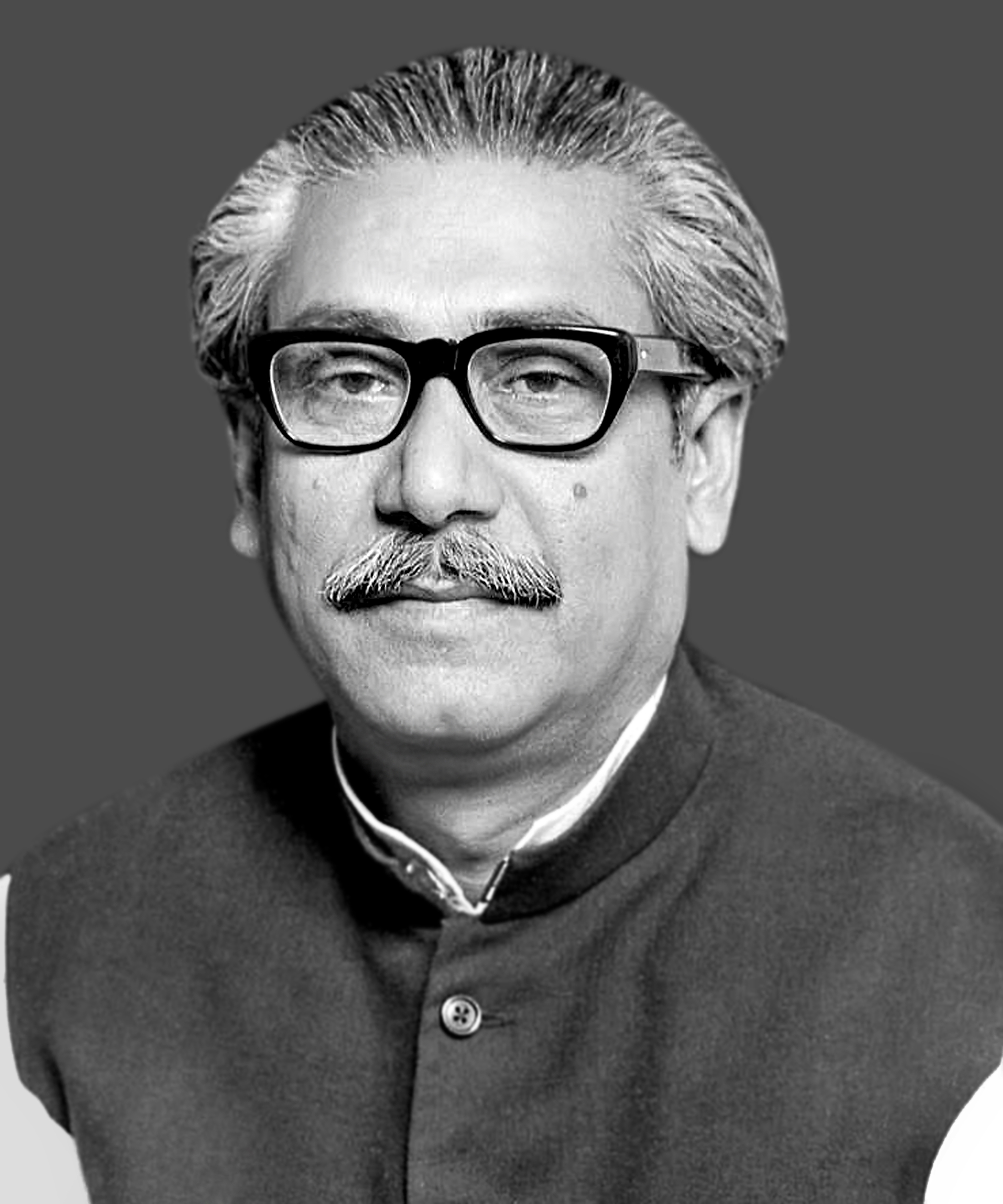
Sheikh Mujibur Rahman
 Bangladesh
Birthday
+1920-03-17
Birth Sign
Pisces
Birthplace
Tungipara Upazila
Age
Died at 55
About
Sheikh Mujibur Rahman, born March 17, 1920, and known widely as Mujib or the honorific Bangabandhu, was a pivotal figure in Bangladeshi politics. A statesman, activist, and writer, he is credited as the founding president of Bangladesh. His leadership guided the nation as president and prime minister from 1972 until his assassination in 1975. He hailed from Tungipara Upazila, a region that would become central to his political journey. Mujib's life, tragically cut short on August 15, 1975, was dedicated to the cause of Bengali self-determination.
Fame & Fandom
Sheikh Mujibur Rahman commands a devotion that transcends the modern concept of fandom, existing instead as a unified national identity where the citizenry itself serves as the collective admirer. Unlike celebrity cultures driven by organized clubs or commercial campaigns, reverence for the Father of the Nation is expressed through state-sanctioned civic rituals and deep historical memory rather than performative adoration. His supporters are defined not by fan names or chart pushes but by their shared political ideology and the enduring legacy of his role in securing Bengali self-determination. This unique form of global attention places him prominently within historical records and contemporary cultural consciousness.
In the August 2026 cycle of the iFANN Global Fame Rankings, Sheikh Mujibur Rahman is recognized as the 5th most famous person from Bangladesh. This placement reflects a sustained trajectory of recognition across media coverage, search activity, and consumption patterns worldwide. While no formal fan club exists to manage his digital presence, the sheer scale of his influence ensures his name remains a constant fixture in global discourse regarding post-colonial leadership.
Interesting Facts and Legends
Historical records document that on March 7, 1971, Sheikh Mujibur Rahman addressed an estimated crowd of 1.5 to 2 million people at the Ramna Race Course. During this pivotal gathering, he delivered a speech declaring, "This time the struggle is for our freedom; this time the struggle is for our independence," an event now regarded as the de facto declaration of independence. Following the 1970 elections, he was arrested on the night of March 25, 1971, and spent nine months in solitary confinement before being flown back to a liberated Dhaka on January 10, 1972, where he was greeted by millions.
The tragic events of August 15, 1975, remain a central element of his legend, marking the assassination of the statesman, his wife, and three sons by disgruntled junior army officers. This coup d'état is frequently cited as a turning point that altered the democratic trajectory of the young nation. Visually, his image wearing a white panjabi and a red gamcha scarf has become an iconic symbol of Bangladeshi patriotism, often described as a national uniform worn during protests and celebrations.
Death & Aftermath
Died
+1975-08-15 (aged 55)
Death Place
Dhaka, Bangladesh
Cause of Death
Multiple gunshot wounds
The assassination of Sheikh Mujibur Rahman triggered immediate national mourning and widespread tributes from international leaders, including the United Nations and heads of state across Asia, Africa, and Europe. In Bangladesh, spontaneous vigils erupted across the nation, and the anniversary of his death on August 15 is now observed as National Mourning Day with flags flown at half-mast and millions gathering at his former residence for moments of silence. The event plunged the country into a period of deep grief. Mujib was killed early in the morning of August 15, 1975, at approximately 06:45 AM inside his residence at Dhanmondi 32 in Dhaka during a military coup d'état led by junior army officers.
Soldiers entered the compound while he was preparing for the day, and he died from multiple gunshot wounds alongside most of his immediate family, including his wife Sheikh Fazilatunnesa Mujib and six of their eight children., the circumstances are universally accepted as an execution by mutinous soldiers of the Bangladesh Army. An initial investigation by the subsequent military regime resulted in the trial and execution of several senior officers, but decades later, the High Court ordered fresh investigations that led to charges against 31 accused individuals in 2013, though legal proceedings have remained prolonged and politically contentious. His funeral took place the following day, August 16, 1975, at the same Dhanmondi 32 residence where thousands of mourners lined the streets to pay their respects before his burial in the garden.
Posthumously, he was officially recognized as Bangabandhu and the Father of the Nation, with numerous institutions bearing his name including the Bangabandhu Sheikh Mujibur Rahman Novo Theatre and various universities. His estate was converted into a museum and memorial complex managed by the state, ensuring his legacy remains central to the national identity.
Awards & Accolades
Keywords
Quick Facts
- Profession
- politician, writer
- Born
- +1920-03-17
- Birthplace
- Tungipara Upazila
- Died
- +1975-08-15
- Death Place
- Dhaka
- Gender
- Male
- Spouse
- Sheikh Fazilatunnesa Mujib
- Birth Sign
- Pisces
Personal Details
- Spouse
- Sheikh Fazilatunnesa Mujib
Join the community
fans discussing