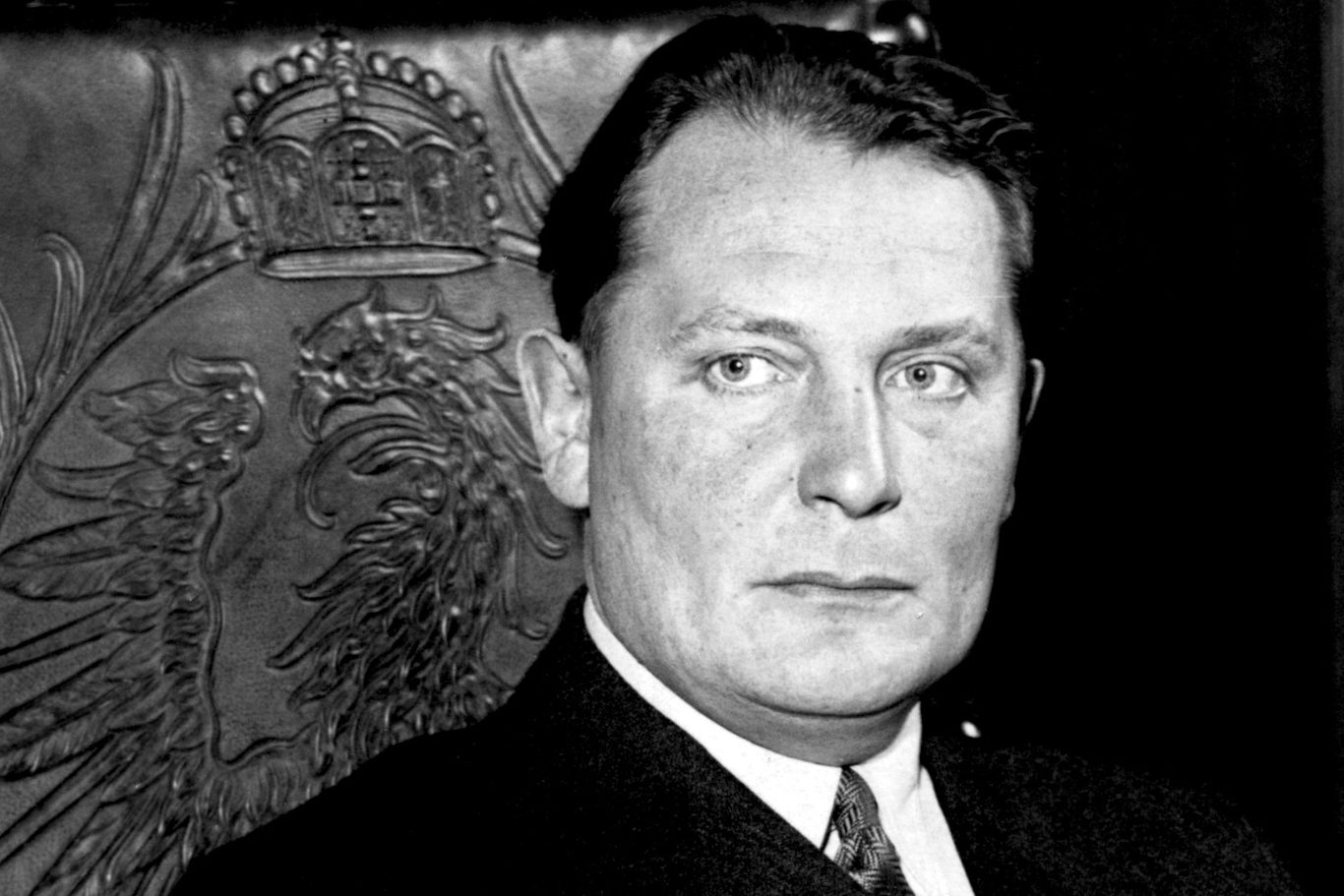
Hermann Göring
 Germany
politician•aircraft pilot•art collector
Also known as: Hermann Wilhelm Goering, Field Marshal Hermann Goering, Reichsmarschall Hermann Göring
Birthday
January 12, 1893
Birth Sign
Capricorn
Birthplace
Rosenheim, Kingdom of Bavaria, German Empire
Age
Died at 53
About
Hermann Göring was a German politician and military leader who rose to become one of the most powerful figures in Nazi Germany. As Commander-in-Chief of the Luftwaffe and Hitler's designated successor, he held authority that extended across the air force, the economy, and the state's security apparatus. He held the unique rank of Reichsmarschall, senior to all other Wehrmacht commanders. His name is permanently tied to the crimes of the Third Reich, from the creation of the Gestapo to the looting of art across occupied Europe.
Göring began his career as a decorated fighter ace in World War I, commanding the famous Flying Circus after the death of Manfred von Richthofen. He joined the Nazi Party in 1922 and was wounded in the Beer Hall Putsch the following year. From 1933 onward he accumulated offices: Minister without Portfolio, President of the Reichstag, overseer of the Four Year Plan, and head of the Luftwaffe. His influence peaked in the early years of the war but declined as the air force failed to protect German cities from Allied bombing and could not resupply the trapped army at Stalingrad.
In April 1945 he was arrested on Hitler's orders for attempting to assume leadership. Captured by the Allies, he stood trial at Nuremberg, was convicted of conspiracy, crimes against peace, war crimes, and crimes against humanity, and was sentenced to death by hanging. He died by suicide the night before his execution, on October 15, 1946. His historical legacy is inextricably linked to the crimes of the Third Reich, and he is remembered as one of its primary architects.
Early Life & Background
Hermann Wilhelm Göring was born on January 12, 1893, in Rosenheim, Bavaria, the fourth of five children. His father, Heinrich Ernst Göring, was a former cavalry officer who had served as governor-general of German South West Africa and was consul general in Haiti when Hermann was born. His mother, Franziska Tiefenbrunn, came from a Bavarian peasant family. She left the six-week-old infant with a friend in Bavaria and did not see him again for three years. In 1901 the family moved into Castle Veldenstein, near Nuremberg, the property of Ritter von Epenstein, a Jewish man who was until 1913 the lover of Göring's mother and godfather to the children.
Göring was trained for an army career from an early age, attending military schools and entering the Prussian Military Academy at Berlin-Lichterfelde. He received his commission as a Second Lieutenant in 1912. When the First World War broke out in August 1914, he served in the German Army, initially in the trenches of the Western Front during 1914–15, before transferring to the German Air Service as an observer and then becoming a fighter pilot. He proved exceptionally skilled, achieving 22 aerial victories, which earned him the Pour le Mérite, the Iron Cross 1st Class, and the Iron Cross 2nd Class. On July 7, 1918, at age 25, he assumed command of Jagdgeschwader 1, the famed Flying Circus fighter wing previously led by Manfred von Richthofen, who had been killed in action three months earlier. Göring deeply resented the treatment given to army officers by the civilian population after Germany's defeat.
After the Armistice in November 1918, Göring worked as a commercial pilot, performing aerobatic displays and demonstrations in Scandinavia for the Fokker Company, and by autumn 1919 was flying passenger planes for Svenska Lufttrafik airline in Sweden. A war hero with pale blue eyes and lean, dashing good looks, he made a splash in Swedish society. He returned to Germany in the early 1920s, enrolling at university in Munich, where he first encountered Hitler.
Career Growth
In 1922 Göring heard Hitler speak and joined the Nazi Party, immediately appointed commander of the Sturmabteilung (SA). He participated in the Beer Hall Putsch in November 1923 and was seriously wounded, developing a morphine addiction during treatment. He fled to Austria and later spent time in a mental hospital in Sweden recovering from his addiction. Returning to Germany, he was elected to the Reichstag in 1928 and became its President in 1932. When Hitler became Chancellor on January 30, 1933, Göring was appointed Minister without Portfolio. One of his first acts was overseeing the creation of the Gestapo, which he ceded to Heinrich Himmler in 1934. He also established concentration camps for the "corrective treatment" of difficult opponents. Göring urged Hitler to destroy SA leader Ernst Röhm and his top associates, a step endorsed by SS chief Himmler, and in return handed off the Gestapo to the SS.
On March 1, 1935, Göring was made Commander-in-Chief of the Luftwaffe. In 1936 Hitler appointed him Plenipotentiary for the Implementation of the Four-Year Plan, giving him enormous power to direct the German economy toward war. He was designated Hitler's successor in a 1939 Reichstag speech, and after the defeat of France in 1940 he was elevated to the rank of Reichsmarschall, above all other military officers. He was also designated by Hitler in 1941 as his successor and second-in-command in all his offices. As the war turned, the Luftwaffe's failures led to his decline in influence. He focused on amassing a vast collection of art and property, much of it looted from Holocaust victims. In April 1945 he was accused of treason, stripped of his offices, and arrested on Hitler's orders.
Career Timeline
Public Image & Style
Göring was known for his larger-than-life personality, vanity, and charm, which carried him from the cockpit of a fighter plane to the heart of Hitler's Reich. He was an ambitious opportunist whose intelligence and arrogance made him the defining symbol of the Nuremberg proceedings. His appearance changed dramatically over the years, from a lean, dashing young officer to a corpulent figure in elaborate uniforms, reflecting his love of pomp and luxury.
In the media and popular culture, Göring is often depicted as the archetypal corrupt Nazi, obsessed with titles, wealth, and art. His name remains a household word in Germany and internationally as one of the primary architects of the Nazi police state. He is remembered for establishing the Gestapo and concentration camps, directing the rebuilding of the German air force, and preparing Germany economically for war.
Fame & Fandom
Hermann Göring remains a figure of intense historical scrutiny, his notoriety sustaining a global footprint that spans academic study and popular cautionary tales. According to the iFANN Global Fame Rankings, he holds the position of the 71st most famous person in Germany, a standing that has held steady from the previous cycle. His prominence among those born in the nation places him at the 23rd most famous person from Germany. Within the specific domain of Automotive / Car Culture, where his role as a pilot and enthusiast is noted, he ranks as the 9th most famous person in Automotive / Car Culture. These placements reflect a legacy measured in infamy rather than admiration. There is no formal fandom or organized fanbase associated with Hermann Göring; the concept does not apply to individuals linked to genocide and totalitarianism. Public discourse remains strictly academic or serves as a warning against unchecked power, with no rituals, charitable drives, or fan-funded projects existing in his name.
Interesting Facts and Legends
Hermann Göring's younger brother Albert actively assisted Jews in escaping Nazi persecution, a stark contrast to Hermann's regime role, and was reportedly spared prosecution by survivors he had aided. The dictator maintained an extravagant lifestyle centered on Carinhall, a hunting estate named for his first wife that featured a private railway station and a vast collection of looted art. During his trial, Göring requested execution by firing squad instead of hanging, a request the court denied. He possessed fluency in English and French, which he utilized effectively during interrogations and proceedings at Nuremberg. His physical form shifted dramatically over time; while lean and athletic in his youth, he weighed over 280 pounds by the late 1930s, earning the nickname 'The Fat Man' among officials. He was 53 years old when he died. Historical records also detail his command of the 'Flying Circus' in World War I, where he achieved 22 aerial victories before leading the Luftwaffe. His creation of the Gestapo in 1933 established the secret police state, cementing his control through force. A defining moment of his end occurred when he swallowed a hidden cyanide capsule hours before his scheduled hanging, successfully evading the gallows. Later accounts highlight his severe drug dependency, which contributed to his erratic behavior and physical decline.
Notable Quotes
“I have no conscience. My conscience is Adolf Hitler.”
“I am the last of the old guard. I am the only one who can still speak to Hitler.”
“The people can always be brought to the bidding of the leaders. That is easy. All you have to do is tell them they are being attacked.”
Family & Personal Life
Göring was the fourth of five children. His father, Heinrich Ernst Göring, was a former cavalry officer and colonial governor; his mother, Franziska Tiefenbrunn, came from a Bavarian peasant family. His siblings included Karl, Olga, Paula, and younger brother Albert, who notably helped Jews during the Nazi period. In 1901 the family moved into Castle Veldenstein, owned by his Jewish godfather, Ritter von Epenstein, who was his mother's lover until 1913.
Göring married Swedish baroness Carin von Kantzow in February 1923; she divorced her first husband to marry him. Carin died in 1931, deeply affecting Göring. In 1935 he married actress Emmy Göring. Their daughter, Edda Göring, was born in 1938. The family lived in grand residences, including Carinhall, a vast estate named after his first wife.
Notable Connections
Göring's political career was tied to Adolf Hitler, who appointed him to numerous high offices and eventually designated him as successor. He succeeded Manfred von Richthofen as commander of the Flying Circus. He worked closely with Heinrich Himmler, who took over the Gestapo from him. He urged Hitler to destroy SA leader Ernst Röhm. His first wife, Carin von Kantzow, and second wife, Emmy Göring, were part of his personal life. His younger brother Albert notably helped Jews during the Nazi period.
Relationships & Dating History
Göring met Swedish baroness Carin von Kantzow while working as a commercial pilot in Sweden after World War I. She divorced her husband and married Göring in February 1923. Their marriage lasted until her death in 1931, which deeply affected him. In 1935, he married actress Emmy Göring. They remained married until his death in 1946. The couple had one daughter, Edda, born in 1938. At the time of his death, Göring was married to Emmy.
- MarriedCarin von Kantzow1923 - 1931First wife; she died in 1931.
- MarriedEmmy Göring1935 - 1946CurrentSecond wife; they had a daughter, Edda.
Death & Aftermath
Died
October 15, 1946 (aged 53)
Death Place
Nuremberg, Bavaria, Germany
Cause of Death
Suicide by cyanide poisoning
Hermann Göring spent his final days in a cell at the Nuremberg Prison following his conviction on all four counts by the International Military Tribunal, where he listened silently to the death sentence before returning to confinement. On October 15, 1946, American military officers discovered him dead from potassium cyanide poisoning, a suicide achieved by concealing a capsule within his bedding despite strict prior searches. An immediate autopsy confirmed the ingestion of the poison through residue found on his lips and an empty capsule recovered from his mouth, leading investigators to rule the cause as suicide. The Allied powers viewed the event as the fitting conclusion for a convicted war criminal responsible for the Holocaust and the initiation of World War II, vigils, or memorials were held by the German public or international institutions.
His funeral remained private and minimal, with U.S. authorities refusing a state burial and instead arranging for cremation followed by the scattering of ashes into the Isar River near Munich to prevent any site from becoming a neo-Nazi shrine. Posthumous analysis has focused entirely on his role in the Nazi regime through documentaries and films such as Nuremberg: Nazis on Trial and The Nuremberg Trials , foundations, or honors created in his name. Family statements from his daughter Edda and son Albert consistently emphasized his guilt, and the estate was liquidated by the Allied Control Council with proceeds directed toward reparations for victims.
Net Worth (Estate Value)
$10 Million
iFANN Editorial Team estimate
As a historical figure, Hermann Göring's personal net worth is not tracked by modern financial sources in the traditional sense. During his lifetime, he amassed an enormous personal fortune derived from his high positions within the Nazi regime. He acquired vast properties, including the estate of Carinhall, and built an extensive art collection, much of which was looted directly from Holocaust victims. After his death, his estate became subject to post-war restitution proceedings, with numerous looted artworks returned to their original owners or their heirs. The estate itself holds no current commercial value as a revenue-generating entity. Per iFANN's editorial analysis, the total estimated value of his assets at their peak stands at $10 Million. This figure encompasses real estate, art, and other valuables, though precise verification remains difficult due to the chaotic nature of the era. As of 2026, no active estate revenue streams exist, and the historical value of his possessions is primarily of interest to researchers and historians.
Awards Won (3)
Göring received several military decorations during World War I, including the Pour le Mérite, the Iron Cross 1st Class, and the Iron Cross 2nd Class. These awards recognized his bravery and skill as a fighter pilot.
1918 · Military
World War I service
1914-1918 · Military
World War I service
Known For
Commander-in-Chief of the Luftwaffe
1935-1945 · Military leader
Plenipotentiary of the Four-Year Plan
1936 · Economic dictator
Reichsmarschall of the Greater German Reich
1940 · Highest military rank
Keywords
Sources
Quick Facts
- Profession
- politician, aircraft pilot, art collector
- Born
- January 12, 1893
- Birthplace
- Rosenheim, Kingdom of Bavaria, German Empire
- Died
- October 15, 1946
- Death Place
- Nuremberg Court Prison
- Gender
- Male
- Spouse
- Carin Göring, Emmy Göring
- Birth Sign
- Capricorn
- Children
- Edda Göring
Personal Details
- Full Name
- Hermann Wilhelm Göring
- Spouse
- Carin Göring, Emmy Göring
- Children
- Edda Göring
- Education
- Prussian Military Academy at Berlin-Lichterfelde
Frequently Asked Questions
How did Hermann Göring die?
What was Hermann Göring's role in the Nazi Party?
How many kills did Hermann Göring have in World War I?
Was Hermann Göring married?
What happened to Hermann Göring's art collection?
Join the community
fans discussing