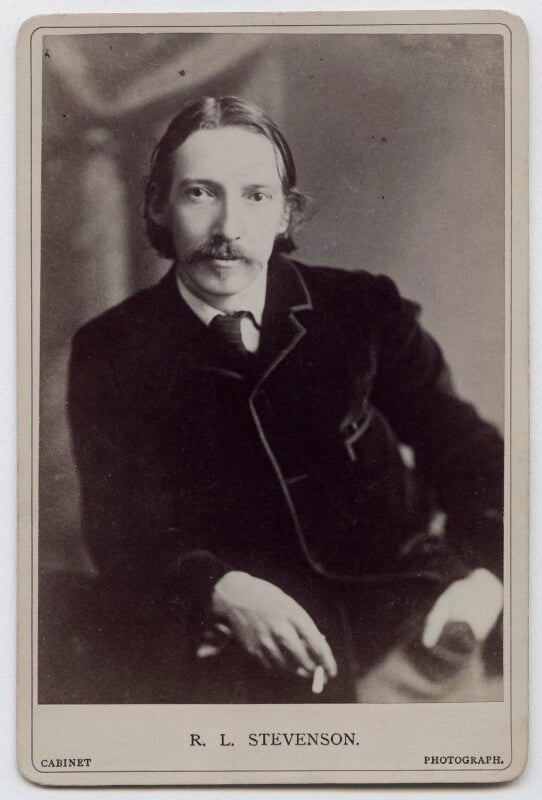
Robert Louis Stevenson
 United Kingdom
Also known as: RLS, Tusitala
Birthday
November 13, 1850
Birth Sign
Scorpio
Birthplace
Edinburgh, Scotland
Age
Died at 44
Height
5 ft 10 in (178 cm)
About
Robert Louis Stevenson was a Scottish novelist, essayist, poet, and travel writer, celebrated for adventure novels like Treasure Island and gothic novellas such as Strange Case of Dr Jekyll and Mr Hyde. His prolific output includes classics like Kidnapped and A Child's Garden of Verses. Stevenson's works have achieved worldwide acclaim, and he ranked as the 26th most-translated author. Known in Samoa as Tusitala, the Teller of Tales, his distinctive storytelling continues to captivate readers and inspire filmmakers globally.
Early Life & Background
Robert Lewis Balfour Stevenson was born on November 13, 1850, in Edinburgh, Scotland, the only child of lighthouse engineer Thomas Stevenson, a prominent lighthouse engineer, and Margaret Balfour. He was raised in a strict Calvinist household in Edinburgh. From an early age, Stevenson suffered from a lifelong bronchial illness, which often kept him bedridden for extended periods. During these long stretches of confinement, he found solace and inspiration in literature, spending his time devouring books and beginning to write his own stories, thus nurturing his early interests and talents.
His formal education began at Edinburgh Academy, and he later enrolled at the University of Edinburgh. Initially, Stevenson pursued engineering, intending to follow in his father's footsteps, but his true passions lay elsewhere. He eventually switched his studies to law and was called to the Scottish bar in 1875. However, he never practiced law professionally. Instead, he gravitated towards the vibrant literary scene of Edinburgh, frequenting pubs and clubs where he honed his craft by imitating his favorite authors and immersing himself in the world of letters.
Stevenson's first steps into the public literary world came with the publication of his essay, "Roads," in 1873. During this formative period, he found a significant mentor in Frances Sitwell, an older married woman who provided crucial guidance and encouragement for his artistic development. His literary career truly began to take shape with the publication of his first book, An Inland Voyage, in 1878, which chronicled a canoe trip he took through France, marking his breakthrough as a professional writer.
Career Growth
Stevenson's breakthrough came in 1883 with Treasure Island, originally serialized in a children's magazine. The novel was a massive success and established him as a master of adventure fiction. In rapid succession he published A Child's Garden of Verses (1885), then in 1886 both Strange Case of Dr Jekyll and Mr Hyde — which sold 40,000 copies in six months — and Kidnapped. He moved to the United States in 1887, then embarked on a South Seas voyage in 1888 aboard the yacht Casco, visiting the Marquesas, Tahiti, and Hawaii. In 1889 he settled in Samoa, building a home called Vailima. Later works include The Master of Ballantrae (1889) and Catriona (1893). He died in 1894 from a stroke.
Career Timeline
Public Image & Style
Stevenson cultivated a romantic, bohemian image: a frail, bearded man in a cape, often with a cigarette, who wrote about swashbuckling heroes. His style blended romantic adventure with gothic darkness, and his lyrical poetry charmed readers. Media and fans see him as the archetypal romantic invalid — a sickly man who lived vicariously through his characters. His fandom, called Stevensonians, includes literary scholars and adventure enthusiasts. They celebrate his birthday, visit his homes in Edinburgh and Samoa, and hold readings. On social media, fan pages share quotes and biographical tidbits, maintaining a reverent, scholarly tone.
Fame & Fandom
The cultural presence of Robert Louis Stevenson is defined by institutional reverence rather than the organized activism typical of modern celebrity. Unlike contemporary figures who command unified fanbases with specific monikers and digital campaigns, his admirers operate through museums, historical societies, and academic circles. There is no formal collective name for his followers, nor are there recorded instances of grassroots movements driving viral trends or social media phenomena in his honor. The primary centers of devotion remain physical locations such as the museum in Apia, Samoa, and the historic sites in Edinburgh and New York, which serve as pilgrimage grounds for scholars and readers alike. Recent efforts to restore statues and maintain summer camps reflect a sustained, quiet appreciation managed by curators rather than an active fanbase orchestrating chart pushes. His legacy rests on the enduring power of works like Treasure Island and Strange Case of Dr Jekyll and Mr Hyde, which have generated countless adaptations without creating a distinct fandom culture around the author himself. While stories of his travels and illness persist as folklore, they lack the chaotic public spectacles often associated with legendary status. As of August 2026, the iFANN Global Fame Engine has evaluated this individual but does not currently assign him a placement within the published rankings or scope lists. Consequently, no numeric rank or score exists for Robert Louis Stevenson in the current global standings.
Interesting Facts and Legends
Robert Louis Stevenson altered the spelling of his middle name from Lewis to Louis at age eighteen yet continued to pronounce it as Lewis throughout his life. He composed the novella Strange Case of Dr Jekyll and Mr Hyde during a six-day feverish period inspired by a recurring nightmare. Despite suffering from chronic lung disease, he maintained a heavy smoking habit. His close friendship with Henry James persisted despite their divergent literary styles. He actively advocated for Samoan independence, earning the title Tusitala, or Teller of Tales, from local residents. His epitaph reads: Under the wide and starry sky, / Dig the grave and let me lie. / Glad did I live and gladly die, / And I laid me down with a will. A persistent legend surrounds his final resting place beneath a mango tree on Vailima, a detail that has become central to his mythos. Another widely retold narrative involves his convalescence in Saranac Lake, New York, where he wrote Kidnapped while battling illness in a modest cottage now preserved as a museum. In 2026, restoration teams utilized 3D printing technology to repair a decapitated statue of the author in Samoa, ensuring the physical legacy remains intact for future generations.
Notable Quotes
“Sooner or later, we all sit down to a banquet of consequences.”
“To travel hopefully is a better thing than to arrive, and the true success is to labour.”
“The world is so full of a number of things, I'm sure we should all be as happy as kings.”
“Quiet minds cannot be perplexed or frightened, but go on in fortune or misfortune at their own private pace, like a clock during a thunderstorm.”
Family & Personal Life
Stevenson was the only child of Thomas Stevenson, a respected lighthouse engineer, and Margaret Isabella Balfour, whose family included lawyers and ministers. His parents were strict Calvinists. He married Fanny Van de Grift Osbourne in 1880; she had two children from a previous marriage: Isobel (Belle) and Lloyd Osbourne. Stevenson legally adopted Lloyd, who later collaborated on works like The Wrong Box. The family lived in Samoa at Vailima, where Fanny managed the household and Stevenson's health. He had no biological children. The Stevensons kept pets, including a horse named Jack.
Notable Connections
Stevenson was married to Fanny Van de Grift Stevenson, who also served as his editor and manager. His stepson and collaborator was Lloyd Osbourne. He was mentored by Sidney Colvin and counted Andrew Lang, Edmund Gosse, Leslie Stephen, and W. E. Henley among his friends. Henley may have inspired Long John Silver. His works were published by Charles Scribner's Sons in the US. He was painted by John Singer Sargent.
Relationships & Dating History
Stevenson's first known romantic attachment was to Frances Sitwell, an older married woman he met in 1873. She encouraged his writing but chose to remain with her husband, ending the relationship around 1875. In 1876, at an artists' colony in Grez-sur-Loing, France, he met Fanny Van de Grift Osbourne, an American separated from her husband. They began a relationship, and when she returned to California in 1878, Stevenson followed her across the Atlantic, nearly dying on the journey. They married on 19 May 1880 in San Francisco. Fanny was his wife, editor, and manager, and the marriage was reportedly happy and enduring. He had no other known partners. As of 2026, Stevenson is deceased; he was married to Fanny at the time of his death.
- DatedFrances Sitwell1873 - 1875Platonic but deeply emotional relationship; she was a married literary mentor who encouraged his early writing.
- MarriedFanny Van de Grift Osbourne1880 - 1894CurrentMet in 1876 in France; she was separated from her first husband. They married in San Francisco and remained together until his death.
Death & Aftermath
Died
December 3, 1894 (aged 44)
Death Place
Apia, Upolu, Samoa
Cause of Death
Cerebral hemorrhage due to tuberculosis
Robert Louis Stevenson died on December 3, 1894, at the age of forty-four in his sleep at Vailima, his home near Apia on the island of Upolu in Samoa. The cause of death was officially ruled as a cerebral hemorrhage resulting from complications of chronic tuberculosis and hypertension, conditions that had plagued him since childhood. This determination relied on family testimony and the medical observations of his physician, Dr. Walter Woodhouse, following a severe stroke in November 1894 that left him partially paralyzed and another on December 2nd before he slipped into unconsciousness., historical consensus confirms he passed peacefully while attempting to write a letter to his wife Fanny, though he never finished it. Public reaction across the British Empire and the United States was immediate and profound, with tributes pouring in from peers such as Arthur Conan Doyle, Rudyard Kipling, and Henry James.
A memorial service was held at St. Paul's Cathedral in London attended by prominent literary figures, while fan gatherings and vigils took place in Edinburgh and New York. Sales of his books surged immediately following the news, prompting publishers to release special editions, and crowds gathered along the coast to meet the steamer Lurline carrying his body back to Europe. Despite the journey, his remains were ultimately interred in Samoa rather than returned to Scotland for burial. Stevenson's funeral was a private ceremony held on December 4, 1894, at Vailima conducted by a missionary and attended by his wife Fanny, their son Lloyd, close friends including American consul William H. Smith, and several Samoan chiefs. Due to the tropical climate and logistical difficulties of transporting a heavy oak coffin up the steep mountainside, the burial took place in a small clearing on Mount Vaea overlooking the ocean, known as the Top of the World.
His son Lloyd recited a passage from Treasure Island during the service, which featured no elaborate performances or public eulogies. Posthumously, his widow Fanny managed his copyrights and published collections such as The Wrecker and St. Ives, while his legacy expanded through numerous film adaptations and the establishment of museums in Edinburgh, Saranac Lake, and Apia.
Net Worth (Estate Value)
$10 Million
iFANN Editorial Team estimate
Per iFANN's editorial analysis, the literary estate of Robert Louis Stevenson holds a value of $10 Million as of 2026 estimates. This valuation reflects ongoing revenue streams derived from book sales, film and television adaptations, audiobooks, and merchandise. Major productions include dozens of film versions of Dr Jekyll and Mr Hyde and Treasure Island, which continue to generate significant income. The estate is administered by the Stevenson family trust, which retains control over the rights to his extensive body of work. Posthumous earnings have expanded steadily, aided by new editions and digital formats that broaden global reach. Additionally, the Robert Louis Stevenson Museum in Samoa contributes to the financial standing of the estate. No public filings exist to verify these figures, yet the estate remains financially substantial among authors from the nineteenth century.
Awards & Accolades
View 3 records, honours and achievementsKnown For
Treasure Island
1883 · Author
Strange Case of Dr Jekyll and Mr Hyde
1886 · Author
Kidnapped
1886 · Author
A Child's Garden of Verses
1885 · Author
The Master of Ballantrae
1889 · Author
Keywords
Quick Facts
- Profession
- poet, essayist, novelist
- Born
- +1850-11-13
- Birthplace
- Edinburgh
- Died
- +1894-12-03
- Death Place
- Vailima
- Gender
- Male
- Spouse
- Fanny Stevenson
- Birth Sign
- Scorpio
Personal Details
- Full Name
- Robert Lewis Balfour Stevenson
- Height
- 5 ft 10 in (178 cm)
- Spouse
- Fanny Stevenson
- Children
- Lloyd Osbourne (adopted stepson), Isobel Osbourne (stepdaughter)
- Education
- University of Edinburgh (studied engineering, then law)
Frequently Asked Questions
How did Robert Louis Stevenson die?
What is Robert Louis Stevenson's most famous book?
Did Robert Louis Stevenson have children?
Where is Robert Louis Stevenson buried?
What was Robert Louis Stevenson's real name?
Similar People
Join the community
fans discussing