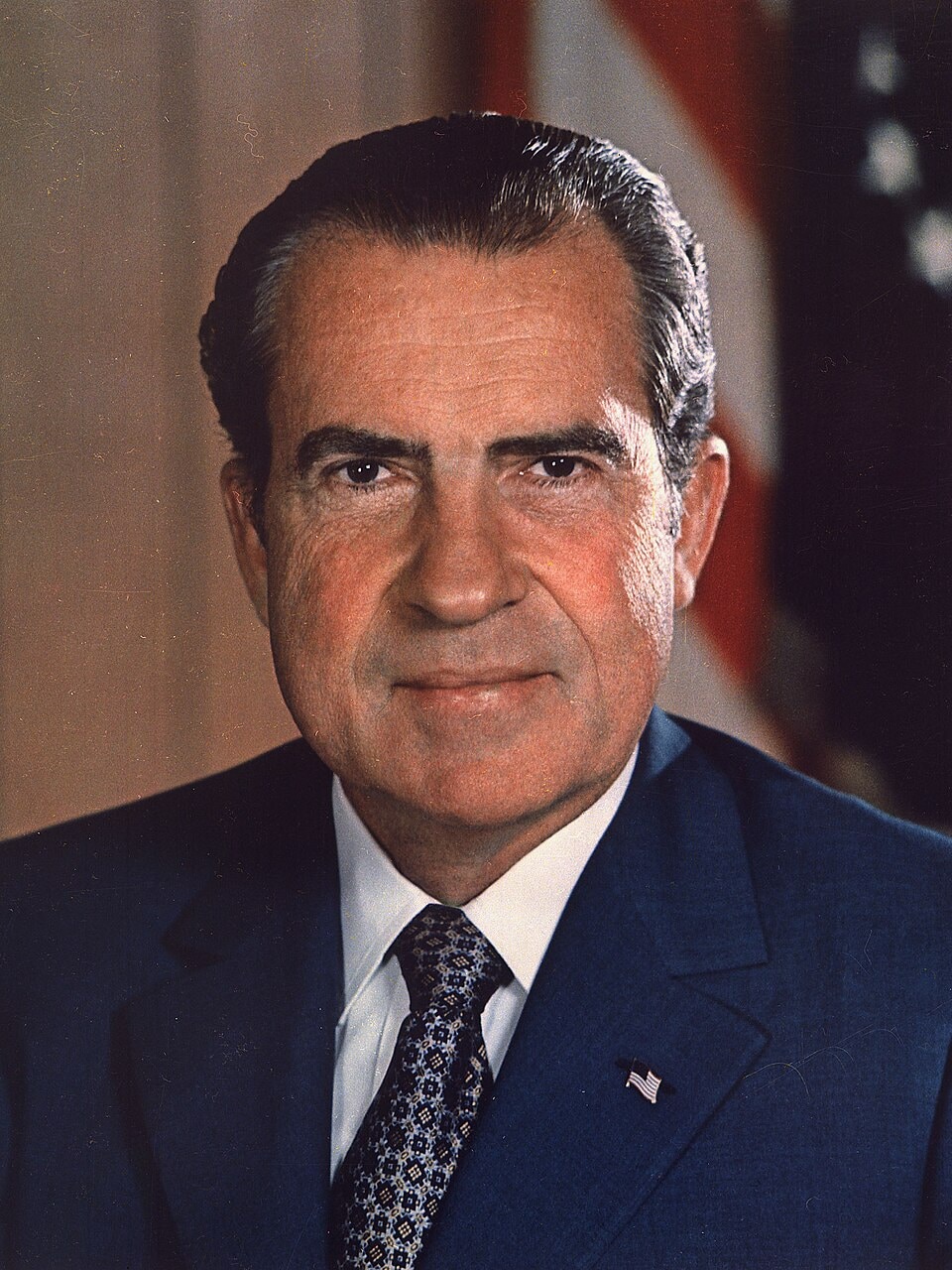
Richard Nixon
 United States
politician•military officer•lawyer
Birthday
January 9, 1913
Birth Sign
Capricorn
Birthplace
Yorba Linda, California, USA
Age
Died at 81
Height
5 ft 11 in (180 cm)
About
Richard Milhous Nixon, the 37th president of the United States, served from 1969 until his resignation in 1974, making him the only American president to leave office that way. His presidency is remembered for historic foreign policy breakthroughs and the Watergate scandal that ended it.
Abroad, Nixon reshaped the Cold War. He opened diplomatic relations with the People's Republic of China in 1972, pursued détente with the Soviet Union, and signed the SALT I arms control treaty. At home, his administration created the Environmental Protection Agency, signed the Clean Air and Clean Water Acts, and oversaw the desegregation of Southern schools. Before the presidency, he served two terms as Dwight Eisenhower's vice president and nearly won the presidency in 1960.
Watergate began with a break-in at Democratic National Committee headquarters and unraveled into a White House cover-up. Facing certain impeachment, Nixon resigned on August 8, 1974. His dual legacy as a skilled statesman and a disgraced president remains one of the most complex in American history.
Early Life & Background
Nixon was born in a house his father built on the family's lemon ranch in Yorba Linda, California. The ranch failed in 1922, and the family moved to Whittier, where his father ran a grocery store and gas station. Everyone worked, including young Richard, who woke at 4 a.m. to buy produce for the store before school.
Two brothers died young. Arthur died at seven in 1925; Harold died of tuberculosis in 1933. At twelve, a spot was found on Nixon's lung, and doctors forbade sports. He poured his energy into debate, drama, and student government at Whittier College, graduating in 1934. A scholarship took him to Duke University School of Law, where he finished third in his class in 1937.
Back in Whittier, he joined the law firm Wingert and Bewley. He applied to the FBI and several big-city firms but got no offers. In 1938, he met Thelma "Pat" Ryan at a community theater rehearsal. They married in 1940. During World War II, he served as a Navy logistics officer in the Pacific, earning two battle stars. After the war, a local Republican committee recruited him to run for Congress. He beat five-term incumbent Jerry Voorhis in 1946, launching his national career.
Career Growth
Nixon arrived in Washington in 1947 and quickly made a name. In 1948, as a freshman congressman, he led the investigation that sent Alger Hiss, a former State Department official, to prison for perjury. The case made Nixon a national anti-communist figure. He won a Senate seat in 1950 and, two years later, Dwight Eisenhower chose him as his running mate. At thirty-nine, Nixon became the second-youngest vice president in history.
As vice president, Nixon took on high-profile assignments, including a 1959 trip to Moscow where he engaged in the famous "Kitchen Debate" with Soviet Premier Nikita Khrushchev. He lost the 1960 presidential election to John F. Kennedy by a razor-thin margin, then lost the 1962 California governor's race, telling reporters they "won't have Nixon to kick around anymore." He moved to New York, practiced law, and rebuilt his political network.
He won the presidency in 1968, defeating Hubert Humphrey. His first term saw the Apollo 11 moon landing, the launch of the EPA, and the winding down of the Vietnam War. In 1972, he made his historic trip to China and signed the SALT I treaty with the Soviet Union. He won reelection in a landslide over George McGovern. But the Watergate break-in, which occurred in June 1972, and the subsequent cover-up consumed his second term. After the Supreme Court ordered him to release secret tape recordings that proved his involvement, the House Judiciary Committee voted articles of impeachment. Nixon resigned on August 8, 1974, the only president ever to do so.
Career Timeline
Public Image & Style
Nixon's public image is a study in contradiction. To supporters, he was a brilliant foreign-policy strategist who stood up to communism and opened China. To critics, he was a paranoid, vindictive figure whose fear of enemies drove him to abuse power. His dark suits, prominent five-o'clock shadow, and habit of sweating under television lights became visual shorthand for political tension.
He is remembered for phrases that entered the American lexicon: "I am not a crook" and "You won't have Nixon to kick around anymore." The "V for victory" hand gesture he often flashed became his signature pose. Films like Oliver Stone's Nixon (1995) and Frost/Nixon (2008) cemented his image as a tragic, Shakespearean figure.
Historians consistently rank his foreign policy among the top tier of presidents, while his domestic record and the Watergate scandal drag his overall ranking to the middle or lower tier. The Nixon Foundation and the Richard Nixon Presidential Library in Yorba Linda continue to promote his legacy, focusing on his diplomatic achievements.
Fame & Fandom
Richard Nixon never had a fanbase in the way pop stars do. No one camped outside his funeral to buy t-shirts or organized birthday billboards with his face on them. The term "Tricky Dick" was a slur from his rivals, not a badge of honor worn by supporters. His audience remained voters and party members rather than a cult of personality. Yet his legend persists through modern re-evaluations where young conservatives now embrace his strategic realism. This shift has spawned a trend called "Nixonmaxxing," a digital movement where users adopt his political tactics rather than worshiping him as a celebrity icon. He is not remembered for viral dance challenges but for historical moments that reshaped the globe. In the iFANN Global Fame Rankings, his enduring presence remains undeniable. Richard Nixon is currently the 301st most famous person in the world, holding steady from the previous cycle. Within his home nation, he ranks as the 68th most famous person in United States, holding steady from the previous cycle. Across North America, he stands at the 49th most famous person in North America, holding steady from the previous cycle. In the specific sphere of governance, he claims the 48th most famous person in Politics, holding steady from the previous cycle. These placements reflect a global attention that tracks media coverage, search trends, and cultural consumption worldwide. Even decades after his death, the former president commands a significant slice of the world's attention without needing a formal fandom to sustain it.
Interesting Facts and Legends
Richard Nixon was named after Richard the Lionheart, and four of the five Nixon boys were named after British kings. An accomplished pianist, he performed impromptu on The Tonight Show in 1963. On July 20, 1969, he made the longest-distance telephone call in history, speaking from the Oval Office to Apollo 11 astronauts Neil Armstrong and Buzz Aldrin on the moon. He became the first U.S. president to visit all fifty states while in office. Despite his anti-communist reputation, he opened diplomatic relations with communist China in 1972, a move that stunned the world. Nixon harbored a lifelong fear of hospitals and doctors, a phobia stemming from his brother Arthur's sudden death in 1925. The single defining incident of his life was his resignation on August 9, 1974, becoming the only U.S. president to leave office voluntarily amid the Watergate scandal. The release of the "Smoking Gun" tape proved his direct involvement in the cover-up, sealing his fate. Another legendary moment is his 1952 "Checkers speech," where he defended his family's ownership of a dog named Checkers to save his vice-presidential nomination. This emotional appeal rallied public support and kept him on the Republican ticket. His nickname "Tricky Dick" originated from opponents and the press due to his aggressive campaigning style during the 1960 election against John F. Kennedy.
Notable Quotes
“I am not a crook.”
“My mother was a saint.”
“She was everything I ever wanted.”
“Reconciliation was the first goal set by President Richard M. Nixon.”
“You won't have Nixon to kick around anymore.”
Family & Personal Life
Nixon's father, Francis A. Nixon, was a former streetcar motorman who converted from Methodism to his wife's Quaker faith. His mother, Hannah Milhous Nixon, was a devout Quaker who raised the boys with strict moral discipline. The family lived modestly; Nixon later said, quoting Eisenhower, "We were poor, but the glory of it was we didn't know it."
He had four brothers: Harold (1909–1933), Donald (1914–1987), Arthur (1918–1925), and Edward (1930–2019). Arthur died of tubercular meningitis at age seven; Harold died of tuberculosis after a long illness.
Nixon married Thelma "Pat" Ryan on June 21, 1940. They had two daughters: Patricia "Tricia" (born 1946) and Julie (born 1948). Pat died of lung cancer on June 22, 1993. Nixon died less than a year later. He called her "everything I ever wanted."
Notable Connections
Nixon's political career was deeply intertwined with key figures. He served as Dwight D. Eisenhower's vice president for eight years. Henry Kissinger was his National Security Advisor and Secretary of State, architect of the China opening and Vietnam negotiations. His 1960 opponent John F. Kennedy defeated him in one of the closest presidential elections in history. The Washington Post reporters Bob Woodward and Carl Bernstein uncovered the Watergate scandal that forced his resignation. His second vice president, Gerald Ford, succeeded him and later pardoned him.
Relationships & Dating History
Nixon's only documented romantic relationship was with Thelma Catherine "Pat" Ryan. They met in January 1938 at a rehearsal for the community play The Dark Tower in Whittier, California, where both were cast as actors. Nixon proposed on the first date, but Pat took longer to commit. They married on June 21, 1940, at the Mission Inn in Riverside, California, and honeymooned in Mexico.
The marriage lasted 53 years, until Pat's death from lung cancer on June 22, 1993. They had two daughters, Tricia and Julie. Nixon was devoted to Pat, calling her "everything I ever wanted." There are no credible reports of affairs or other relationships. After Pat's death, Nixon did not remarry. He died less than a year later, on April 22, 1994, at age 81.
- MarriedPat Nixon1940 - 1993Married June 21, 1940; met at community theater rehearsal in 1938. Had two daughters. Pat died June 22, 1993.
Death & Aftermath
Died
April 22, 1994 (aged 81)
Death Place
Park Ridge, New Jersey
Cause of Death
cerebral thrombosis following a massive stroke
Richard Nixon collapsed while watching television with his wife Pat and daughter Julie at their home in Park Ridge, New Jersey. The former president was rushed to St. Clare's Hospital in Passaic where doctors confirmed a massive stroke that left him unconscious for four days before he passed away on April 22, 1994. Medical records established the cause as cerebral thrombosis resulting from the cerebrovascular accident, ending a life that had spanned eight decades of public service and private struggle. The reaction to his death blended reverence for his diplomatic breakthroughs with the enduring shadow of Watergate. President Bill Clinton issued a statement honoring Nixon's opening of relations with China and détente with the Soviet Union while acknowledging the complex history shared by the nation.
Former Presidents Gerald Ford, Jimmy Carter, and Ronald Reagan joined the mourning alongside international leaders like Chinese Premier Li Peng and Mikhail Gorbachev, who reflected on the foreign policy legacy that reshaped the Cold War landscape. A private funeral service took place five days later at the Richard Nixon Presidential Library and Museum in Yorba Linda, California. The procession traveled from New York to the West Coast where Nixon was interred in the library garden next to his late wife. Tributes poured in from across the political spectrum even as book sales of his memoirs and biographies surged in the immediate aftermath, cementing a posthumous reputation defined by both historic achievements and profound controversy.
His estate settled through private trust arrangements managed by his children and the Nixon Foundation, which continues to maintain the library and promote research into his administration. Decades later, documentaries and academic studies keep his complex story alive, ensuring the 37th president remains a subject of intense historical scrutiny rather than simple commemoration.
Net Worth (Estate Value)
$15 Million
iFANN Editorial Team estimate
Richard Nixon's estate at the time of his death in 1994 was valued at approximately $15 Million per iFANN's editorial analysis. The bulk of his wealth came from post-presidential book advances and royalties, particularly from his memoirs RN: The Memoirs of Richard Nixon (1978) and several foreign policy books. He also earned substantial speaking fees after his resignation, commanding up to $50,000 per speech in the 1980s. During his presidency, Nixon's salary was $200,000 per year plus expenses. He had modest investments and real estate holdings, including a home in San Clemente, California, which he sold after leaving office. His presidential pension, about $60,000 per year in the 1970s, provided a steady income. The Nixon Foundation manages his legacy, with revenue from the Richard Nixon Presidential Library and Museum, book royalties, and licensing of his image and speeches. As of 2026, the estate continues to generate income, though exact figures are private.
Awards Won (29)
Nixon's awards were military and honorary rather than entertainment industry honors. He earned two battle stars for his U.S. Navy service in the Pacific during World War II. He was awarded the National Order of the Cedar (Lebanon) and the Order of the Brilliant Star (Taiwan). He declined the Presidential Medal of Freedom offered to him post-presidency.
1945 · Military
U.S. Navy service in Pacific theatre
1945 · Military
U.S. Navy service in Pacific theatre
1959 · Fordham University, Doctor of Laws, 1959
1959 · Thiel College, Doctor of Humane Letters, 1959
1959 · University of San Diego, Doctor of Laws, 1959
1957 · Bethany College, Doctor of Laws, 1957
1957 · Defiance College, Doctor of Laws, 1957
1957 · DePauw University, Doctor of Laws, 1957
1957 · Michigan State University, Doctor of Laws, 1957
1957 · Wilberforce University, Doctor of Humanities, 1957
1957 · Yeshiva University, Doctor of Laws, 1957
1956 · Lafayette College, Doctor of Laws, 1956
1955 · Temple University, Doctor of Humane Letters, 1955
1954 · Lowell Technological Institute, Doctor of Science, 1954
1954 · Whittier College, Doctor of Laws, 1954
1953 · University of Tehran, 1953
1951 · Bradley University, Doctor of Laws, 1951
Known For
President of the United States
1969-1974 · 37th President
Vice President of the United States
1953-1961 · Vice President under Dwight D. Eisenhower
Watergate Scandal
1972-1974 · Resigned presidency
Opening of China
1972 · First U.S. president to visit China
U.S. Senator from California
1950-1953 · Senator
Keywords
Sources
Quick Facts
- Profession
- politician, military officer, lawyer
- Born
- +1913-01-09
- Birthplace
- Yorba Linda, California, USA
- Died
- +1994-04-22
- Death Place
- New York City, New York, USA
- Gender
- Male
- Spouse
- Pat Nixon
- Birth Sign
- Capricorn
- Height
- 5 ft 11 in (180 cm)
- Education
- Whittier College, Duke University School of Law
Personal Details
- Full Name
- Richard Milhous Nixon
- Height
- 5 ft 11 in (180 cm)
- Spouse
- Pat Nixon
- Children
- Patricia "Tricia" Nixon Cox, Julie Nixon Eisenhower
- Education
- Whittier College, Duke University School of Law
Frequently Asked Questions
How old was Richard Nixon when he died?
What was Richard Nixon's net worth at the time of his death?
Did Richard Nixon have children?
Who was Richard Nixon married to?
Why did Richard Nixon resign?
Social Media
Similar People
Join the community
fans discussing