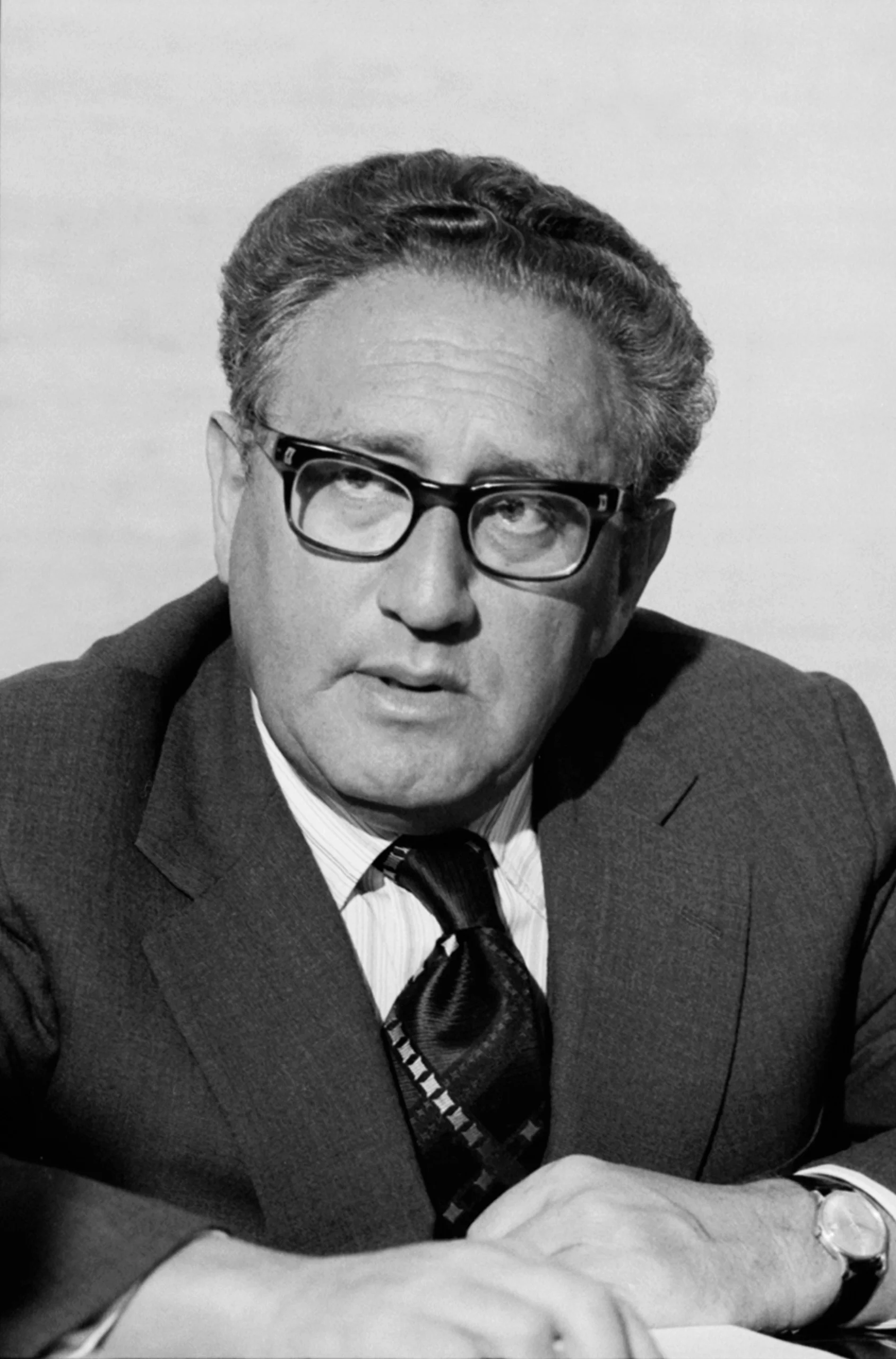
Henry Kissinger
 Germany
politician•political scientist•diplomat
Also known as: Heinz Alfred Kissinger, Dr. Henry Kissinger
Birthday
May 27, 1923
Birth Sign
Sagittarius
Birthplace
Fürth, Bavaria, Germany
Age
Died at 100
Height
5 ft 10 in (178 cm)
About
Henry Kissinger stands as one of the most consequential and polarizing figures in American history, serving as the 56th United States Secretary of State and National Security Advisor under Presidents Richard Nixon and Gerald Ford. Born Heinz Alfred Kissinger in Fürth, Germany, he fled the Nazi regime with his family in 1938, eventually becoming a central figure in shaping American foreign policy during the Cold War. His tenure is defined by the strategy of Realpolitik, which prioritized national interest over ideological concerns. Kissinger's influence extended far beyond his official government service, orchestrating the opening of relations between the United States and the People's Republic of China and playing a key role in détente with the Soviet Union. For his efforts to negotiate a ceasefire in the Vietnam War, he was awarded the Nobel Peace Prize in 1973, though the award remains controversial due to the subsequent failure of the accords to bring lasting peace. After leaving public office in 1977, he founded a consulting firm and continued to write extensively on international relations until his death at the age of 100.
Kissinger's legacy is measured not by fleeting viral moments but by decades of strategic maneuvering that fundamentally altered the global order. As of the September 2026 rankings, he holds a steady place in global consciousness as the 39th most famous person from Germany and the 76th most famous person in Books & Literature. These placements reflect a career marked by sharp suits, distinctive glasses, and a calm, intellectual demeanor that masked the intensity of his strategic thinking. To supporters, he was a visionary who navigated the complexities of the Cold War with pragmatism. To critics, he represented a cold-blooded approach to geopolitics associated with controversial interventions in Latin America and Southeast Asia. His signature style included a sharp suit and a calm, intellectual demeanor that commanded respect in diplomatic circles. The audience that follows his life today consists primarily of historians, political scientists, and readers of his extensive bibliography who analyze his work through books like Great Americans: Niall Ferguson on Henry Kissinger's Very American Life. While some might argue that the sheer scale of his power created a following of sorts, the reality is that his supporters and critics alike engaged with him as a statesman, not as an idol.
Early Life & Background
Heinz Alfred Kissinger entered the world on May 27, 1923, in Fürth, Bavaria, into a Jewish family that faced immediate persecution as the Nazi party rose to power. His father Louis worked as a schoolteacher while his mother Paula came from a prominent banking background. The family's life changed drastically in 1938 when they emigrated to the United States to escape the Holocaust. Upon arriving in New York City, they settled in Washington Heights and anglicized their name from Heinz to Henry. The transition to American life was difficult. The young Henry worked various odd jobs to support his family while attending public schools in New York. Despite these challenges, he excelled academically and enlisted in the U.S. Army in 1943. During World War II, he served in the Intelligence Corps, rising to the rank of Captain and earning a Bronze Star for his bravery in France. After the war, he attended Harvard University, where he earned his bachelor's degree in 1950, a master's in 1951, and a Ph.D. in political science in 1954. His doctoral dissertation on the Congress of Vienna established his reputation as a serious scholar of international relations before he ever stepped foot in the White House. He became a professor at Harvard, where he taught and conducted research on nuclear strategy and great power politics before entering government service.
Career Growth
Kissinger's ascent to power began in 1969 when President Richard Nixon appointed him as National Security Advisor. He quickly became the president's most trusted confidant, wielding immense influence over foreign policy decisions. In September 1973, he made history by becoming the first person to hold both the National Security Advisor and Secretary of State positions simultaneously. His tenure as Secretary of State lasted until January 1977, spanning the end of the Nixon administration and the beginning of Gerald Ford's presidency. His diplomatic achievements were monumental yet polarizing. In 1971, he initiated secret back-channel negotiations with China, leading to President Nixon's historic visit to Beijing in 1972. This move fundamentally altered the Cold War landscape. Later that year, he co-architectured détente with the Soviet Union, including the Strategic Arms Limitation Talks (SALT I). Following the Yom Kippur War in 1973, he engaged in intensive shuttle diplomacy across the Middle East, securing disengagement agreements between Israel, Egypt, and Syria. After leaving government service, he founded Kissinger Associates in 1982 and remained a prolific author and consultant until his death. He published major works such as Diplomacy (1994), On China (2011), and World Order (2014). He received numerous prestigious awards, including the Presidential Medal of Freedom in 1977, the Franklin D. Roosevelt Four Freedoms Award, the Legion of Honour from France, and the National Humanities Medal in 1999. He also received over 40 honorary doctorates from universities worldwide, including Oxford, Cambridge, and Yale. His induction into the National Academy of Arts and Sciences and the Foreign Policy Association Hall of Fame further cemented his status as a towering figure in international relations.
Career Timeline
Public Image & Style
Kissinger cultivated a public persona of the ultimate realist statesman. He was known for his sharp suits, distinctive glasses, and a calm, intellectual demeanor that masked the intensity of his strategic thinking. Media portrayals often focused on his philosophy of Realpolitik, emphasizing his belief that moral considerations should be secondary to national interest. To supporters, he was a visionary who navigated the complexities of the Cold War with pragmatism. To critics, he represented a cold-blooded approach to geopolitics associated with controversial interventions in Latin America and Southeast Asia. His signature style included a sharp suit and a calm, intellectual demeanor that commanded respect in diplomatic circles. He appeared on the covers of major publications like TIME Magazine, Newsweek, and The New Yorker, often reflecting his polarizing status. His physical presence was noted for his height of approximately 5 feet 10 inches and an average to slender build, especially in later years. The release of the "Kissinger Tapes," secretly recorded conversations from 1973, later revealed his involvement in regime change operations in Chile, adding a layer of controversy to his legacy.
Fame & Fandom
According to the iFANN Global Fame Rankings, Henry Kissinger holds a steady place in global consciousness as a historical figure of immense consequence. As of the September 2026 rankings, he is the 39th most famous person from Germany and stands as the 76th most famous person in Books & Literature. These placements reflect a legacy measured by decades of strategic maneuvering rather than fleeting viral moments. The rankings track attention across media coverage, search activity, and consumption signals worldwide, confirming that his influence on international relations remains a subject of intense scrutiny over a century after his birth. Unlike pop stars or actors, Kissinger never cultivated a formal fanbase with an official name. His interactions with the public were confined to diplomatic summits, academic lectures, and policy interviews where he addressed complex geopolitical issues rather than engaging in the rituals of celebrity worship. There are no documented instances of crowds shutting down streets for his arrival, nor are there records of fan-funded projects or birthday billboards. The audience that follows his life today consists primarily of historians, political scientists, and readers of his extensive bibliography who analyze his work through books like Great Americans: Niall Ferguson on Henry Kissinger's Very American Life. While some might argue that the sheer scale of his power created a following of sorts, the reality is that his supporters and critics alike engaged with him as a statesman, not as an idol. Recent news in 2026 includes articles discussing how the US-China relationship is evolving toward scenarios Kissinger predicted as potential "nightmares" regarding artificial intelligence and strategic competition. Interviews and discussions continue to debate the importance and morality of Kissinger's policies, highlighting the enduring cultural impact of his persona.
Interesting Facts and Legends
Henry Kissinger was born Heinz Alfred Kissinger but changed his name upon immigrating to the United States. One of the most famous anecdotes from his career involves his 1971 trip to Beijing, where he traveled incognito to avoid detection by the press and Chinese authorities. The so-called "Kissinger Tapes," secretly recorded conversations from August 10, 1973, later revealed his involvement in regime change operations in Chile, adding a layer of controversy to his legacy. Another notable fact is that he shared the 1973 Nobel Peace Prize with Le Duc Tho, who refused the award because he believed peace had not been achieved. The North Vietnamese negotiator Le Duc Tho refused the Nobel Peace Prize, arguing that peace had not been established, making Kissinger the only co-recipient to accept it alone. Before politics, he was a renowned academic who wrote extensively on the Congress of Vienna and the balance of power. He died on November 29, 2023, at his home in Greenwich, Connecticut, at the age of 100. The cause of death was reported as natural causes related to old age. His final days were spent in private, with no widely documented public appearances in the months leading up to his death. Following his passing, tributes poured in from political leaders globally. President Joe Biden issued a statement honoring Kissinger's contributions to U.S. foreign policy, acknowledging his role in opening relations with China and negotiating the end of the Vietnam War. Former presidents and world leaders also paid homage. The New York Times published an extensive obituary detailing his complex legacy. A private funeral service was held, attended by close family members, including his wife Nancy Kissinger, and key associates. The event was intimate, consistent with his wishes. Streaming services and book sales saw increased interest in his works, particularly Diplomacy and On China.
Notable Quotes
“I don't know if God exists, but I'm sure He knows me.”
“The future is not something we enter. The future is something we create.”
“In the absence of a consensus, the weaker must yield to the stronger.”
“The ultimate sin in foreign policy is to be irrelevant.”
Family & Personal Life
Kissinger lived primarily in Greenwich, Connecticut, maintaining a private household despite his high profile. He had two sons, David and Walter, from his first marriage. He raised his stepchildren from that union alongside his second wife. His widow, Nancy Kissinger, passed away on August 20, 2026, at the age of 92, predeceasing her husband by nearly three years. The couple lived a quiet life in their Connecticut home, where they hosted intimate gatherings rather than grand public events. Their estate continues to be managed privately by the family, supporting the Henry A. Kissinger Foundation which operates independently to support diplomatic initiatives. The foundation has maintained its mission to support diplomatic initiatives and educational programs since his passing.
Notable Connections
Relationships & Dating History
Henry Kissinger was married twice. His first marriage was to Ann Fleischer (née Elizabeth Fleischman) in 1949. They met while both were students or shortly after at Harvard. The couple had two sons, David and Walter, before divorcing in 1964. In 1965, he married Nancy Maginnes, a former model and socialite who became known as his conscience and managed his public image. They met in 1964 through mutual friends shortly after his divorce. They had no biological children together but raised his stepchildren. Nancy passed away in August 2026, predeceasing her husband by three years. The couple lived primarily in Greenwich, Connecticut, and maintained a private household despite their high profile.
- MarriedAnn Fleischer1949 - 1964Met at Harvard; two children together; divorced.
- MarriedNancy Maginnes1965 - 2023Second wife; died in 2026; managed his public image.
Death & Aftermath
Died
November 29, 2023 (aged 100)
Death Place
Greenwich, Connecticut
Cause of Death
natural causes related to old age
Net Worth (Estate Value)
$30 Million
iFANN Editorial Team estimate
As of 2026, Henry Kissinger is deceased, so his net worth refers to the value of his estate. Estimates vary based on the valuation of his assets, book royalties, and speaking fees prior to his death. Research by the iFANN Editorial Team puts his fortune at around $30 million. This figure accounts for his extensive library, property in Greenwich, Connecticut, and ongoing royalty streams from his bibliography. Celebrity Net Worth archives suggest a peak net worth of approximately $25 million USD at the time of his death, derived from book sales, consulting fees, and real estate holdings. Financial analyses of his estate indicate a value ranging between $20 million and $30 million USD, accounting for his extensive library, property in Greenwich, Connecticut, and ongoing royalty streams from his bibliography. Following his death, his estate was managed privately by his family. The Henry A. Kissinger Foundation continues to operate, supporting diplomatic initiatives. Posthumous releases of his transcripts and new editions of his works have generated revenue for the estate, though specific figures are not publicly detailed. The estate's financial trajectory has remained stable due to the enduring demand for his writings on international relations and strategy.
Awards Won (5)
Henry Kissinger received numerous prestigious awards throughout his life, including the Nobel Peace Prize in 1973 for the Paris Peace Accords. He was also awarded the Presidential Medal of Freedom in 1977 by President Gerald Ford. Other honors include the Franklin D. Roosevelt Four Freedoms Award, the Legion of Honour from France, and the Order of the Aztec Eagle from Mexico. He received over 40 honorary doctorates from universities worldwide and was inducted into the National Academy of Arts and Sciences.
1973 · Peace
Paris Peace Accords
1977 · Civilian Honor
Public Service
Known For
Diplomacy
1994 · Author
On China
2011 · Author
World Order
2014 · Author
Keywords
Sources
Quick Facts
- Profession
- politician, political scientist, diplomat
- Born
- May 27, 1923
- Birthplace
- Fürth, Bavaria, Germany
- Died
- November 29, 2023
- Death Place
- Greenwich, Connecticut
- Gender
- Male
- Spouse
- Ann Fleischer, Nancy Kissinger
- Birth Sign
- Sagittarius
Personal Details
- Full Name
- Heinz Alfred Kissinger
- Height
- 5 ft 10 in (178 cm)
- Spouse
- Ann Fleischer, Nancy Maginnes
- Children
- David Kissinger, Walter Kissinger
- Education
- Harvard University (BA 1950, MA 1951, PhD 1954)
Frequently Asked Questions
How did Henry Kissinger die?
Was Henry Kissinger married?
What is Henry Kissinger famous for?
Did Henry Kissinger have children?
Is Henry Kissinger still alive?
Join the community
fans discussing