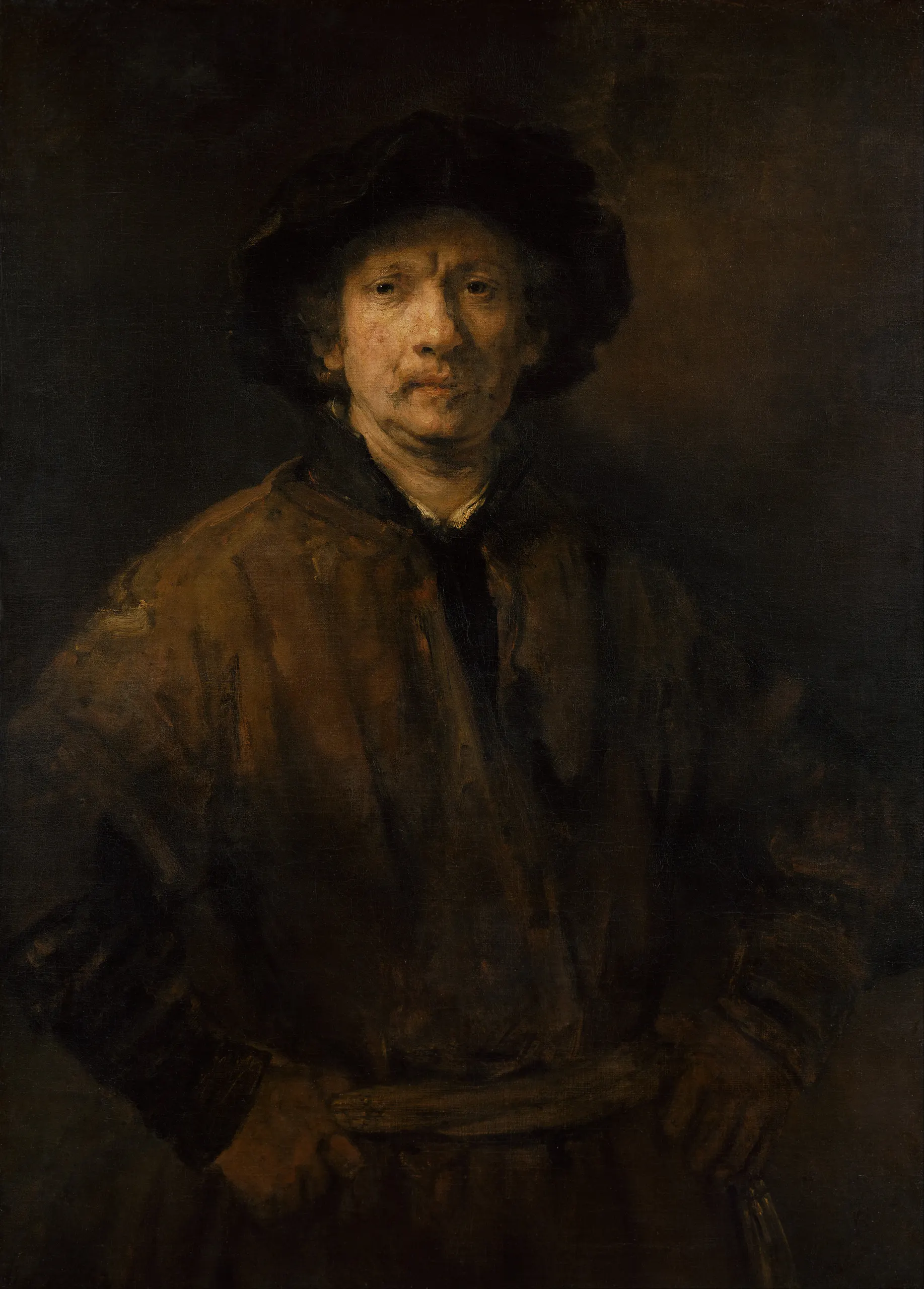
Rembrandt
 Netherlands
painter•printmaker•draughtsman
Also known as: Rembrandt van Rijn, Rembrandt Harmenszoon van Rijn, RHL
Birthday
July 15, 1606
Birth Sign
Cancer
Birthplace
Leiden, Netherlands
Age
Died at 63
About
Rembrandt Harmenszoon van Rijn is the Dutch painter, printmaker and draughtsman of the Golden Age whose name sits at the top of almost every account of Western art. The scale of the surviving work explains the standing: roughly 300 paintings, 300 etchings and several hundred drawings, plus around 100 self-portraits, more than 40 of them paintings. No other seventeenth-century artist left a comparable visual diary of a single face across a lifetime, and the sequence from the young man of 1629 to the worn figure of 1669 is the closest thing he left to an autobiography.
He worked in every genre his market would bear, from portraits of Amsterdam merchants to biblical history, landscapes and animal studies. The Night Watch (1642) remains the work most people name first, but the etchings are the quiet engine of his reputation: they sold steadily during his lifetime and carried his name across Europe in a way the Amsterdam commissions never could. He never travelled abroad, and he built his knowledge of Italian art from prints and from Dutch and Flemish artists who had been to Italy. The Rijksmuseum frames him as an innovator and a rule-breaker, and that is the version most visitors meet first.
His last two decades brought insolvency, the sale of his house, and the deaths of his wife, his companion and his son. He died at 63 with no estate to speak of. What survived was the work, and it has not stopped being looked at: the Met's Rembrandt and the Ancients opens in November 2027, and Self-Portrait, Age 23 (1629) drew fresh attention at the Isabella Stewart Gardner Museum in October 2026. The audience is institutional, patient, and not going anywhere.
Early Life & Background
Rembrandt was born on 15 July 1606 in Leiden, the ninth of ten children. His father, Harmen Gerritszoon van Rijn, was a miller who did well enough to give the family a comfortable footing; his mother, Neeltgen (Cornelia) van Zuytbrouck, was a baker's daughter. The household was Catholic in a Protestant republic, a detail that sits awkwardly with the standard framing of his career but is well documented.
He attended the Latin school in Leiden and enrolled at Leiden University around 1620, though he left without taking a degree. Painting pulled him away. His first training came under Jacob van Swanenburg in Leiden, probably from about 1620 to 1623, and then under Pieter Lastman in Amsterdam around 1624 to 1625. Lastman was a history painter who had been to Italy, and he is generally credited as the strongest early influence on the young Rembrandt's approach to narrative and staging.
By about 1625 he was back in Leiden, sharing a studio with Jan Lievens. The two worked side by side, sometimes on similar subjects, and the comparison between them was already being made by visitors. Rembrandt began signing works RHL, for Rembrandt Harmensz. Leiden, a habit that stuck long enough that scholars still use it to date pieces from the Leiden years. He was taking portrait commissions by his early twenties, which is unusually early for a painter without a court or a guild network behind him.
The move to Amsterdam came around 1631 or 1632. He worked through the studio and dealership of Hendrick van Uylenburgh, a connection that gave him access to the city's merchant clientele and led directly to the commissions that made his name in the capital.
Career Growth
The Amsterdam years opened with a run of portraits and history paintings that established him quickly. The Blinding of Samson (1636) is the clearest statement of his early dramatic manner: large, high-contrast, almost theatrical in its staging. In 1639 he bought a substantial house on the Jodenbreestraat on credit, now the Rembrandthuis museum, a purchase that signalled confidence as much as income.
The Night Watch came in 1642, the militia portrait that broke with convention by showing the company in motion rather than in a static row. It is the commission most closely tied to his name. Through the 1640s and 1650s the etchings sold steadily and he taught a long stream of Dutch painters, many of whom carried his manner into other cities. His output across these decades runs to landscapes, biblical scenes, nude studies and a steady flow of self-portraits.
In 1656 he declared insolvency, a formal cessio bonorum, and his house and collection were sold off. The legal record is clear on this and it marks the sharpest turn in his career. He kept working. The 1660s produced the late works that many consider his strongest, including The Return of the Prodigal Son and the final self-portraits, painted with a looseness and psychological weight that earlier work only hinted at. Surviving output is usually given as roughly 300 paintings, 300 etchings and several hundred drawings.
Career Timeline
Public Image & Style
Rembrandt's public image during his lifetime was that of the ambitious Amsterdam history painter and portraitist, the man who bought a grand house on credit and filled it with art and curiosities. Contemporaries noted the scale of his collecting as much as the scale of his commissions. His self-portraits did a lot of the image work themselves: he painted himself in armour, in oriental dress, in working clothes, and in the plain dark coat of his late years, and the sequence reads as a deliberate public presentation of the artist as a thinking, feeling professional rather than a craftsman.
His etching practice gave him a second, wider public, and the prints travelled where paintings could not. The later image, the one that stuck after his death, is the insolvent genius, the man who died broke and was rediscovered. That narrative is partly true and partly a story told by later generations, and it has shaped how every museum wall label introduces him. The story that The Night Watch ruined his reputation belongs to that same layer of legend: Britannica flags it as a rumour circulating since 1669, not as documented fact, and the commission itself was paid and accepted. The painting's real trouble came later, when it was trimmed to fit a wall in the 1700s and the missing figures on the left were lost.
Fame & Fandom (iFAMOUS Rankings)
iFANN has not yet collected fame data for Rembrandt, so no ranking appears here. The absence is not a judgement on his standing; it reflects the fact that the Global Fame Rankings measure contemporary attention across public signals, and a seventeenth-century painter sits outside that frame. He is, by any art-historical measure, one of the most written-about artists in the Western tradition, routinely described as one of the greatest visual artists in the history of Western art, and the Rijksmuseum's own framing of him as an innovator and rule-breaker is the version most visitors meet first.
The fandom, such as it is, has no formal name and no organized campaign culture. It is the museum-going public, the print collectors, and the scholarly tradition that keeps revising the catalogue. Fans of Rembrandt tend to express it through pilgrimage rather than campaigns: a trip to the Rijksmuseum to stand in front of The Night Watch, a visit to the Rembrandthuis on the Jodenbreestraat, an afternoon with the etchings when a touring show comes within driving distance. The 2026 touring exhibition of Rembrandt etchings at the Collier County museum in Naples, Florida, is exactly the kind of event this audience turns out for, and Esther in the Age of Rembrandt programming has drawn the same classical-scene crowd.
He does not appear on the September 2026 iFAMOUS Rankings flagship list. What he has instead is a different kind of longevity: the Met's Rembrandt and the Ancients, opening in November 2027, is billed as its first major Rembrandt show in more than 20 years, and the National Gallery in London built a 40-work exhibition around him alongside Magritte.
Interesting Facts and Legends
He never travelled abroad. Everything he knew of Italian art came through prints and through Dutch and Flemish artists who had studied in Italy, which makes the Italianate streak in his history paintings a matter of secondhand absorption rather than firsthand study. The line often attributed to him, that he sought the greatest and most natural emotion, still needs a specific letter or document behind it before anyone should quote it as his.
Van Gogh revered him and remarked on his ability to render the human soul, though the exact wording deserves careful sourcing. The self-portraits, around 100 in total with more than 40 paintings, are the closest thing he left to an autobiography. He painted himself at 23, at 34, at 63, and the face changes more than the style does.
No reliable recorded height exists for him, and any figure would be speculation. There are no awards, no hall of fame induction and no magazine covers from his lifetime, because none of those things existed in a form that could reach a seventeenth-century miller's son from Leiden. The honours he collects now are exhibitions and catalogue revisions.
Family & Personal Life
Rembrandt's father, Harmen Gerritszoon van Rijn, was a miller in Leiden, and his mother, Neeltgen (Cornelia) van Zuytbrouck, was a baker's daughter. The family was Catholic and comfortably off, and Rembrandt was the ninth of ten children, a lot of siblings even by seventeenth-century standards. He married Saskia van Uylenburgh in 1634; she was the daughter of a wealthy Leeuwarden family and the cousin of the dealer Hendrick van Uylenburgh, and the match brought both social standing and money. They had four children, three of whom died in infancy. The surviving son, Titus, born in 1641, became a painter himself.
After Saskia's death in 1642, Geertje Dircx came into the household as Titus's nurse and became Rembrandt's lover. The relationship ended in court. Hendrickje Stoffels, his housekeeper from around 1649, became his companion for the rest of her life; they never married, apparently because of Saskia's will and the financial complications that followed. Their daughter Cornelia was born in 1654. A son died young. Hendrickje and Titus jointly administered Rembrandt's affairs after the 1656 insolvency. Titus died in 1669, months before his father; Cornelia survived him.
Notable Connections
Pieter Lastman, his teacher in Amsterdam and the strongest early influence on his history painting. Jan Lievens, his studio partner in Leiden from around 1625. Hendrick van Uylenburgh, the dealer whose studio gave him access to Amsterdam's merchant clients and whose cousin Saskia became his wife. Saskia van Uylenburgh, Geertje Dircx and Hendrickje Stoffels, the three women at the center of his private life. Titus van Rijn, his son and a painter himself, and Cornelia van Rijn, his daughter, who survived him.
Relationships & Dating History
Rembrandt married Saskia van Uylenburgh in 1634. She was the daughter of a wealthy Leeuwarden family and the cousin of the dealer Hendrick van Uylenburgh, and the marriage brought him both social standing and money at a point when his Amsterdam career was taking off. They had four children, three of whom died in infancy; Titus, born in 1641, survived. Saskia died in 1642, probably of tuberculosis, shortly after The Night Watch was completed. Rembrandt was widowed at 36 and never remarried.
Geertje Dircx came into the household around 1643 as Titus's nurse and became Rembrandt's lover. The relationship lasted about six years and ended badly. In 1650 he had her committed to a house of correction in Gouda, and she later sued him for breach of promise, winning an annuity. The court records make this one of the most documented episodes in his private life. They had no children together.
Hendrickje Stoffels became his housekeeper around 1649 and his companion until her death in 1663, probably of plague. They never married, apparently because of the terms of Saskia's will and the financial complications that followed. They had two children: Cornelia, born in 1654, and a son who died young. Hendrickje and Titus jointly administered his affairs after the 1656 insolvency. At the time of his death in 1669, Rembrandt was a widower twice over, having outlived Saskia and Hendrickje and lost Titus months before his own death.
- MarriedSaskia van Uylenburgh1634 - 1642Daughter of a wealthy Leeuwarden family and cousin of the dealer Hendrick van Uylenburgh; four children, three of whom died in infancy, and she died in 1642 probably of tuberculosis.
- DatedGeertje Dircx1643 - 1649Titus's nurse and Rembrandt's lover; he had her committed to a house of correction in Gouda in 1650 and she later sued him for breach of promise, winning an annuity.
- DatedHendrickje Stoffels1649 - 1663Housekeeper and companion until her death in 1663, probably of plague; they never married, and their daughter Cornelia was born in 1654.
Death & Aftermath
Died
October 4, 1669 (aged 63)
Death Place
Amsterdam, Netherlands
Cause of Death
Unknown
Rembrandt Harmenszoon van Rijn died in Amsterdam on 4 October 1669, aged 63. The cause of death was not recorded, and no contemporary account supplies one; it is a genuine gap rather than a suppressed fact. His final years had been shaped by the insolvency he declared in 1656, the subsequent sale of his house on the Jodenbreestraat and his collection, and the deaths of his wife Saskia in 1642, his companion Hendrickje Stoffels in 1663, and his son Titus in 1669, months before his own death.
He was buried in the Westerkerk in Amsterdam in a private funeral. No public ceremony, eulogy, or family statement is recorded. Because he died insolvent, his goods had already been sold and the household effects dispersed; there was no estate to settle in any meaningful sense. Hendrickje and Titus had jointly administered his affairs after 1656, and what remained went through the ordinary processes of the insolvency.
The afterlife of his work has been almost entirely institutional. Museums hold the paintings and etchings, auction houses handle the rare rediscoveries, and scholars keep revising the catalogue. The Metropolitan Museum of Art scheduled Rembrandt and the Ancients for 7 November 2027 to 6 February 2028, co-organized with the Louvre and billed as its first major Rembrandt show in more than 20 years, with Danh Vo and Sandra Mujinga involved in the curation. None of this is estate income; it is the ordinary market and exhibition life of a canonical name.
Net Worth (Estate Value)
$0
iFANN Editorial Team estimate
Any figure for Rembrandt's net worth is a formal exercise rather than a meaningful one. He died insolvent in 1669, having declared cessio bonorum in 1656, and his house on the Jodenbreestraat and his collection had already been sold to satisfy creditors. There was no estate to pass on, no licensing body, and no posthumous revenue stream in the modern sense. The iFANN Editorial Team's estimate for the estate is therefore zero, and it is stated that way rather than dressed up as a market valuation.
During his lifetime the money came from three sources: portrait commissions from Amsterdam's merchant class, history paintings sold through dealers, and etchings, which sold steadily and reached a wider market than any painting could. The 1639 house purchase was made on credit, which tells you something about the gap between his income and his ambitions. The 1656 insolvency was the reckoning.
The modern money around Rembrandt is not his. It belongs to the auction houses, the museums and the sellers. A rediscovered painting sold at Sotheby's for nearly $14 million, and the buyer of a $9 million work that had been misattributed was unmasked in September 2026. Those are transactions in individual objects, not income to an estate. The Rembrandthuis operates as a museum, the Rijksmuseum holds The Night Watch, and the scholarly catalogue continues to be revised. As of 2026, the financial story is entirely institutional.
Awards & Accolades
View 6 records, honours and achievementsKnown For
The Night Watch
1642 · Painting
The Blinding of Samson
1636 · Painting
The Return of the Prodigal Son
c. 1668 · Painting
Self-Portrait, Age 23
1629 · Painting
Self-portraits (around 100 in total)
· Paintings, etchings, drawings
Etchings (around 300)
· Prints
Keywords
Sources
Quick Facts
- Profession
- painter, printmaker, draughtsman
- Born
- July 15, 1606, Leiden
- Died
- October 4, 1669, Amsterdam
- Gender
- Male
- Spouse
- Saskia van Uylenburgh (m. 1634, died 1642)
- Children
- Titus van Rijn, Cornelia van Rijn
- Birth Sign
- Cancer
- Surviving Works
- roughly 300 paintings, 300 etchings, several hundred drawings
Personal Details
- Full Name
- Rembrandt Harmenszoon van Rijn
- Spouse
- Saskia van Uylenburgh
- Children
- Titus van Rijn, Cornelia van Rijn
- Education
- Latin School, Leiden; Leiden University (left without a degree)
Frequently Asked Questions
What is Rembrandt most famous for?
How did Rembrandt die?
Who was Rembrandt's wife?
What is Rembrandt's net worth in 2026?
Where can I see Rembrandt's paintings today?
Similar People
Join the community
fans discussing