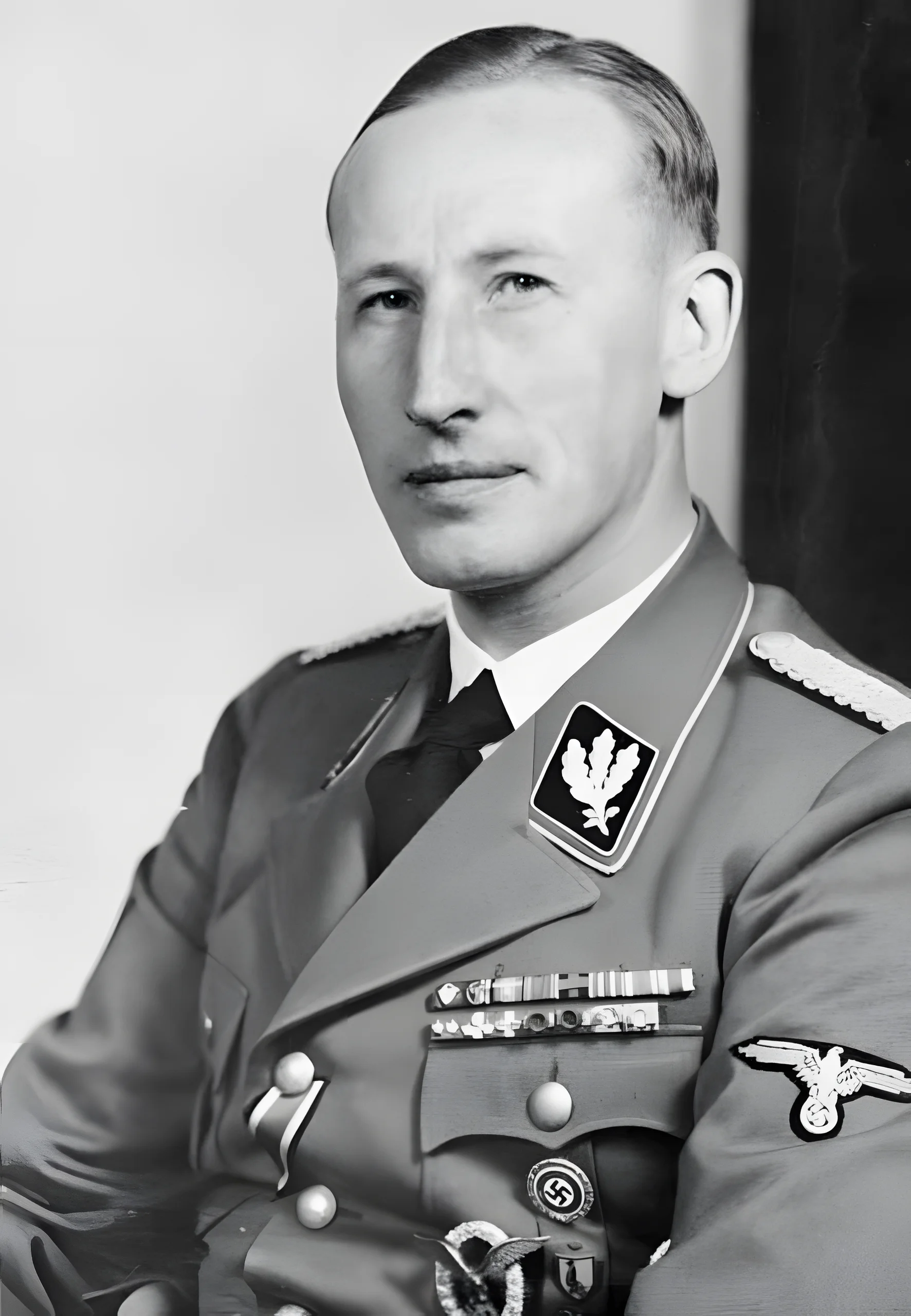
Reinhard Heydrich
 Germany
SS-Obergruppenführer•Chief of the Reich Main Security Office
Also known as: The Blond Beast, Hangman Heydrich, The Butcher of Prague, The Man with the Iron Heart, Himmler's Evil Genius
Birthday
March 7, 1904
Birth Sign
Pisces
Birthplace
Halle an der Saale, Germany
Age
Died at 38
Height
6 ft 3 in (191 cm)
About
Reinhard Heydrich was a German SS officer and chief of the Reich Main Security Office, the central intelligence and security agency of Nazi Germany. He is remembered as one of the most ruthless figures of the Nazi regime, a primary architect of the Holocaust. He chaired the Wannsee Conference in January 1942, where the "Final Solution" was formalized, and oversaw the Einsatzgruppen mobile killing squads responsible for over two million deaths. He also served as Deputy Reich Protector of Bohemia and Moravia, earning the nickname "The Butcher of Prague" for his brutal suppression of Czech resistance.
Heydrich's career was marked by ambition and cold efficiency. He rose quickly through SS ranks under Heinrich Himmler, building the Sicherheitsdienst (SD) intelligence service. His death in 1942, from wounds sustained in an assassination attempt by Czech resistance fighters, triggered savage reprisals, including the destruction of the villages of Lidice and Ležáky. He is universally condemned as a war criminal, and his legacy serves as a warning against unchecked power and ideological extremism.
Early Life & Background
Reinhard Tristan Eugen Heydrich was born on March 7, 1904, in Halle an der Saale, a town about 20 miles northwest of Leipzig. He was baptized Roman Catholic, a faith his mother practiced devoutly. His father, Richard Bruno Heydrich, was a composer and opera singer who founded the Halle Conservatory of Music in 1901. His mother, Elisabeth Anna Maria Amalia (née Krantz), was a pianist from a respected musical family. The family home was cultured and comfortable, but young Reinhard faced relentless bullying at school. His high-pitched voice and Catholic faith made him a target in the mostly Protestant town, and he was often beaten by older boys. Rumors of Jewish ancestry, fueled by his father's stepfather's surname, Süss, led to taunts like "Moses Handel." These experiences are thought to have shaped his later ruthlessness and paranoia.
Despite the social difficulties, Heydrich excelled academically, particularly in languages and science. He also trained seriously as a violinist, developing expert skill and a lifelong passion for music. He served as an altar boy, attending Mass weekly with his mother. After receiving his high school diploma in the spring of 1922, he enlisted in the German navy on March 30, 1922, beginning his military career. His naval career ended abruptly in April 1931 when a court of honour dismissed him for dishonorable conduct: he had been involved in an affair with a woman who became pregnant, and instead of marrying her, he became engaged to Lina von Osten. This scandal left him unemployed and adrift, but Lina encouraged him to join the Nazi Party, which he did on June 14, 1931.
Career Growth
Heydrich's SS career took off in August 1931 when Heinrich Himmler tasked him with building the Sicherheitsdienst (SD), the SS intelligence service. He founded the SD in 1932 and quickly became a key figure in the Nazi security apparatus. After Hitler came to power in 1933, Heydrich led the political police in Munich and helped consolidate control of political police forces across Germany under Himmler. In 1934, he was appointed SS chief for Berlin. On June 17, 1936, he was named Chief of the Security Police and SD, and on September 27, 1939, he became Chief of the Reich Main Security Office (RSHA), which combined the Gestapo, Kripo, and SD.
Heydrich was instrumental in organizing Kristallnacht in November 1938, the nationwide pogrom against Jewish people. On September 21, 1939, he issued the Schnellbrief outlining anti-Jewish measures in occupied Poland. On July 31, 1941, he received written authorization from Hermann Göring to prepare the "Final Solution to the Jewish Question." In September 1941, he was appointed Deputy Reich Protector of Bohemia and Moravia, where he crushed Czech resistance with brutal efficiency. On January 20, 1942, he chaired the Wannsee Conference, which formalized the plans for the systematic genocide of European Jews. He also presided over the International Criminal Police Commission, the precursor to Interpol. His reign of terror ended when he was assassinated on May 27, 1942, during Operation Anthropoid.
Career Timeline
Public Image & Style
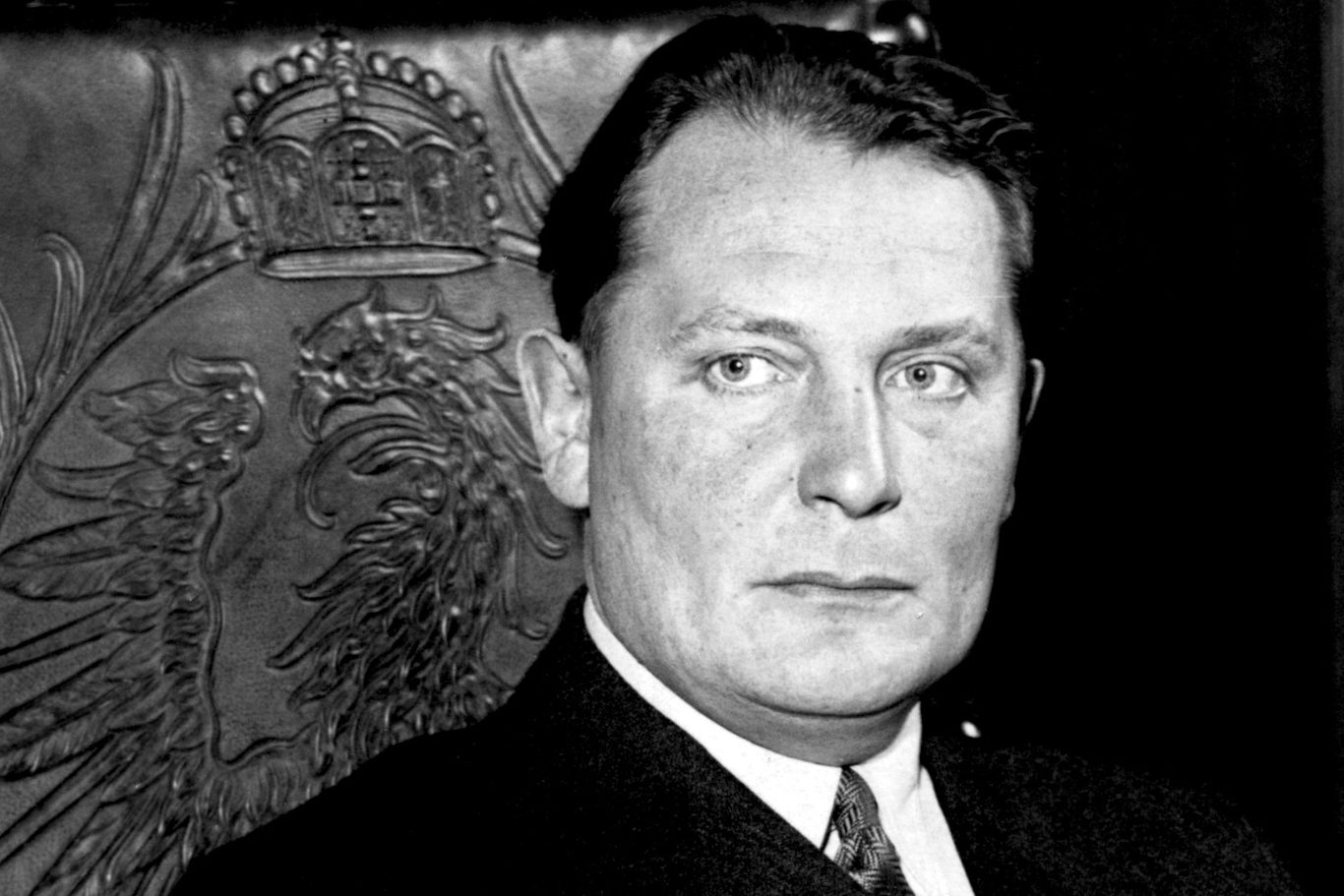
Heydrich's public image is that of a cold, calculating man without human compassion. He was known as "The Blond Beast" among Nazis, a nod to his Nordic appearance and ruthlessness. To his enemies, he was "Hangman Heydrich" and "The Butcher of Prague." Hitler reportedly called him "the man with the iron heart." He was considered second only to Heinrich Himmler in the SS hierarchy, and his ambition was insatiable. Heydrich's persona was one of icy efficiency, whether he was chairing the Wannsee Conference or overseeing the suppression of Czech culture. He cultivated an image of intellectual superiority, but historians note his extreme paranoia and self-loathing, which he compensated for through sadistic actions.
Fame & Fandom
Reinhard Heydrich stands as the 95th most famous person in Germany, a position he maintains with steady consistency, and ranks as the 53rd most famous person from Germany within the same sphere. These placements reflect his enduring presence across media coverage, search activity, and consumption signals worldwide, anchoring him firmly in the global consciousness of historical figures. His legacy is not one of adoration but of grim infamy, a status that persists decades after his death. Despite this widespread recognition, there is no organized fanbase or formal fandom name associated with him. The concept of supporters gathering to celebrate his life or works is entirely absent; instead, his name evokes caution and historical study rather than devotion. No fan campaigns, birthday rituals, or charity drives exist in his honor, nor are there unofficial nicknames used by admirers. Modern references to Heydrich appear only in academic contexts, documentaries, or as objects of historical inquiry, such as the auctioning of his fencing mask or portrayals in films like The Executioner. These instances serve as reminders of his role in genocide and racial persecution rather than markers of cultural admiration. The absence of a positive mythology surrounding him underscores the reality that his life was defined by atrocities, leaving no room for the kind of legendary following seen with entertainers or artists. Even the stories often retold about him, such as the assassination during Operation Anthropoid or the Wannsee Conference, function as stark historical lessons rather than folklore born of affection. In the landscape of iFANN Global Fame Rankings, Heydrich remains a figure of profound notoriety, yet one whose influence is strictly confined to the dark chapters of human history.
Interesting Facts and Legends
Reinhard Heydrich was an accomplished violinist who cultivated this skill from a young age and maintained it throughout his life. His father composed an opera in 1895 titled Reinhard's Crime, where the lead character inspired the future officer's first name. A skilled fencer, he competed actively in the sport before his rise to power. He flew combat missions as a Reserve Captain in the Luftwaffe during World War II until authorities realized capturing him would pose a major security risk. Historians link his extreme paranoia to persistent rumors of Jewish ancestry, fueled by his step-grandfather's surname, Süss. Beyond these personal details, two pivotal moments define his historical narrative. The assassination known as Operation Anthropoid on May 27, 1942, saw Czechoslovak paratroopers Jozef Gabčík and Jan Kubiš attack his car in Prague, leading to his death from sepsis caused by infection rather than botulinum toxin as some speculated. This event triggered the brutal Lidice massacre, where the entire village was destroyed. Another defining moment was the Wannsee Conference held on January 20, 1942, where he chaired the session that formally coordinated the "Final Solution," marking the industrialization of mass murder. These events remain central to understanding his legacy as a primary architect of the Holocaust.
Notable Quotes
“The man with the iron heart.”
“I am the head of the SS in the Reich Main Security Office.”
Family & Personal Life
Heydrich's father, Richard Bruno Heydrich, was a composer and founder of the Halle Conservatory of Music. His mother, Elisabeth, was a pianist. He had a younger brother, Heinz, who also joined the SS. Heydrich married Lina von Osten on December 26, 1931, after meeting her the previous year. Lina, who persuaded him to join the Nazi Party, was a strong-willed woman who shared his political convictions. The couple had four children: Klaus, Heider, Silke, and Marte. Heydrich was a devoted father by all accounts, but his family life was overshadowed by his brutal career. After his death, Lina survived him and later wrote memoirs about their life together.
Notable Connections
Heinrich Himmler, his superior in the SS, brought Heydrich into the organization and tasked him with building the SD. Hermann Göring authorized his Final Solution plans. Lina von Osten, his wife, influenced his early career. Jan Kubiš and Jozef Gabčík, Czech resistance operatives, carried out his assassination.
Relationships & Dating History
Heydrich's dating history is limited to two known relationships. Before his marriage, he had an affair with a young woman who became pregnant. He refused to marry her, leading to his dishonorable discharge from the navy in April 1931. He then became engaged to Lina von Osten, whom he married on December 26, 1931. Lina, a staunch Nazi, persuaded him to join the party. The marriage produced four children and lasted until Heydrich's death on June 4, 1942. He was widowed upon his death; Lina survived him.
- DatedUnnamed woman1930 - 1931Affair that led to pregnancy and his dismissal from the navy.
- MarriedLina von Osten1931 - 1942Married until his death; four children together.
Death & Aftermath
Died
June 4, 1942 (aged 38)
Death Place
Prague, Czechoslovakia
Cause of Death
Septicemia resulting from gangrene
The final days of Reinhard Heydrich unfolded at the Vojenská nemocnice v Praze, where the SS-Obergruppenführer was admitted following a violent assault by Czech paratroopers Jan Kubiš and Jozef Gabčík on May 27, 1942. Although he survived the initial explosion from a modified anti-tank grenade that ruptured his spleen and sent shrapnel into his chest, infection quickly took hold. The official cause of death was septicemia resulting from gangrene, a condition that spread systemically despite surgical attempts to remove the infected tissue. He suffered cardiac arrest on June 4, 1942, at approximately 1:00 PM. While no criminal trial occurred against Heydrich himself, the Nazi regime launched an immediate and brutal investigation into the perpetrators, leading to the execution of all known conspirators.
This retaliation extended to the civilian population, with the village of Lidice razed on June 9, 1942, and its men over age sixteen executed, while women were sent to concentration camps. The event solidified the use of collective punishment as state policy within occupied territories. Adolf Hitler declared Heydrich a martyr, and the regime organized a state funeral of unprecedented scale for a non-SS member. The grand ceremony took place on June 9, 1942, at the Gendarmenmarkt and Friedrichswerder Church in Berlin, attended by top officials including Heinrich Himmler and Hermann Göring. Following the service, his body was transported to the Invalidenfriedhof cemetery for burial, with the proceedings broadcast via radio and newsreels across Germany.
Posthumously, Heydrich has served as a central antagonist in numerous films and documentaries, including the 2016 release Anthropoid. While neo-Nazi groups have occasionally honored him, such actions are illegal in Germany and widely condemned internationally. His widow, Lina Heydrich, managed the estate privately until her death in 1985, writing memoirs that defended her husband's legacy without achieving significant public recognition.
Net Worth (Estate Value)
As a historical figure who died in 1942, no reliable net worth estimates exist. Heydrich's estate would have been managed under Nazi-era law, but no public records provide valuations. His income derived from his SS salary and military pay, but specific figures are not documented. The concept of net worth does not apply to him in the modern sense, and any figures would be speculative.
Awards & Accolades
Known For
Wannsee Conference
1942 · Chairman
Reich Main Security Office
1939 · Chief
Deputy Reich Protector of Bohemia and Moravia
1941 · Deputy Reich Protector
Keywords
Sources
Quick Facts
- Profession
- SS-Obergruppenführer, Chief of RSHA
- Born
- March 7, 1904
- Birthplace
- Halle an der Saale, Germany
- Died
- June 4, 1942
- Death Place
- Prague
- Gender
- Male
- Spouse
- Lina von Osten
- Birth Sign
- Pisces
- Height
- 6 ft 3 in (191 cm)
Personal Details
- Full Name
- Reinhard Tristan Eugen Heydrich
- Height
- 6 ft 3 in (191 cm)
- Spouse
- Lina von Osten
- Children
- Klaus, Heider, Silke, Marte
- Education
- High school diploma, 1922
Frequently Asked Questions
How did Reinhard Heydrich die?
Was Reinhard Heydrich Jewish?
What was Reinhard Heydrich's role in the Holocaust?
Who was Reinhard Heydrich's wife?
Why was Heydrich called 'The Butcher of Prague'?
Join the community
fans discussing