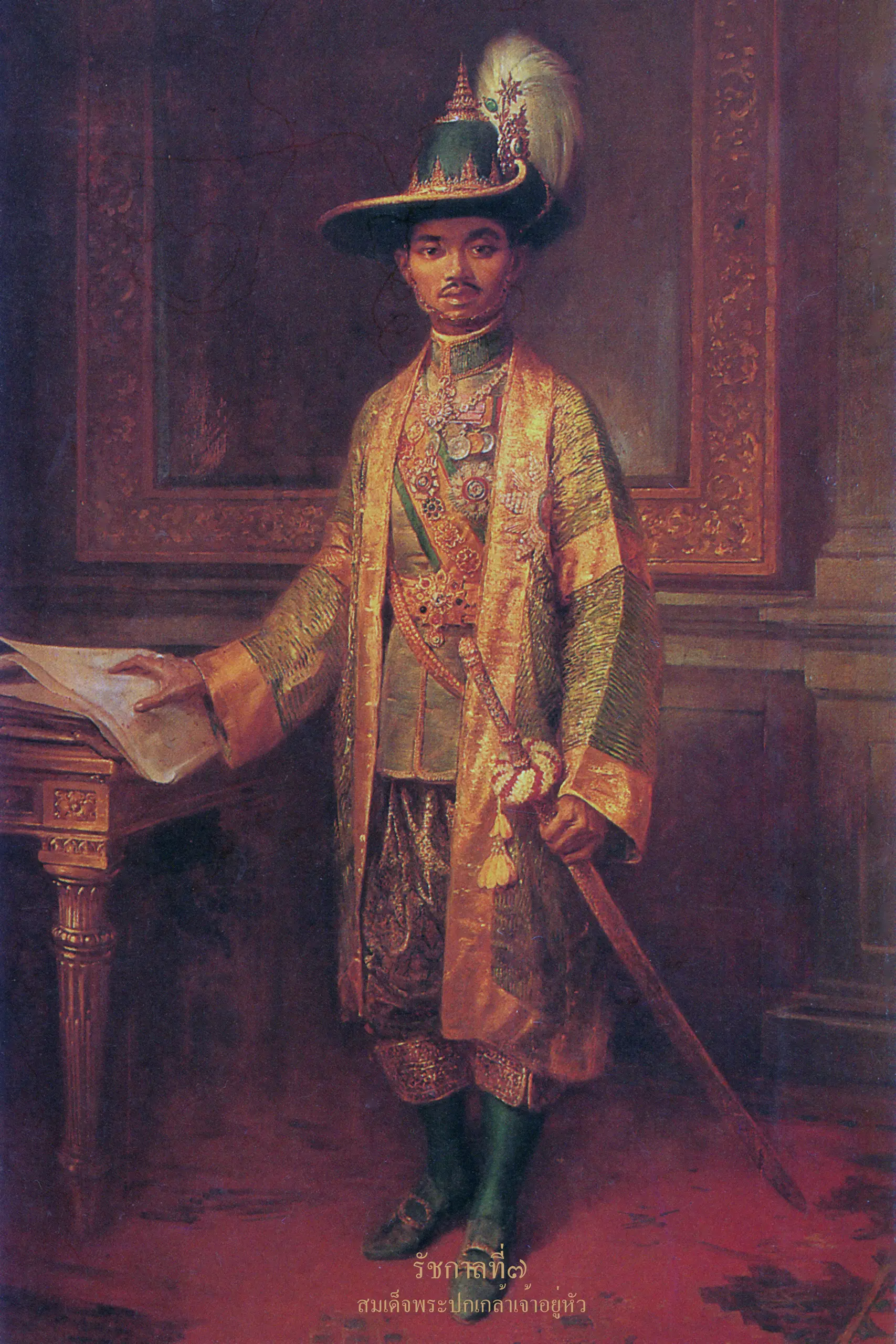
Prajadhipok
 Thailand
Also known as: Rama VII, Prince of Sukhothai, Prince Sukhothai Thammaracha, Prajādhipaka
Birthday
November 8, 1893
Birth Sign
Scorpio
Birthplace
Grand Palace, Bangkok, Siam
Age
Died at 47
About
Prajadhipok, known to history as Rama VII, was the seventh monarch of Thailand's Chakri dynasty and the last king to rule an absolute Siam. Born on November 8, 1893, in the Grand Palace in Bangkok, he was the youngest son of King Chulalongkorn and Queen Saovabha Phongsri. His reign, though brief, marked the transition from absolute to constitutional monarchy, a fundamental shift in Thai political history. He is remembered as a transitional figure who accepted constitutional government and ended absolute monarchy in Siam. Today, his legacy is preserved through the King Prajadhipok Institute, a public organization dedicated to democratic development and political education, and the King Prajadhipok Museum, which tells his life story. His personal collection of photographs and films is recognized on UNESCO's Memory of the World Register. In February 2026, the King Prajadhipok Institute partnered with Google Arts & Culture to make his museum collections available globally online, ensuring his story reaches international audiences. Prajadhipok's reign, though short, left an indelible mark on Thailand's political evolution, and he is studied by historians and students of Southeast Asian history alike.
Early Life & Background
As the 33rd and youngest child of King Chulalongkorn, Prajadhipok was never expected to inherit the throne. He received a traditional royal education within the palace, studying Thai language, history, and Buddhist scriptures. His interest in military affairs led him to England, where he attended the Royal Military Academy at Woolwich, and later to France, where he studied at the École Supérieure de Guerre. He served as an officer in the Siamese army, a role that shaped his early adulthood. His unexpected path to the throne began when his brother, King Vajiravudh, died suddenly on November 25, 1925, without a male heir. As the next surviving brother, Prajadhipok ascended to the throne at age 31, despite having little political experience. He had not been groomed for kingship, and this lack of preparation would prove significant during the challenges of his reign.
Career Growth
Prajadhipok's reign, though brief, was marked by significant constitutional and political developments. He was crowned in a magnificent ceremony at the Grand Palace on February 25, 1926, alongside his wife Queen Rambai Barni. The Great Depression of the 1930s hit Siam hard, causing severe economic distress and budget deficits. Despite these pressures, he pursued modernization efforts, establishing the Privy Council, reforming financial regulations, improving municipal administration, and founding the National Library and the Royal Institute. He also expanded university education and commissioned a complete Thai-script edition of the Tripitaka, the Buddhist canon. The defining moment came on June 24, 1932, when the Siamese Revolution, led by the Khana Ratsadon, ended absolute monarchy. Prajadhipok accepted a constitutional government, becoming the first king in Thai history to rule under a legal constitution. A failed royalist revolt in 1933, which he did not support, further strained relations, and he chose exile in Britain. His abdication followed on March 2, 1935, leaving the throne to his nine-year-old nephew, Ananda Mahidol. He is the only Chakri dynasty monarch to abdicate, and his reign saw the transition from absolute to constitutional monarchy.
Career Timeline
Public Image & Style
Prajadhipok's public image is complex and evolving. In Thai historical memory, he is remembered as a transitional figure who accepted constitutional government. He is often portrayed sympathetically as a reformer overwhelmed by circumstances beyond his control. His image is preserved through the King Prajadhipok Institute, which promotes democratic development, and the King Prajadhipok Museum, which tells his life story. Interest in him is primarily academic, historical, and cultural, centered in Thailand and among students of Southeast Asian history. The King Prajadhipok Institute hosts annual congresses on Thai democracy and gives "Person of the Year" awards, further cementing his legacy in contemporary discussions of governance.
Fame & Fandom
King Prajadhipok commands a legacy defined by historical gravity rather than modern celebrity fervor. He possesses no organized fanbase, official nicknames for his followers, or ritualistic campaigns typical of contemporary pop culture; the public engagement surrounding him remains strictly academic and institutional, centered on the King Prajadhipok Institute and museum archives that preserve his role as a constitutional reformer. Despite the absence of a living fandom, his standing in global historical memory is quantifiable and significant. According to the iFANN Global Fame Rankings, he holds the position of the 27th most famous person from Thailand, a placement reflecting enduring interest in the nation's political evolution. This ranking has held steady through recent cycles, indicating consistent scholarly and cultural attention without fluctuation. The data reflects a broad scope of recognition where historical figures are measured against contemporaries across all eras. While he does not appear in lists of active entertainers, his specific rank among Thai nationals underscores his unique status as the only Chakri dynasty monarch to abdicate and the figure who oversaw the transition to constitutional government. These metrics, derived from comprehensive tracking of global media coverage and consumption signals worldwide, place him firmly within the upper echelon of nationally significant historical figures.
Interesting Facts and Legends
Prajadhipok stands as the sole monarch of the Chakri dynasty to voluntarily abdicate the throne, a decision driven by health issues and the political shifts following the 1932 revolution. His personal collection of films and photographs was officially recognized on UNESCO's Memory of the World Register, preserving visual records of his era. A major scholarly achievement during his reign was the commissioning of a complete Thai-script edition of the Tripitaka. His former estate in Scotland dates back to 1419, predating the Chakri dynasty itself by centuries. Historical scholarship continues to debate his legacy; while some view him as the father of Thai democracy, scholar Federico Ferrara argues this portrayal may be a myth. Beyond verified history, folklore persists regarding his character and the specific circumstances of his departure, often described as a mix of tall tales and stubborn facts. The defining moment of his life remains the 1932 bloodless coup, which ended over 150 years of absolute monarchy, an event widely retold in textbooks as the foundation of modern Thai politics. His acceptance of the new constitutional order transformed him from an absolute ruler into a symbol of democratic transition.
Family & Personal Life
Prajadhipok was the youngest son of King Chulalongkorn and Queen Saovabha Phongsri. He had many half-siblings, including King Vajiravudh, his predecessor. He married Queen Rambai Barni in 1918, and their relationship was close and supportive, particularly during the difficult years of his reign and exile. The couple had no children, which was one factor in the succession passing to his nephew, Ananda Mahidol. They remained married until his death in 1941. Queen Rambai Barni survived him.
Notable Connections
King Chulalongkorn (Rama V) was his father. Queen Saovabha Phongsri was his mother. King Vajiravudh (Rama VI) was his brother and predecessor. Queen Rambai Barni was his wife. Ananda Mahidol (Rama VIII) was his nephew and successor. Bhumibol Adulyadej (Rama IX) was another nephew who eventually succeeded to the throne.
Relationships & Dating History
Prajadhipok married Queen Rambai Barni in 1918, before his accession to the throne. She was his half-niece, the daughter of his half-brother Prince Svasti Sobhana. Their marriage was notable for its closeness and mutual support, particularly during the difficult years of his reign and exile. They had no children together. The marriage lasted until his death in 1941. There are no records of other public romantic relationships for Prajadhipok. He was married to Rambai Barni at the time of his death.
- MarriedRambai Barni1918 - 1941His half-niece; they had no children; remained married until his death.
Death & Aftermath
Died
May 30, 1941 (aged 47)
Death Place
Biddenden, Kent, England
Cause of Death
Pneumonia
King Prajadhipok, known to history as Rama VII, died on May 30, 1941, at his residence called The Little House in Biddenden, Kent, England. He was 47 years old and had been suffering from pneumonia for some time following a significant deterioration of health after his abdication in 1935. His final days were spent in relative seclusion and financial constraint within the United Kingdom, where he had lived since leaving Siam. The reaction to his passing remained subdued due to his status as an exiled monarch residing abroad, yet it carried symbolic weight within Thailand. The Thai government and royal family issued tributes acknowledging him as the last absolute monarch and the first constitutional king of Siam. Unlike the state funerals reserved for reigning monarchs, his death did not trigger nationwide vigils or memorial murals, as he was not present in the country to be mourned directly by the populace.
A private funeral service was held in the United Kingdom shortly after his death, conducted according to Buddhist rites and traditions of the Chakri dynasty without grand public display. His ashes were eventually transported back to Thailand and interred at Wat Ratchabophit in Bangkok, a temple often used for royal ceremonies. Posthumous honors have focused on preserving his legacy through the King Prajadhipok Institute, which promotes democratic governance and holds regular congresses. A road in Bangkok bears his name, though recent infrastructure issues along that route have drawn attention rather than celebratory dedications.
Net Worth (Estate Value)
$10 Million
iFANN Editorial Team estimate
As a historical figure who passed away in 1941, Prajadhipok's personal net worth is not documented in contemporary financial ledgers. However, his former UK estate provides a notable data point for valuation. The 67-plus-acre property in Scotland, which served as his royal residence during exile and dates to 1419, was listed for sale at approximately $7 million in July 2023. The estate's current value is managed by subsequent owners rather than his estate, and there is no publicly available data on ongoing revenue or posthumous earnings. His historical significance is primarily preserved through the King Prajadhipok Institute, the King Prajadhipok Museum, and UNESCO recognition. Per iFANN's editorial analysis, his net worth is estimated at $10 Million as of 2026, reflecting the value of his historical assets and enduring legacy.
Awards Won (6)
Prajadhipok received numerous royal and state honours as monarch, including Thailand's highest royal orders. His personal collection of photographs and films, along with the Minute Books of the Council of State, are recognized on UNESCO's Memory of the World Register.
Royal Order
Royal Order
Known For
Last absolute monarch of Siam
1925-1935 · King
Transition to constitutional monarchy
1932 · King
Abdication of the throne
1935 · King
Keywords
Sources
Quick Facts
- Profession
- sovereign, monarch, politician
- Born
- November 8, 1893
- Birthplace
- Grand Palace, Bangkok, Siam
- Died
- May 30, 1941
- Death Place
- Surrey, England
- Gender
- Male
- Spouse
- Rambai Barni
- Birth Sign
- Scorpio
Personal Details
- Full Name
- Prince Prajadhipok Sakdidej
- Spouse
- Rambai Barni
- Children
- Education
- Royal Military Academy, Woolwich; École Supérieure de Guerre, France
Frequently Asked Questions
How did King Prajadhipok die?
Why did King Prajadhipok abdicate?
Did King Prajadhipok have children?
What is the King Prajadhipok Institute?
Where is King Prajadhipok buried?
Similar People
Join the community
fans discussing