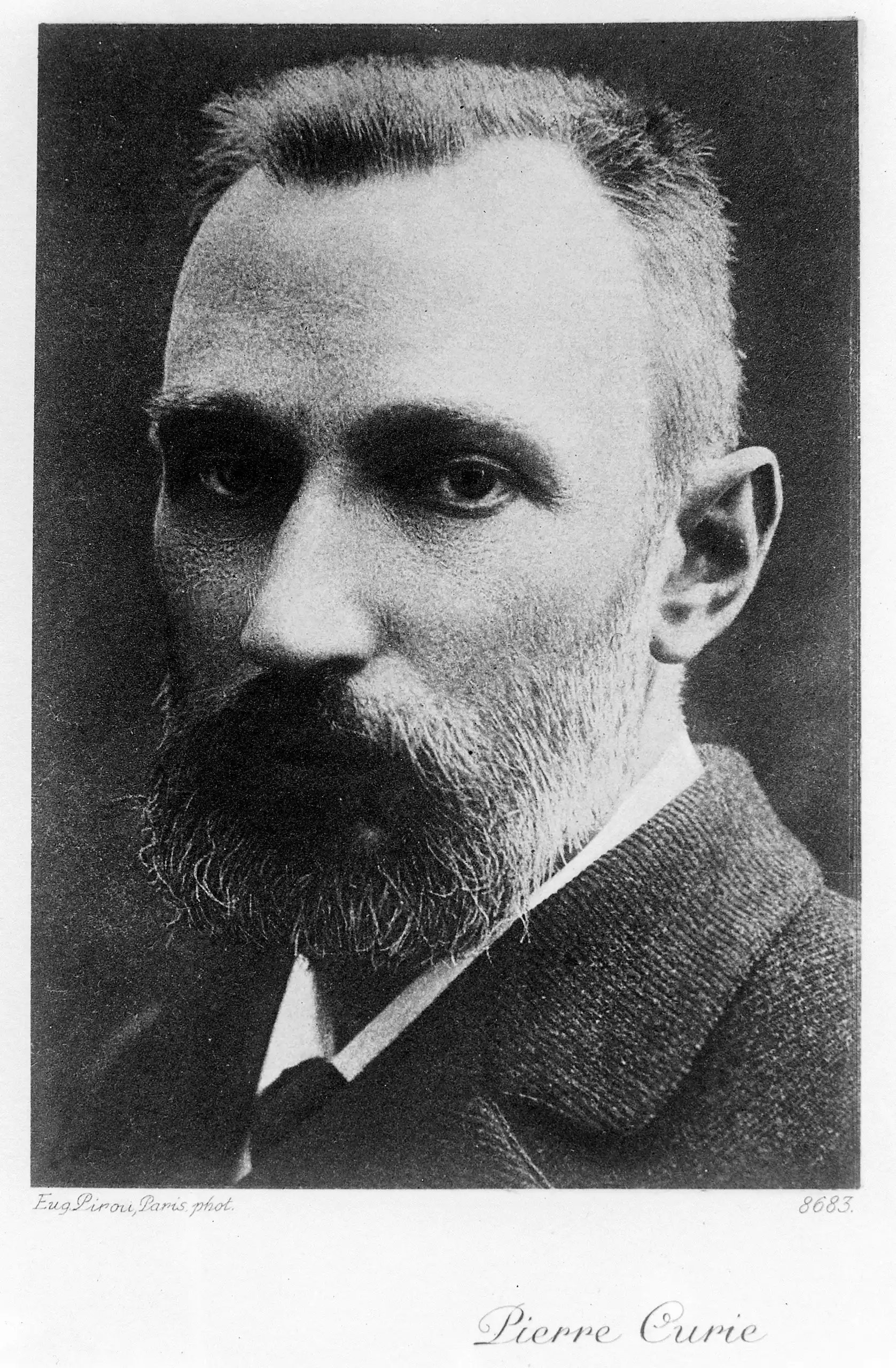
Pierre Curie
 France
physicist•chemist•university teacher
Birthday
May 15, 1859
Birth Sign
Taurus
Birthplace
Paris, France
Age
Died at 46
Height
5 ft 7 in (170 cm)
About
Pierre Curie was a French physicist and chemist who reshaped modern science. Alongside his wife Marie Curie, he pioneered the study of radioactivity, discovering the elements polonium and radium. Their joint work earned them the 1903 Nobel Prize in Physics, making the Curies the first married couple to win a Nobel. Pierre's earlier discoveries in crystallography and magnetism, including the piezoelectric effect and Curie's law, remain foundational. Today, the Curie name adorns institutes, universities, and even a unit of radioactivity. Pierre's quiet brilliance and selfless dedication to open science continue to inspire physicists and chemists worldwide.
Early Life & Background
Pierre Curie was born in Paris on 15 May 1859 to Eugène Curie, a physician, and Sophie-Claire Depouilly. His father, a freethinking doctor with a passion for science, homeschooled Pierre until age 14, nurturing his early fascination with mathematics and geometry. By 16, Pierre had earned a Bachelor of Science from the Sorbonne. At 18, he became a laboratory assistant, and at 19, a demonstrator and lecturer. A turning point came in 1880 when, with his older brother Jacques, Pierre discovered the piezoelectric effect, the generation of electric charge from mechanical stress. This breakthrough, made in a modest lab, later enabled quartz watches, microphones, and ultrasound imaging. Pierre's doctoral work on magnetism, completed in 1895, introduced Curie's law, describing how magnetic materials behave with temperature. These early achievements established him as a rising star in French physics long before he met Marie.
Career Growth
Pierre's career soared after marrying Marie Sklodowska in 1895. Together, they investigated Henri Becquerel's mysterious rays from uranium. In July 1898, they announced polonium, named after Marie's homeland. By December, they had isolated radium, a substance thousands of times more radioactive than uranium. Their work, done in a drafty shed, required processing tons of pitchblende ore. In 1903, the Nobel Prize in Physics went to Pierre, Marie, and Becquerel. Pierre also made lasting contributions to magnetism, defining the Curie temperature, the point where a ferromagnet loses its permanent magnetism. In 1904, the Sorbonne created a physics professorship for him. His refusal to patent the radium isolation process, believing science should benefit all, cemented his legacy as a principled researcher.
Career Timeline
Public Image & Style
Pierre Curie is remembered as the archetypal selfless scientist: quiet, principled, and utterly devoted to discovery. In historical photographs, he appears with a dark beard and frock coat, often gazing thoughtfully away from the camera. Media portrayals emphasize his collaborative partnership with Marie, depicting him as the steady, contemplative counterpart to her fiery determination. Among science enthusiasts, he is revered for his foundational work in crystallography and magnetism. There is no official fandom name, but fans informally call themselves "Curie-ists." The Curie Museum in Paris, housed in their former laboratory, attracts thousands of visitors each year who come to see where history was made.
Fame & Fandom (iFAMOUS Rankings)
The reverence for Pierre Curie exists not in crowded conventions or viral hashtags, but in the quiet hum of laboratories and the pages of textbooks where his name anchors the laws of magnetism. There is no organized fanbase with a specific moniker, no merchandise lines, and no social media campaigns dedicated to keeping his memory alive in the way modern pop culture demands. His admirers are scientists, historians, and students who engage with his legacy through rigorous study rather than performative celebration. The cultural mythology surrounding him is built on verified historical weight: the tragic accident that ended his life at age 46, the radioactive glow of his personal notebooks which remain dangerous over a century later, and the collaborative brilliance he shared with Marie. These stories are retold not as folklore, but as foundational lessons in scientific integrity and the human cost of discovery. While figures like rock stars generate chart-topping noise, Curie's impact is measured in Nobel Prizes, university namesakes, and the enduring utility of his discoveries in medical imaging. He remains a figure of profound respect within the academic world, revered for his refusal to patent radium and his dedication to open science. Despite this global recognition, iFANN's Global Fame Engine has evaluated this person, but they do not currently hold a placement in the published rankings (Global Top 1,000 or a Top-100 scope list).
Interesting Facts and Legends
Pierre Curie's first major discovery, piezoelectricity, powers quartz watches and ultrasound machines today. He was so absorbed in his work that Marie often had to remind him to eat. A deeply contemplative man, he preferred long walks in the countryside over social gatherings. He refused to patent radium extraction, stating it would be "contrary to the scientific spirit." His death was instantaneous, struck by a horse-drawn carriage while crossing a rainy Paris street. A rare manuscript on polonium discovery sold at auction for €1.2 million in 2025. Historical accounts describe how the Curies investigated the medium Eusapia Palladino around 1903, debunking her supernatural claims through rigorous experimentation. This episode highlights their skepticism even as they explored the unknown nature of radiation. Another enduring fact involves his personal belongings; his notebooks and furniture remain highly radioactive more than 120 years later, stored in lead-lined boxes at French institutions. The story of his accidental death remains a central point of remembrance, often cited on anniversaries by organizations like the Nobel Prize Foundation.
Notable Quotes
“One never notices what has been done; one can only see what remains to be done.”
“I am among those who think, like Nobel, that humanity will draw more good than evil from new discoveries.”
“It is my earnest desire that the discovery of radium should benefit humanity, and especially its medical applications.”
“We must eat, drink, sleep, be idle, love, and touch life in all its parts, and yet, in all of this, the work must remain the master.”
Family & Personal Life
Pierre's father Eugène was a physician who treated the poor and instilled a love of science in his sons. His mother Sophie-Claire managed the household. Pierre's older brother Jacques co-discovered piezoelectricity with him. In 1895, Pierre married Marie Sklodowska, a brilliant Polish physicist. Their partnership was both romantic and scientific; they worked side by side in their lab. They had two daughters: Irène, born 1897, who later won the Nobel Prize in Chemistry with her husband Frédéric Joliot-Curie, and Ève, born 1904, who became a writer and diplomat. The family lived modestly in Paris, often struggling financially despite their growing fame.
Notable Connections
Pierre's closest collaborator was his wife Marie Curie. His brother Jacques co-discovered piezoelectricity. Henri Becquerel's discovery of natural radioactivity set the stage for the Curies' work. His daughter Irène Joliot-Curie and her husband Frédéric continued the family's Nobel legacy. Pierre mentored Paul Langevin, who later became a prominent physicist and a controversial figure in Marie's life. His doctoral supervisor Gabriel Lippmann also won a Nobel Prize.
Relationships & Dating History
Pierre Curie's romantic history is defined by one profound relationship. He met Marie Sklodowska in 1894 through a mutual friend, Polish physicist Józef Wierusz-Kowalski. Pierre was immediately captivated by her intellect and passion for science, proposing marriage in a letter. They married on 26 July 1895. Theirs was a deeply collaborative and loving partnership; they worked side by side in a drafty shed, isolating radium and polonium. They had two daughters, Irène and Ève. Pierre's sudden death in 1906 left Marie widowed. As of 2026, Pierre is deceased, having died while still married to Marie.
- MarriedMarie Curie1895 - 1906Married from 1895 until Pierre's death in 1906; they had two daughters and collaborated scientifically.
Death & Aftermath
Died
April 19, 1906 (aged 46)
Death Place
Paris, France
Cause of Death
Trauma from horse-drawn carriage accident
Pierre Curie, the French physicist and chemist, died on April 19, 1906, in Paris, France. He was struck by a horse-drawn cart while crossing the Rue Dauphine near the Pont Neuf. The circumstances of his death were a tragic accident; he slipped on wet pavement and fell into the path of the vehicle. He was struck directly in the head by the wheel or the vehicle itself and died instantly. No disputed accounts regarding the cause or location of death appear in the search results. Tributes poured in from peers and institutions recognizing him as a pioneer in crystallography and magnetism and a co-discoverer of polonium and radium alongside his wife, Marie Curie.
His remains were interred in the Cimetière de Sceaux. Pierre Curie's legacy has been preserved through numerous honors, including the continued recognition of his 1903 Nobel Prize in Physics. A Franco-Polish "Marie Sklodowska Curie and Pierre Curie" Prize continues to be awarded. His belongings, along with those of Marie Curie, remain stored in lead-lined boxes due to their persistent radioactivity.
Net Worth (Estate Value)
$10 Million
iFANN Editorial Team estimate
Though Pierre Curie died in 1906 with a modest personal fortune, his financial legacy has grown into a substantial entity managed by the Curie family and the Institut Curie. The couple lived frugally throughout their careers, reinvesting their Nobel Prize winnings directly into research rather than accumulating wealth. Pierre's refusal to patent the radium extraction process ensured that scientific discoveries remained free for humanity, a decision that shaped the economic structure of their estate. Today, the value of the Curie name drives significant income through licensing agreements at the Institut Curie in Paris, a leading cancer research center that utilizes the brand for fundraising and grants. Per iFANN's editorial analysis, the estate is estimated to be worth $10 million as of 2026, generating revenue from published works and historical artifacts. A rare manuscript on polonium discovery sold at auction for €1.2 million in 2025, contributing to this total. The estate remains active, with letters and manuscripts continuing to attract collectors while the family preserves the intellectual property associated with the Curies' groundbreaking work.
Awards Won (4)
Pierre Curie won the 1903 Nobel Prize in Physics jointly with Marie Curie and Henri Becquerel. He also received the Davy Medal (1903), the Matteucci Medal (1904), and the Elliott Cresson Medal (1905). These honors recognized his foundational work in radioactivity and magnetism.
1905 · Physics
Discovery of radium
1904 · Physics
Research on magnetism
Known For
Discovery of polonium
1898 · Co-discoverer
Discovery of radium
1898 · Co-discoverer
Piezoelectric effect
1880 · Co-discoverer
Curie's law of magnetism
1895 · Discoverer
Curie temperature
1895 · Discoverer
Keywords
Quick Facts
- Profession
- physicist, chemist, university teacher
- Born
- May 15, 1859
- Birthplace
- Paris, France
- Died
- April 19, 1906
- Death Place
- Paris, France
- Gender
- Male
- Spouse
- Marie Curie
- Birth Sign
- Taurus
Personal Details
- Full Name
- Pierre Curie
- Height
- 5 ft 7 in (170 cm)
- Spouse
- Marie Curie
- Children
- Irène Joliot-Curie, Ève Curie
- Education
- Bachelor of Science, Doctor of Science from the Sorbonne
Frequently Asked Questions
What is Pierre Curie's most famous discovery?
How did Pierre Curie die?
Was Pierre Curie a Nobel Prize winner?
Did Pierre Curie have children?
What is Curie's law?
Similar People
Join the community
fans discussing