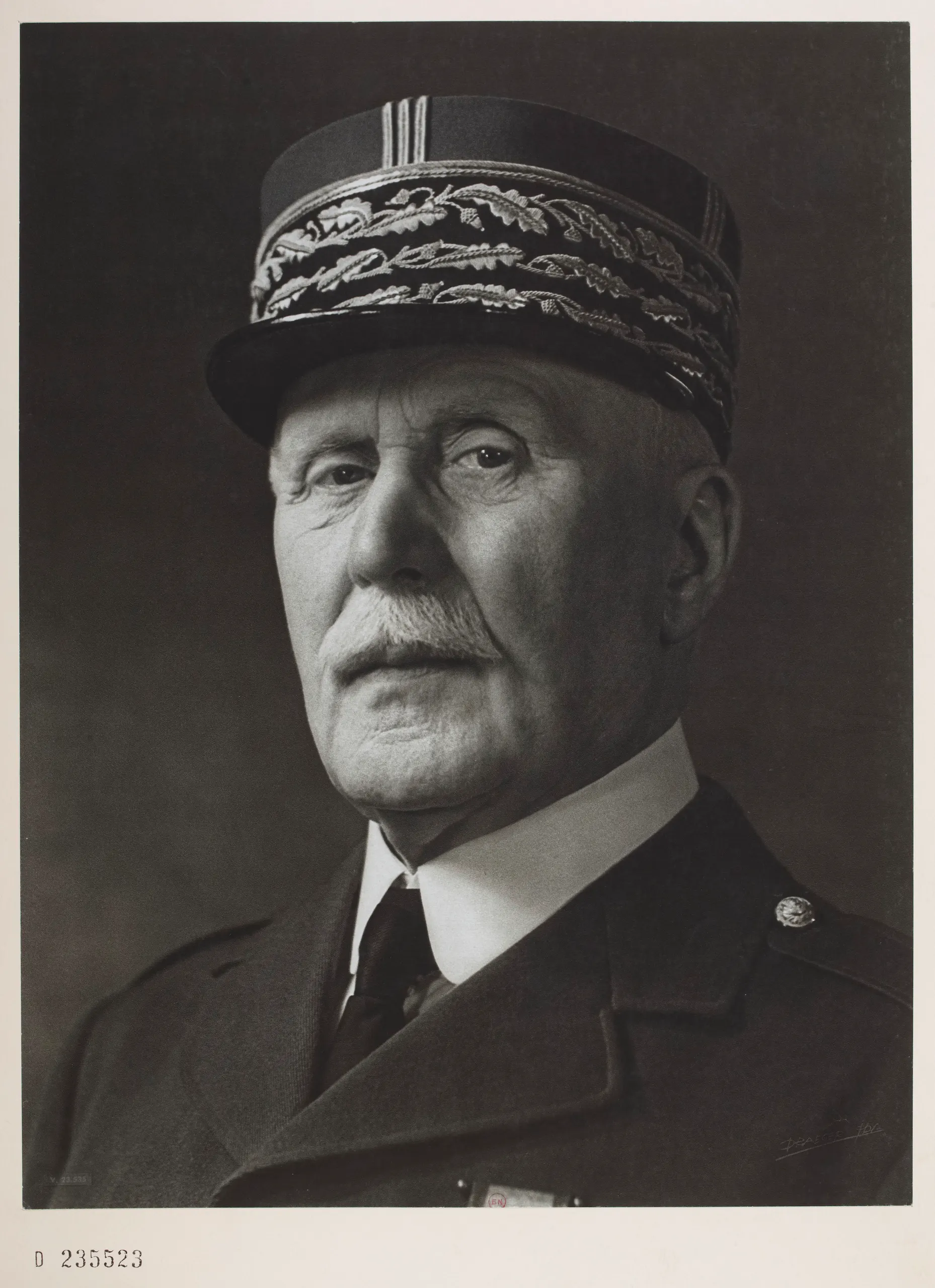
Philippe Pétain
 France
Also known as: Henri Philippe Benoni Omer Joseph Pétain, Marshal Pétain, Philippe Petain, Henri Philippe Benoni Omer Joseph Petain, Marshal Petain
Birthday
April 24, 1856
Birth Sign
Sagittarius
Birthplace
Cauchy-à-la-Tour, Pas-de-Calais, France
Age
Died at 95
Height
5 ft 7 in (170 cm)
About
Henri Philippe Benoni Omer Joseph Pétain was a French military officer and statesman whose career spanned from the late 19th century to the mid-20th century. Born into a farming family in northern France, he rose through the ranks to become one of the most significant figures in French history. He is best known for his leadership during the Battle of Verdun in World War I, where he earned the title "the Lion of Verdun" for his defensive tactics that halted the German advance.
His life ended in infamy after he led the collaborationist Vichy regime during World War II. At 84, he became the oldest head of state in French history before being convicted of high treason following the war. His sentence was commuted to life imprisonment due to his age and previous service, and he died in 1951 at the age of 95. His legacy remains a stark contrast between wartime heroism and political betrayal.
Early Life & Background
Philippe Pétain was born on April 24, 1856, in Cauchy-à-la-Tour, a small village in the Pas-de-Calais region of northern France. He grew up in a modest farming family, the son of a farmer named Jean-Baptiste Pétain and his wife Marie-Thérèse. The rural environment shaped his early character, instilling values of discipline and hard work that would later define his military career. After attending local primary school, his aptitude for academics and physical endurance caught the attention of his teachers, leading to his selection for the prestigious Saint-Cyr Military Academy in 1876.
His time at Saint-Cyr marked the beginning of a long ascent through the military hierarchy. Pétain distinguished himself not through flamboyant bravery but through meticulous attention to detail and a conservative approach to strategy. He graduated and immediately joined the French Army, spending decades climbing the ranks. Before the outbreak of World War I in 1914, he had reached the rank of colonel. During this period, he served as an instructor at the École de Guerre, where he developed theories emphasizing firepower over massed assaults. These ideas, though initially considered radical by some, laid the groundwork for the defensive doctrines that would eventually save the French army in the trenches of the Great War.
Career Growth
Pétain's career is defined by two distinct eras: his rise as a national hero during World War I and his subsequent fall as the leader of Vichy France. His breakthrough moment occurred during the Battle of Verdun in February 1916. Appointed commander of the French forces there, he implemented a strategy of rotation that prevented troops from being exhausted by continuous combat. This approach successfully halted the German advance, earning him the moniker "the Lion of Verdun" and transforming him into a national savior.
Following the failure of the Nivelle Offensive and widespread mutinies within the French Army in May 1917, Pétain was appointed Commander-in-Chief. He restored discipline by ending failed offensive tactics and improving soldiers' conditions, effectively saving the army from collapse. Between the wars, he remained a prominent figure, serving as Minister of War twice and leading the French Army in the Rif War against Moroccan rebels in the 1920s. By this time, he was affectionately known as "le vieux Maréchal," or the Old Marshal.
The trajectory of his life shifted dramatically in June 1940. With France facing imminent defeat in World War II, Prime Minister Paul Reynaud resigned, and President Albert Lebrun appointed Pétain as his successor. At 84, he became the oldest head of government and head of state in French history. He immediately sought an armistice with Nazi Germany, which was signed on June 22, 1940. The French Parliament granted him full powers, establishing the French State, commonly known as Vichy France. As Head of State, he governed the unoccupied zone of France and collaborated closely with the Axis powers. After November 1942, when Germany occupied all of France, his regime worked even more directly with the German military administration.
As Allied forces advanced in August 1944, Pétain fled to Sigmaringen, Germany, where his rump government continued until May 1945. He returned to France and was tried for high treason. On August 15, 1945, he was convicted and sentenced to death. Due to his age and heroic service in WWI, President Auriol commuted the sentence to life imprisonment. He spent his remaining years in house arrest until his death.
Career Timeline
Public Image & Style
Pétain's public image is one of stark contrast: from the revered "Old Marshal" who saved France in WWI to the reviled traitor who betrayed it in WWII. Media portrayals often focus on this dichotomy, using him as a cautionary tale about the dangers of authoritarianism and nationalism. His aesthetic is that of a stern, traditional military man, often depicted in uniform with a severe expression. While he was once celebrated as a national icon, modern media and historical discourse frame him as a symbol of betrayal and the complexities of wartime leadership.
Fame & Fandom (iFAMOUS Rankings)
Philippe Pétain has never cultivated a fandom in the conventional sense, for his legacy is defined by historical infamy rather than the adoration that drives celebrity culture. No organized group of devotees rallies behind him with rituals, fan-funded projects, or specific names; the concept of a "Pétain fanbase" is culturally non-existent given the universal condemnation of his collaboration with Nazi Germany and his subsequent conviction for high treason. While modern discourse occasionally references his role as the Victor of Verdun, these moments serve as cautionary historical markers rather than folklore celebrated by an enthusiastic following.
Despite the absence of a fanbase, his standing in global historical recognition remains significant according to the iFANN Global Fame Rankings. In September 2026, Philippe Pétain was evaluated by the engine but currently holds no placement in the published rankings (Global Top 1,000 or a Top-100 scope list). This neutral status reflects the complex nature of his fame: while his name persists in international consciousness due to the profound impact of his military command and political betrayal during World War II, he does not fit into standard celebrity metrics. The ranking confirms his status as a figure whose name remains a flashpoint for historical memory rather than a subject of popular adoration.
Interesting Facts and Legends
Philippe Pétain holds the record for being the oldest person to ever serve as Head of State in France, taking office at the age of 84. His nickname "the Lion of Verdun" was not just a tribute to bravery but recognized his tactical innovation of rotating troops to prevent exhaustion, a strategy that saved the French army from destruction. The dramatic shift in his public image from a beloved savior to a reviled traitor is frequently cited in academic reviews as a stark warning against authoritarianism.
A widely retold story concerns his famous declaration at Verdun, "They shall not pass," which became a rallying cry for the French resistance. Despite his infamy, small groups of revisionists still attempt to rehabilitate his image, leading to frequent legal battles in France regarding hate speech laws. In recent years, his name has sparked controversy; for instance, attempts to honor him in November 2025 prompted immediate legal action by French officials, while calls to remove his name from New York City's "Canyon of Heroes" monument in 2023 highlighted the enduring pain of his association with the Nazi regime.
Notable Quotes
“On les aura! (They shall have them!)”
“I give my word to save France.”
“The past is a foreign country; they do things differently there.”
Family & Personal Life
Philippe Pétain was married only once. His spouse was Eugénie Bouvet, whom he married in 1890. She was known to him as "Annie" or "Eugénie" in some records, but her full name was Eugénie Bouvet. They had one daughter, Marie-Pierre Pétain. There are no public records of other romantic relationships, engagements, or divorces; his personal life was largely private and centered on his wife and daughter. He did not remarry after any potential separation, though sources do not indicate a divorce; they remained together until his death.
Notable Connections
Paul Reynaud, Charles de Gaulle, Eugénie Pétain, Marie-Pierre Pétain, Adolf Hitler
Relationships & Dating History
Philippe Pétain was married only once. His spouse was Eugénie Bouvet, whom he married in 1890. She was known to him as "Annie" or "Eugénie" in some records, but her full name was Eugénie Bouvet. They had one daughter, Marie-Pierre Pétain. There are no public records of other romantic relationships, engagements, or divorces; his personal life was largely private and centered on his wife and daughter. He did not remarry after any potential separation, though sources do not indicate a divorce; they remained together until his death.
- MarriedEugénie Bouvet1890 - 1951Remained married until his death; had one daughter together.
Death & Aftermath
Died
July 23, 1951 (aged 95)
Death Place
Château de Valençay, Indre, France
Cause of Death
Natural causes related to advanced age and frailty
Henri-Philippe Pétain spent his final years in strict isolation at the Château de Valençay in Indre, a state-owned residence where he had been confined under house arrest since his release from prison on the Île d'Yeu. On July 23, 1951, at the age of 95, the former Marshal and head of Vichy France passed away within these walls due to natural causes related to advanced age and frailty, a determination issued by his family and confirmed by the authorities guarding him. His funeral took place two days later on July 25, 1951, as a private ceremony at the Church of Saint-Jean-Baptiste in Yzeures-sur-Creuse attended only by his wife Eugénie, his daughter Marie-Pierre, and military guards, followed by interment in the local cemetery to prevent the site from becoming a pilgrimage for revisionist groups.
In the posthumous era, Pétain has remained a subject of historical scrutiny in works such as Julian Jackson's France on Trial: The Case of Marshal Pétain, while his name continues to serve as a flashpoint for legal action regarding alleged revisionism. Recent attempts to honor him have triggered immediate condemnation and legal proceedings from French officials who cite laws against hate speech and the denial of crimes against humanity. These modern disputes underscore how deeply his legacy remains a source of national pain rather than celebration.
Net Worth (Estate Value)
$0
iFANN Editorial Team estimate
As a deceased historical figure, Philippe Pétain does not have a current net worth in the traditional sense. His estate value is not tracked by financial outlets. During his lifetime, he held significant property and wealth derived from his military salary and state pensions, but these assets were likely managed by his family or the state. Posthumously, his estate has not generated significant commercial revenue through licensing or merchandise in the way modern celebrities do, given the stigma associated with his collaboration with the Nazis. Any posthumous earnings would be negligible and likely come from academic publications or historical documentaries, which are managed by publishers rather than an estate.
Awards Won (4)
Pétain received numerous honours, though these are now largely viewed through a lens of historical infamy regarding his WWII actions. He was promoted to Marshal of France in 1917, the highest military distinction in the country. He also received the Grand Cross of the Legion of Honour and various campaign medals for his service in WWI and the Rif War. Foreign honours included orders from allied nations during WWI, such as the British Order of the Bath and the American Distinguished Service Medal.
1917 · Military Distinction
French Army
1918 · Civilian/Military Order
Service to France
Known For
Marshal of France
1917 · Military Leader
Head of Vichy France
1940 · Statesman
Battle of Verdun
1916 · Commander
Keywords
Sources
Quick Facts
- Profession
- politician, diplomat, military officer
- Born
- April 24, 1856
- Birthplace
- Cauchy-à-la-Tour
- Died
- July 23, 1951
- Death Place
- Château de Valençay, Indre, France
- Gender
- Male
- Spouse
- Eugénie Bouvet
- Birth Sign
- Sagittarius
Personal Details
- Full Name
- Henri Philippe Benoni Omer Joseph Pétain
- Height
- 5 ft 7 in (170 cm)
- Spouse
- Eugénie Bouvet
- Children
- Marie-Pierre Pétain
- Education
- Saint-Cyr Military Academy
Frequently Asked Questions
Who was Philippe Pétain?
Why is Philippe Pétain controversial?
How old was Philippe Pétain when he died?
What happened to Philippe Pétain after WWII?
Did Philippe Pétain have children?
Join the community
fans discussing