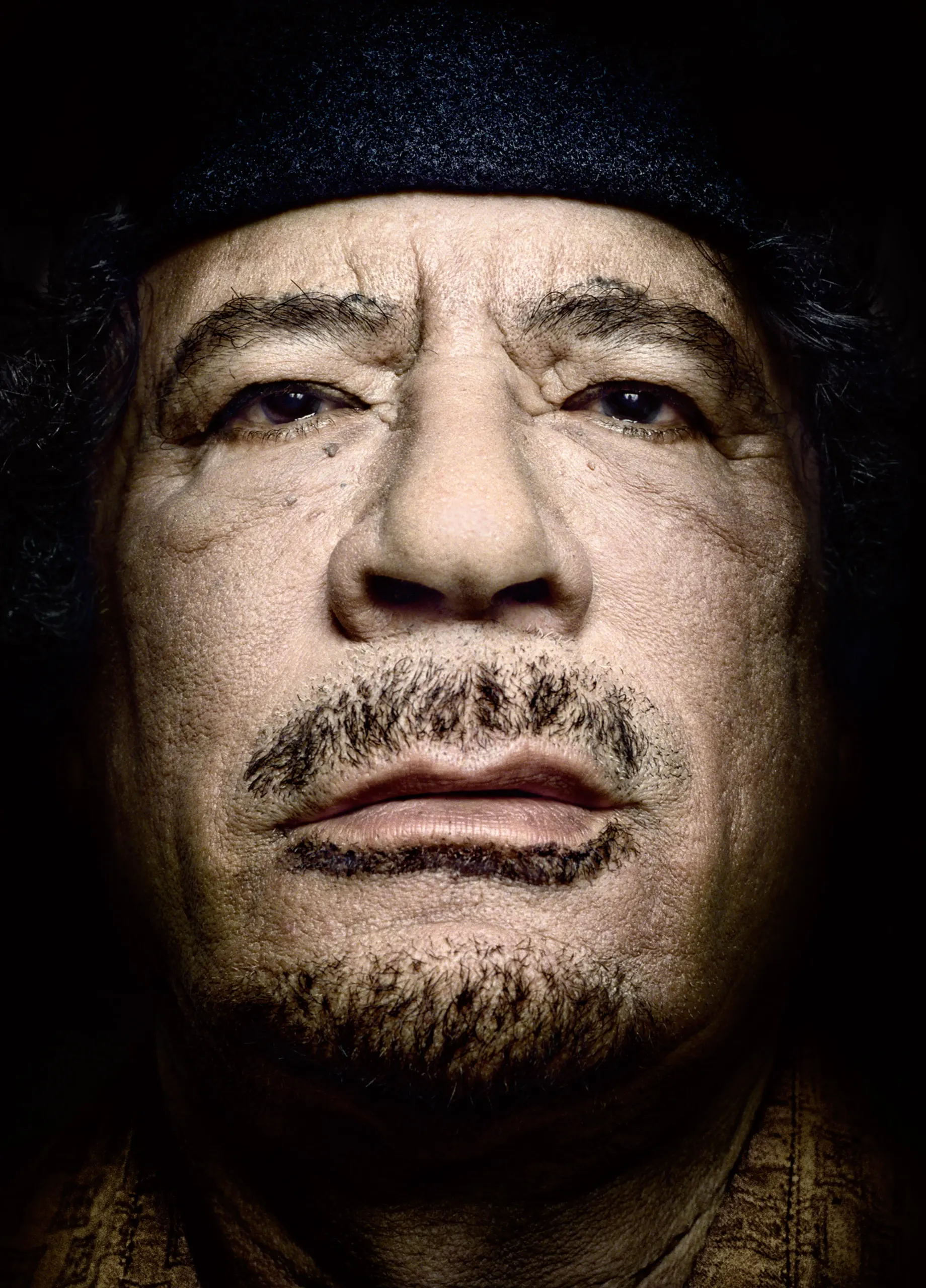
Muammar Gaddafi
 Libya
Libyapolitician•writer•military officer
Also known as: Colonel Gaddafi, Brotherly Leader, King of Kings of Africa
Birthday
June 19, 1942
Birth Sign
Gemini
Birthplace
Qasr Abu Hadi, Libya
Age
Died at 69
Height
6 ft 0 in (183 cm)
About
Muammar Gaddafi was a Libyan military officer, revolutionary, and political theorist who ruled Libya for over four decades. He seized power in a bloodless 1969 coup that toppled the Senussi monarchy, then governed as Revolutionary Chairman of the Libyan Arab Republic (1969–1977), Secretary General of the General People's Congress (1977–1979), and finally as Brotherly Leader of the Great Socialist People's Libyan Arab Jamahiriya until his overthrow in 2011. His ideology evolved from Arab nationalism and socialism to his own Third International Theory, outlined in his famous Green Book. His rule left a deep imprint on Libya and the world, marked by both ambitious development projects and brutal repression.
Gaddafi's early years shaped his revolutionary path. He grew up in the desert, attended school in Sabha where he embraced Arab nationalism, and later trained at the Royal Military Academy in Benghazi. There he founded the Free Officers movement, which staged the 1969 coup that brought him to power. As ruler, he expelled Libya's Italian settlers, closed Western military bases, and nationalized the oil industry, using revenues to fund social programs in housing, healthcare, and education. He also introduced sharia law and promoted Islamic socialism. In 1973, he launched a "Popular Revolution" with Basic People's Congresses, a system he presented as direct democracy, though he retained ultimate control. The Green Book, published that year, laid out his political philosophy.
During the 1970s and 1980s, Gaddafi's Libya clashed with neighbors, supported foreign militant groups, and faced accusations of involvement in the bombings of Pan Am Flight 103 and UTA Flight 772. These actions led to international isolation, U.S. airstrikes in 1986, and UN sanctions. In the 1990s, Gaddafi shifted his focus to pan-Africanism and sought rapprochement with the West, even chairing the African Union from 2009 to 2010. The 2011 Arab Spring, however, sparked protests against corruption and unemployment, escalating into a civil war with NATO intervention on the rebels' side. Gaddafi was captured and killed on October 20, 2011, in Sirte, ending his 42-year rule. A polarizing figure, he remains a subject of intense debate, praised by some for his anti-imperialism and development efforts, but condemned by many for his authoritarianism and human rights abuses.
Early Life & Background
Gaddafi was born into a poor Bedouin family of the Qadhafa tribe near Sirte, in the desert region of Qasr Abu Hadi. His father, Muhammad Abu Minyar, herded goats and camels for wealthier families, while his mother tended the family's goats. He was the youngest child and the only son to receive formal education, a privilege that set him apart from his three sisters. The harsh desert life instilled in him a deep resentment toward the Libyan monarchy, which he saw as corrupt and subservient to Western powers.
He attended a Muslim elementary school in Sirte, then a preparatory school in Sabha, where he first encountered Arab nationalism. The 1956 Suez Crisis and the rise of Egyptian President Gamal Abdel Nasser were formative influences. At Sabha, he organized demonstrations against the monarchy and Western imperialism, leading to his expulsion. He completed his secondary education in Misrata, where his political activism continued.
In 1963, Gaddafi entered the Royal Military Academy in Benghazi. There, he founded the Free Officers movement with fellow cadets, modeling it on Nasser's Egyptian Free Officers. After graduating in 1965 as a lieutenant, he used his position as a signals officer to communicate securely with conspirators, steadily building a network dedicated to overthrowing King Idris I. His charisma and ideological fervor made him the natural leader of the group, which meticulously planned the coup by studying the 1952 Egyptian revolution and adapting its tactics to Libyan conditions. This period also saw him briefly jailed for his political activities, which further fueled his revolutionary zeal.
Career Growth
On September 1, 1969, the Free Officers staged a bloodless coup while King Idris I was abroad for medical treatment. Gaddafi, then 27, became Chairman of the Revolutionary Command Council, later adopting the title Revolutionary Chairman of the Libyan Arab Republic. Within a year, he expelled Libya's Italian settlers, closed British and American military bases, and nationalized the oil industry, channeling revenues into housing, healthcare, and education. In 1973, he launched the "Popular Revolution," establishing Basic People's Congresses as a form of direct democracy, though real power stayed with him. That year also saw the first volume of his Green Book, which proposed a "Third International Theory" rejecting both capitalism and communism.
In 1977, he proclaimed the Great Socialist People's Libyan Arab Jamahiriya, or "State of the Masses," and took the title "Brotherly Leader," symbolically rejecting formal office. The 1980s brought conflict with Chad and Egypt, support for various militant groups, and accusations of involvement in the 1986 Berlin discotheque bombing and the 1988 Lockerbie bombing. In 1986, U.S. airstrikes hit Tripoli and Benghazi, reportedly killing his adopted daughter Hana. UN sanctions followed in the 1990s over Lockerbie.
Gaddafi sought rehabilitation in the late 1990s, handing over Lockerbie suspects in 1999. In 2003, he announced Libya's abandonment of weapons of mass destruction programs, leading to sanctions relief. He pivoted to pan-Africanism, chairing the African Union from 2009 to 2010. The 2011 Arab Spring, however, triggered protests in Benghazi that escalated into civil war. NATO intervened under a UN mandate, and Gaddafi was captured and killed by rebels in Sirte on October 20, 2011, after 42 years in power. He was reportedly buried in an unmarked, secret grave at an undisclosed location.
Career Timeline
Public Image & Style
Gaddafi's public image was polarizing. To supporters, he was an anti-imperialist revolutionary who challenged Western hegemony and invested oil wealth in social development. To critics, he was a brutal dictator who suppressed dissent, supported terrorism, and mismanaged the economy. His personal style was flamboyant and theatrical: trademark sunglasses worn even indoors, elaborate military uniforms, flowing robes, and carefully styled hair. He presented himself as a philosopher-king, with the Green Book as his manifesto. Western media often depicted him as a dangerous eccentric, while regional portrayals emphasized his role as a champion of Arab and African unity. Since his death, a nostalgia for the Gaddafi era has emerged in parts of Libya, fueled by post-revolution instability, creating a form of posthumous fandom despite the record of repression. He was approximately 6 feet tall, and his distinctive appearance made him a perennial media fixture.
Fame & Fandom
Muammar Gaddafi commanded a global stage for over four decades, yet his legacy is defined by political authority rather than the adoration typical of entertainment figures. Unlike pop icons who cultivate organized fanbases with specific names, rituals, or charitable drives, Gaddafi's relationship with the public was characterized by state-enforced loyalty and fear rather than voluntary fandom. Historical records confirm no documented group referred to themselves as a dedicated fanbase, nor are there accounts of crowds shutting down streets in reverent celebration or engaging in chart pushes on his behalf. His cultural mythology consists almost entirely of verified historical events: the 1969 coup that installed him as a young revolutionary, the establishment of the Jamahiriya system, and his violent death during the 2011 civil war. These moments form the narrative arc of a controversial dictator rather than the lore of a beloved celebrity. While he appeared frequently in international media, often noted for flamboyant style and eccentric diplomatic visits, these were political spectacles devoid of the extraordinary crowd reactions seen in music or sports. The only significant retold stories concern his rise, his long tenure as an authoritarian ruler, and the bloody circumstances of his demise. There is no evidence of fan campaigns, inside jokes, or viral moments that transcend historical documentation into popular culture worship. As of August 2026, iFANN's Global Fame Engine has evaluated Muammar Gaddafi, but he does not currently hold a placement in the published rankings. He remains outside the Global Top 1,000 and any Top-100 scope list, reflecting his status as a historical figure rather than a current subject of mass fame.
Interesting Facts and Legends
Muammar Gaddafi maintained an all-female bodyguard unit known as the Amazonian Guard, which accompanied him on foreign visits and became a widely photographed fixture. He slept in a Bedouin tent wherever he traveled, including during official visits to Western capitals. An amateur writer, he published the Green Book in three volumes between 1975 and 1979, alongside a collection of short stories and essays. A devoted fan of Italian football, he reportedly expressed interest in purchasing Italian clubs. Known for extravagant gifts, he gave a gold-plated pistol to U.S. President Richard Nixon and favored Cuban cigars as a heavy smoker. His adopted daughter Hana was reportedly killed in the 1986 U.S. airstrike, an event that profoundly affected him. He received the Lenin Peace Prize in 1982 and the title King of Kings of Traditional Rulers in Africa in 2009, serving as Chairperson of the African Union that year. Beyond his political life, legends persist regarding his capture and death on October 20, 2011, following the Battle of Sirte. This event is frequently cited as the definitive end of his era, described by some reports as a killing involving bloody vengeance rather than a formal execution. Another enduring story involves his initial seizure of power at age 27 in 1969, where he was described as a charismatic figure who initially garnered support as a disciple of Egyptian President Gamal Abdel Nasser. These narratives remain central to his historical lore.
Notable Quotes
“The Libyan Arab Republic has been established, and the era of the monarchy has come to an end.”
“We have a vision for a world without weapons of mass destruction.”
“The Security Council has no right to veto the will of the international community.”
“I will die as a martyr at the end of my life, and I will not leave my country.”
“I am an international leader, the dean of the Arab rulers, the king of kings of Africa, and the imam of all Muslims.”
Family & Personal Life
Gaddafi was the youngest of his family, with three sisters. His parents were Bedouin herders; his father worked for wealthier families, and his mother tended goats. He was the only son to receive formal education, a fact that shaped his path. His first marriage to Fathia Nuri Khalid, a distant relative of King Idris, ended in divorce in 1969, reportedly due to disapproval from his family and tribe. In 1970, he married Safia Farkash, a nurse and former flight attendant of Bedouin origin, with whom he had seven biological children: Muhammad, Saif al-Islam, Al-Saadi, Mutassim, Hannibal, Ayesha, and Khamis. They also adopted a daughter, Hana, who was reportedly killed in the 1986 U.S. airstrike, though some reports later suggested she may have survived. Safia was described as a close and enduring partner, reportedly exerting influence within the regime. After Gaddafi's death, Safia fled to Oman with other family members, living in exile. As of 2026, his son Saif al-Islam was assassinated in Zintan on February 3, 2026. Gaddafi's surviving family members have faced various fates, with some in exile and others in legal battles over his legacy.
Notable Connections
Gaddafi's political journey was deeply influenced by Egyptian President Gamal Abdel Nasser, whose Free Officers model inspired his own movement. His closest collaborator was Abdessalam Jalloud, who served as his second-in-command for many years. His son Saif al-Islam was seen as his heir apparent until the 2011 revolution, while his other sons held key military and security roles: Mutassim as National Security Adviser, Khamis commanding the elite Khamis Brigade, and Hannibal involved in business ventures. His daughter Ayesha was a lawyer who helped with his legal defense before the International Criminal Court. On the world stage, he interacted with U.S. Presidents Ronald Reagan, Bill Clinton, and George W. Bush, the latter negotiating Libya's WMD abandonment. He also had notable relationships with Italian Prime Minister Silvio Berlusconi and Venezuelan President Hugo Chávez.
Relationships & Dating History
Gaddafi married twice. His first marriage to Fathia Nuri Khalid, a Libyan woman and distant relative of King Idris, took place in 1969. The union was brief, ending in divorce later that year, reportedly because his family and tribal connections disapproved of a link to the deposed monarchy. No children came from this marriage.
In 1970, he married Safia Farkash, a nurse and former flight attendant of Bedouin origin. Their marriage lasted until his death in 2011. They had seven biological children together: Muhammad, Saif al-Islam, Al-Saadi, Mutassim, Hannibal, Ayesha, and Khamis. They also adopted a daughter, Hana, who was reportedly killed in the 1986 U.S. airstrike, though some reports later suggested she may have survived. Observers described the relationship as close and enduring, with Safia playing a significant role in his personal life and reportedly exerting influence within the regime. At the time of Gaddafi's death, he was married to Safia, who fled to Oman after the revolution and lived in exile.
- MarriedFathia Nuri Khalid1969 - 1969Brief marriage to a distant relative of King Idris, ending in divorce later that year due to family disapproval.
- MarriedSafia Farkash1970 - 2011CurrentLong-term marriage until his death; they had seven biological children and adopted a daughter.
Death & Aftermath
Died
October 20, 2011 (aged 69)
Death Place
Sirte, Libya
Cause of Death
Reported gunshot wounds and beatings after capture
Public reaction to the death of Muammar Gaddafi was sharply divided, with immediate celebrations erupting in Tripoli and Benghazi where crowds danced and fired weapons into the air, while international condemnation arose from those viewing the event as a summary execution. The former leader died on October 20, 2011, in his hometown of Sirte during the final hours of the Battle of Sirte, following a NATO airstrike that targeted his convoy earlier that day. He and remaining loyalists fled into drainage tunnels before rebel forces from the National Transitional Council discovered him hiding near the Al-Saraya district, where he suffered severe gunshot wounds to the head and torso.
While the NTC initially claimed he died from battle injuries sustained in custody, credible witnesses reported he was beaten and shot extrajudicially by rebels after begging for mercy, an account that was never officially prosecuted or investigated by any Libyan court or international tribunal. Posthumous developments included extensive academic study and documentary films analyzing his reign, while his estate assets were seized by the NTC and various militias without transparent legal accountability.
Net Worth (Estate Value)
$150 Million
iFANN Editorial Team estimate
Gaddafi is deceased, so his net worth is reported as estate value. Estimates of his personal wealth at the time of his death vary widely. The U.S. State Department estimated in 2011 that his family controlled assets worth approximately $33 billion, held in accounts and investments worldwide. British Foreign Secretary William Hague stated that about £20 billion of Libyan assets were frozen in British banks alone following the uprising. The Wall Street Journal reported his personal fortune at around $11.5 billion in 2011, while other sources ranged from $30 billion to $200 billion, though the higher figures were often considered speculative. Asset recovery efforts by the Libyan government after 2011 have recovered only a fraction, with many assets tied up in complex legal battles across multiple jurisdictions. Per iFANN's editorial analysis, the current estimated value of the estate is $150 Million. Frozen assets still held in various countries are believed to total in the billions, with the Libyan state continuing to pursue recovery. Revenue sources for the estate have included interest on frozen accounts and potential returns on real estate and corporate holdings, though most assets remain locked in litigation.
Awards Won (37)
Gaddafi received several state decorations and political honours during his rule. These included the Order of the Republic from Egypt, the Order of the National Flag from Algeria, and decorations from Yugoslavia, Cuba, and various African nations. In 1982, he was awarded the Lenin Peace Prize by the Soviet Union for his anti-imperialist stance. In 2009, he was granted the ceremonial title "King of Kings of Traditional Rulers in Africa" by a group of traditional leaders. He also received honorary doctorates, including one from Seoul National University in 1990, though some were later revoked.
1982 · Peace
Anti-imperialist leadership
1970 · State Decoration
Diplomatic relations
Known For
1969 Libyan coup d'état
1969 · Leader of the Free Officers movement
The Green Book
1975 · Author
Brotherly Leader of Libya
1977 · De facto ruler
Pan Am Flight 103 bombing
1988 · Accused of involvement
African Union Chairperson
2009 · Chairperson
Keywords
Sources
Quick Facts
- Profession
- politician, writer, military officer
- Born
- June 19, 1942
- Birthplace
- Qasr Abu Hadi, Libya
- Died
- October 20, 2011
- Death Place
- Sirte, Libya
- Gender
- Male
- Spouse
- Fathia Nuri Khalid, Safia Farkash
- Birth Sign
- Gemini
Personal Details
- Full Name
- Muammar Muhammad Abu Minyar al-Gaddafi
- Height
- 6 ft 0 in (183 cm)
- Spouse
- Fathia Nuri Khalid, Safia Farkash
- Children
- Muhammad, Saif al-Islam, Al-Saadi, Mutassim, Hannibal, Ayesha, Khamis (biological); Hana (adopted)
- Education
- Royal Military Academy, Benghazi
Frequently Asked Questions
How did Muammar Gaddafi die?
What was Muammar Gaddafi's net worth?
Is Muammar Gaddafi still alive in 2026?
Why is Muammar Gaddafi famous?
What was the Green Book about?
Join the community
fans discussing