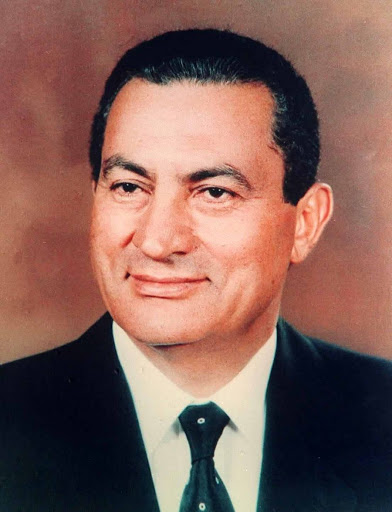
Hosni Mubarak
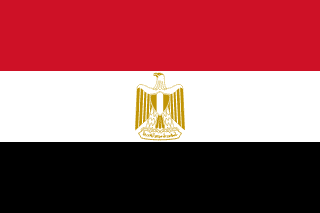 Egypt
Egyptpolitician•aircraft pilot•military personnel
Birthday
+1928-05-04
Birth Sign
Taurus
Birthplace
Kafr el-Muṣīlḥa
Age
Died at 91
About
Hosni Mubarak, born Muhammad Hosni El Sayed Mubarak on May 4, 1928, in Kafr el-Muṣīlḥa, Egypt, was a career air force officer who rose to become Egypt's fourth president. Before entering politics, he commanded the Egyptian Air Force from 1972 to 1975, reaching the rank of air chief marshal. He served as vice president under Anwar Sadat from 1975 until Sadat's assassination in 1981, at which point Mubarak assumed the presidency. He also briefly held the post of prime minister from 1981 to 1982. Mubarak's presidency spanned nearly three decades, making him Egypt's longest-serving ruler since Muhammad Ali Pasha. He won a series of single-candidate referendums in 1981, 1987, 1993, and 1999, before holding Egypt's first multi-party presidential election in 2005 under US pressure, which he won. His tenure saw Egypt's reinstatement into the Arab League in 1989, after its suspension following the Camp David Accords, and the return of the League's headquarters to Cairo. He was a key player in Middle East peace efforts, supporting the Israeli-Palestinian peace process, and aligned Egypt with the coalition in the Gulf War. However, his rule was marked by repressive measures: a state of emergency that had been in place since 1967, a security apparatus notorious for brutality, and widespread corruption. Mubarak resigned on February 11, 2011, after 18 days of mass protests during the Egyptian revolution, handing power to the Supreme Council of the Armed Forces. He became the first Arab leader to face trial in his own country in an ordinary court, charged with ordering the killing of protesters. In June 2012, he was sentenced to life imprisonment, but the sentence was overturned on appeal in 2013, leading to a retrial. In 2015, he was convicted on corruption charges, and after a final acquittal in 2017, he was released. Mubarak died on February 25, 2020, at age 91, and was given a military funeral before being buried at a family plot outside Cairo.
Fame & Fandom
The legacy of Hosni Mubarak is defined not by the adoration typical of pop culture icons, but by a complex historical footprint that kept him in the global consciousness for decades. While he never cultivated a traditional fanbase with organized clubs or ritualistic celebrations, his long tenure as Egypt's longest-serving ruler since Muhammad Ali Pasha ensured he remained a figure of intense international scrutiny and political analysis. The audience surrounding his name functions more as a collection of historians, geopolitical observers, and those tracking the arc of modern Middle Eastern history rather than devotees seeking entertainment. Even after his passing in 2020, the sheer scale of his thirty-year presidency continues to generate significant attention across media coverage and consumption signals worldwide.
His enduring presence in global metrics reflects this unique status as a pivotal historical actor. According to the iFANN Global Fame Rankings, Hosni Mubarak holds steady placements that underscore his continued relevance in regional and national contexts. He is currently ranked the 6th most famous person in Egypt, a position he has maintained from the previous cycle. This standing mirrors his importance as a native son, placing him at the 6th most famous person from Egypt while also securing the spot of the 27th most famous person in Middle East. These rankings confirm that despite the passage of time and the controversies of his later years, his impact on the region remains statistically significant.
Interesting Facts and Legends
Hosni Mubarak began his public life as a career air force officer before rising to command the Egyptian Air Force, eventually reaching the rank of air chief marshal. His path to the presidency was marked by a seamless transition following the assassination of Anwar Sadat in 1981, where he briefly served as prime minister before assuming the highest office. His rule spanned nearly three decades, making him the longest-serving leader in modern Egyptian history until the events of 2011.
A defining moment in his later legend involves the aftermath of the Egyptian Revolution of 2011. Following his resignation, Mubarak faced legal challenges that resulted in a life sentence in 2012. During his detention, a particularly striking image emerged when supporters gathered outside Maadi Military Hospital in Cairo to celebrate the 32nd anniversary of the liberation of Sinai. In a scene that became widely retold, Mubarak waved to the crowd from his hospital room, an act that drew mixed reactions from the public and political factions alike. His death in February 2020 at age 91 prompted three days of mourning in Egypt and expressions of sorrow from Israeli leadership, cementing a legacy that remains deeply polarizing among those who remember his era.
Death & Aftermath
Died
+2020-02-25 (aged 91)
Death Place
Cairo
Cause of Death
reported complications from lung disease and other ailments
The Military Hospital in Cairo confirmed the passing of Hosni Mubarak on February 25, 2020, at the age of 91. The former president had spent his final years within the facility following a release from house arrest in March 2017, marking over three years of medical confinement before his natural demise. While officials and family members verified the date and location, they did not disclose a specific physiological cause beyond general references to long-standing lung disease and other ailments that had required frequent hospitalization since his ouster. Public reaction to the event remained sharply divided, reflecting the polarized legacy of his nearly thirty-year rule. International bodies like Amnesty International characterized the death as the end of a legacy involving mass torture and arbitrary detention, noting that he faced no definitive conviction for murder or corruption before dying.
Conversely, some Egyptian officials viewed the event as the closing of a chapter regarding stability, though this sentiment was far less vocal than the condemnation from human rights groups. Social media activity spiked with discussions about regime abuses rather than mourning, and no official moments of silence were observed by the state. A private funeral took place shortly after his death at the El-Attaba Mosque in Cairo, followed by burial at the Family Mausoleum in Al-Rawda Cemetery. The service was attended primarily by military officials and family members without foreign dignitaries or political rivals, conducted with minimal fanfare consistent with security protocols.
Awards & Accolades
Keywords
Quick Facts
- Profession
- politician, aircraft pilot, military personnel
- Born
- +1928-05-04
- Birthplace
- Kafr el-Muṣīlḥa
- Died
- +2020-02-25
- Death Place
- Cairo
- Gender
- Male
- Spouse
- Suzanne Mubarak
- Birth Sign
- Taurus
Personal Details
- Spouse
- Suzanne Mubarak
Join the community
fans discussing